

The FIFA Men’s World Cup never stops generating headlines. Even as the football world celebrates one tournament and prepares for the next, attention quickly shifts to an even bigger question: where will the 2038 FIFA World Cup be played?
While FIFA has already locked in hosts through 2034, the race for 2038 remains wide open—at least officially. Yet behind the scenes, discussions about continental rotation, infrastructure, and hosting capacity have already fueled intense speculation.
The United States has emerged as one of the most talked-about possibilities, but there is an important distinction between public expectations and official reality. No country has been awarded the tournament, no bidding process has begun, and FIFA has not selected a host.
Still, the roadmap leading to that future is becoming increasingly interesting. Here’s everything confirmed so far, why North America is attracting so much attention, and what could ultimately determine the destination of football’s biggest event.
Confirmed FIFA Men’s World Cup Hosts Through 2034
Before looking ahead to 2038, it’s important to understand what FIFA has already confirmed.
| Tournament | Official Host(s) | Key Details |
| 2026 | United States, Canada and Mexico | Co-hosted by three nations with an expanded 48-team tournament; ongoing or recently concluded around the time of this query. |
| 2030 | Morocco, Portugal and Spain, with centenary matches in Argentina, Paraguay and Uruguay | First World Cup spanning three continents. Three centenary celebration matches commemorate the inaugural 1930 World Cup. |
| 2034 | Saudi Arabia | Solo host confirmed by acclamation at an Extraordinary FIFA Congress on December 11, 2024. |
These hosting decisions were not made independently. They followed a coordinated bidding process supported by confederations for “harmony and rotation.”
The unique structure of the 2030 tournament serves two major purposes. Morocco, Portugal and Spain will stage the majority of the competition across Africa and Europe, while Argentina, Paraguay and Uruguay will each host one centenary celebration match to honour the 100th anniversary of the first FIFA World Cup in 1930.
That arrangement also helped shape the path toward the next tournament, with Saudi Arabia becoming the confirmed solo host for 2034.

Why the 2038 FIFA World Cup Is Already Becoming a Major Talking Point
Unlike the tournaments through 2034, the 2038 FIFA World Cup has no official host.
No host has been officially selected or bid process opened yet. Bidding and selection are expected in the coming years (likely around 2030–2035).
Despite that, football observers are already analysing which nations—or continents—are most likely to emerge as serious contenders.
The reason is simple: FIFA’s historical approach to continental rotation.
FIFA’s Continental Rotation Could Shape the Entire 2038 Race
FIFA has historically used (though not always strictly enforced in statutes) a continental rotation principle to promote geographic diversity and avoid consecutive hosting by the same confederation.
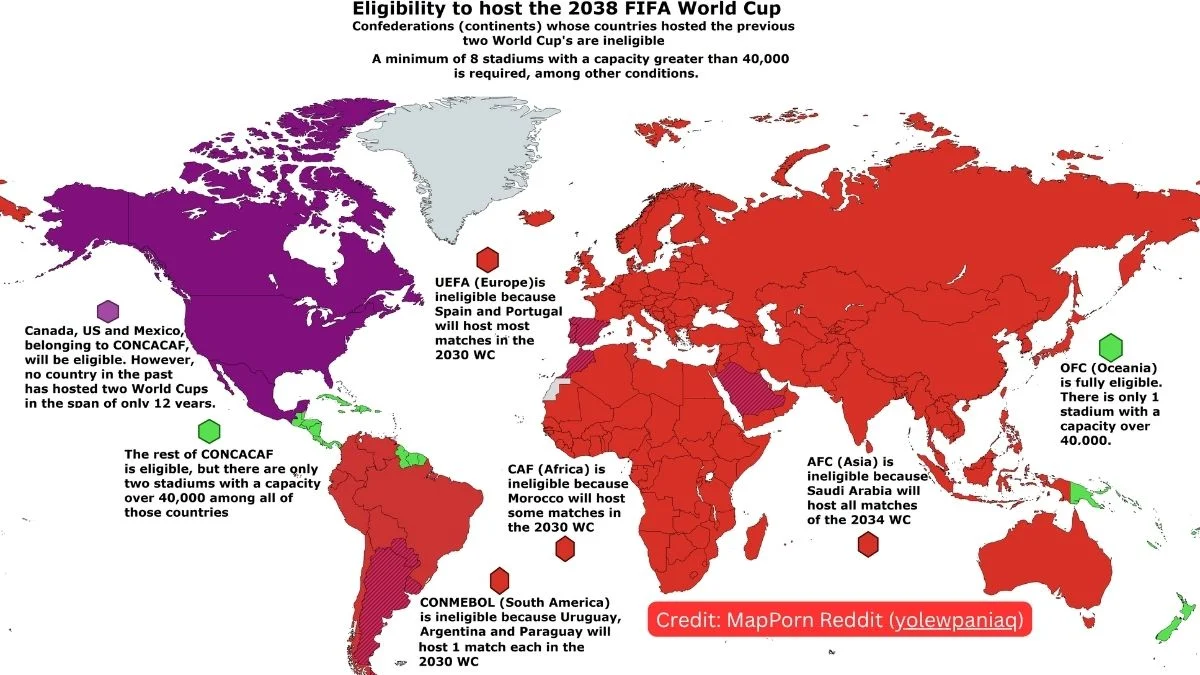
If that model continues into the 2038 selection process, several major football regions would effectively be out of contention.
Under a continued rotation model:
- Europe (UEFA)
- Africa (CAF)
- South America (CONMEBOL — due to 2030 involvement)
- Asia (AFC — 2034)
would typically be sidelined.
That would leave only two realistic confederations as primary eligible options:
- CONCACAF (North, Central America and Caribbean)
- OFC (Oceania)
This potential limitation dramatically changes the landscape before bidding has even begun.

Why Oceania Faces Significant Challenges
On paper, Oceania could benefit from the rotation scenario.
In reality, significant practical hurdles remain.
Oceania lacks the large-scale stadium infrastructure for a modern 48+ team tournament alone, making a solo OFC bid unrealistic without major partners.
As FIFA continues expanding the scale of the World Cup, hosting requirements become increasingly demanding. Stadium capacity, transportation networks, accommodation, training facilities and commercial infrastructure all play enormous roles in determining whether a bid is viable.
That makes partnerships an increasingly attractive option.
Why the United States Is Already Viewed as the Leading Candidate
Much of the conversation surrounding 2038 centres on one country.
In June 2026, Andrew Giuliani, executive director of the White House’s 2026 World Cup task force, publicly stated that the US is interested in bidding for 2038.
His reasoning focused on several advantages already in place.
He highlighted existing infrastructure from 2026, the upcoming 2028 Olympics, and the US’s capacity to handle an even larger tournament (FIFA has discussed expanding to 64 teams).
Those arguments resonate because many of the stadiums, transport systems and operational plans developed for the 2026 tournament could potentially be reused or enhanced.
Rather than starting from scratch, the United States would already possess proven experience in delivering a World Cup on an enormous scale.

Could Another Multi-Nation Bid Emerge?
Although the United States is frequently mentioned on its own, another possibility has also entered discussions.
The US (and potentially Canada/Mexico) would be strong favorites due to proven venues, logistics, and revenue potential.
Discussions have included possible co-hosting with Oceania nations (e.g., New Zealand + Fiji) to broaden the bid.
Such a proposal could satisfy both practical hosting needs and broader geographic representation.
Whether FIFA would ultimately favour another multi-country tournament remains an open question, especially after consecutive editions involving multiple hosts.
Why Many Analysts Believe North America Has the Inside Track
Even without an official bidding process, many observers believe North America currently enjoys significant advantages.
Many analysts and fans view a US (or North American) return as highly probable — or even “engineered” — given the rotation dynamics and lack of viable alternatives.
Supporters of that view point to existing stadiums, commercial opportunities, broadcasting potential and successful experience hosting major international sporting events.
However, that outlook has not gone unchallenged.
This has drawn criticism from some fans regarding frequency (US hosting/co-hosting in 1994, 2026, and potentially 2038).
Those concerns reflect a broader debate over balancing commercial success with giving different football regions opportunities to stage the world’s biggest sporting event.
Could Europe Still Surprise Everyone?
Although rotation currently appears to favour North America or Oceania, the situation is not completely settled.
Various European nations (e.g., Germany, France, Italy, England/UK, Baltic-Nordic/Baltic proposals) have expressed exploratory interest, though rotation norms would need to be waived or reinterpreted.
That caveat is particularly important.
FIFA has not confirmed the exact rotation rules for 2038, so surprises are possible.
The governing body has demonstrated flexibility before, meaning no continent can be entirely ruled out until the official bidding framework is published.
When Will FIFA Make the 2038 Decision?
For now, patience remains essential.
No host has been officially selected or bid process opened yet.
Bidding and selection are expected in the coming years, likely between 2030 and 2035, after preparations for the 2030 and 2034 tournaments are further advanced.
Only then will FIFA officially define eligibility, bidding requirements and the timetable leading to the final vote.
Until that process begins, every potential host remains speculative regardless of public interest or infrastructure advantages.
Final Verdict: Is the USA Really the Favourite for the 2038 FIFA World Cup?
Based on everything confirmed as of mid-2026, the United States occupies an exceptionally strong position.
Continental rotation, existing stadium infrastructure, operational experience, commercial strength and public interest from government officials all contribute to that outlook.
At the same time, the most important fact has not changed.
No host has been officially selected.
The formal bidding process has not begun.
FIFA has not confirmed the exact rotation rules that will govern the competition.
So while the United States appears well positioned—and many observers see North America as the logical frontrunner—the destination of the 2038 FIFA World Cup remains undecided.
For now, football fans can only watch as the next chapter unfolds. The confirmed hosts through 2034 have already reshaped the global football landscape, and the decisions made over the next several years will determine where the world’s biggest sporting event heads next.


Leave a Reply