

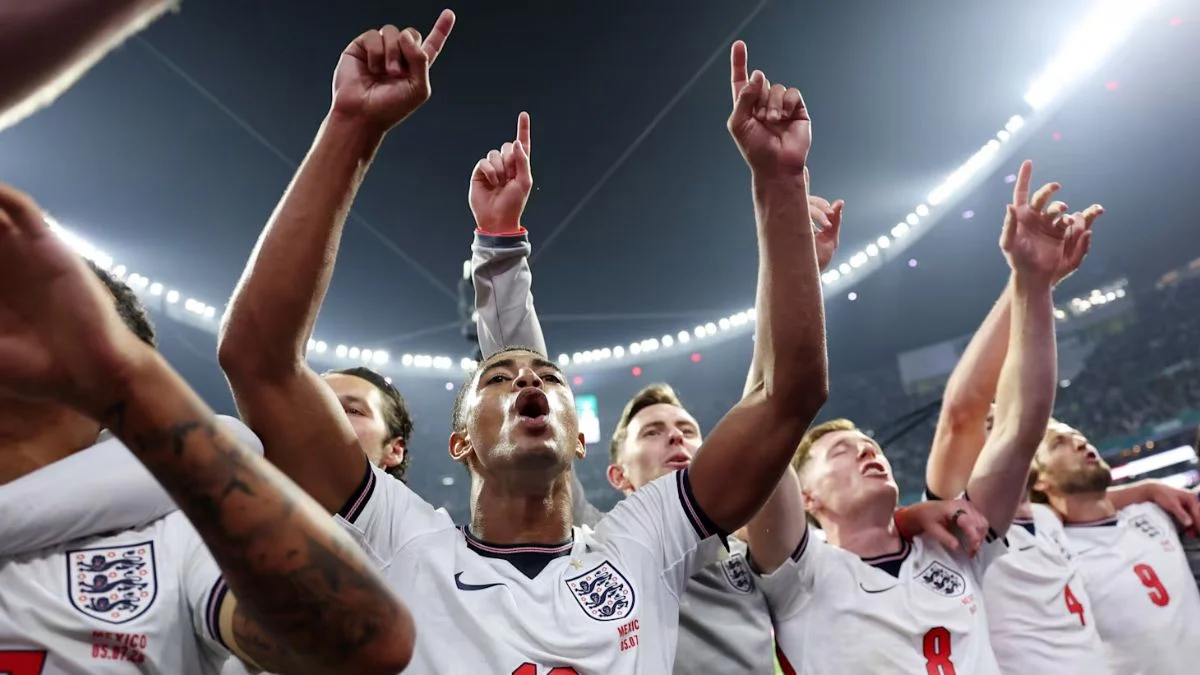
England’s journey through the 2026 FIFA World Cup has delivered memorable goals, dramatic victories, and standout individual performances. Yet one of the tournament’s most talked-about stories hasn’t come from a tactical masterclass or a spectacular strike—it has come from the stands after the final whistle.
Across stadiums in the United States, Mexico, and Canada, thousands of England supporters have transformed Oasis’ iconic hit “Wonderwall” into the soundtrack of the Three Lions’ campaign. What began as a spontaneous singalong has quickly evolved into one of the defining images of the tournament, with fans and players celebrating together in emotional scenes that have spread rapidly across social media and television broadcasts worldwide.
For football supporters in both the UK and the USA, the tradition has become far more than a post-match song. It represents a rare connection between players and fans, blending football, British music, nostalgia, and tournament momentum into one unforgettable moment after every England victory.
England’s 2026 FIFA World Cup “Wonderwall” Tradition Started Naturally—Not Through Planning
Despite how established it already feels, this is not a long-standing historical custom tied to previous FIFA World Cups.
England’s last World Cup triumph came in 1966, and there has never been a tradition of celebrating victories by singing Oasis’ “Wonderwall.” Instead, this has emerged as an entirely fresh phenomenon during the 2026 FIFA World Cup in North America, co-hosted by the United States, Mexico, and Canada.
The movement first gained widespread attention after England defeated Croatia 4-2 in their opening Group L match in Dallas/Arlington, Texas, around mid-June 2026.
Following the final whistle, the stadium atmosphere shifted from celebration to something much more memorable. As “Wonderwall” echoed through the speakers, thousands of England fans instinctively joined in. Players soon followed, creating one of the tournament’s most emotional post-match scenes.
Rather than fading as a one-off celebration, the tradition returned after subsequent England victories—including wins over Panama, DR Congo, Mexico in the Round of 16 at the Azteca Stadium, and others.

Why Did England Choose Oasis’ “Wonderwall” for the 2026 FIFA World Cup?
The story behind the song begins before the tournament itself.
Ahead of the World Cup, FIFA asked every participating nation to submit three songs that could potentially be used before or after matches.
England’s selections were:
| Official Detail | Information |
| Tournament | 2026 FIFA World Cup |
| Hosts | United States, Mexico and Canada |
| FIFA Request | Each team submitted three songs for matchday use |
| England’s Song Choices | “Wonderwall” (Oasis), “Sweet Caroline” (Neil Diamond), “Hey Jude” (The Beatles) |
| Song Played After Croatia Win | “Wonderwall” |
After England’s opening victory over Croatia, a DJ played “Wonderwall.” The response from supporters was immediate.
Fans sang together in huge numbers, players joined the celebrations, and the atmosphere created something few expected. From that moment onward, the song became inseparable from England’s winning celebrations.
The Perfect Timing Behind “Wonderwall’s” World Cup Success
Several factors combined to make “Wonderwall” the perfect post-match anthem.
One of the biggest reasons was Oasis’ hugely successful 2025 reunion tour.
The Oasis Live ’25 reunion, which began in July 2025, reignited enthusiasm for the legendary Manchester band across the UK. Their music once again became a staple in pubs, football gatherings, and sporting events, introducing younger fans while reconnecting older generations with Britpop classics.
Originally released in 1995 on the album (What’s the Story) Morning Glory?, “Wonderwall” has long been one of Britain’s most recognizable songs.
Its simple melody, familiar lyrics, and easy singalong structure make it particularly effective inside football stadiums, where thousands of supporters can instantly join together.
The band’s Manchester roots also strengthen the emotional connection for English football supporters, with Oasis maintaining close cultural links to Manchester and Manchester City supporters over the years.
How “Wonderwall” Replaced “Sweet Caroline” as England’s Feel-Good Celebration Song
For several recent tournaments, Neil Diamond’s “Sweet Caroline” had become England supporters’ preferred celebration anthem.
During the 2026 World Cup, however, “Wonderwall” has brought something different.
Rather than simply serving as a victory song, it has become what many observers describe as an emotional bridge between supporters and players.
At the elite international level, moments where players remain on the pitch, singing directly with travelling fans, are relatively uncommon.
The shared celebration has given England’s campaign an atmosphere that feels both authentic and spontaneous.
Importantly, “Wonderwall” has not replaced traditional England football chants such as “Three Lions” and its famous “It’s Coming Home” refrain. Instead, it has become the team’s unofficial post-match soundtrack—a celebration reserved for victories.

Every Major England “Wonderwall” Moment During the 2026 FIFA World Cup
As England continued advancing through the tournament, the celebrations became increasingly anticipated.
| Match | What Happened |
| Croatia (Group L opener) | First viral stadium-wide “Wonderwall” singalong after England’s 4-2 victory in Dallas/Arlington |
| Panama | Celebration repeated following another England victory |
| DR Congo | Players and supporters again sang together after the knockout win |
| Mexico (Round of 16, Azteca Stadium) | Another emotional rendition featuring players and travelling fans |
| Other victories | Tradition continued after England wins throughout the tournament |
Each celebration strengthened the bond between the team and supporters, creating scenes that many fans described as goosebump-inducing.
Videos circulating online consistently showed players facing the travelling England supporters rather than immediately leaving the pitch, turning the closing moments of each victory into shared celebrations.
Harry Kane and England Players Helped Turn the Song Into a Tournament Tradition
One of the biggest reasons the celebrations resonated so widely was player participation.
Rather than allowing supporters to celebrate alone, England’s squad embraced the tradition.
Harry Kane joined supporters after the Croatia victory and later described the experience as one of his most memorable moments representing his country.
He called it “one of his ‘favourite ever moments in an England shirt.’”
Other players also embraced the celebrations.
Videos from multiple matches showed Jude Bellingham encouraging supporters to continue singing, while teammates joined the chorus, looking back toward the stands instead of immediately heading down the tunnel.
Those moments helped transform what might have remained a fan chant into a genuine player-supporter tradition.
Oasis Members Responded as “Wonderwall” Became England’s Unofficial World Cup Anthem
As the celebrations gained worldwide attention, the members of Oasis also responded.
Noel Gallagher (songwriter) said “Wonderwall belongs to the people” and praised the fan-player connection.
Meanwhile, Liam Gallagher posted supportive messages like urging fans to “keep the biblical vibrations going.”
Those endorsements only strengthened the association between the song and England’s World Cup campaign, adding another cultural layer to an already emotional sporting story.
Why “Wonderwall” Connects So Deeply With England Supporters
The success of the tradition extends beyond nostalgia.
“Wonderwall” combines several qualities that make it uniquely suited to football celebrations.
Its melody is instantly recognizable.
Its lyrics focus on connection and hope, making it naturally uplifting after important victories.
Almost every generation of English supporters knows the song, allowing parents, children, lifelong fans, and first-time tournament followers to sing together without hesitation.
England supporters have long been known for turning stadiums into giant karaoke events, and “Wonderwall” has amplified that tradition on the biggest stage in world football.
Commentators have noted that the song quickly developed both “emotional life and nostalgia” because of its repeated association with England victories.
With players singing back toward supporters, arms around teammates and fans embracing one another in the stands, every performance has reinforced that emotional connection.

“Wonderwall” Has Become the Defining Soundtrack of England’s 2026 FIFA World Cup
The tradition has already produced effects beyond the stadium.
Streaming numbers reportedly experienced a significant boost, with UK streams increasing by around 50 percent following England’s early victories.
Observers have also praised the song for creating a stronger shared atmosphere than England’s national anthem in post-match celebrations, while comparing it favorably to victory songs adopted by other nations during international tournaments.
As of early July 2026, with the tournament still ongoing, “Wonderwall” has firmly established itself as England’s unofficial World Cup soundtrack.
It remains separate from classic football anthems like “It’s Coming Home,” yet complements them perfectly by providing supporters with a post-victory ritual that feels entirely organic.
Rather than being manufactured through marketing campaigns or planned ceremonies, the tradition emerged naturally from one unforgettable moment after England’s opening win over Croatia.
Since then, every chorus has strengthened the bond between fans and players, proving that sometimes the most enduring football traditions are the ones nobody plans. In a tournament already filled with unforgettable memories, England’s stadium-wide renditions of “Wonderwall” have become one of the defining cultural stories of the 2026 FIFA World Cup—and one that supporters on both sides of the Atlantic are unlikely to forget anytime soon.


Leave a Reply