

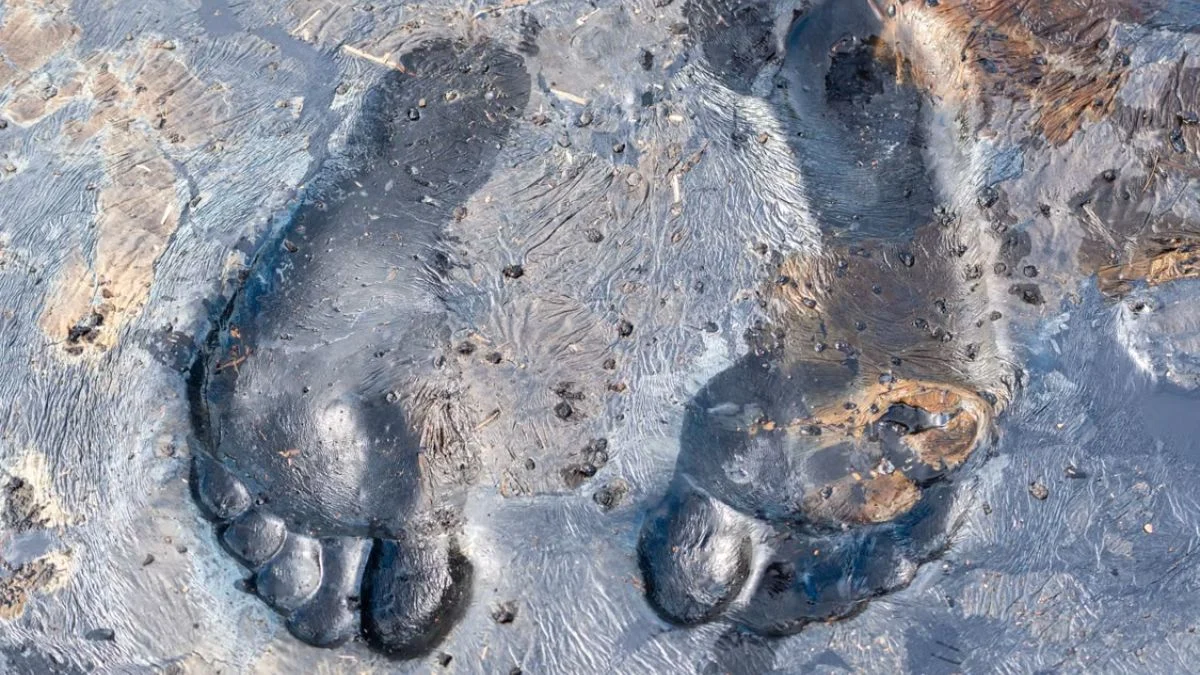
A mysterious 16mm film reel, reportedly discovered inside a safe after its owner’s death, has become the centre of a new controversy surrounding one of the most famous pieces of alleged Bigfoot evidence. Decades after Roger Patterson and Bob Gimlin filmed a large, hair-covered figure walking through a California forest, a documentary claims newly developed footage could change how the iconic encounter is understood.
Titled Capturing Bigfoot, the documentary by director Marq Evans presents the reel as a possible rehearsal for the famous 1967 footage. But not everyone is convinced. Questions about the film’s date, the identity of the figure shown and whether the reel proves anything about the original encounter have divided the Bigfoot community ahead of its October 20, 2026, release.
What Does the Newly Discovered Bigfoot Film Reel Show?
The documentary’s central piece of evidence is a roughly 40-second reel of 16mm film. According to reports about the film, the footage shows a slimmer figure wearing what appears to be a Bigfoot costume walking into woodland, with Gimlin visible on horseback.
Evans argues that markings along the film indicate it was shot in 1966, approximately a year before Patterson and Gimlin recorded their famous footage at Bluff Creek in Northern California. He interprets the reel as a trial run for the later film.
Speaking to People, Evans described the footage as evidence of an “incredible hoax.” He believes the reel captures a rehearsal that was never discarded and remained hidden for decades.
Business Insider, however, reported that the location shown in the newly surfaced footage looks more like Washington state, where Patterson and Gimlin lived, than Northern California.
Evans said he had the reel developed soon after Teresa Brooks contacted him. Days later, he found himself watching a 40-second clip filmed in a setting resembling the location associated with the 1967 footage.
The documentary reportedly saves the reel for its ending, presenting it as a potential rehearsal for the encounter that helped make Bigfoot a household name.
That interpretation is central to the film’s argument, but the reel has not been independently authenticated as a rehearsal, and no independent forensic analysis of it has been published.
Into More Bigfoot Mysteries?
A Maine Bigfoot sighting prompted a police search, and the coverage follows how the reported creature was eventually found. To see how the story played out, explore our Maine Bigfoot sighting police search report.
How Did the Lost Bigfoot Film Reel Surface?
The story began with Teresa Brooks, a film instructor at Olympic College and a colleague of Evans, who also teaches film there.
After her father, Norm Johnson, died, Brooks discovered a canister of 16mm film inside his safe. Unsure how to proceed, she contacted Evans for help developing it.
The reported timeline of that contact is not consistent across sources. Business Insider dates Brooks’s approach to Evans to 2022, while People reports that she emailed him in June 2024.
According to People, Johnson ran the film department at Seattle’s Boeing and was connected to Patterson and Gimlin through his brother, Dave. Evans told the publication that he quickly realised Johnson had developed the famous 1967 film.
Brooks reportedly told Evans that the reel had remained locked away because her mother feared Johnson could get into trouble over it. According to Evans’s account, she told Johnson to put away any evidence and never speak about it again.
Evans said it took him approximately nine months to understand what the footage might represent.
The director, whose earlier film was Claydream, also had a personal connection to the region’s Bigfoot lore. His father grew up in Yakima, Washington, where Evans said he had heard plenty of local gossip about whether the original footage was genuine.
The Wall Street Journal reported that Evans paid a $30,000 licensing fee to use the original 1967 footage in his documentary.
Yet the circumstances surrounding the newly discovered reel remain part of the wider debate. Its discovery and the family history described by Evans do not, by themselves, establish when it was filmed or what it was intended to show.
Why the 1967 Patterson-Gimlin Bigfoot Film Matters
On October 20, 1967, Patterson and Gimlin said they filmed a large, hair-covered figure walking along Bluff Creek in the Six Rivers National Forest in Del Norte County, California.
The silent footage, shot by Patterson, a former rodeo star, runs for approximately 59 seconds. The figure later became known as Patty, and the clip helped launch a multi-million-dollar Bigfoot industry.
For decades, the footage has attracted both believers and sceptics. Critics have argued that the figure was a person wearing a costume, while supporters have continued to regard the recording as evidence of an encounter with an unidentified creature.
Bob Heironimus, who knew Patterson in Yakima, Washington, has claimed that he wore the suit. Author Greg Long popularised that claim in 2004.
However, Outside reported in 2016 that neither Heironimus’s account nor the costume-maker’s account was supported by concrete proof. The publication also noted that the original film had never been conclusively debunked.
Patterson died in 1972, still insisting that the creature was real. According to People, he died of Hodgkin’s lymphoma.
Evans argues that Patterson sincerely believed in Bigfoot but knew he was dying in 1967 and wanted to leave his wife and three young children some kind of legacy.
Gimlin, meanwhile, has consistently denied involvement in a hoax. Outside quoted him recalling what he told researcher John Green years earlier: he knew it “wasn’t a man in a suit.”
The reporting reviewed for the documentary’s coverage did not show Gimlin retracting that account.
Clint Patterson’s Account Raises More Questions
One of the documentary’s most significant developments is the participation of Roger Patterson’s family, who had not previously given interviews on the subject.
Clint Patterson, described by People as a 66-year-old Montana rancher, told Evans that he learned from his mother roughly a decade ago that the sighting had been a hoax.
Evans said he initially expected the family to refuse to discuss the subject, as they had done previously. But after he showed Clint the newly discovered footage, Clint became eager to speak.
According to Evans, Clint said the lie had weighed on him and that he wanted to get out from under it.
Clint also reportedly told Evans that he watched his father burn the Bigfoot suit in a barrel behind the family home one night. The account describes Patterson throwing the suit into the fire piece by piece over approximately 30 minutes.
Evans has described the suit’s fate as the last open question in the story.
However, these details come from Evans’s account to People. The reported conversation and the alleged destruction of the suit have not been independently verified.
Bigfoot Field Researchers Organization founder Matt Moneymaker disputes the documentary’s interpretation. He says Patricia Patterson has maintained throughout her life that the original film was real and does not say otherwise in the documentary.
Moneymaker also argues that Gimlin does not retract his position and that Clint has no direct knowledge of the original filming.
The competing accounts leave a crucial distinction: a family member’s reported recollection, a director’s interpretation and independently established evidence are not the same thing.
Why the New Bigfoot Documentary Has Divided Believers
Capturing Bigfoot premiered at SXSW on March 12, 2026, and its reported revelations have prompted sharply different reactions among enthusiasts and sceptics.
Entertainment Weekly reported that the Bigfoot community was reeling after the premiere. Business Insider described YouTuber Eric Palacios, who had entered the experience believing the original footage held up, as changing his mind after watching the documentary.
The outlet also reported that others refused to accept the film’s conclusions, describing its impact on the online Bigfoot community as “like a nuclear bomb.” It noted that almost no hardcore fans had seen the documentary at that stage.
Forbes reported that some online commentators speculated that the newly surfaced reel might be AI-generated, while people who attended the film’s premiere appeared convinced by the evidence.
Skeptic magazine’s UK site observed that the enthusiast community was already splitting into factions over a documentary that very few people had watched. It also noted that believers who regard Bigfoot as a paranormal entity did not necessarily depend on the 1967 film to support their beliefs.
The disagreement illustrates how the documentary has become about more than a single piece of footage. For some, the reel potentially undermines an iconic recording. For others, even evidence against that particular film would not settle the broader question of whether Bigfoot exists.
Matt Moneymaker Challenges the Documentary’s Central Evidence
Not everyone accepts Evans’s conclusion that the reel shows a rehearsal filmed in 1966.
Moneymaker has published a statement arguing that the footage is a replica of the original Patterson-Gimlin film, rather than a rehearsal recorded before it.
He cites special-effects specialist Bill Munns, who appears in the documentary, as saying that the figure is an obvious man wearing a poor imitation of the creature.
Moneymaker goes further, arguing that the person in the reel is Al DeAtley, who toured the original film around the country. He suggests DeAtley may have created the replica while planning a larger documentary.
The dispute also centres on how the newly discovered reel was dated.
Evans says markings along the film’s edges indicate that it dates to 1966. Moneymaker argues that the two small plus marks in question are Kodachrome manufacturing marks, which indicate when Kodak produced the film stock rather than when someone recorded footage on it.
Under his interpretation, film stock manufactured in 1966 could have been used to record footage in 1967 or 1968. If that is correct, the markings alone would not establish that the reel predates the original encounter.
Moneymaker also says Heironimus has given contradictory accounts over the years but insists that he did not wear the suit shown in this reel. He has called the documentary clickbait.
The central disagreement can be summarised as follows:
| Question | Evans and the filmmakers | Moneymaker and critics |
| When was the reel filmed? | Evans dates it to 1966 based on film markings. | Moneymaker says the markings date the stock, not necessarily the filming. |
| What does the footage represent? | A rehearsal for the 1967 film. | A replica made after the original film. |
| Who wore the suit? | Heironimus has claimed he wore the suit in the 1967 footage, a claim popularised by Greg Long. | Moneymaker identifies DeAtley as the figure in the new reel and says Heironimus was not in it. |
| Does the reel prove the original was a hoax? | Evans says it demonstrates that the famous footage was staged. | Moneymaker argues that a later replica would not establish that the original was a hoax. |
Without independent forensic analysis, the available information does not conclusively resolve the disagreement over the reel’s date or purpose.
Who Appears in Capturing Bigfoot?
The documentary brings together people with different connections to the original footage and its long-running controversy.
Those interviewed include Bob Gimlin, Heironimus, Clint Patterson, Roger Patterson’s widow Patricia, anthropologist Jeffrey Meldrum, special-effects specialist Bill Munns and Greg Long.
The XYZ Films cast list also names Larry Lund, Vaile Thompson, Sandy Collier and Teresa Brooks.
Meldrum, who argued during his career for the biological plausibility of Bigfoot, died in September 2025 at age 67 after a short illness. He filmed his appearance before the documentary premiered.
The Wall Street Journal framed the documentary’s subject as an early example of the confusion surrounding misinformation and viral conspiracy theories in the modern era.
Writing in Skeptical Inquirer, Benjamin Radford suggested that sceptics would likely greet the reported hoax finding with a shrug, while arguing that the film offers lessons about confirmation bias, including among prominent Bigfoot advocates.
Evans told People that he did not set out to disprove Bigfoot and expects many believers to find the documentary difficult to accept.
When and Where to Watch Capturing Bigfoot
XYZ Films will release Capturing Bigfoot in New York, Los Angeles and select theatres nationwide on October 20, 2026.
The documentary will also be available for a limited time to rent or buy exclusively through Prime Video in the United States and Canada from the same date. It will not be included as part of a standard Prime subscription.
The release date coincides with the anniversary of the day Patterson and Gimlin said they filmed the creature in 1967. October 20 is also marked by fans as National Bigfoot Day.
The documentary runs for approximately 103 minutes. Its official synopsis describes a story about family legacy, broken friendships and belief itself.
Dread Central covered a teaser on September 11, 2026, followed by a full trailer on October 2.
Key Dates in the Patterson-Gimlin Film Controversy
| Date | Event |
| 1966 | Evans dates the newly discovered reel to this year. |
| October 20, 1967 | Patterson and Gimlin say they filmed the creature at Bluff Creek, California. |
| 1972 | Patterson dies while continuing to insist the creature was real. |
| 2004 | Greg Long publishes his claim that Heironimus wore the suit. |
| September 2025 | Jeffrey Meldrum dies at age 67. |
| March 12, 2026 | Capturing Bigfoot premieres at SXSW. |
| October 20, 2026 | The documentary receives its limited theatrical and Prime Video release. |
Curious About Strange Sightings?
radio host in Haywood County, Tennessee, has captured strange lights on video, and the coverage describes the UFO mystery as continuing. Dive deeper with our Tennessee Haywood County strange lights video coverage.
Conclusion: Has the Patterson-Gimlin Bigfoot Mystery Finally Been Solved?
Capturing Bigfoot presents a potentially significant new chapter in the decades-long debate over the Patterson-Gimlin film. Evans believes a reel discovered in a safe reveals a rehearsal for the famous encounter, while Moneymaker argues that it may instead be a later replica whose markings do not establish when it was recorded.
The reported statements from Clint Patterson add another layer to the story, but the family accounts and the reel’s interpretation have not been independently verified. Gimlin continues to deny involvement in a hoax, and the original footage has not been conclusively debunked.
For now, the documentary offers a disputed interpretation rather than a definitive resolution. Whether the newly discovered reel changes anyone’s mind may depend on the evidence viewers find convincing—and whether independent analysis can establish what the footage actually shows.
Source and research disclaimer: This article has been prepared using the sources listed below and the information available from those reports at the time of writing. Claims, quotations and interpretations have been attributed to the relevant individuals or publications where appropriate. The article does not imply independent forensic verification of the newly discovered reel or independent confirmation of disputed accounts.
Sources
- People (via Yahoo): The Famed 1967 Bigfoot Film Was an ‘Incredible Hoax,’ Says the Director of a Groundbreaking New Documentary
- Kitsap Sun (via Yahoo): Will a film made in Bremerton answer a secret about Bigfoot?
- Business Insider (via AOL): The Bigfoot community is being torn apart by a documentary’s new evidence
- Entertainment Weekly (via AOL): Bigfoot community reeling as new documentary casts doubt on iconic footage of mythic creature
- Outside: The Man Who Created Bigfoot — July 5, 2016
- XYZ Films: Capturing Bigfoot
- Dread Central: ‘Capturing Bigfoot’ Full Trailer Teases a Revelation I Can Tell You Is a Shocker — October 2, 2026
- Matt Moneymaker: Statement: ‘Capturing Bigfoot’
- Forbes: Has Bigfoot Finally Been Debunked? — March 31, 2026
- The Wall Street Journal: A New Bigfoot Documentary Helps Explain Our Conspiracy-Minded Era
- Wikipedia: Capturing Bigfoot and Jeffrey Meldrum
Featured Image Credit: Dominik Gryzbon / Pexels


Leave a Reply