

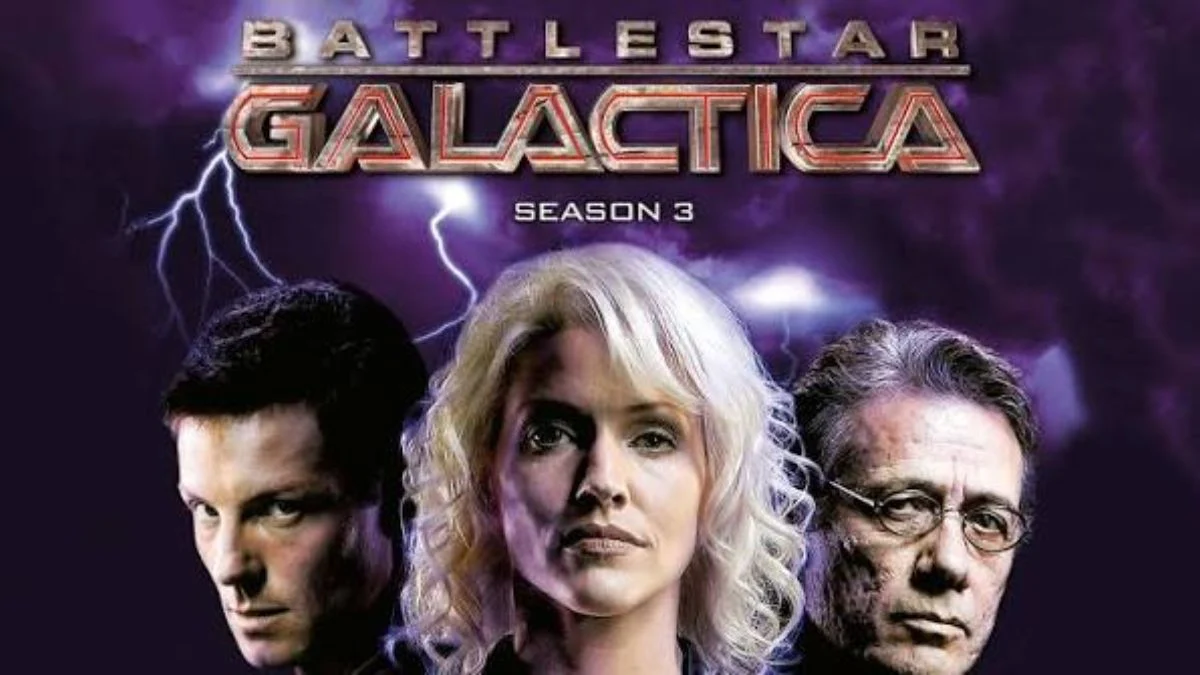
Twenty years after Battlestar Galactica Season 3 premiered, its New Caprica storyline remains a defining chapter in the science fiction drama. What began as humanity’s attempt to rebuild after devastating losses quickly became another fight for survival, with the survivors discovering that finding a place to live did not mean they had found freedom.
Premiering on October 6, 2006, the season confronted viewers with a difficult question: when an oppressive regime controls your world, how far can you go to fight back before the struggle for liberation begins to compromise your own principles? Through political collaboration, underground resistance and increasingly difficult moral choices, Battlestar Galactica turned its futuristic conflict into a story about the human cost of occupation.
Battlestar Galactica Season 3 Begins Under Cylon Occupation
Developed by Ronald D. Moore and David Eick as a reimagining of the original 1978 series, Battlestar Galactica had already established a universe shaped by war, survival and the consequences of humanity’s decisions. Season 3 raised the stakes by shifting the conflict to New Caprica, the planet where the surviving humans had hoped to establish a permanent settlement.
The opening episodes, “Occupation” and “Precipice,” begin approximately four months after the Cylons seize control of the planet. The survivors had spent years fleeing the machines responsible for destroying the Twelve Colonies. New Caprica was supposed to offer them an opportunity to rebuild their lives, but that hope had collapsed under Cylon rule.
Instead of escaping their enemies, the humans found themselves living under an occupying force with the power to dictate the conditions of their survival.
The central conflict was no longer simply about escaping extinction. It was about what freedom meant when the people seeking it were divided over how to fight for it.
Still Thinking About That Finale?
The latest TV finales can leave viewers debating character choices, hidden connections, and what comes next. Explore our Lanterns Season 1 finale explainer for a closer look at Hal Jordan, Noah, and John Stewart.
Gaius Baltar’s Leadership Creates a Political Dilemma
President Gaius Baltar remains in office under Cylon authority, placing his leadership at the centre of the occupation’s political tensions.
His continued position raises uncomfortable questions about collaboration. What responsibilities does a leader have when power can only be maintained under an occupying regime? And where is the line between attempting to protect a population and becoming complicit in the system controlling it?
The series does not reduce these questions to an easy choice between courage and cowardice. Instead, Baltar’s position becomes part of a wider examination of political loyalty, responsibility and survival.
For the humans trapped on New Caprica, the situation is especially complicated. Resistance carries risks, but accepting the occupation also has consequences. Neither option offers an uncomplicated path forward.
Galen Tyrol and Saul Tigh Reveal the Divisions Within the Resistance
While the Cylons control New Caprica, an underground resistance movement begins challenging their authority. However, the people fighting for liberation are not united in their approach.
Chief Galen Tyrol emerges as a prominent resistance figure, while Colonel Saul Tigh embraces increasingly extreme methods against the occupying force. Their differing approaches highlight a central tension within the storyline: even people who agree that oppression must end can disagree sharply about the methods required to achieve that goal.
The conflict forces the resistance to confront more than its military disadvantage. Its members must also decide what risks they are willing to take, what sacrifices they can justify and whether the pursuit of freedom places limits on the violence they are prepared to use.
A movement fighting an overwhelmingly powerful enemy cannot avoid difficult decisions. Yet Battlestar Galactica makes clear that desperation does not automatically settle the question of whether a particular action is justified.
Starbuck’s Captivity Adds Another Layer to the Occupation
Kara Thrace, better known as Starbuck, is held captive by the Cylon Leoben Conoy.
Her captivity adds a personal dimension to a storyline already shaped by political repression and the struggle for survival. Across New Caprica, the occupation affects people in different ways, leaving the survivors to navigate an environment where their freedom and security have been taken away.
Laura Roslin must also grapple with the political and ethical consequences of decisions made during the resistance. As the conflict intensifies, its effects extend beyond the people directly involved in fighting the Cylons, deepening divisions among the survivors and increasing the danger faced by civilians.
The storyline’s tension comes from this collision of personal suffering and collective responsibility. The resistance is attempting to end an oppressive system, but its decisions can also create new risks for the people it hopes to protect.
The Suicide-Bombing Plot Raises Difficult Questions About Resistance
One of the most morally challenging developments in the season’s opening episodes involves a proposed suicide bombing targeting a graduation ceremony for the New Caprica Security Forces.
The force consists of humans enforcing the Cylon regime’s laws. That detail makes the proposal especially troubling: the intended targets are not Cylons themselves, but human beings participating in the occupation’s security apparatus.
The situation confronts the resistance with a difficult distinction between opposing an oppressive regime and deciding which methods are acceptable in that struggle.
The humans have legitimate reasons to resist Cylon rule. However, the series does not present their opposition as automatic justification for every act of violence. The proposed attack instead exposes the moral complications of an insurgency operating under extreme pressure.
Producer Mark Verheiden discussed the creative thinking behind this storyline in So Say We All: The Complete, Uncensored, Unauthorized Oral History of Battlestar Galactica, a 2018 book by Mark A. Altman and Edward Gross.
Verheiden explained:
“We were able to subvert the idea of who’s the good guys and who are the bad guys in terms of our guys being essentially the suicide bombers,” Verheiden said.
The observation captures the challenge the storyline presents to conventional ideas about heroes and villains. The resistance may be fighting an occupying power, but its members can still become responsible for actions that raise serious ethical questions.
Verheiden also clarified that the creative approach was not intended to portray suicide bombing as morally acceptable.
“I don’t think we were trying to say any point of view was morally better or worse — suicide bombing is not good — but that was where they had been driven to by the desperation of the situation,” Verheiden said.
His comments reinforce the distinction at the heart of the New Caprica storyline: understanding why people resort to extreme methods is not the same as endorsing those methods.
The circumstances may narrow the choices available to the resistance, but they do not remove the consequences of its decisions.
How Battlestar Galactica Used Historical Conflicts to Explore Occupation
The New Caprica storyline draws on the history of occupation and insurgency, including World War II, collaboration under the Vichy regime in occupied France, and the Iraq War.
These parallels give the science fiction narrative a wider context. Although the conflict unfolds on a fictional planet, its central questions concern recognisable struggles over political authority, loyalty, resistance and the treatment of civilians.
The comparison is not a claim that New Caprica directly recreates any single historical conflict. Rather, Battlestar Galactica uses its futuristic setting to examine recurring dilemmas that emerge when one group controls another and those living under its authority attempt to fight back.
Who has the right to define legitimate resistance? When does cooperation with an occupying power become complicity? And what happens when a movement seeking justice begins using methods that place civilians at risk?
The series also explores religious extremism, political loyalty and violence against civilians through the decisions made by both humans and Cylons.
The Cylons Are Divided Over Humanity’s Future
The conflict becomes more complicated because the Cylons are not entirely united in their objectives.
Caprica Six and other Cylon models consider whether peaceful coexistence with humanity is possible. Versions of Brother Cavil, by contrast, favour harsher repression.
Their disagreements challenge the idea that the occupation is being directed by a single, unified enemy. The Cylons themselves are divided over how humanity should be treated, introducing competing approaches to the future of the conflict.
This internal tension also complicates the relationship between power and morality. The human resistance faces disagreements about acceptable methods, while the Cylons face disagreements about coexistence and repression.
Neither side is presented as entirely free from internal conflict. The result is a story in which political choices, personal loyalties and competing ideas about the future shape the struggle alongside military force.
The Exodus Storyline Brings the New Caprica Crisis to a Head
Following “Occupation” and “Precipice,” the two-part “Exodus” storyline delivers a high-stakes rescue operation involving the battlestar Galactica and its sister ship, Pegasus.
The rescue brings together the season’s central concerns: resistance under occupation, the dangers faced by civilians and the difficult decisions required to challenge a powerful enemy.
The storyline also demonstrates the scale of the production’s ambitions. Its conflict between human survivors and the Cylons combines political and ethical questions with some of the series’ most ambitious visual effects.
The season’s wider recognition included Emmy attention for “Exodus, Part 2” and “Occupation/Precipice.” “Exodus” also won recognition for visual effects in a broadcast series at the Visual Effects Society’s 5th Annual VES Awards.
These awards records provide another dimension to the season’s legacy. Its New Caprica story was not defined solely by the spectacle of a rescue mission. It also brought together character-driven drama, questions about the ethics of resistance and large-scale science fiction production.
Why the New Caprica Occupation Still Matters 20 Years Later
The enduring significance of Battlestar Galactica Season 3 lies in its refusal to make the struggle for freedom morally simple.
Baltar’s leadership under Cylon authority raises questions about collaboration. Tyrol and Tigh reveal divisions within the resistance. Starbuck’s captivity and Roslin’s difficult decisions bring the personal and political costs of occupation into focus. Meanwhile, the disagreement among the Cylons prevents the enemy from becoming a completely uniform force.
The proposed suicide bombing sharpens the season’s central dilemma: people can have compelling reasons to resist oppression while still being accountable for the methods they choose.
Through its historical parallels and fictional conflict, the series explores the relationship between power, morality and survival without reducing those questions to a straightforward division between good and evil.
Following Another Epic Fantasy Series?
Fantasy dramas often use visions and prophecies to hint at conflicts still to come. Discover our House of the Dragon Season 3 Episode 7 explainer to explore Helaena’s prophetic dreams and their possible implications for the Dance of the Dragons.
Conclusion
Twenty years after its October 6, 2006, premiere, Battlestar Galactica Season 3 remains a defining examination of occupation and resistance. The New Caprica storyline transformed humanity’s search for survival into a deeper conflict over freedom, political responsibility and the moral limits of rebellion.
From Baltar’s compromised leadership to the resistance’s internal divisions and the rescue depicted in “Exodus,” the season connected personal suffering with difficult questions about power and justice. Its lasting impact comes from confronting an uncomfortable possibility: escaping an oppressive enemy may be only the beginning of the struggle to decide what kind of people the survivors will become.
Source Disclaimer
This article has been prepared using the seven sources listed below, including official episode guides, awards records, published interviews, oral-history references and entertainment-industry reporting. It reflects the information and source material available for this article and does not imply independent verification beyond what those sources support.
Sources
- Paramount+ – Battlestar Galactica Season 3 Episode Guide — Episode titles, original air dates and official descriptions of the New Caprica storyline.
- Television Academy – Battlestar Galactica Awards and Nominations — Emmy wins and nominations for “Exodus, Part 2” and “Occupation/Precipice.”
- Television Academy – 2007 Outstanding Special Visual Effects for a Series — Official Emmy winner and credited visual-effects personnel.
- Visual Effects Society – 5th Annual VES Awards — Official award record listing “Exodus” as the winner for outstanding visual effects in a broadcast series.
- So Say We All: The Complete, Uncensored, Unauthorized Oral History of Battlestar Galactica — Publication record for the oral history by Mark A. Altman and Edward Gross, which contains recollections from the show’s production.
- Polygon – Battlestar Galactica’s New Caprica Occupation Retrospective — Retrospective reporting on the occupation storyline and production history.
- Inverse – Battlestar Galactica’s New Caprica Storyline — Retrospective discussion of the season’s themes and effects on its characters.
Featured Image Credit: Universal Cable Productions


Leave a Reply