

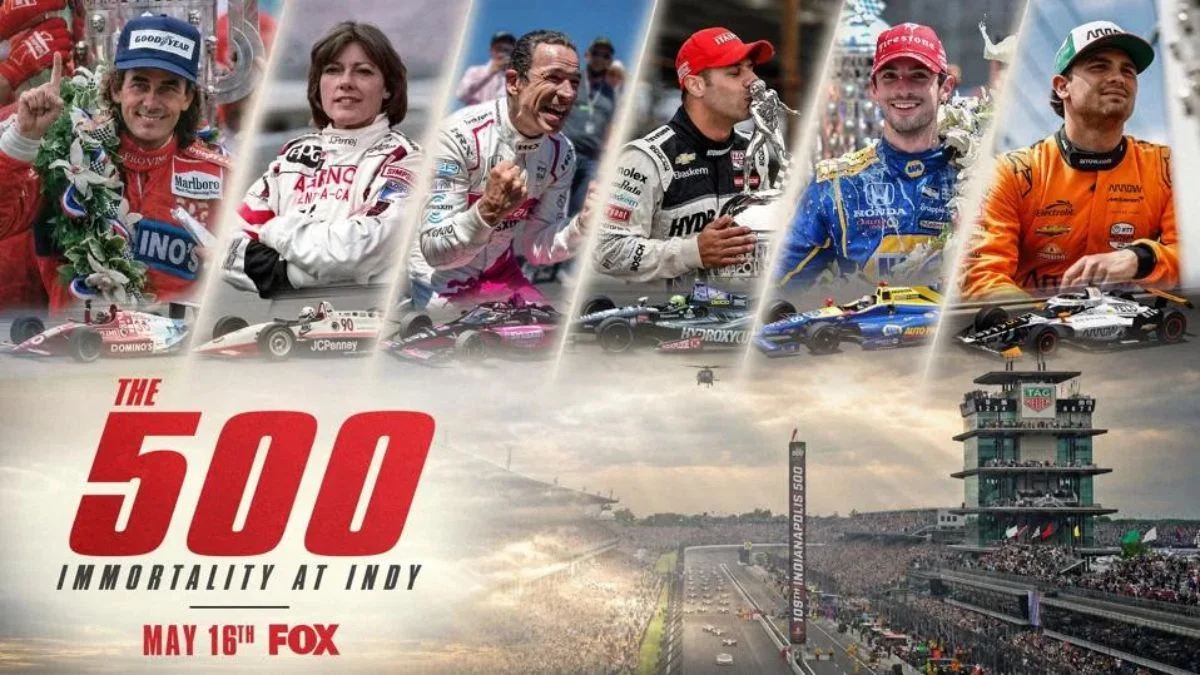
The 109th Indianapolis 500 was more than just another edition of “The Greatest Spectacle in Racing.” On May 25, 2025, the iconic race at the Indianapolis Motor Speedway (IMS) became a showcase for one of the most ambitious live sports productions ever attempted. While millions of viewers witnessed an unforgettable finish on track, few realized the extraordinary broadcast operation working behind the scenes to bring every second into homes across the United States and beyond.
The race itself delivered history as Álex Palou of Chip Ganassi Racing claimed victory in the closest Indianapolis 500 finish ever recorded. At the same time, FOX Sports and IMS Productions introduced viewers to a new level of storytelling through cutting-edge camera technology, immersive graphics, enhanced audio, and one of the largest production infrastructures assembled for any motorsport event.
With approximately 350,000 spectators filling the Speedway and millions more watching on television, the 2025 Indianapolis 500 became a defining moment not only for INDYCAR but also for the future of live sports broadcasting.
109th Indianapolis 500 Official Details and Broadcast Overview
| Category | Official Details |
| Event | 109th Running of the Indianapolis 500 presented by Gainbridge |
| Date | May 25, 2025 |
| Venue | Indianapolis Motor Speedway (IMS) |
| Winner | Álex Palou (Chip Ganassi Racing) |
| Margin of Victory | 0.0233 seconds (closest in Indy 500 history) |
| Estimated Attendance | Around 350,000 |
| Television Network | FOX |
| Broadcast Resolution | 1080p HDR (distributed in 4K/upconverted) |
| Estimated Nielsen Viewership | Approximately 7.05 million |

A Historic Race That Deserved a Historic Broadcast
The 109th Indianapolis 500 took place on May 25, 2025, at the legendary Indianapolis Motor Speedway. It marked the first Indy 500 broadcast on FOX, in its second year as INDYCAR’s media rights holder after taking over beginning in 2025.
The event was produced on-site primarily by IMS Productions, while FOX Sports made significant contributions in talent, technology, graphics, and overall production scale.
The race itself lived up to every expectation.
Álex Palou, driving for Chip Ganassi Racing, secured victory after one of the most dramatic finishes the Indianapolis 500 has ever witnessed. Crossing the finish line just 0.0233 seconds ahead of his nearest challenger, Palou earned the closest victory margin in the race’s long history. Combined with an attendance of around 350,000 and television viewership of approximately 7.05 million according to Nielsen, the event became one of the defining sporting spectacles of the year.
Why FOX’s Arrival Changed the Indianapolis 500 Broadcast

FOX Sports officially acquired INDYCAR media rights beginning in 2025, replacing NBC as the series’ broadcaster.
The agreement placed every INDYCAR race across FOX, FS1, and FS2 while significantly expanding shoulder programming around the championship. From the outset, FOX positioned the Indianapolis 500 as one of its premier sporting events, treating it similarly to the Daytona 500 as a flagship property.
Meanwhile, IMS Productions—part of Penske Entertainment—continued handling the core on-site production responsibilities. With decades of experience producing INDYCAR and Indianapolis Motor Speedway events, IMS brought venue expertise that perfectly complemented FOX’s national broadcast capabilities.
By year two of their partnership, both organizations had refined workflows developed during the previous season, allowing them to dramatically scale the production while operating more efficiently.
Executives from both organizations described the relationship as built on passion, shared infrastructure, and rapid iteration. They emphasized that operations became considerably smoother during the second year, with FOX contributing extensive production resources while IMS provided unmatched knowledge of the Speedway.

Managing One of the Largest Live Sports Productions of the Year
Broadcasting from the 559-plus-acre Indianapolis Motor Speedway presented enormous logistical challenges.
The venue’s famous 2.5-mile oval, hundreds of thousands of spectators, expansive infield, ceremonial traditions, and constant high-speed racing required producers to make split-second editorial decisions while monitoring an enormous number of camera feeds simultaneously.
Preparation extended well beyond race weekend.
The production infrastructure remained in place throughout the Month of May, covering practice sessions, qualifying, Carb Day activities, and finally race day itself.
More Than 100 Cameras Captured Every Angle of the Action

The technical scale of the broadcast was extraordinary.
More than 100 cameras were deployed across the Speedway, providing extensive live coverage and replay capabilities. Director Mitch Riggin managed more than 70 cameras alongside over 100 incoming video feeds throughout the race.
Approximately 16 cars carried onboard camera systems, creating more than 32 individual onboard signals through dual transmission paths. Each feed also included both clean and graphics-enhanced versions.
Several new specialty camera systems added entirely new viewing perspectives.
The “Top Gun” mini RF cockpit cameras delivered dramatic head-on views of drivers inside the cockpit, while “Buckeye” rear-side pod cameras offered fresh racing angles. Driver’s Eye helmet-mounted cameras were installed on multiple cars, allowing viewers to experience visor-level perspectives that showcased steering wheel movements, mirrors, and the driver’s direct line of sight.
IMS also operated robotic camera systems throughout the facility.
For dramatic replay coverage, Sony supplied ten high-frame-rate 240-frames-per-second super slow-motion cameras. More than fourteen RF handheld and pit cameras, Technocranes, telescoping cranes, and numerous additional specialty systems completed the expansive camera package.

Drones, Helicopters and Immersive Audio Elevated the Experience
The aerial coverage also expanded significantly.
Three drones—an increase from two used previously—provided wide, mid-range, and FPV chase shots through Beverly Hills Aerials. A helicopter supplemented the drone fleet to deliver sweeping perspectives of the Speedway and race action.
Audio production matched the visual ambition.
More than 150 microphones were installed around the circuit to create an immersive 5.1 surround sound experience.
Every race car carried dedicated stereo microphones positioned on both the left and right sides. Rather than simply emphasizing engine noise, these placements captured subtle track sounds that enhanced realism. Four top audio engineers coordinated the massive audio operation throughout the event.
Replay Systems and IP Infrastructure Powered the Entire Broadcast
Behind every replay was an equally impressive technical backbone.
More than five EVS XT-VIA replay servers handled over 30 isolated recording channels, ensuring producers could instantly revisit every key moment from multiple angles.
Grass Valley switching systems formed the heart of the production.
A Kayenne K-Frame SXP-I served as the primary production switcher, while a K-Frame VXP loaner managed sub-switching and replay operations. Separating replay switching from the main production allowed directors to maintain greater flexibility during live coverage despite maximizing available inputs.
The broadcast relied heavily on IP-based infrastructure.
IMS HD-5, rebuilt around Grass Valley and Cisco ST 2110 IP technology, served as the core race production truck. Game Creek Video’s Ovation mobile unit handled studio programming, replay operations, and overflow production using the same ST 2110 IP architecture.
FOX also established a dedicated central engineering facility that streamlined workflows, reduced cable complexity, and enabled faster scaling throughout the event.
Supporting the production required more than 20 miles of fiber infrastructure, multiple transmission paths, roughly two megawatts of electrical power, NEP Specialty Capture’s RF systems, and approximately 200 personnel working on-site.

Advanced Graphics Made Fans Feel Like They Were Inside the Cockpit
FOX invested heavily in automated storytelling technologies developed alongside partners including Mobii and SMT.
Perhaps the most striking innovation involved the driver’s-eye graphics overlays.
Automatic tracking technology allowed onboard cameras to display live telemetry—including throttle position, brake pressure, gear selection, speed, race position, and time gaps—while graphics remained perfectly aligned even as cameras moved. The presentation created a cinematic “Top Gun” or “Iron Man”-style cockpit experience.
FOX expanded its use of these enhanced in-car views by approximately 30 percent compared with previous broadcasts.
Additional technologies included Ghost Car comparisons, real-time lap-time overlays, virtual threat indicators, optical pointers identifying competitors, track maps, pylon takeovers, digital twin Speedway graphics built using Unreal Engine, and extensive telemetry integration.
Augmented reality graphics also appeared within drone footage, while automation significantly reduced manual coordination between production teams.
The result was a broadcast that made complex racing strategy easier for casual viewers to understand while giving experienced motorsport fans deeper insight into every lap.
Premium Studio Presentation Added to Race-Day Spectacle
FOX’s presentation extended beyond the race itself.
Four separate pre-race studio sets were positioned throughout the venue, including locations at the track, the Pagoda, a Big Noon-style outdoor set, and the Snake Pit featuring Rob Gronkowski.
Premium ARRI ALEXA 35 Live cinematic cameras, supplied through The HELM, gave studio programming a polished, cinematic appearance rarely seen in live motorsport broadcasts.
Talent teams were strategically positioned across the commentary booth, pit lane, starting grid, garages, and other key locations to ensure comprehensive coverage of both the competition and the event’s famous pageantry.

A Blueprint for the Future of Live Sports Broadcasting
By the end of race day, FOX Sports and IMS Productions had successfully delivered one of the most technically sophisticated motorsport broadcasts ever produced.
The event showcased how year-two improvements in infrastructure, creative workflows, IP connectivity, and immersive production tools could elevate an already world-famous sporting event.
Looking ahead, both organizations identified continued expansion of ST 2110 IP workflows and ongoing collaboration with Grass Valley and other technology partners as major priorities.
Perhaps most importantly, the strengthened partnership between FOX and IMS Productions—described as operating like “one big family”—demonstrated how rights holders and venue producers can combine decades of experience with cutting-edge innovation to transform the viewing experience.
From unprecedented onboard perspectives and advanced augmented reality graphics to one of the largest camera deployments in motorsport history, the 2025 Indianapolis 500 proved that the future of live racing broadcasts is already here—and it is every bit as thrilling as the race itself.


Leave a Reply