

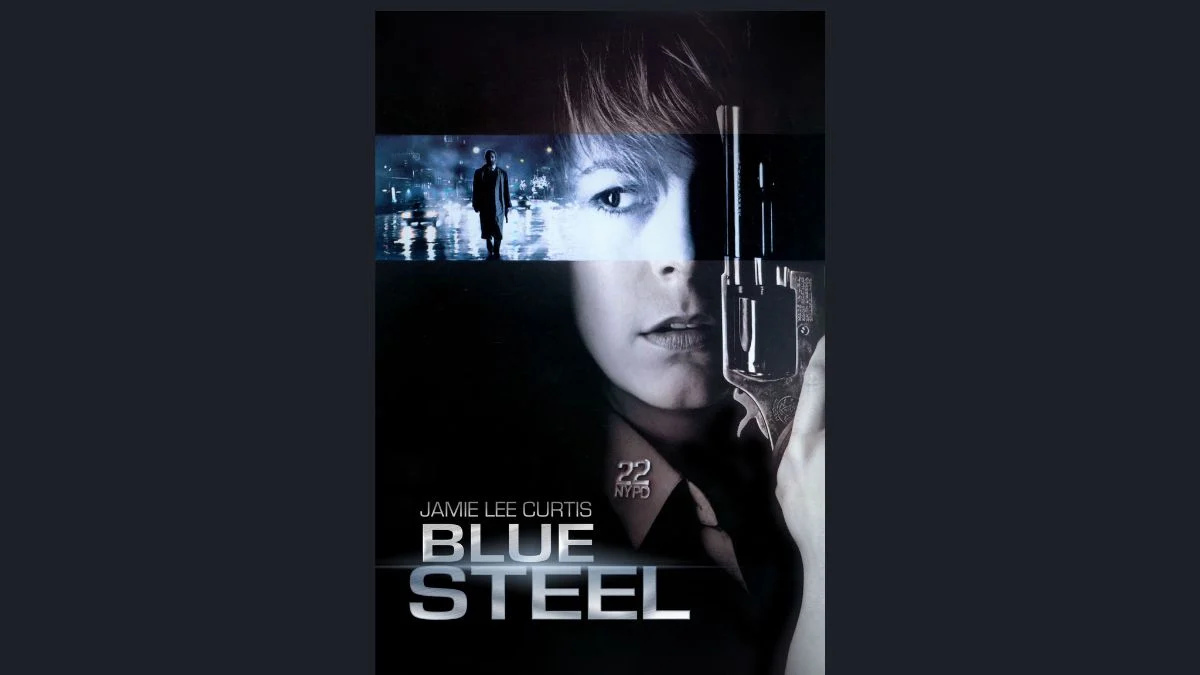
In an era dominated by superhero franchises and prestige streaming dramas, some films quietly wait for rediscovery. That rediscovery moment has officially arrived for Blue Steel (1990) — the gritty neo-noir action thriller directed by Kathryn Bigelow and starring Jamie Lee Curtis as a rookie NYPD officer pushed to her psychological limits.
On February 28, 2026, a Collider article by Jake Hodges reignited interest in the film, calling it Curtis’s “underrated ‘Jessica Jones’ predecessor” and spotlighting its arrival on Plex this March as a “fresh streaming home.”
For UK and US audiences alike, that headline isn’t just clever — it’s accurate. Long before streaming antiheroines dominated Netflix, Blue Steel was already exploring trauma, obsession, misogyny, and female resilience in a dark, dangerous New York City.
And now, more than 35 years later, it feels startlingly modern.
Why Blue Steel Is Trending in 2026: The ‘Jessica Jones’ Comparison Explained
When critics compare Blue Steel to Jessica Jones, they’re not talking about superpowers — they’re talking about tone, trauma, and feminist grit.
The 2015 Netflix series, starring Krysten Ritter, introduced audiences to a flawed female protagonist navigating a noir-inspired New York while confronting a manipulative, predatory villain.
But Blue Steel did it first.
In 1990.
Twenty-five years earlier, Curtis’s Megan Turner was battling:
- Institutional sexism in the NYPD
- A wealthy, psychopathic stalker
- Trauma rooted in domestic abuse
- Gun culture and male obsession
- A city that feels both empowering and isolating
Both stories center on women fighting to reclaim agency from powerful men who weaponize obsession. In Blue Steel, that man is Eugene Hunt. In Jessica Jones, it’s Kilgrave. The thematic DNA is undeniable.
The difference? Bigelow’s lens predates the streaming era — and arguably paved the way for it.

Blue Steel (1990): Full Movie Overview & Official Details
Before diving deeper, here’s a quick reference guide to the film’s key facts.
| Category | Details |
| Title | Blue Steel |
| Release Year | 1990 |
| Director | Kathryn Bigelow |
| Writers | Kathryn Bigelow & Eric Red |
| Producers | Edward R. Pressman & Oliver Stone |
| Cinematography | Amir Mokri |
| Music | Brad Fiedel |
| Runtime | 102 minutes (1h 42m) |
| Rating | R |
| Genres | Action, Crime, Drama, Thriller, Neo-Noir, Psychosexual Thriller |
| Premiere | Sundance Film Festival – January 1990 |
| US Theatrical Release | March 16, 1990 (MGM) |
| Box Office | Approx. $8.2 million (domestic) |
| Rotten Tomatoes | 75% (28 reviews) |
| IMDb Rating | 5.8/10 (~20K ratings) |
| CinemaScore | B− |
Despite modest box office returns, critical consensus praised its stylish direction and performances — even if some critics felt the escalating plot strained credibility.
The Plot of Blue Steel: A Rookie Cop’s Nightmare Begins

The story opens with Megan Turner (Curtis), a rookie NYPD officer on her first day. During a supermarket robbery, she shoots and kills an armed suspect — played in an early role by Tom Sizemore.
But the gun disappears.
A wealthy commodities trader, Eugene Hunt (Ron Silver), witnessed the shooting — and secretly stole the weapon. With no recovered firearm, Megan is accused of killing an unarmed man and suspended from duty.
From there, the film shifts into psychological horror territory.
Hunt begins carving Megan’s name into bullet casings. He embarks on a killing spree. He becomes obsessed. And horrifyingly, Megan unknowingly begins dating him.
Detective Nick Mann (Clancy Brown) teams up with Megan to investigate the murders. Hunt even confesses — but is released due to lack of evidence.
What follows is a relentless descent:
- Hunt attacks Megan’s apartment
- He kills her best friend Tracy Perez (Elizabeth Peña)
- Megan arrests her abusive father (Philip Bosco) after seeing her mother (Louise Fletcher) bruised
- Hunt stalks and rapes Megan
The climax erupts into a subway shootout and Wall Street chase. Megan, wearing a stolen police uniform (after Curtis refused a nude finale rewrite), runs Hunt down with a car and fatally shoots him.
The film ends with Megan being taken for medical treatment as officers arrive — victorious, but scarred.

Kathryn Bigelow’s Feminist Neo-Noir Vision
Long before winning the Academy Award for Best Director for The Hurt Locker — becoming the first woman in history to do so — Bigelow was already redefining action cinema.
Blue Steel was only her third feature, yet it contains hallmarks she would later perfect in Point Break and Zero Dark Thirty:
- Kinetic camera work
- Urban intensity
- Obsession with power structures
- Morally complex protagonists
The film originated after Oliver Stone offered to produce anything Bigelow wanted. She developed it as a female-led twist on pursuit thrillers — what co-writer Eric Red described as “a female version of The Hitcher.”
The result? A psychosexual thriller that interrogates gun worship and male dominance as much as it delivers action.
Gun Culture, Misogyny & Trauma: Why Blue Steel Feels Ahead of Its Time
The movie’s most striking motif is its fetishistic gun imagery — close-ups of cold steel, bullets engraved with Megan’s name, the phallic symbolism of firearms as extensions of male power.
Hunt is aroused by Megan’s authority.
The NYPD doubts her competence.
The legal system releases her rapist.
The film explores:
- Institutional misogyny
- Domestic violence
- Male entitlement
- Psychological obsession
- Female resilience
In a post-#MeToo world, Blue Steel feels eerily prophetic. It portrays a woman fighting not just a villain — but a system.
Critical Reception: Underrated or Misunderstood?
The late critic Roger Ebert compared it to a “sophisticated update” of Curtis’s breakout hit Halloween, praising its “angry ideas” and fleshed-out characters.
Rotten Tomatoes’ consensus reads:
“Blue Steel’s increasingly over-the-top story beggars disbelief, but this cop drama is elevated by an appealing cast and Kathryn Bigelow’s stylish direction.”
Some critics labeled it implausible. Others called it a hidden gem.
What’s undeniable is its influence.
Where to Watch Blue Steel in March 2026 (Streaming Guide for US & UK)
As of March 2026, Blue Steel has found a “fresh streaming home” on Plex — available free with ads or via Plex Pass.
Other platforms include:
- Amazon Prime Video
- Starz
- Tubi
- Pluto TV
- The Roku Channel
- Kanopy
Rental options are also available on Apple TV and Fandango at Home.
For audiences searching “underrated 90s thrillers now streaming free,” this is the answer.
Jamie Lee Curtis in 2026: Why This Rewatch Matters Now
Curtis was transitioning from scream queen status to serious dramatic actor when she took on Blue Steel. Today, she’s enjoying another career renaissance.
In 2026, she appears in The Bear as Donna Berzatto, with Season 5 production recently wrapped. She’s also linked to a revival of Murder, She Wrote as Jessica Fletcher.
Revisiting Blue Steel offers a glimpse of Curtis between eras — before True Lies, before the modern Halloween revival, and before her Oscar-winning comeback years.
It shows the blueprint of a performer willing to be vulnerable, furious, and flawed on screen.

Final Verdict: Is Blue Steel Worth Streaming in 2026?
Absolutely.
It may not have dominated the box office in 1990. It may not have blockbuster polish. But Blue Steel delivers:
- A fearless female lead
- A chilling villain
- Stylish neo-noir direction
- Themes that feel painfully contemporary
For UK and US viewers browsing Plex this March, this is more than a nostalgic rewatch — it’s a rediscovery of a thriller that was arguably ahead of its time.
Before Jessica Jones.
Before prestige feminist thrillers.
Before Bigelow’s Oscar history.
There was Blue Steel.
And now, it’s ready to be seen again.


Leave a Reply