


Introduction: A Gothic Classic Reborn in a Fever Dream
In 2026, Wuthering Heights returned to the big screen in a bold, visually extravagant adaptation directed by Emerald Fennell and starring Margot Robbie and Jacob Elordi. Unlike traditional period dramas, this version does not simply retell Emily Brontë’s 1847 Gothic novel—it reimagines it as a sensual, nihilistic, and emotionally brutal fever dream.
Instead of focusing on the novel’s sweeping multi-generational saga, the film compresses the story into a single, obsessive romance—intensifying passion, betrayal, and psychological torment. This shift has polarized critics and fans alike, sparking debate over fidelity, artistic interpretation, and whether the adaptation honors or undermines Brontë’s original masterpiece.
This article breaks down the plot, ending, themes, cinematography, and key differences between the novel and the film, while also comparing the 2026 version with the iconic 1939 adaptation.
Wuthering Heights 2026 Plot Breakdown: A Condensed Gothic Tragedy
Emerald Fennell’s adaptation focuses almost exclusively on Catherine “Cathy” Earnshaw and Heathcliff, condensing the sprawling narrative into a tightly focused psychological and romantic tragedy.

The Origins of Heathcliff and Cathy’s Bond
The story unfolds in the late 18th-century Yorkshire moors, a harsh and isolated landscape that mirrors the emotional turbulence of its characters.
Mr. Earnshaw discovers an orphaned Heathcliff and brings him to Wuthering Heights, the Earnshaw family estate. Though the novel describes Heathcliff as dark-skinned and possibly of Romani or mixed heritage, the film downplays racial elements, focusing instead on his outsider status.
Heathcliff quickly forms a powerful bond with Cathy Earnshaw, the wild and spirited daughter of the house. Their childhood is defined by freedom, rebellion, and a near-supernatural connection—captured in the famous line:
“Whatever our souls are made of, his and mine are the same.”
The film amplifies this bond, portraying them as two halves of a single soul.
Class, Jealousy, and Betrayal
As they grow older, class differences intrude. Cathy’s brother Hindley despises Heathcliff and reduces him to a servant after their father’s death, fueling Heathcliff’s resentment and anger.
Cathy becomes entangled with Edgar Linton, a wealthy and refined neighbor from Thrushcross Grange. Edgar represents civility, wealth, and social stability—the opposite of Heathcliff’s chaotic intensity.
The film heightens sexual tension, depicting explicit encounters between Cathy and Heathcliff that are only implied in the novel. Their relationship becomes a “bodice-ripping” whirlwind of passion and heartbreak, transforming psychological yearning into physical obsession.
Heathcliff’s Revenge and Cathy’s Collapse
When Heathcliff overhears Cathy saying that marrying him would degrade her socially, he leaves and later returns as a wealthy, vengeful man.
He marries Edgar’s sister Isabella purely out of spite, triggering a chain of manipulation and cruelty. Meanwhile, Cathy marries Edgar, gaining material comfort but emotional emptiness.
Her psychological decline is depicted as a feverish spiral of hallucinations, guilt, and longing. Heathcliff’s return intensifies her torment, and the film frames their bond as destructive destiny rather than romantic fate.

Ending Explained: A Brutal Departure From the Novel
The Film’s Nihilistic Finale
The 2026 adaptation diverges sharply from Emily Brontë’s novel, ending roughly halfway through the original text.
Cathy falls into severe depression during pregnancy and suffers a miscarriage, depicted graphically with blood symbolizing finality and loss. Heathcliff arrives too late and cradles her lifeless body, pleading for her to haunt him:
“I pray one prayer—I repeat it till my tongue stiffens—Catherine Earnshaw, may you not rest as long as I am living; you said I killed you—haunt me, then!”
Childhood memories flash across the screen as Heathcliff crawls into bed with her corpse. The film ends in suffocating nihilism, offering no redemption, no afterlife reunion, and no generational continuation.
How the Novel’s Ending Differs
In the book, Cathy dies after giving birth to her daughter, Heathcliff continues his revenge for decades, and eventually dies haunted by her ghost. The next generation (young Cathy, Hareton, and Linton) finds tentative reconciliation.
By contrast, the film cuts the entire second half, stripping away Brontë’s themes of cyclical abuse and redemption.
Philosophical and Psychological Interpretation
Love as Destruction, Not Salvation
Philosophically, the film portrays love as a destructive force rather than a redemptive one. It suggests that humans are drawn to toxic relationships because they mirror internal contradictions and trauma.
The moors symbolize untamed human nature, where primal instincts collide with societal expectations, leading to inevitable ruin.

Freudian and Jungian Psychological Framework
The film also lends itself to psychological interpretation:
- Heathcliff represents the id, driven by raw emotion, desire, and revenge.
- Cathy represents the ego, balancing instinct with social reality.
- Edgar represents the superego, embodying societal order and moral constraints.
Cathy and Heathcliff function as two halves of a fractured psyche, projecting trauma and unresolved identity crises onto each other. Their love becomes psychological consumption rather than healing.
Cinematography and Visual Style Analysis
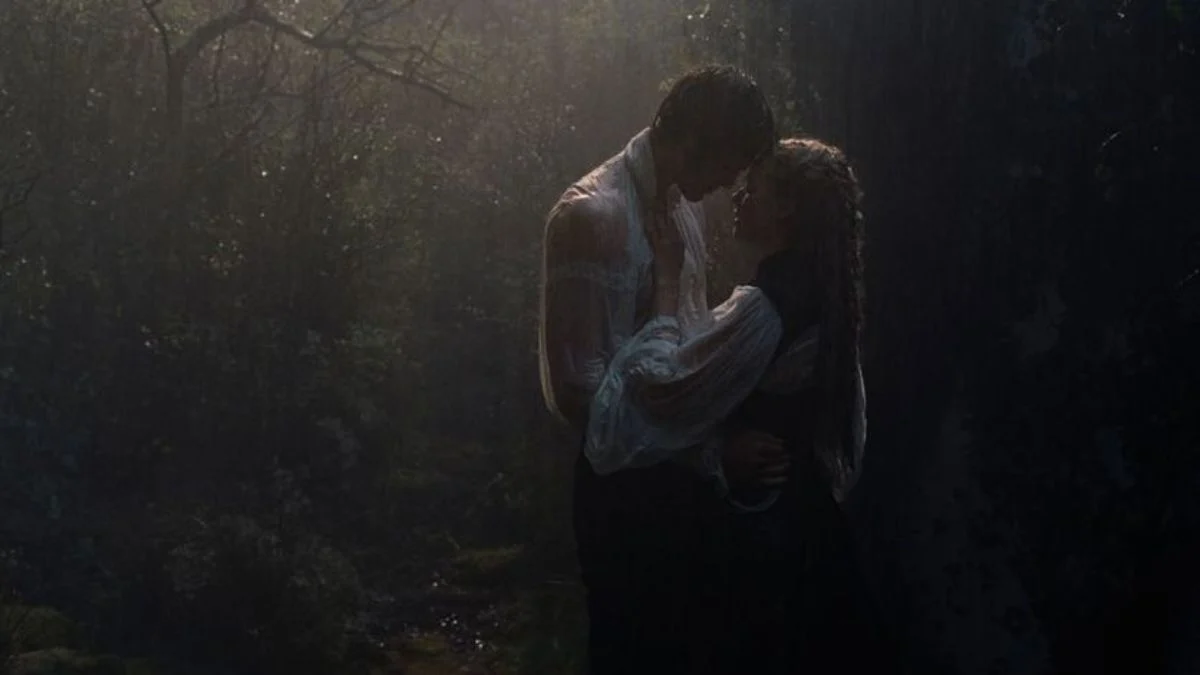
Linus Sandgren’s cinematography is one of the film’s most praised aspects. Shot on 35mm VistaVision, the film features:
- High contrast lighting and deep reds
- Fog-filled Gothic landscapes
- Oppressive interiors resembling a “brutalist dollhouse”
- Sensual close-ups and hallucinatory sequences
Suzie Davies’ production design and Jacqueline Durran’s costumes reject strict period accuracy in favor of symbolic flair. Charli XCX’s score blends gothic orchestral swells with modern tracks, giving the film a music-video-like aesthetic.
While visually stunning, some critics argue the excess prioritizes style over substance.
Novel vs Movie: Major Drawbacks of the 2026 Adaptation
| Aspect | Novel (1847) | 2026 Film | Major Drawback |
| Scope | Two generations, cyclical abuse, redemption | Ends with Cathy’s death | Loses epic scale and moral complexity |
| Ending | Heathcliff haunted, next generation reconciles | Nihilistic death with no closure | Removes hope and thematic resolution |
| Themes | Social prejudice, cruelty, revenge | Focus on romance and obsession | Downplays social critique |
| Character Depth | Complex racial and social dynamics | Simplified, modernized | Reduced complexity |
| Sensuality | Subtle metaphysical longing | Explicit sexual scenes | Shifts focus from psychological to physical |
| Fidelity | Grim, morally ambiguous | Style-driven reinterpretation | Feels superficial to purists |
Wuthering Heights 1939 vs 2026: A Comparative Analysis
Key Similarities
- Both adaptations focus only on the first generation.
- Both romanticize Cathy and Heathcliff’s doomed love.
- Both cast white leads despite ambiguous racial descriptions in the novel.

Key Differences Between the Adaptations
| Aspect | 1939 Adaptation | 2026 Adaptation | Implications |
| Tone | Classic gothic romance | Psychedelic, sensual, modern | 2026 is more provocative |
| Explicitness | Subtle and implied | Explicit sexual content | More visceral but less metaphysical |
| Ending | Ghostly reunion, romantic closure | Nihilistic devastation | 2026 rejects redemption |
| Cinematography | Black-and-white classic Hollywood | Colorful, hallucinatory visuals | Sensory overload vs poetic restraint |
| Fidelity | Softened but respectful | Highly reinterpretive | Divisive among purists |
Why the 2026 Adaptation Is So Controversial
The film’s controversy stems from three main issues:
- Narrative Truncation – Cutting the second half removes Brontë’s deeper themes.
- Explicit Sensuality – Modern sexuality shifts the story’s focus.
- Style Over Substance – Critics argue visuals overshadow narrative depth.
Fans praise its audacity and emotional intensity, while purists criticize its lack of fidelity.
Official Film Details Table
| Category | Details |
| Director | Emerald Fennell |
| Release Year | 2026 |
| Lead Cast | Margot Robbie (Cathy), Jacob Elordi (Heathcliff), Shazad Latif (Edgar) |
| Cinematographer | Linus Sandgren |
| Runtime | ~136 minutes |
| Genre | Gothic Romance / Psychological Drama |
| Setting | Late 18th-century Yorkshire moors |

Final Verdict: Masterpiece or Misinterpretation?
Emerald Fennell’s Wuthering Heights (2026) is not a faithful adaptation—it is a personal reinterpretation. It transforms Brontë’s grim, morally complex novel into a stylized, sensual, nihilistic tragedy that prioritizes emotional intensity over social critique.
For modern audiences, the film offers a visually stunning, emotionally raw experience. For literary purists, it may feel incomplete, superficial, and unfaithful to the source material.
Ultimately, the 2026 adaptation stands as a bold cinematic experiment—a fever dream of obsession, trauma, and doomed love that invites debate about what adaptation truly means.


Leave a Reply