

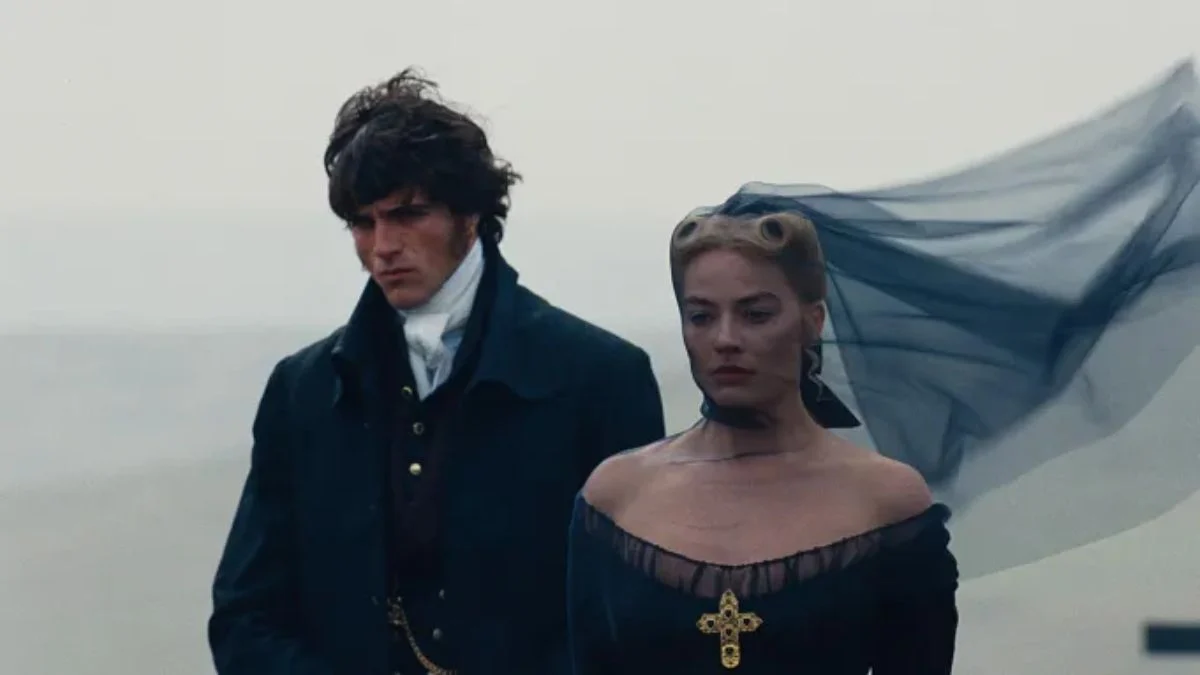
Emerald Fennell has never been a filmmaker interested in playing it safe. From the razor-sharp revenge fantasy of Promising Young Woman to the decadent psychological provocation of Saltburn, she has built a reputation for reworking familiar genres into something unnerving, stylish, and culturally combustible. With her 2026 film “Wuthering Heights”, Fennell takes on one of the most revered novels in English literature—and intentionally places quotation marks around the title to signal that what audiences are getting is not a museum-piece adaptation, but her own emotional, sensual response to Emily Brontë’s 1847 classic.
Released for Valentine’s Day weekend in February 2026, the film quickly became one of the most talked-about projects of the year. Praise, backlash, fascination, and outrage have surrounded it in equal measure. Some viewers hail it as a bold reinvention of Gothic romance, while others accuse it of distorting the spirit of the novel for shock and spectacle. Either way, Fennell’s “Wuthering Heights” is no quiet literary exercise—it is a cultural event.
This article offers a detailed overview of Emerald Fennell’s “Wuthering Heights” (2026), including cast, plot, production, release timeline, controversies, and the most important differences between the film and Emily Brontë’s novel, all revealed gradually so the story of the film unfolds as you read.
What Makes Emerald Fennell’s “Wuthering Heights” (2026) Different?
Unlike traditional period adaptations, Fennell’s version is designed as a reimagining rather than a literal translation of the book. She has publicly described the film as her response to how Wuthering Heights felt when she read it as a teenager—primal, obsessive, emotional, and dangerous—rather than a scene-by-scene reconstruction.
The quotation marks in the title, “Wuthering Heights,” are intentional. They emphasize that this is Fennell’s interpretation of Brontë’s work, filtered through a modern cinematic lens that blends Gothic atmosphere with provocative sensuality and contemporary style.
Produced by LuckyChap Entertainment (Margot Robbie’s company), MRC, and Lie Still, the film carries a reported $80 million budget. Principal photography took place largely on the Yorkshire moors, capturing the bleak landscapes that made the novel iconic. Warner Bros. Pictures distributed the film, positioning it as both prestige drama and high-profile pop-culture release.

Emerald Fennell’s “Wuthering Heights” Release Date and Production Timeline
The project moved quickly from announcement to cultural lightning rod. Below is a table summarizing key official milestones.
| Time / Period | Event | Official Details |
| July 2024 | Project announced | Fennell reveals “Wuthering Heights” as her follow-up to Saltburn. |
| 2025 (Spring–Fall) | Casting revealed | Margot Robbie, Jacob Elordi, and ensemble announced, sparking online debate. |
| Late 2025 | Filming wraps | Principal photography completed on the Yorkshire moors. |
| September 2025 | Trailer released | Erotic, stylized trailer goes viral and fuels controversy. |
| Feb 11, 2026 | Early premiere | Select international markets screen the film. |
| Feb 13, 2026 | Wide U.S. release | Warner Bros. releases the film for Valentine’s Day weekend. |
The timing was deliberate. Releasing a dark romantic drama on Valentine’s Day positioned the film as both seductive and subversive, challenging traditional ideas of cinematic romance.
“Wuthering Heights” (2026) Cast and Characters Explained
Fennell assembled a cast that mixes Hollywood power with rising talent, while reinterpreting classic characters.
- Margot Robbie as Catherine “Cathy” Earnshaw (adult) – A free-spirited, commanding heroine torn between desire and social ambition.
- Charlotte Mellington as Young Catherine Earnshaw – Captures Cathy’s feral childhood energy.
- Jacob Elordi as Heathcliff (adult) – The brooding outsider whose love for Cathy turns into obsession and revenge.
- Owen Cooper as Young Heathcliff – Shows Heathcliff’s vulnerability before bitterness takes hold.
- Hong Chau as Nelly Dean – The household’s watchful narrator figure, grounding the chaos emotionally.
- Vy Nguyen as Young Nelly Dean – Reflects Nelly’s formative years within the Earnshaw home.
- Shazad Latif as Edgar Linton – Cathy’s refined, socially respectable husband.
- Alison Oliver as Isabella Linton – Edgar’s sister, drawn into Heathcliff’s schemes.
- Martin Clunes in a supporting role – Likely Mr. Earnshaw or another patriarchal presence.
- Ewan Mitchell in a supporting role – Possibly Hindley Earnshaw, Cathy’s abusive brother.
Fennell described Robbie as possessing “otherworldly power,” while calling Elordi a “surprising actor” who matched her childhood image of Heathcliff.

Plot Summary of Emerald Fennell’s “Wuthering Heights” Film
Set against the bleak, windswept Yorkshire moors of 18th-century England, the story begins when Mr. Earnshaw adopts a mysterious orphan boy named Heathcliff and brings him to the isolated estate known as Wuthering Heights. The outsider quickly forms an intense bond with Earnshaw’s daughter, Catherine, and together they roam the landscape in untamed freedom.
But this freedom is fragile. Heathcliff is treated as inferior due to his ambiguous origins and dark features. Catherine’s brother Hindley abuses him, and class prejudice steadily pushes Heathcliff to the margins of the household. Childhood intimacy gives way to social reality.
As adults, Catherine faces a devastating choice. She loves Heathcliff, yet she marries Edgar Linton, a wealthy and respectable neighbor, believing social security will protect her future. To Heathcliff, the decision is betrayal. He vanishes from the moors, only to return years later transformed—wealthy, controlled, and burning with revenge.
His return destabilizes everything. He manipulates Edgar, seduces circumstances, and marries Edgar’s sister Isabella not out of affection, but as a calculated strike. When Heathcliff and Catherine reunite, their connection becomes destructive rather than healing—an all-consuming affair driven by desire, jealousy, and emotional cruelty.
Fennell’s version leans heavily into obsession, power, and intimacy, framing the love story as something toxic yet magnetic. The narrative unfolds largely through Nelly Dean’s perspective, giving the chaos emotional context while never fully excusing it.

Erotic Style and Modern Sensibility in “Wuthering Heights” (2026)
One of the most discussed aspects of Emerald Fennell’s “Wuthering Heights” is its tone. Trailers showcase provocative imagery—blindfolded encounters, symbolic domestic intimacy like dough-kneading, and death scenes stylized almost like seduction.
Fennell describes the relationship between Cathy and Heathcliff as “primal,” “sexual,” and “sado-masochistic.” Where Brontë’s novel suggests passion psychologically, the film externalizes it visually. This stylistic choice has led to both admiration and criticism.
Rumors also circulated about a contemporary-influenced soundtrack, including Charli XCX, adding a modern edge to a period story and reinforcing Fennell’s refusal to treat the material as purely historical.
Controversy Surrounding Emerald Fennell’s “Wuthering Heights” Film
From casting announcements to marketing strategy, controversy followed the project long before release.
1. Whitewashing Heathcliff
In Brontë’s novel, Heathcliff is described as “dark-skinned,” possibly Romani, South Asian, or mixed-race, with racism shaping his outsider identity. Casting white Australian actor Jacob Elordi triggered backlash.
Fennell defended the choice by saying Elordi resembled the illustration she first associated with Heathcliff, while critics argued this erases a core theme of racial exclusion.

2. Aging Up Catherine
Catherine is a teenager in the book, dying young. Casting Margot Robbie, in her 30s, reframes the story as adult erotic obsession rather than youthful innocence corrupted by society. Supporters praise the chemistry; detractors say it changes the emotional arc.
3. Eroticism and Romanticization
Marketing emphasized sensuality, leading to claims the film turns tragedy into “Victorian erotica.” Some see bold reinvention; others see romanticization of abuse.
4. Deviations From the Source
The quotation marks, modern soundtrack influences, costume liberties, and focus on shock led critics to accuse the film of rage-baiting for younger audiences rather than honoring literary complexity.
Despite the backlash, book sales of Wuthering Heights reportedly surged after the trailer release, showing renewed interest in Brontë’s work.
Emily Brontë’s Novel vs Emerald Fennell’s “Wuthering Heights” (2026)
Fennell’s film does not simply adapt—it transforms. The biggest differences lie in tone, scope, and identity.
| Aspect | Emily Brontë’s Novel (1847) | Emerald Fennell’s Film (2026) |
| Tone | Gothic tragedy of obsession and revenge | Erotic, primal, stylized reimagining |
| Character Ages | Teen protagonists | Mature adult passion |
| Heathcliff’s Identity | Dark-skinned, racially ambiguous outsider | White casting, racial themes reduced |
| Scope | Multi-generational saga | Focus on first-generation romance |
| Erotic Content | Implicit, psychological | Visually sensual and provocative |
| Themes | Class, racism, cruelty, generational trauma | Emotional obsession and shock aesthetics |
The novel ends with partial redemption through the younger generation. Fennell’s version centers far more on the tragic magnetism of Cathy and Heathcliff themselves.
Early Reception and Cultural Impact of “Wuthering Heights” (2026)
By February 2026, reactions to Emerald Fennell’s “Wuthering Heights” were sharply divided. Supporters called it “singular,” “intoxicating,” and fearless in its visual ambition. Critics labeled it “style over substance,” accusing it of simplifying Brontë’s layered tragedy into provocative spectacle.
Yet the film undeniably dominates cultural conversation. Social platforms, press tours, and promotional buzz turned it into one of the most debated literary adaptations in years.

Final Thoughts on Emerald Fennell’s “Wuthering Heights” Film
Emerald Fennell’s “Wuthering Heights” (2026) is less a traditional adaptation and more a cinematic argument about obsession, power, and desire. It refuses safety, embraces discomfort, and deliberately unsettles expectations around a literary classic.
For purists, it may feel like a distortion. For adventurous viewers, it becomes a provocative re-encounter with Brontë’s emotional core. Either way, Fennell’s film proves that Wuthering Heights is still alive—not as a relic, but as a story capable of igniting fierce debate nearly two centuries after it was written.
In an era where many adaptations aim for comfort, Emerald Fennell’s “Wuthering Heights” chooses confrontation, ensuring that audiences don’t simply watch it—they argue with it long after the screen fades to black.


Leave a Reply