


Introduction: A Hidden Tragedy Behind One of Horror’s Most Infamous Windows
For decades, fans of Rosemary’s Baby remembered Terry Gionoffrio as a mysterious, tragic footnote—a troubled young woman who jumped from a New York apartment window after briefly befriending Rosemary Woodhouse. But Apartment 7A (2024) transforms that brief moment into a haunting psychological horror epic, revealing that Terry’s death was not random, accidental, or meaningless.
Instead, it was the final act of defiance in a sinister Satanic conspiracy decades in the making.
Directed by Natalie Erika James, Apartment 7A serves as an explicit prequel to Roman Polanski’s 1968 masterpiece and Ira Levin’s novel, expanding the universe of the Bramford apartment building and exposing a terrifying backstory that reshapes the original film’s mythology.This article breaks down the complete storyline, major plot points, themes, and connections to Rosemary’s Baby—unfolding the horror slowly, just as the film does.
Apartment 7A (2024) Plot Summary
The Setting: New York City, 1965
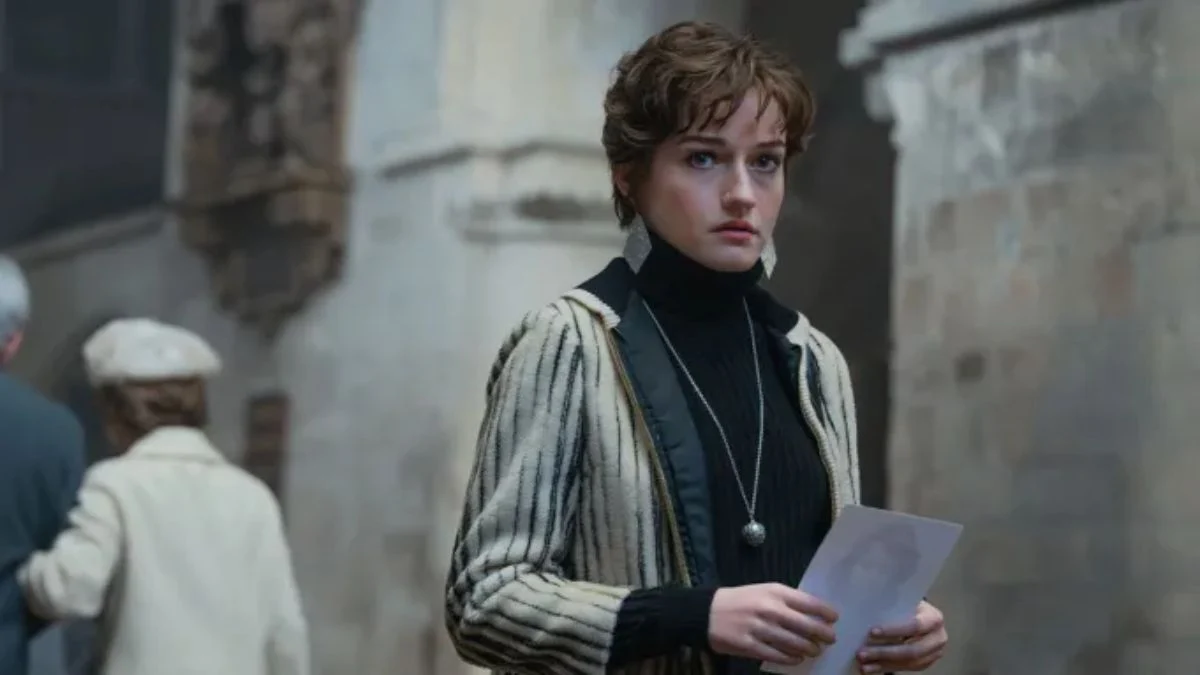
The film takes place in 1965 New York City, three years before Rosemary’s Baby. The story centers on Terry Gionoffrio, played by Julia Garner—an ambitious young dancer from Nebraska chasing Broadway fame.
Her life takes a devastating turn during a performance when she suffers a severe ankle injury mid-jump, earning her the humiliating nickname “the girl who fell.” The injury derails her career, and painkillers become her emotional and physical crutch.
Auditions reject her. Directors lose interest. Her dreams fade.
And desperation sets in.
A Fateful Encounter at the Bramford
In her darkest moment, Terry follows Broadway producer and director Alan Marchand (Jim Sturgess) to the Bramford apartment building, the same iconic setting from Rosemary’s Baby.
There, she meets the elderly and wealthy couple:
- Minnie Castevet (Dianne Wiest)
- Roman Castevet (Kevin McNally)
They appear kind, nurturing, and generous—offering Terry a rent-free apartment and promising to revive her career through their powerful connections.
At first, they seem like saviors.
But the Bramford is never what it seems.

The Miracle and the Warning Signs
Soon after moving in, Terry’s injured foot mysteriously heals—far faster than medically possible. Her career prospects suddenly improve. She gets promising auditions and renewed confidence.
But the miracle comes with a price.
Strange things begin happening:
- Hallucinations
- Unexplained bruises
- Visions of a demonic figure
- Nightmares blending with reality
She discovers a hidden passage connecting apartments, along with a book filled with Satanic rituals and occult imagery. The building itself seems alive with secrets.
The Castevets’ kindness begins to feel like surveillance.
The Ritual: A Broadway Nightmare in Sequins
During a glamorous “cocktail party” at Marchand’s apartment, Terry is drugged and subjected to a Satanic ritual.
In hallucinatory, Broadway-style surreal sequences, she is raped by the Devil, portrayed as a decaying yet sequined demonic figure—a symbolic fusion of showbiz glamour and corruption.
She becomes pregnant with Satan’s child—the Antichrist.
The coven reveals that Terry is not the first young woman they tried to use, but she is the first successful pregnancy.
Their plan has been decades in the making.
The Horrifying Truth: A Coven in Plain Sight
Terry realizes the Castevets are part of a Satanic cult operating within the Bramford, manipulating careers, lives, and bodies to usher in the birth of Satan’s son.
Key elements of the coven’s plan include:
- Drugging young women
- Ritual impregnation by Satan
- Occult talismans (including the tannis root necklace)
- Demonic visions and psychological manipulation
- Long-term planning to birth the Antichrist
Unlike Rosemary’s Baby, which kept supernatural elements ambiguous, Apartment 7A makes the Satanic horror explicit and visual.

The Failed Escape: Abortion and Confrontation
Determined to reclaim her body and destiny, Terry attempts an abortion. But an invisible demonic force attacks the provider, preventing the procedure.
She confronts the cult and threatens suicide to kill the baby, but the entity physically stops her.
Her agency is stripped away. Her body is no longer her own.
The Final Act: Dance, Defiance, and Death
In the climax, the coven celebrates Terry as the mother of Satan’s child. She performs a dramatic dance—a symbolic expression of her lost dreams and entrapment.
Then, in a devastating act of resistance, she leaps from a window, sacrificing herself to prevent the birth of the Antichrist.
Her death is no longer meaningless—it is a tragic act of rebellion.
Post-Credits Scene: Rosemary Arrives
The film ends with a chilling post-credits scene showing Rosemary and Guy Woodhouse viewing an apartment at the Bramford.
The coven failed with Terry.
They won’t fail again.
Key Plot Structure of Apartment 7A
| Act | Key Events | Significance |
| Act 1 | Terry’s dance career, injury, meeting the Castevets | Establishes ambition and vulnerability |
| Act 2 | Moving into Bramford, career revival, occult discoveries | Rising dread and mystery |
| Act 3 | Ritual impregnation, failed abortion, cult reveal, suicide | Tragic defiance and direct prequel bridge |
How Apartment 7A Connects to Rosemary’s Baby
In Rosemary’s Baby, Terry appears briefly as a recovering addict who soon dies after meeting Rosemary. The Castevets describe her as a “poor lost girl.”
Apartment 7A reframes that narrative completely:
- Terry was not just troubled—she was the coven’s first successful vessel.
- Her suicide was an intentional sacrifice to stop the Antichrist.
- The coven failed with her but succeeded with Rosemary soon after.
- The Bramford’s occult history is expanded and confirmed.
This prequel deepens the horror of the original film, revealing that Rosemary’s fate was premeditated.
Satanic Horror and Occult Themes Explained
Explicit Satanism
The film features:
- Ritual ceremonies
- Occult texts and talismans
- Demonic hallucinations
- The Devil appearing physically
- A coven operating inside elite society
Unlike the original’s ambiguity, the supernatural here is undeniable.
The Covens’ Long-Term Plan
The Satanists have tried for years to birth the Antichrist. Terry is their first success, but her death delays the prophecy—until Rosemary.
Major Themes Shared with Rosemary’s Baby
1. Paranoia and Gaslighting
Terry, like Rosemary, is dismissed and manipulated, making her doubt reality. The film critiques how women’s fears are ignored by society.
2. Loss of Bodily Autonomy
Terry is drugged, raped, and forced into pregnancy—echoing real-world fears of reproductive coercion and patriarchal control.
3. Patriarchy and Ambition
Alan Marchand and the coven represent a Faustian bargain: women’s bodies traded for male success. Domesticity becomes a horror trap.
4. Urban Isolation
The Bramford’s claustrophobic setting mirrors fears of urban anonymity, where evil hides in plain sight.
5. Performance and Moral Compromise
Broadway and acting symbolize ambition. Success comes at a moral and literal bodily cost.
Why Apartment 7A Changes Rosemary’s Baby Forever
By giving Terry a full narrative, the film recontextualizes the original story:
- Terry becomes a tragic heroine rather than a footnote.
- The coven’s conspiracy is larger and more organized.
- Rosemary’s pregnancy becomes part of a planned generational prophecy.
- The Bramford’s evil history becomes canonically expanded.
It transforms a psychological horror classic into a broader occult saga.

Critical Reception and Cultural Impact
Apartment 7A has been analyzed by critics and publications such as Wikipedia, IMDb, Collider, Decider, ScreenRant, Roger Ebert, and Variety, all noting how it expands the original’s themes while making the supernatural explicit.
The film modernizes feminist horror discussions, focusing on agency, ambition, and exploitation in entertainment industries.


Leave a Reply