


Introduction: Why The Wailing Still Haunts Viewers Worldwide
Released in 2016, The Wailing (Gokseong), directed by Na Hong-jin, stands as one of the most disturbing and intellectually unsettling Korean horror films ever made. With an IMDb rating of 7.4, the film has earned global acclaim not because it answers questions—but because it refuses to.
Unlike conventional horror movies that clearly define good and evil, The Wailing traps its audience in uncertainty. Every explanation is later contradicted. Every truth collapses into doubt. Even Na Hong-jin himself has publicly stated that there is no single correct interpretation, and viewers are free to form their own conclusions.
At its core, The Wailing is not just a horror story—it is a meditation on faith, fear, paranoia, grief, and human weakness. What follows is a complete, verified, spoiler-filled breakdown of the film’s storyline, its layered symbolism, and its haunting ending.
In This Post:

The Wailing Movie Plot Overview: A Village Descends Into Madness
The story takes place in Gokseong, a quiet rural mountain village in South Korea. Life here is slow, communal, and deeply traditional—until an inexplicable illness begins to spread.
People develop boils filled with pus, descend into violent insanity, murder their own families, and eventually die or destroy themselves. Rumors, fear, and superstition spread faster than reason.
At the center of the story is Jong-goo, a local police sergeant—an unlikely hero, deeply flawed, fearful, and emotionally unprepared for what unfolds.
Opening Scene Explained: The Fisherman and the Worm

The film opens with an eerie and deceptively simple image:
A Japanese man sits quietly beside a river, fishing. He places a worm on his hook.
The scene cuts abruptly.
This moment, seemingly insignificant, becomes one of the film’s most important metaphors. Later, a shaman explains that the demon hunts randomly, like fishing, using bait without knowing who will bite. From the very first frame, the film tells us:
victims are not chosen for who they are—but for their vulnerability.
Introducing Jong-goo: A Flawed Protector

The next morning, we meet Jong-goo, a bumbling, overweight police officer awakened by news of a murder. He is married, has a young daughter named Hyo-jin, and lives with his wife and mother-in-law.
Jong-goo is not heroic. He is passive, often incompetent, and fearful under pressure. These personal flaws are not incidental—they are crucial to the film’s moral structure.
The First Murder Case: Boils, Blank Eyes, and Brutality

At the crime scene, Jong-goo encounters a horrifying sight.
The killer—already apprehended—is covered in boils, his eyes vacant, his mind seemingly absent. He appears unaware of his actions.
The victims include his entire family. His wife’s body was dragged from another location and stabbed around 20 times.
When Jong-goo investigates the original murder site, he notices something strange:
dried flowers tied together with thread.
At this stage, no one knows what they mean. But they will return—fatally—later.
The Japanese Stranger and Growing Suspicion
Back at the police station, Jong-goo’s partner recounts a disturbing rumor told by a local hunter. The hunter claims he once saw a Japanese man in the forest, half-naked, eating raw deer meat, with glowing red eyes.
Jong-goo dismisses the story, suggesting wild mushrooms or superstition.
Then the lights go out.
Outside the station window, Jong-goo sees a naked woman staring back at him. Terrified, he screams. When he rushes outside, she has vanished.
From this point onward, Jong-goo begins having nightmares—and the boundary between reality and fear starts to dissolve.
The Burning House and the Ash-Covered Woman
Another tragedy strikes: a house burns down completely. Jong-goo arrives at the scene visibly shaken.
Suddenly, a woman known as Ajumma, her face blackened with ash, attacks him. Jong-goo panics and screams hysterically, humiliating himself as a police officer.
Later, he realizes the naked woman he saw earlier was actually Ajumma.
The next day, Ajumma is found hanging from a tree. Witnesses insist she was normal before encountering the Japanese man.
Like the other victims, her body is covered in boils.
A pattern becomes undeniable:
- Boils appear
- Victims turn violent
- Families are slaughtered
- The victim dies
- The Japanese man is always nearby

The Woman in White: A Warning Without Answers
While guarding the crime scene, Jong-goo encounters a young woman dressed entirely in white. She calmly explains how Ajumma killed the family in the burned house, claiming she witnessed everything.
She tells Jong-goo something chilling:
The Japanese man is a ghost that drinks human blood. If you see him repeatedly, you have been marked.
Before Jong-goo can ask more, she disappears.
Soon after, Jong-goo begins dreaming of the Japanese man devouring raw meat—visions that feel less like dreams and more like intrusions.
When Horror Becomes Personal: Hyo-jin Falls Ill
The nightmare turns personal when Hyo-jin, Jong-goo’s daughter, begins behaving strangely. She develops rashes, convulsions, and sudden aggression.
Jong-goo visits the hunter again, who insists the Japanese man is not human.
Driven by fear, Jong-goo, his partner, and his partner’s nephew—an assistant pastor fluent in Japanese—visit the stranger’s house.
Inside, they find occult books, ritual objects, demon statues, and most horrifying of all:
photographs of people who recently died.
In another room, Jong-goo’s partner discovers his daughter’s shoe.
Hyo-jin has been marked.
Possession Confirmed: A Child Turns Against Her Father

At home, Jong-goo confronts his daughter. She admits meeting the Japanese man.
Suddenly, she erupts—calling her father a loser, mocking him with cruel accuracy. This language is entirely out of character.
Jong-goo later finds demonic drawings in her notebook and discovers boils on her thighs.
That night, she threatens to kill him.
The horror is no longer external. It lives inside his home.
The Exorcism Ritual: Two Forces Collide
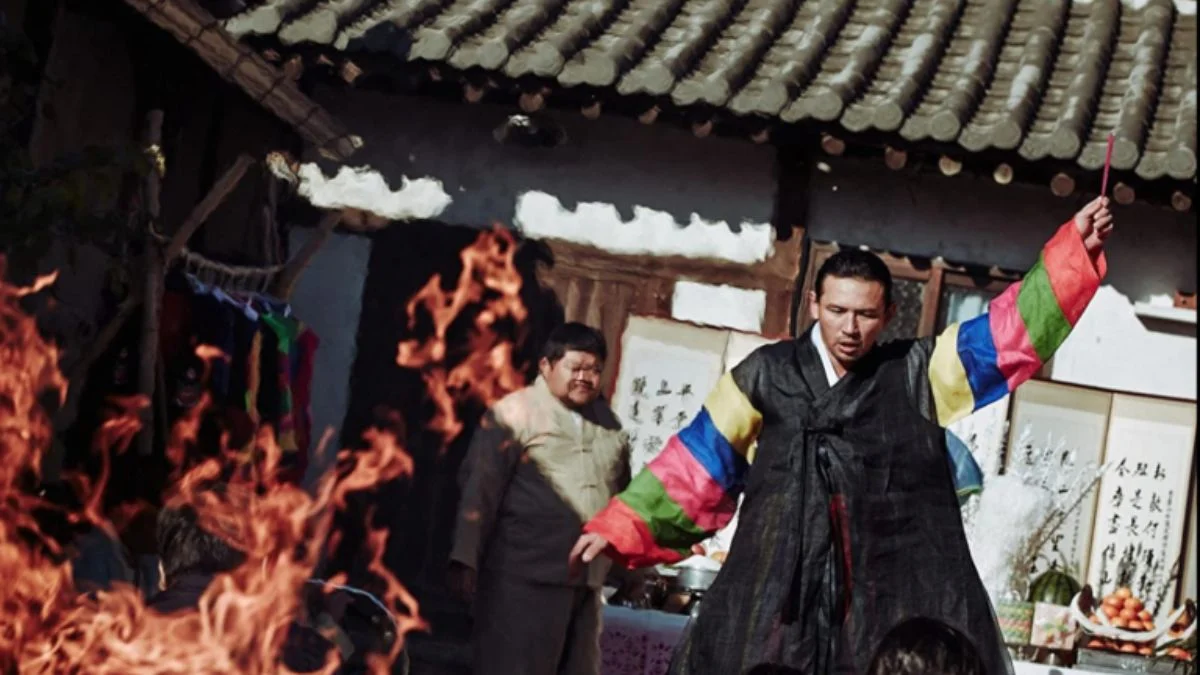
A famous shaman named Il-gwang is summoned. He confirms Hyo-jin is possessed and explains that the Japanese man is a wild ghost who hunts randomly, like fishing.
Il-gwang performs an elaborate ritual using white chickens, animal sacrifices, drums, and chanting.
At the same time, the Japanese man performs a dark ritual using black chickens.
As nails are driven into wood, both Hyo-jin and the Japanese man scream in pain. The stranger appears near death.
Unable to bear his daughter’s suffering, Jong-goo interrupts the ritual.
This single act becomes the film’s point of no return.
The Great Reversal: Who Is the Real Demon?
Later, Il-gwang claims he made a terrible mistake. He insists the woman in white is the real demon, and the Japanese man was actually trying to stop her.
Panic reaches its peak.
The woman in white warns Jong-goo:
Do not enter your house until the rooster crows three times, or the protective trap will break.
This echoes the biblical story of Peter denying Jesus three times—a test of faith.
Confused, frightened, and manipulated, Jong-goo ultimately returns home anyway.

Decoding Key Events
The film’s events are deliberately ambiguous, blending Korean shamanism, Christianity, and folklore to create paranoia and misdirection. Here’s a breakdown:
- The Infection and Possessions: Not a virus but a demonic curse. The stranger (demon) uses personal items (e.g., shoes, clothes) to target victims, causing rashes and madness. Victims kill loved ones, then the demon or Il-gwang photographs the dead to “reap” souls. This is systematic soul collection, like a fisherman casting random bait.
- The Stranger’s Identity: He’s the primary demon, possibly a fallen shaman or monk possessed by evil. He survives apparent death via soul transference (e.g., swapping with zombie-like victims like Park Choon-bae). His red eyes, deer-eating, and shrine confirm his supernatural nature.
- Il-gwang’s Role: Initially a helper, he’s the demon’s accomplice. His rituals weaken Moo-myeong’s protections, allowing possessions. The locust swarm is the demon calling him back. His photography is key to soul-harvesting.
- Moo-myeong’s Identity: A good guardian spirit or shaman in white (contrasting the demon’s darkness). She sets protective traps (dried flowers) and throws stones to warn people away from evil. She collects victims’ items to protect their souls posthumously. Her test of Jong-goo’s faith echoes biblical trials.
- Rituals and Symbols: The dual rituals (Il-gwang vs. stranger) are a battle of good vs. evil forces. Rooster crows reference Peter’s denial (doubt leading to downfall). Locusts and stigmata draw from Christianity. Zombies are temporary vessels for the demon’s escape.
- Jong-goo’s Sins: His violence (killing the stranger), and lack of faith doom his family. Killing the stranger (actually a bait body) is a moral trap, staining his soul and breaking protections.
These elements create reversals: characters’ alignments flip, building distrust and ambiguity.
The Tragic Ending Explained: Faith Shattered, Evil Unleashed
Inside the house, Jong-goo finds his wife and mother-in-law brutally murdered.
Hyo-jin, fully possessed, attacks him with a knife, fatally wounding him.
Outside, the woman in white watches in devastation.
Meanwhile, the Japanese man reveals his true demonic form, complete with red eyes and stigmata, photographing the assistant pastor before killing him.
The next morning, Il-gwang arrives, calmly photographs the dead family, and places the images into a box already filled with photos of previous victims.
The truth is revealed:
Il-gwang and the Japanese demon were working together all along, harvesting souls through photography.
Jong-goo dies, remembering happier moments with his daughter. Although Hyo-jin can still be seen sitting outside the house. she is left alive and traumatized, appearing lifeless and catatonic after the demon escapes her body.
The wailing never ends.
Interpretations vary:
- Supernatural Victory: Evil wins due to human doubt; good (Moo-myeong) is genuine but powerless without faith.
- Rational Alternative: The “infection” could be poisonous mushrooms causing hallucinations and violence, with no demons—just mass hysteria and xenophobia toward the Japanese stranger.
- Biblical Parallels: Jong-goo’s denial mirrors Peter’s, leading to crucifixion-like family destruction.
The ambiguity paralyzes viewers, mirroring the characters’ indecision.
Alternate Ending and Final Interpretation
In a deleted ending, the Japanese demon offers candy to a child while Il-gwang waits in a car. Moo-myeong watches from afar.
The cycle continues.
Whether supernatural or psychological, The Wailing leaves viewers in the same state as its characters—uncertain, terrified, and grieving.
There is no comfort.
There is no certainty.
Only the sound of wailing.

Meaning of The Wailing: Faith, Doubt, and Human Weakness
At its core, The Wailing grapples with the randomness of suffering and death, inspired by Na Hong-jin’s personal tragedies (e.g., friends’ losses). It questions “why bad things happen” without easy answers, critiquing blame-seeking in religion, outsiders, or fate. Themes include:
- Faith vs. Doubt: Blind faith (deacon) or none (Jong-goo) fails; true faith requires trust in the unknown, but humans demand proof.
- Good vs. Evil: Evil is opportunistic, exploiting sins like adultery or murder. Good offers protection but depends on cooperation.
- Parental Desperation: Jong-goo’s arc is a father’s futile quest to save his child, highlighting powerlessness.
- Cultural Elements: Blends Korean shamanism (rituals, spirits) with Christianity (Bible quotes, stigmata) and xenophobia (Japanese outsider as “other”).
- Human Flaws: Sin enables evil; the village’s collective guilt draws the demon. Grief (“wailing”) is inevitable, but acceptance brings peace over control.
The film portrays a bleak world where evil is resilient, but good persists in fighting, offering sympathy for victims amid uncertainty.
Final Thoughts
The Wailing (2016) is not meant to be solved. It is meant to be felt.
And once felt, it never truly leaves you.


Leave a Reply