

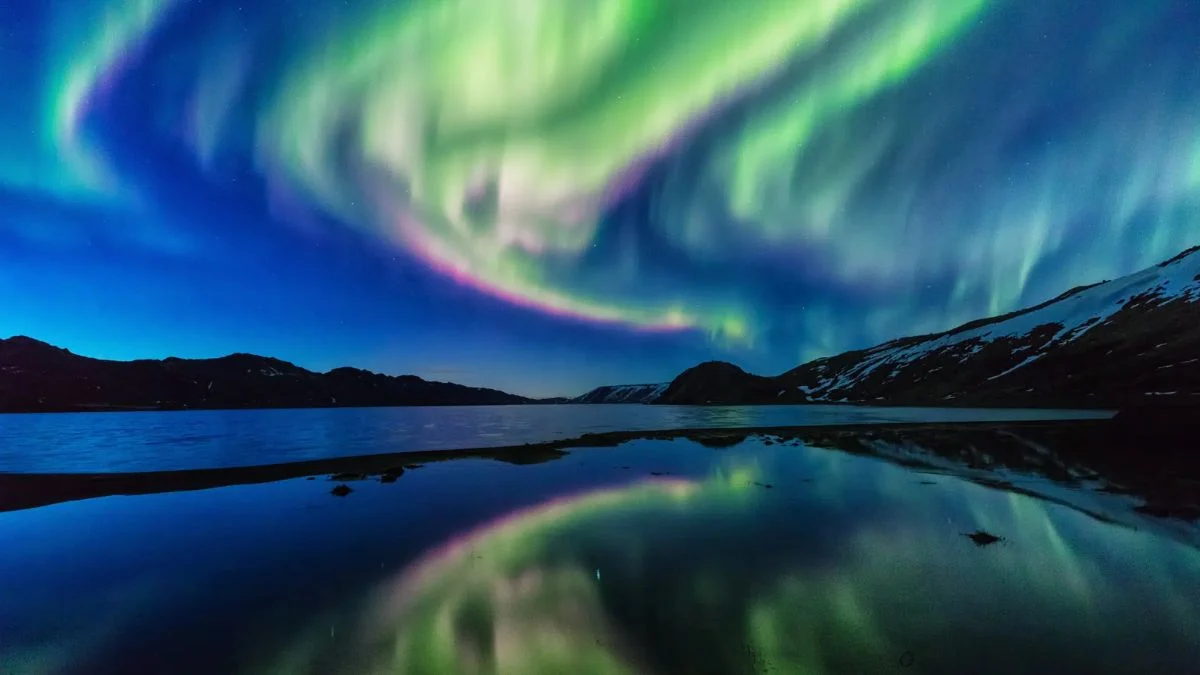
The night sky could have a surprise in store for millions of Americans as the northern lights are expected to make a possible appearance across parts of the northern United States. While the event is not forecast to be one of the strongest aurora displays in recent years, experts say the conditions may still be favorable enough for skywatchers near the Canadian border to witness the spectacular phenomenon.
According to PEOPLE, citing forecasts from the National Oceanic and Atmospheric Administration (NOAA), a minor G1 geomagnetic storm is expected to develop late on Tuesday, July 21, and continue into Wednesday, July 22. If conditions align, the aurora borealis could become visible in several northern states, although visibility will depend on factors such as cloud cover, darkness and the strength of incoming solar wind.
Skies across parts of the country have also been affected by an entirely different atmospheric phenomenon in recent weeks. To know more, read our article Why Are Skies Across the US Turning Orange? Canadian Wildfire Smoke Triggers Widespread Air Quality Alerts
NOAA Forecast: Why the Northern Lights May Be Visible Across 10 States
Unlike some of the dramatic aurora events seen over the past few years, this display is not being triggered by a powerful coronal mass ejection (CME). Instead, NOAA forecasters are tracking a large recurring coronal hole on the Sun.
According to NASA, a coronal hole is an opening in the Sun’s magnetic field that allows high-speed solar wind to stream into space. When those charged particles interact with Earth’s magnetic field, they can trigger geomagnetic activity capable of producing the northern lights.
NOAA’s Space Weather Prediction Center expects “unsettled to active conditions” beginning late on July 21, with G1 (Minor) storm levels becoming likely by July 22 as the solar wind stream reaches a position where it can more effectively interact with Earth.
Although this is considered a relatively minor space weather event, experts note that the aurora could still become visible if the solar wind arrives with the right magnetic orientation.

Space and science stories have been generating plenty of buzz lately, including one remarkable discovery made almost by accident. To know more, read our article Amateur Astronomer’s Google Maps Discovery Stuns Scientists as 390-Million-Year-Old Meteorite Crater Is Finally Confirmed in Canada
Official Northern Lights Forecast at a Glance
| Detail | Official Information |
| Event | Minor G1 Geomagnetic Storm |
| Expected Dates | July 21–22, 2026 |
| Cause | High-speed solar wind from a coronal hole |
| Trigger | Interaction with Earth’s magnetic field |
| Best Viewing Time | Late-night hours |
| Main Challenge | Summer twilight and first-quarter moonlight may reduce visibility |
Which U.S. States Could See the Aurora Borealis Tonight?
If the forecast holds, residents in the following states may have the best chance of spotting the northern lights:
- Washington
- Idaho
- Montana
- North Dakota
- Minnesota
- Wisconsin
- Michigan
- Maine
- Vermont
- New Hampshire
However, NOAA emphasizes that visibility can change quickly depending on solar wind speed, density, local weather conditions, and light pollution. Stronger geomagnetic activity allows the aurora to extend farther away from the poles, but clear skies remain essential.
Weather elsewhere in the country has been far less calm, with a tropical system currently threatening the Gulf Coast. To know more, read our article Tropical Storm Bertha Nears Louisiana: Beaches Close, Sandbags Fill as Gulf Coast Braces for Flooding and Powerful Winds
How to Improve Your Chances of Seeing — and Photographing — the Northern Lights
Even if the aurora appears faint at first, patience can make all the difference. During weaker geomagnetic storms, the lights may begin as a subtle glow before developing into brighter ribbons or waves of green across the sky.
Experts recommend leaving city lights behind and heading to a dark location with an unobstructed northern horizon. Real-time aurora forecasts from NOAA and space weather tracking apps can also help monitor changing conditions throughout the night.

Those looking for a new outdoor spot closer to home might also be interested in a recently opened recreational destination. To know more, read our article Why Is Everyone Talking About Lake Sophia? New York’s First New State Park Swimming Area in Over 20 Years Opens This Week
For those hoping to capture the event, modern smartphones may actually perform better than the human eye during weaker displays. Using Night Mode or Pro Mode, along with a tripod or another stable surface, can significantly improve long-exposure photographs of the aurora.
While there is no guarantee the display will be visible everywhere within the forecast zone, favorable weather and a bit of patience could reward skywatchers with one of nature’s most breathtaking spectacles.
Elsewhere, a fast-moving wildfire recently forced evacuations and left a firefighter injured on the West Coast. To know more, read our article Firefighter Injured as California’s Little Fire Explodes Past 1,000 Acres Near Pleasanton, Triggering Urgent Evacuations


Leave a Reply