
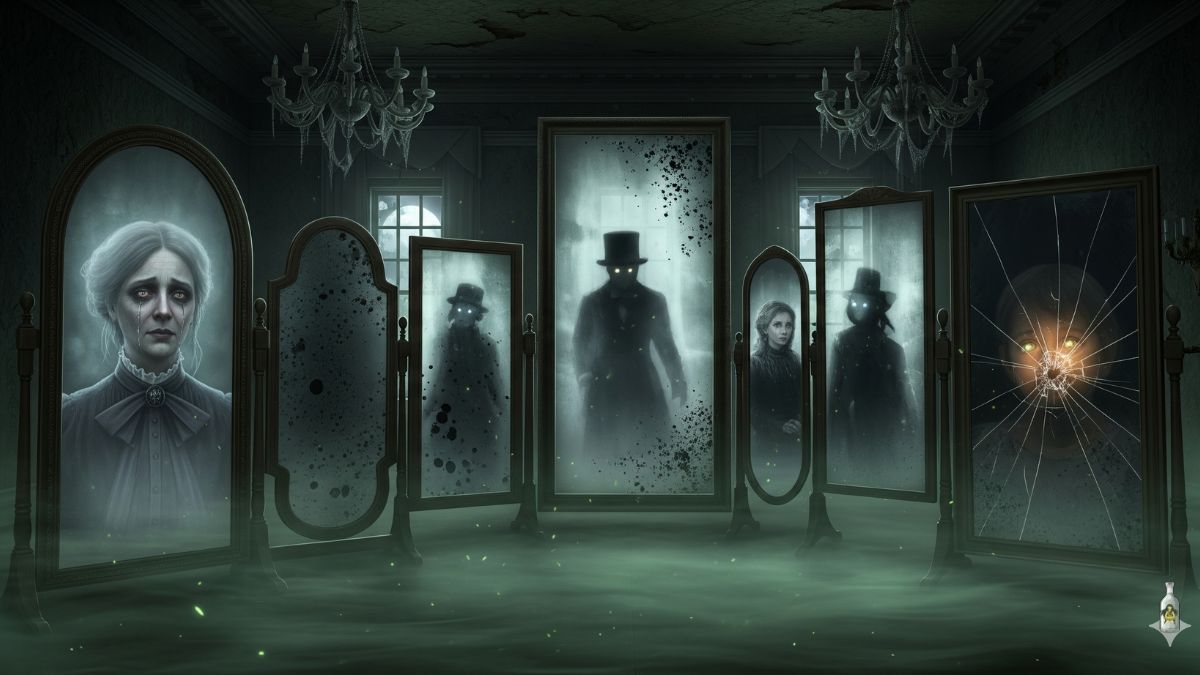
There’s something intimate and uncanny about a surface that gives you an instant duplicate of yourself…
In the uncanny and eerie darkness of antique shops and the dimly lit halls of grand estates, certain mirrors hold more than mere reflections. They whisper of trapped souls, spectral handprints, and faces that appear unbidden in the glass. These are the cursed mirrors—objects that blur the line between the mundane and the malevolent, where folklore meets fear in the most intimate of encounters.
History of Cursed Mirrors: Folklore, Rituals, and Superstition
Ancient Roots of Mirror Magic
Long before the silvered glass of modern mirrors, humanity gazed into polished bronze, still water, and obsidian surfaces, seeking glimpses of the divine. The practice of catoptromancy—divination through mirrors—stretched across civilizations like shadows at dusk. Ancient Greeks peered into bronze mirrors to divine the future, while medieval Europeans gazed into darkened water to see their destined spouse on All Hallows’ Eve.
These weren’t mere superstitions but sacred rituals woven into the fabric of daily life. The mirror became a threshold, a liminal space where the physical world touched something far more mysterious. In this context, mirrors weren’t just tools for vanity—they were portals, conduits between realms where mortal eyes could glimpse the impossible.
The Soul-Trap Tradition
Perhaps no belief shaped cursed mirror lore more profoundly than the notion that mirrors could trap souls. Victorian mourning customs demanded that household mirrors be draped with black cloth during funerals, lest the departing spirit become ensnared in the glass. This wasn’t melodrama but genuine terror—families feared their beloved dead might be imprisoned forever in their own reflections, unable to find peace.
The symbolic power ran deeper still. Mirrors reverse left and right, creating an “other self” that moves in perfect synchrony yet remains fundamentally different. Many cultures viewed this duality with suspicion, seeing mirrors as spaces where spirits might be caught between worlds, neither fully alive nor truly dead.
Birth of Modern Mirror Curses
The 19th and 20th centuries transformed ancient fears into contemporary terror. The rise of spiritualism brought mirrors into séance rooms as tools for manifestation, while the advent of photography seemed to capture spectral images that human eyes had missed. Suddenly, mirrors weren’t just portals—they became permanent prisons, holding ghostly impressions like photographic plates exposed to supernatural light.
As antique mirrors found their way into estate sales and curiosity shops, their histories became embellished with each retelling. A cracked looking glass from a grand home became the “cursed mirror that drove a family to madness.” An ornate Victorian piece gained phantom provenance linking it to tragic deaths. The stories grew because the mirrors themselves seemed to demand dark histories—their aged silver backing and mysterious blemishes providing perfect canvases for fearful imaginations.
Top Haunted Mirrors Around the World and Their Terrifying Stories

The Myrtles Plantation Mirror: America’s Most Haunted Looking Glass
In the sultry air of St. Francisville, Louisiana, stands the Myrtles Plantation, home to what many consider America’s most haunted mirror. The ornate parlor mirror, with its gilt frame and mysterious blemishes, tells a tale that has captivated ghost hunters for decades.
Legend speaks of Sara Woodruff and her children, allegedly poisoned by a vengeful slave named Chloe. According to the story, their souls became trapped within the mirror’s silvered depths, manifesting as spectral handprints and the shadowy figure of a child that appears in photographs. Visitors report seeing these ghostly impressions even after the mirror has been re-silvered, as if the spirits refuse to be erased from their glassy prison.
The mirror’s fame has spread through paranormal television shows and haunted tourism, making it a pilgrimage site for those seeking supernatural encounters. Tour guides speak in hushed tones of the cold spots that emanate from the mirror’s vicinity and the way cameras malfunction when pointed at its surface. Whether one believes in its supernatural properties or not, the mirror continues to draw visitors seeking their own brush with the otherworldly.
Celebrity Cursed Mirrors in the Museum Circuit
The world of celebrity-linked cursed objects has given rise to some of the most intriguing mirror legends in modern paranormal lore. Museums dedicated to haunted artifacts often feature mirrors allegedly connected to tragic figures from Hollywood’s golden age or historical personalities who met untimely ends.
One such mirror, purportedly connected to classic horror actor Bela Lugosi, sits behind protective glass in a Nevada museum, accompanied by warnings about its malevolent influence. The mirror’s ornate Victorian frame and darkened glass seem to hold secrets, though skeptical investigators have found gaps in its provenance and questioned the authenticity of its dark history.
These celebrity connections create a powerful psychological framework for supernatural experiences. When visitors know they’re looking at an object supposedly touched by tragedy, their expectations prime them to interpret ambiguous visual phenomena as paranormal manifestations. The mirrors become focal points for projection, where the human mind’s pattern-seeking tendencies transform ordinary reflections into extraordinary encounters.
International Mirrors of Malevolence
Across the globe, cursed mirrors surface in various cultural contexts, each shaped by local folklore and beliefs.European estates and castles harbor their own mirror legends, often connected to tragic historical figures or family curses. These stories typically involve antique mirrors that allegedly show the faces of the long-dead or reflect rooms as they appeared in centuries past. The mirrors become time capsules of tragedy, holding onto traumatic events like historical echoes that refuse to fade.
Bloody Mary Ritual: The World’s Most Famous Haunted Mirror Legend
The Sleepover Dare That Never Dies
Perhaps no mirror legend has achieved the widespread cultural penetration of Bloody Mary, the bathroom ritual that has terrified children for generations. The formula remains remarkably consistent across cultures and decades: stand in a darkened bathroom, light a candle, and chant “Bloody Mary” three times into the mirror. What happens next varies by telling, but the results are invariably sinister.
In some versions, Mary appears as a vengeful spirit ready to scratch out the summoner’s eyes. In others, she reveals the face of the person’s future husband—or their death. The ritual serves as a rite of passage, a test of courage that transforms an ordinary bathroom mirror into a gateway to terror.
Psychological Roots of the Ritual
The power of the Bloody Mary ritual lies in its perfect combination of psychological triggers. The dim lighting, repetitive chanting, and intense focus on one’s own reflection create ideal conditions for perceptual distortions. Participants often report seeing their faces transform, appearing older, younger, or morphing into entirely different visages—experiences that modern neuroscience can explain through documented visual phenomena.
The ritual also taps into deeper anxieties about identity, mortality, and the transition from childhood to adolescence. For many participants, Bloody Mary represents their first conscious encounter with the possibility that familiar spaces can become alien, that mirrors might show more than simple reflection.
Cultural Variations and Evolution
The Bloody Mary legend demonstrates remarkable adaptability, evolving to reflect local fears and cultural contexts. Some variations invoke historical figures like Queen Mary I of England, while others create entirely fictional entities. The core elements remain constant—the mirror, the darkness, the repetitive summoning—but the details shift to match contemporary anxieties.
Modern digital culture has transformed the ritual from a private dare to a shared experience, with countless videos documenting attempts to summon Bloody Mary. These recordings, while often showing little more than nervous teenagers in dark bathrooms, perpetuate the legend and introduce it to new generations of potential participants.

Chilling Paranormal Experiences with Cursed Mirrors
The Reappearing Handprint
Among the most commonly reported cursed mirror phenomena are marks that resist all attempts at removal. Owners describe handprints, smudges, or mysterious stains that reappear on mirror surfaces even after thorough cleaning or professional re-silvering. These persistent marks become the focal point of supernatural belief, seemingly defying natural explanation.

The testimony follows a familiar pattern: initial discovery of the mark, attempts to clean it, temporary success, and then the mysterious return of the blemish in exactly the same location. Owners often interpret this cycle as evidence of spiritual attachment, proof that some ghostly presence refuses to be erased from the mirror’s surface.
Autonomous Reflections and Spectral Faces
More dramatic are reports of mirrors showing reflections that move independently of their viewers. Witnesses describe seeing their mirror image wearing different clothing, appearing older or younger, or performing actions they themselves are not making. These autonomous reflections create profound psychological distress, challenging fundamental assumptions about identity and reality.

Equally unsettling are accounts of entirely foreign faces appearing in mirrors—the visages of strangers, historical figures, or deceased family members materializing in the glass. These spectral appearances often occur during moments of transition: late at night, during illness, or times of emotional stress, when the boundary between waking and dreaming becomes permeable.
The Summoner’s Mirror and Ritual Consequences
Some cursed mirror stories involve deliberate attempts to enhance supernatural properties through ritual modification. Practitioners of various occult traditions have long used mirrors in magical workings, believing that properly consecrated looking glasses can serve as tools for scrying, spirit communication, or dimensional access.

These ritual mirrors often develop reputations for producing unusual phenomena: unexplained glowing effects, temperature changes in their vicinity, or electronic equipment malfunctions near their location. Whether these effects result from genuine supernatural influences or the psychological impact of ritual belief remains a matter of ongoing debate among paranormal researchers.
Why Do Mirrors Attract Spirits? Scientific and Paranormal Explanations
The Strange-Face Illusion: When Science Meets Supernatural

Modern neuroscience offers compelling explanations for many reported mirror hauntings through documented perceptual phenomena known as strange-face illusions. Controlled laboratory studies have shown that prolonged mirror gazing in dim lighting conditions reliably produces vivid visual distortions in most participants.
These experiments reveal that when people stare at their own reflection in low light for several minutes, their visual system begins to generate hallucinations. Faces appear to morph, age, or transform into entirely different visages. Participants report seeing deceased relatives, monsters, or completely unfamiliar faces materializing in their reflection. The effect is reproducible, measurable, and entirely natural—requiring no paranormal explanation.
The mechanism involves several well-understood neurological processes. Troxler fading causes steady visual stimuli to disappear from perception, while the brain’s pattern-recognition systems work overtime to interpret ambiguous visual information. In dim lighting, these processes combine to create vivid, often frightening visual experiences that feel entirely real to the observer.
Material Science and the Persistence of “Ghostly” Marks
The mystery of reappearing handprints and persistent stains finds explanation in the physical properties of antique mirrors. Traditional mirror silvering involves applying a thin layer of silver nitrate to the back of glass, creating the reflective surface. Over time, this silver backing oxidizes, develops microscopic cracks, or separates from the glass in specific patterns.
Environmental factors—humidity, temperature changes, or chemical residues—can cause consistent degradation patterns that appear and reappear in the same locations. When a mirror is “cleaned” or even re-silvered, underlying glass damage or residual contamination may cause similar patterns to emerge again, creating the illusion of supernatural persistence.
The human tendency toward pareidolia—seeing meaningful patterns in random stimuli—transforms these material imperfections into ghostly handprints, faces, or mysterious symbols. Once an observer identifies a particular pattern as supernatural, confirmation bias ensures they’ll continue to see the same “ghostly” image in future degradation.
Psychological and Cultural Priming
The cultural context surrounding cursed mirrors creates powerful psychological priming effects that shape perception and memory. When people approach a mirror with supernatural expectations—whether due to its reputation, the setting, or the social situation—their brains become hypersensitive to ambiguous stimuli that might confirm those expectations.
This priming effect extends beyond individual psychology to encompass group dynamics and cultural transmission. Stories about cursed mirrors spread and evolve, becoming more elaborate and convincing with each retelling. Tourist locations, paranormal museums, and media presentations amplify these effects, creating feedback loops where expectation generates experience, which then reinforces belief.
Cursed Mirrors in Pop Culture: From Horror Films to Urban Legends
The Cinematic Mirror as Portal and Famous Cursed Mirrors Featured in Horror Movies
Horror cinema has embraced the cursed mirror motif with particular enthusiasm, recognizing its perfect balance of familiarity and fear. Films like “Oculus” and “Mirrors” represent famous cursed mirrors featured in horror movies and folklore, elevating mirror-based horror to new heights while exploring themes of fractured identity, parallel dimensions, and inescapable curses that persist across generations.
These cinematic portrayals often feature mirrors as interdimensional portals or prisons that trap souls across time. The visual medium allows filmmakers to literalize the metaphorical properties of mirrors—showing reflections that move independently, revealing hidden rooms, or displaying scenes from different time periods. These images become part of cultural consciousness, shaping how audiences interpret real-world mirror encounters.

Another Paranormal Read: The Hungry Ghost: Desire that never sleeps
Global Haunted Mirror Tales: Asia, Europe, and the Americas
Asian Mirror Traditions and Modern Manifestations
Asian cultures have developed rich traditions surrounding mirrors and supernatural encounters, often emphasizing themes of spiritual communication and ancestral presence.
- Japanese folklore includes numerous mirror-related entities, from the bathroom-dwelling Hanako-san to various mirror spirits that appear during specific rituals or circumstances.
- Chinese feng shui practices treat mirrors as powerful tools that can redirect spiritual energy, but also as potential hazards that might trap or misdirect beneficial forces.
- Korean shamanic traditions incorporate mirrors into ritual practices, using them as focal points for communication with spirit realms.
European Castle Mirrors and Aristocratic Curses
The grand estates and ancient castles of Europe provide perfect settings for cursed mirror legends, often incorporating themes of family curses, tragic love affairs, or historical trauma. These stories typically involve ornate antique mirrors that allegedly show visions of past events or manifest the ghosts of former residents.
Many European mirror legends connect to specific historical figures or documented tragedies, lending them an air of authenticity that purely fictional accounts lack. The mirrors become repositories of historical trauma, holding onto tragic events like emotional imprints that refuse to fade with time.
American Plantation Mirrors and Colonial Hauntings
American cursed mirror stories often center around antebellum plantations and colonial-era estates, locations already heavy with historical trauma and cultural significance. The Myrtles Plantation mirror represents the archetypal American haunted mirror—ornate, historically connected, and steeped in stories of violence and injustice.
These mirrors serve as focal points for grappling with historical trauma, allowing contemporary visitors to encounter the past in visceral, immediate ways. Whether supernatural or psychological, the experiences these mirrors generate provide a connection to historical events that might otherwise remain abstract or distant.
Should You Fear a Cursed Mirror? Myths vs. Reality

For most people, cursed mirrors represent no genuine supernatural threat. The strange-face illusion and related perceptual phenomena are natural, harmless effects that occur under specific conditions. The persistent marks and stains that characterize many haunted mirrors result from material degradation rather than spiritual attachment.
The question isn’t whether cursed mirrors actually harbor supernatural forces, but rather why humans continue to find meaning, terror, and fascination in these reflective surfaces. They serve as repositories for our deepest fears about identity, mortality, and the unknown, transforming ordinary household objects into profound symbols of existential uncertainty.
In the end, perhaps the true curse of mirrors lies not in any supernatural power they possess, but in their ability to show us exactly what we bring to them—our fears, our expectations, and our unending fascination with the mysteries that lurk just beyond the edge of reflection.
References
- Caputo, G.B. (2010). Visual perception during mirror gazing at one’s own face. PubMed Central. Retrieved from PMC database.
- Caputo, G.B. et al. (2012). Strange-face-in-the-mirror illusion literature and reviews. Taylor & Francis Online.
- Bloody Mary (folklore). (2025). Wikipedia. Retrieved from https://en.wikipedia.org/
- Myrtles Plantation haunted mirror documentation. (2025). American Hauntings.
- Biddle, K. et al. (2024). Investigative pieces on celebrity and museum haunted mirrors. Skeptical Inquirer.
- Mirror divination and catoptromancy practices. (2024). International University Institute of Lisbon. Retrieved from home.iscte-iul.pt
- Haunted object investigations and provenance analysis. (2025). Zak Bagans’ The Haunted Museum.
- Perceptual illusions and mirror-gazing phenomena. (2024). Psychology Today.
- Historical mirror customs and folklore traditions. (2025). House Beautiful.
- Paranormal tourism and mirror legends. (2025). US Ghost Adventures.
More Interesting Reads:


Leave a Reply