


When HBO announced IT: Welcome to Derry (2025), fans of Stephen King’s terrifying universe braced for a chilling return to the most cursed town in horror fiction. The series, set in 1962 Maine, explores the dark origin story of Pennywise and the generational trauma that keeps Derry haunted. With two shocking episodes already aired, the mystery of Derry’s evil grows deeper — and Episode 3 is about to unleash even darker secrets.
Below, we break down Welcome to Derry Episodes 1 and 2, decode the psychological symbolism hiding beneath the blood, and predict what awaits fans in Episode 3 — titled “Now You See It.”
In This Post:
Welcome to Derry Episode 1: The Pilot — A Town Drenched in Fear
The first episode of IT: Welcome to Derry begins not with a clown, but with a quiet unease. The year is 1962 — a time of postwar optimism, yet in Derry, Maine, the air hums with paranoia and prejudice.
The story opens on Matty Clements, a young boy who dreams of escaping Derry. Hitchhiking his way out of town, Matty encounters a seemingly ordinary family — a moment that quickly twists into horror. The cheerful smiles turn lifeless; the car becomes a trap. This early scene sets the tone: in Derry, kindness hides cruelty, and innocence is always the first casualty.
Meanwhile, Leroy Hanlon, a skilled Black engineer, arrives in town for a government aircraft project. His presence immediately exposes the undercurrent of racism in Derry. The show cleverly uses Leroy’s story to parallel the nature of fear — how it thrives on division, hatred, and silence.
Late that night, Leroy is assaulted by masked men in gas masks — an image that feels both literal and symbolic. It’s Derry’s sickness made visible: faceless hate consuming those who dare to challenge its order.
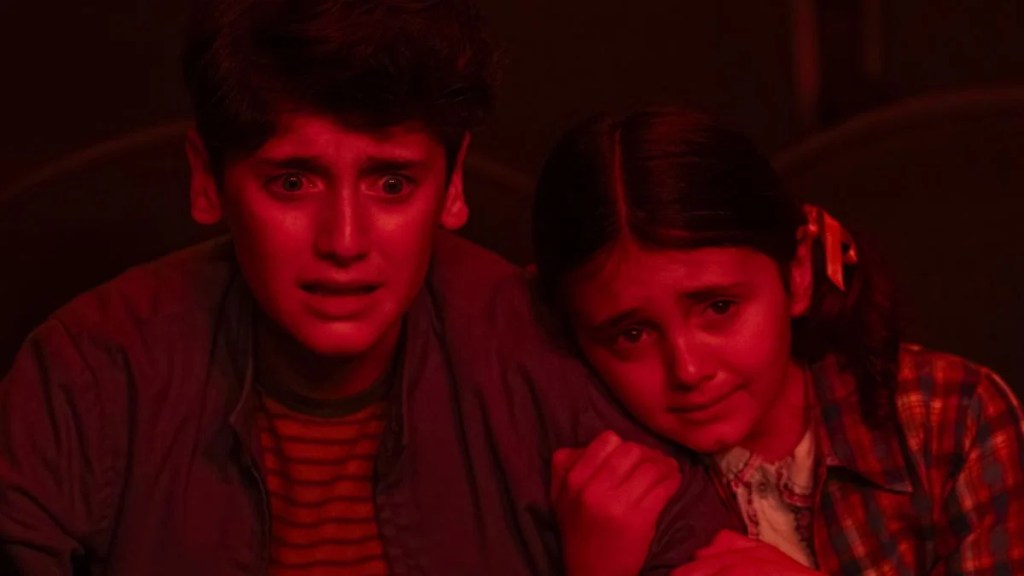
But it’s the final act that delivers the episode’s first true nightmare. In the local theater, three kids — Teddy, Phil, and Susie — sneak in for late-night fun. What they find instead is something monstrous. The lights flicker, the projector rattles, and a shape — perhaps not yet the Pennywise we know — emerges from the darkness. Their screams echo as the camera cuts to black, leaving only blood-spattered walls.
This isn’t just horror for shock’s sake. It’s Derry’s first whisper: evil has awakened.
Episode 2: “The Thing in the Dark” — The Horror Beneath Derry’s Smiles
Episode 2 dives deeper into the trauma the murders have left behind. The town tries to rationalize the impossible, but Derry’s adults, as always in King’s mythology, seem oddly indifferent.
The local police turn suspicion toward Hank Grogan, the theater projectionist whose daughter Ronnie Grogan (played brilliantly by Amanda Christine) becomes one of the emotional centers of the story. Ronnie’s confusion mirrors the audience’s — how can horror like this exist in plain sight, yet no one seems to remember?
Elsewhere, Lilly Dunning (Clara Stack) becomes increasingly haunted by visions — whispers from the sewers, flickering lights, and a sense that the town itself is watching. The moment she stares down into a drain, viewers catch the faintest echo of Georgie’s iconic scene from IT (2017). No clown yet — but the dread is unmistakable.
We also learn more about Derry’s social rot. The town’s mayor insists on covering up the killings, calling them “isolated tragedies.” Yet rumors swirl of missing children stretching back decades. Leroy, shaken by his attack, starts connecting the dots between Derry’s violence and its systemic fear.
The episode’s standout scene comes when Lilly follows a blood trail to the “kissing bridge” — another haunting nod to IT: Chapter Two. There, she glimpses something impossible: a monstrous, two-headed creature fluttering in the dark, its laughter sounding almost… human.
The show doesn’t reveal Pennywise outright. Instead, it builds the psychological scaffolding of his power — fear as infection, collective denial as its fuel.
Welcome to Derry’s Philosophy — Fear, Memory, and the Cycle of Evil

Beneath its jump scares and 1960s Americana, IT: Welcome to Derry is a story about how fear shapes identity. Derry is more than a town — it’s a psychological organism, feeding on secrets, guilt, and suppressed trauma.
1. Fear as Currency
Stephen King’s original IT described Pennywise as an entity that feeds on fear because it “seasons the flesh.” Here, fear isn’t just emotional — it’s sustenance. The show’s subtle genius lies in turning Derry itself into a predator. When townspeople ignore evil, they feed it.
Leroy’s racial tension storyline isn’t random — it’s metaphorical. Pennywise represents not only supernatural terror but also the social horror of hatred, ignorance, and silence. The gas-masked attackers aren’t just men; they’re embodiments of fear’s many faces.
2. The Psychology of Denial
One of IT’s most chilling ideas has always been Derry’s collective amnesia. The adults forget what happens, the police turn away, and children bear the trauma. This suppression becomes psychological armor — and the monster’s greatest weapon.
By showing the adults rationalize the theater massacre, Welcome to Derry critiques a timeless truth: society prefers denial over confrontation. The show asks, what happens when fear becomes normal?
3. Childhood vs. Corruption
The children’s purity — their capacity to see truth — stands in contrast to the adults’ blindness. This mirrors the broader philosophical message of the IT universe: innocence perceives evil clearly because it hasn’t yet been corrupted by the comfort of forgetting.
Lilly and Ronnie’s storylines echo the Losers Club’s future. They are the first generation to sense the evil festering beneath Derry’s calm facade — and they will pay the price for knowing too much.
The Cinematic & Psychological Symbolism of Pennywise’s Shadow
Even without a full appearance, Pennywise’s shadow stretches across every frame. The theater, the drains, the laughter — all are manifestations of his essence. But symbolically, Pennywise is more than a killer clown; he’s fear’s mask.
Each episode uses mirrors, flickering projectors, and distorted reflections to imply that Pennywise lives in perception itself. The title of Episode 3 — “Now You See It” — suggests the coming reveal of that truth: Pennywise doesn’t need to exist physically to influence minds. He thrives in imagination, hallucination, and the stories people tell themselves to survive horror.
The recurring visual of flickering light is key. It represents memory breaking — the moment people choose to unsee. In King’s mythology, that’s when the real feeding begins.
Episode 3 Predictions: “Now You See It” — Derry Awakens
As Episode 3 approaches (releasing November 9, 2025), anticipation builds for what’s next.
1. The Disappearance Mystery Deepens
Matty Clements’ fate will likely be revealed. Clues from Episode 2 suggest he’s either the first “chosen” victim of Pennywise or a vessel through which the creature’s consciousness manifests. His innocence, longing to escape, makes him the perfect psychological target.
2. Lilly’s Awakening
Expect Lilly’s visions to intensify. The title Now You See It implies she may fully “see” Pennywise — or the entity behind Derry’s evil — for the first time. Her descent into madness could mirror Beverly Marsh’s psychic sensitivity in the original story.
3. Leroy’s Investigation
Leroy will probably uncover Derry’s buried history — old newspaper clippings, missing-children reports, maybe even references to the 1908 Kitchener Ironworks explosion (a core event in King’s lore). His role could evolve into that of Derry’s first truth-seeker — the prototype of Mike Hanlon from the later timeline.
4. The Birth of Pennywise
While we may not see Bill Skarsgård’s full transformation yet, Episode 3 is expected to drop the first unmistakable sign — the red balloon, the echo of laughter in the drain, or perhaps a face glimpsed in a reflection. This is where Derry stops pretending to be ordinary.
5. The Philosophy of “Now You See It”
If Episodes 1 & 2 explored denial, Episode 3 could explore recognition. Seeing evil — truly acknowledging it — is the first step toward resisting it. The episode title hints that Derry’s inhabitants will finally face what they’ve long refused to see. But as IT lore warns, those who see often don’t survive the vision.
Cinematic Power & Cultural Impact
IT: Welcome to Derry isn’t just another horror spin-off — it’s a psychological and sociopolitical dissection of mid-century America through King’s monstrous lens. By weaving racism, small-town conformity, and generational fear into a supernatural narrative, the series achieves rare thematic depth.
Every scream, every shadow, every forgotten name serves a philosophical function: to show how evil endures when good people look away.
The cinematography — all muted pastels and crimson bursts — paints Derry as both idyllic and diseased. The town itself becomes a character: beautiful from afar, rotten within.
The Ending Explained — What “Welcome to Derry” Really Means

The first two episodes end with more questions than answers, but the meaning is clear: Derry is a mirror. Every society that hides its sins creates its own monsters. Pennywise isn’t born from the void; he’s summoned by neglect, cruelty, and fear.
Psychologically, the series suggests that the monster is a projection — the embodiment of repressed guilt. Each act of violence Derry ignores strengthens it. Each silence feeds it.
Philosophically, Welcome to Derry is about cycles — of fear, of denial, of destruction. Until someone remembers — until someone dares to see — the cycle will repeat.
The true horror isn’t Pennywise’s grin; it’s the comfort of forgetting.
Final Thoughts — The Horror Beneath Our Reflection
As we await Episode 3, IT: Welcome to Derry stands as one of HBO’s most ambitious horror dramas — less about jump scares, more about psychological revelation. It’s a chilling reminder that monsters aren’t always born in sewers. Sometimes, they’re born in silence, in prejudice, and in the things we choose not to see.
Episode 3 — “Now You See It” — promises to shatter that silence.
More Trending Stories:


Leave a Reply