

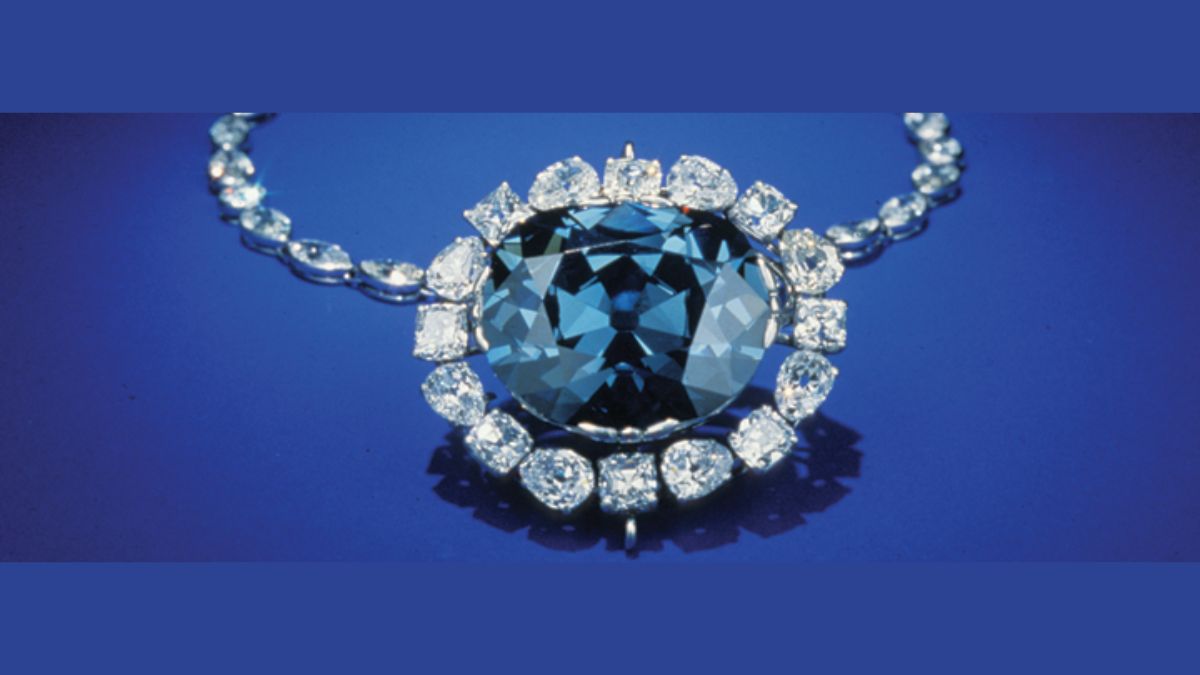
Deep within the hallowed halls of Washington, DC’s Smithsonian National Museum of Natural History, a mesmerizing blue stone pulses with an otherworldly glow. Visitors from around the globe journey to the nation’s capital to witness this 45.52-carat marvel, yet few realize they’re gazing upon what may be history’s most cursed gemstone.
In This Post:
The Sinister Origins: Sacred Temple Desecration in Ancient India’s Diamond Kingdom

Deep in the heart of 17th-century India, where 30,000 people at a time worked in one mine beneath the scorching Deccan sun, lay the legendary Kollur Mine—the crown jewel of the Golconda diamond fields. This was no ordinary mining operation; the Golconda diamond industry was at its peak from the 16th to 18th centuries, when 23 mines, of which Kollur Mine was the most active, operated in the region.
The Sacred Temple and the Stolen Eye of Sita
The most chilling version of the Hope Diamond’s origin tells of a sacred temple hidden deep within the Krishna River valley, where diamonds were found in alluvial mines. The tale goes that the diamond was initially embedded in the head (perhaps as an eye) of a statue of a Hindu goddess—specifically, the revered goddess Sita, wife of Lord Rama.

Legend speaks of a magnificent blue stone, weighing over 112 carats in its original form, that served as the divine eye of this sacred statue. The diamond was said to pulse with an otherworldly blue fire, visible even in the temple’s shadowy recesses. Local priests and devotees believed the gem held the goddess’s protective gaze, watching over the temple and its surrounding villages for centuries.
But greed knows no sacred boundaries.

Might Interest You: The Mysterious World of Ouija Boards
The Merchant’s Dark Transaction
Enter Jean-Baptiste Tavernier, the ambitious French gem merchant whose six voyages to the Orient would forever alter the course of European jewelry. Tavernier acquired the diamond on his last journey to India (1664-1668), and it came from the Kollur Mine of the Golconda region, though the circumstances remain shrouded in mystery and conflicting accounts.

Some whisper that Tavernier himself committed the ultimate sacrilege—some stories say it was Tavernier himself who plucked the stone out of the goddess statue under cover of darkness. Others claim he purchased it from local thieves who had already desecrated the temple, making him complicit in the crime but not the original perpetrator.
The Industrial Hell of Kollur Mine
The Kollur Mine, where the cursed stone originated, was a place of unimaginable human suffering. The famous Golconda mine at Kollur was the first mine found in this area, and that was not until around 1619, and it quickly became a center of both incredible wealth and devastating exploitation.

Workers, many of them slaves and indentured laborers, descended daily into the treacherous alluvial pits along the Krishna River. A slave worker who found the diamond smuggled it out by hiding it deep inside a self-inflicted cut—though this refers to another famous Golconda diamond, it illustrates the desperate conditions under which these legendary stones were extracted.
The very earth seemed cursed around these mines. Workers spoke in hushed tones of supernatural occurrences: tools that would mysteriously break, cave-ins that claimed lives without warning, and strange blue lights that danced in the mine shafts at night. Many believed the goddess Sita’s wrath had contaminated the very ground from which her stolen eye had been torn.
The Awakening of Ancient Vengeance
A curse befell the large, blue diamond when it was plucked (i.e. stolen) from an idol in India — a curse that foretold bad luck and death not only for the owner of the diamond but for all who touched it. The moment the sacred stone was removed from its divine perch, ancient Hindu texts suggest that cosmic balance was disrupted.

The curse was not merely about ownership—it was about desecration. According to the legend, it was stolen from the statue several centuries ago, and this was the start of the fabled curse, which foretold bad luck and death not only for the owner, but for all who touched it. The goddess Sita’s divine rage would follow the stone across oceans and through generations, ensuring that no one who possessed her stolen eye would know peace.
The Transformation from Sacred to Cursed
What makes the Hope Diamond’s origin story particularly haunting is the transformation from sacred protector to supernatural destroyer. In the temple, the stone had been a source of divine blessing, its blue radiance believed to bring prosperity and protection to devotees. But once severed from its sacred context, that same divine energy became malevolent.

The Tavernier Blue diamond was purchased by Jean-Baptiste Tavernier from the Kollur Mine in the mid-17th century, marking the moment when a sacred object became a cursed artifact. Tavernier’s acquisition of the 112-carat rough stone would prove to be the first link in a chain of supernatural vengeance that would stretch across continents and centuries.
The French merchant, oblivious to the cosmic forces he had unleashed, carefully transported the stone back to Europe, unaware that he carried with him the concentrated wrath of an ancient goddess whose divine eye had been violently torn from its rightful place.

Washington DC’s Crown Jewel: The Hope Diamond at the Smithsonian Museum
Today, millions of visitors flock to Washington DC’s National Museum of Natural History, making it one of the city’s most popular tourist destinations. The Hope Diamond remains on exhibit at the National Museum of Natural History, where millions of visitors have the chance to see it each year, with more than 100 million visitors having marveled at the 45.52-carat blue gem since it was donated to the Smithsonian by famed jeweler Harry Winston in 1958.

Located in the prestigious Harry Winston Gallery, this Washington DC landmark draws treasure hunters, history enthusiasts, and supernatural believers from across the globe. The diamond’s current estimated value of $250 million makes it not just a cursed relic, but one of the most valuable single items housed in any American museum.
The French Blue: Royal Deaths and Revolutionary Terror in Pre-Revolutionary France
The diamond’s dark legacy truly began when it was transformed into the heart-shaped “French Blue” for King Louis XIV. Court whispers spoke of strange occurrences surrounding the gem—unexplained illnesses, financial ruin, and untimely deaths among those who handled it.
The curse seemed to reach its terrible crescendo during the French Revolution. King Louis XVI and his queen, Marie Antoinette, both met their fate at the guillotine. Princess de Lamballe, Marie Antoinette’s closest confidante who had often admired the royal jewels, suffered an even more gruesome end—brutally murdered by revolutionary mobs in 1792.
Most mysteriously, the French Blue vanished during the chaos of 1792, stolen along with other crown jewels. For decades, the diamond disappeared completely, as if the earth itself had swallowed this cursed stone.
The Hope Family Fortune: London Banking Empire’s Mysterious Downfall
The gem’s reemergence in early 19th-century London brought fresh tragedy. Now recut to 45.52 carats to disguise its identity, the diamond found its way to Henry Philip Hope, a wealthy London banker whose family name would forever be linked to the cursed stone.

The Hope family’s financial empire, built over generations, began crumbling almost immediately after acquiring the diamond. Business ventures failed inexplicably, investments turned to dust, and the once-mighty banking dynasty found itself forced to sell their most prized possession to settle mounting debts.
Evalyn Walsh McLean: American Tragedy in Washington DC High Society
Perhaps no story illustrates the curse’s malevolent power more tragically than that of Evalyn Walsh McLean, the American socialite who purchased the Hope Diamond in 1911. Living on Washington DC’s prestigious Embassy Row, McLean wore the diamond daily, treating it as her personal talisman.

The curse, however, showed no mercy. Her nine-year-old son died in a horrific car accident. Her daughter succumbed to a drug overdose at just 25 years old. Her husband abandoned her for another woman before descending into madness. McLean herself became addicted to drugs and alcohol, dying in misery and financial ruin.
Eerily, McLean had often hosted lavish parties in Washington DC, where guests would dare each other to touch the cursed diamond, unaware they might be inviting tragedy into their own lives.
The Postal Worker’s Curse: Modern Washington DC Encounters the Ancient Evil
Even the diamond’s final journey to the Smithsonian Institution was marked by supernatural malevolence. The story of a curse is a recent part of the diamond’s history, apparently having its origins in the early 20th century. James Todd, the postal worker who delivered the Hope Diamond to the Smithsonian Museum in Washington DC in 1958, experienced a series of inexplicable misfortunes.

Within a single year of handling the package, Todd broke his leg, suffered a severe head injury in an accident, and tragically lost both his wife and beloved dog. The diamond had arrived at its final destination, but not without claiming one more victim along the way.
Scientific Mysteries: Washington DC Researchers Uncover Supernatural Properties
The Hope Diamond’s supernatural reputation isn’t merely folklore. Scientists at the Smithsonian Institution have documented the gem’s extraordinary properties that seem to defy natural explanation. When exposed to ultraviolet light, the diamond glows with an intense red-orange phosphorescence that continues for several seconds even after the UV source is removed.

This otherworldly phenomenon has never been fully explained, leading some researchers to wonder if there’s more to the curse than mere coincidence. The diamond’s unique Type IIb classification, containing trace amounts of boron, makes it one of the rarest diamonds on Earth—and perhaps one of the most supernatural.
Modern-Day Pilgrims: Visiting the Cursed Gem in Washington DC
Today, visitors to Washington DC can witness the Hope Diamond’s mesmerizing beauty firsthand at the National Museum of Natural History. You can see the Hope Diamond at the Smithsonian’s National Museum of Natural History in the Harry Winston Gallery. The diamond sits in a specially designed rotating display, allowing viewers to observe its hypnotic blue depths from every angle.

Many visitors report feeling an inexplicable chill when approaching the display case, while others claim to experience vivid dreams after viewing the stone. Whether these effects are psychological or supernatural remains a mystery that continues to intrigue both scientists and believers in Washington DC and beyond.
The Smithsonian’s Perspective: Debunking or Embracing the Mystery?
The Hope Diamond is one of the most iconic items in the Smithsonian’s collections, but this glittering gem is rumored to have a dark side. French monarchs, an heiress, and at least one unlucky postman have met misfortune after possessing it—though does that really constitute a curse?
While Smithsonian researchers officially maintain that the curse is merely coincidence and myth-making, they acknowledge that the stories have become an integral part of the diamond’s allure. The diamond has been surrounded by a mythology of a reputed “curse” to the effect that it brings misfortune and tragedy to anyone who owns it or wears it, but there are strong indications that such fabrications enhance the stone’s mystery and appeal.
Washington DC Tourism: The Curse That Keeps Giving
Paradoxically, the Hope Diamond’s cursed reputation has brought tremendous fortune to Washington DC’s tourism industry. The gem consistently ranks as one of the most photographed and visited attractions in the nation’s capital, drawing international tourists who contribute millions to the local economy.
Hotels near the National Museum of Natural History often report fully booked rooms during peak tourist seasons, with many guests specifically requesting accommodations within walking distance of the cursed diamond. Local tour guides have built entire Washington DC ghost tours around the Hope Diamond and other supernatural attractions in the area.
The Eternal Question: Curse or Coincidence?
As millions continue to visit the Hope Diamond in Washington DC each year, the question remains: Is this stunning blue gem truly cursed, or are the tragedies merely tragic coincidences amplified by our human need to find meaning in chaos?
Perhaps the answer lies not in scientific analysis or historical records, but in the diamond itself—forever rotating in its display case, catching the light with an otherworldly brilliance that seems to whisper secrets from centuries past.
Whether believer or skeptic, one thing remains undeniable: the Hope Diamond continues to cast its spell over all who encounter it, ensuring that its legacy of mystery will endure for generations to come in the heart of Washington DC.
More Interesting Reads for You:


References
- Smithsonian Institution – “The Curse of the Hope Diamond” – Official Smithsonian documentation and analysis of the Hope Diamond’s history and alleged curse
- Smithsonian National Museum of Natural History – “History of the Hope Diamond” – Comprehensive historical record of the diamond’s provenance and ownership
- Smithsonian National Museum of Natural History – “Hope Diamond Collection” – Current exhibition information and scientific analysis
- Wikipedia – “Hope Diamond” – Detailed encyclopedia entry with historical documentation and curse mythology analysis
- Discovery UK – “Beyond the Sparkle: Unravelling the Mystery of the Hope Diamond Curse” (July 2024)
- With Clarity – “The Hope Diamond Story and Curse” (May 2023)
- Smithsonian Magazine – “How a Smithsonian Curator Discovered the Hope Diamond’s Many Secrets” (September 2023)
- Cape Town Diamond Museum – “The Hope Diamond Curse and Mystery” (May 2025)
- Ripley’s Believe It or Not! – “Hope Diamond’s Curse: Tracing Its Trail of Victims and Mysteries” (June 2020)

Leave a Reply