

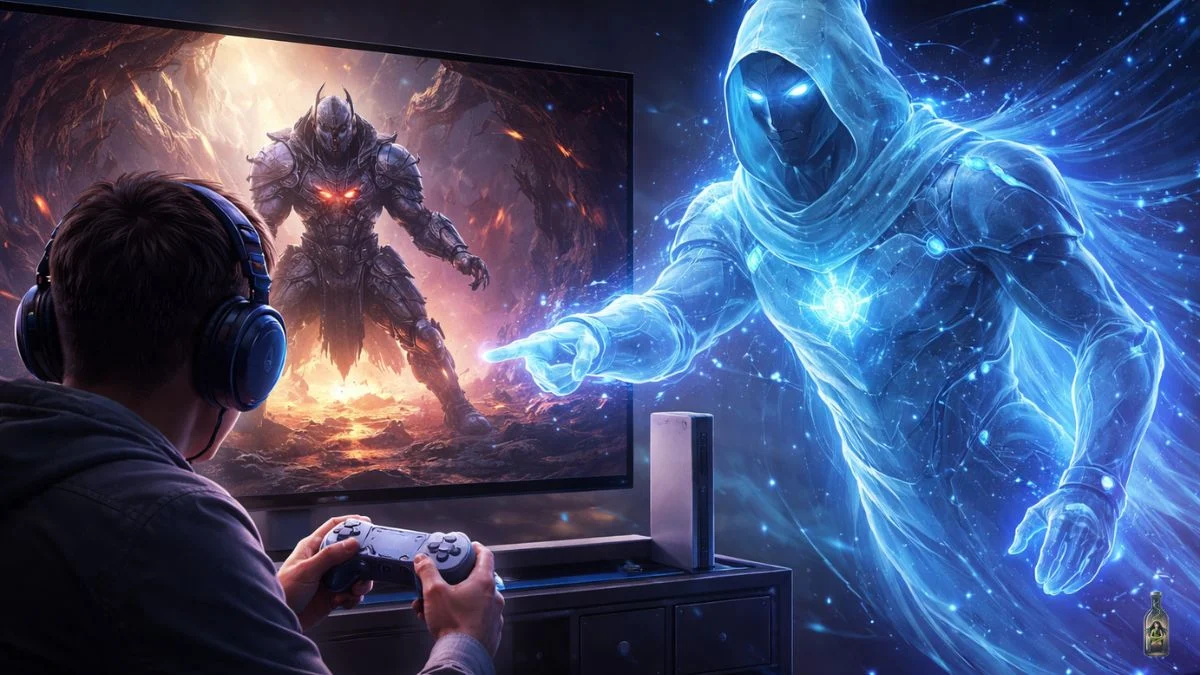
Sony’s latest patent imagines a future where help arrives inside the game itself. Instead of pausing your session, searching for walkthroughs, or skimming old gameplay clips, you could call upon an AI ghost that understands your struggle and offers a path forward. This idea leans on training models with thousands of hours of real gameplay, forming a guide that knows the terrain you are standing on rather than a general snapshot of the game.
This approach stands out because it pushes assistance into the moment where you actually need it. Not as a tooltip, not as a vague suggestion, but as a companion that has learned how real players solved the same challenge. You keep playing, and the world continues to move around you.
How the AI Ghost System Works
Sony describes a system that learns from varied gameplay footage. The model examines movements, strategies, failures, and victories from many different players. Once trained, the AI watches what you are doing in real time.
When you hit a wall in a puzzle or a boss encounter, the AI identifies the scenario and offers one of two forms of help:
Guide Assistance
The ghost appears and shows the path forward. You still perform the actions yourself, but you now understand the timing, inputs, or pattern needed to advance.
Full Completion Option
If you choose, the ghost completes the sequence for you and hands control back as soon as the obstacle clears. This could help you keep your rhythm during story-heavy games or maintain accessibility if your reflexes or inputs are limited.
This is a shift from simple difficulty scaling. The ghost responds to exactly what is happening on your screen, not a generic assumption about your skill level.
Why Sony is Pushing AI Ghosts?
The patent frames this as a response to modern game complexity. Puzzles lean into layered mechanics, boss fights often require precise execution, and exploration can hide essential details in dense spaces. Many players enjoy this challenge, but others can feel locked out of key story moments or discouraged when retry loops drag on.
AI ghosts aim to close that gap. They could offer:
Personalized Progression
Instead of slowing down and looking for guides on YouTube or forums, you receive help tailored precisely to your moment in the game.
Accessibility Support
Players who struggle with timing or precision could move through a difficult sequence without abandoning the experience.
Better Learning Tools
You see how a solution unfolds in context rather than watching a long clip that may not match your situation.
This level of responsiveness may help you stay immersed while still feeling in control of your journey.

Where Concerns Begin
Concepts like this often spark debate, and Sony’s idea is no different. Several points raised by critics revolve around what you lose when a helping system becomes too powerful.
Player Autonomy
Some fear that easy access to AI assistance could dilute the satisfaction of overcoming a hard challenge. If you rely too often on the ghost, the emotional payoff that comes from conquering a tricky fight might fade.
Privacy Questions
The system requires extensive gameplay footage as training data. If it expands to include personal stats, eye tracking, or camera-based inputs, Sony would need robust protections to avoid misuse of player data.
Artistic Intent
Developers craft sequences with specific tension and pacing. Interventions that solve puzzles before they naturally unfold may disrupt that design.
These concerns do not dismiss the value of AI help, but they highlight the need for balance and thoughtful implementation.
A Familiar Direction Across the Industry
Sony is not alone in exploring AI powered game assistance. Microsoft introduced Copilot for Gaming last year with similar goals, and several studios are experimenting with in-game assistants built around large language models. These systems attempt to create coaching tools that support players without leaving the game world.
Sony’s approach differs through its focus on trained gameplay models rather than text-based responses. The ghost behaves as a second player who already knows your game inside out.
Will AI Ghosts Appear on the PS6 or Stay on Paper?
Patents do not always reach production. Many remain conceptual experiments or technical explorations that never transform into features. Sony’s recent filings also include real time content filtering and new variations of Game Help, but there is no guarantee that any of these will appear on future hardware.
Still, the timing hints at a broader direction. With console makers emphasizing hardware level AI acceleration and more adaptive game systems, the idea of a fully trained ghost assistant sits comfortably in the vision for next generation experiences.
You may never see the feature as described today, but it signals where PlayStation wants to push the conversation.
More Trending Gaming News & Guides:


Leave a Reply