

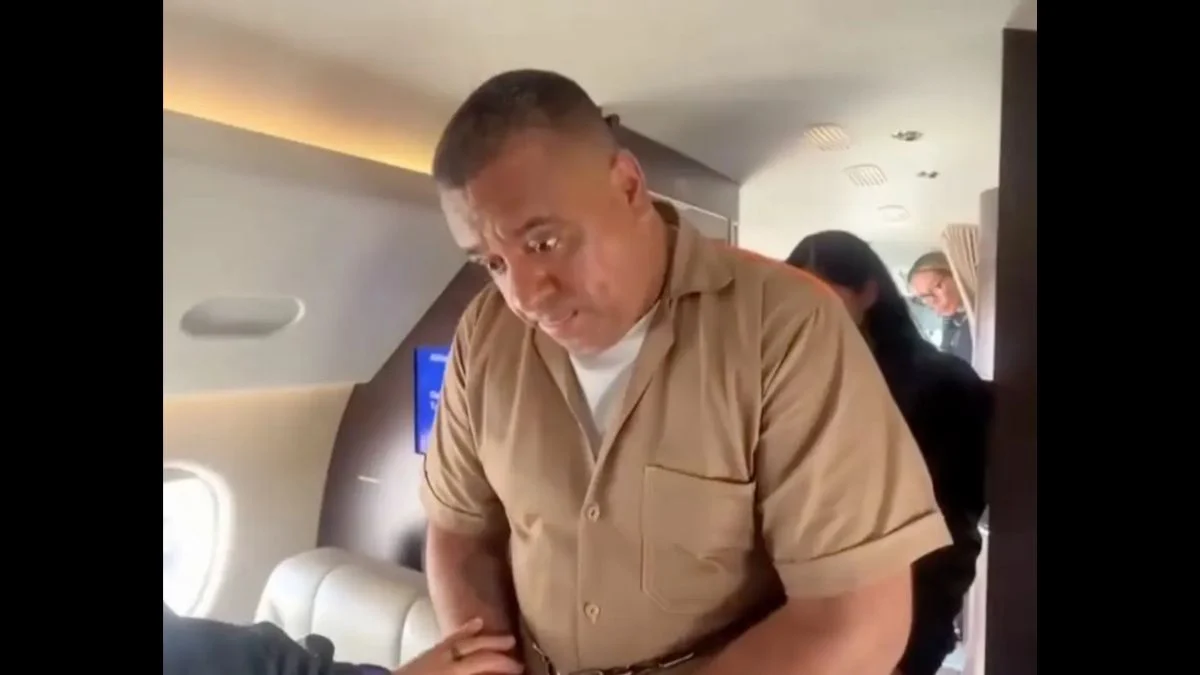
A case that had been caught between Colombia’s peace negotiations and a U.S. criminal prosecution has now entered a new phase. Geovany Andres Rojas, known by the alias “Araña” or “The Spider,” has been transferred from Colombia into U.S. custody to face federal charges tied to an alleged international cocaine-trafficking conspiracy and narco-terrorism.
Rojas’ extradition on September 25, 2026, followed months of uncertainty over whether Colombia would ultimately send him to the United States. His case had become closely connected to the country’s efforts to negotiate with armed groups, even as U.S. authorities pursued allegations involving cocaine trafficking and violence.
Who is Geovany Andres Rojas, or “The Spider”?
Geovany Andres Rojas is 45 and has been identified by U.S. authorities as a Colombian national and an alleged high-level leader and spokesman of Comandos de la Frontera, an armed organization operating in southwestern Colombia.
The U.S. Department of Justice says Rojas served as a leader of the organization before his arrest and publicly presented himself as a senior figure within the group.
Comandos de la Frontera is estimated by U.S. authorities to have around 1,000 members. The organization operated in a part of southwestern Colombia that plays a significant role in the country’s cocaine-production and trafficking networks.
Rojas also has a history connected to Colombia’s former Revolutionary Armed Forces of Colombia, or FARC.
According to the U.S. Justice Department, Rojas signed Colombia’s 2016 peace agreement with FARC before later rejecting the peace process and returning to armed activity.
Comandos de la Frontera emerged during the years following that 2016 agreement. The organization has been associated with former FARC members who returned to armed activity and became involved in territorial and criminal disputes in parts of southern Colombia.
Rojas had also publicly described Comandos de la Frontera as part of the Segunda Marquetalia structure, another armed organization associated with former FARC combatants.
The United States designated Segunda Marquetalia as a foreign terrorist organization in December 2021.
What became of the tonne of drugs a Kenyan Navy patrol seized in October 2025? See how the case reached this stage in our Kenya Destroys $63 Million Methamphetamine Haul After Indian Ocean Seizure as Six Iranians Face Trial report.
What charges does Rojas face in the United States?
The U.S. prosecution centres on two federal charges:
| Charge | Potential penalty |
| International conspiracy to distribute cocaine | Mandatory minimum of 10 years; maximum of life imprisonment |
| Narco-terrorism | Mandatory minimum of 20 years; maximum of life imprisonment |
A federal grand jury in the Southern District of California returned a two-count superseding indictment against Rojas on March 7, 2025.
The indictment alleges that Rojas participated in an international cocaine-trafficking operation and helped orchestrate large shipments intended for the United States.
U.S. authorities further allege that Comandos de la Frontera, under Rojas’ leadership, profited from cocaine cultivation and production in southwestern Colombia while using armed control and violence to maintain its territory.
Those allegations are at the centre of the federal case now moving forward in California.
But there is an important legal distinction: Rojas has been charged, not convicted.
The U.S. Department of Justice states that the allegations contained in the indictment are accusations and that Rojas is presumed innocent unless and until proven guilty.
Rojas was arrested in Colombia in February 2025
The road to extradition began with Rojas’ arrest in Colombia.
Colombian authorities arrested him on February 12, 2025, pursuant to an INTERPOL Red Notice connected to the U.S. case.
At the time, Rojas was also connected to peace negotiations involving the Colombian government and armed groups.
That created a complicated situation. While U.S. authorities were seeking to prosecute him over alleged drug trafficking and narco-terrorism, he was simultaneously involved in Colombia’s peace process.
Colombia’s Supreme Court unanimously approved his extradition in October 2025.
Yet that did not immediately result in his transfer to the United States.
Then-President Gustavo Petro suspended the extradition while Rojas participated in a new round of peace talks between armed groups and the Colombian government.
The decision became controversial because Rojas remained the subject of serious U.S. allegations while participating in negotiations connected to Colombia’s efforts to address armed conflict.
How did a Dallas rapper booked on three charges on Friday still perform in Des Moines on Saturday? Get the timeline in our BigXthaPlug Arrested on DWI, Gun, and Drug Charges in Texas – Then Takes Stage in Iowa: “They Didn’t Think I Was Coming” coverage.
Colombia reversed course in August 2026
The uncertainty surrounding Rojas’ fate continued until Colombia’s government changed direction in August 2026.
President Abelardo de la Espriella ordered that the extradition should proceed on August 26.
The eventual handover came less than a month later.
On September 25, Rojas was transferred under heavy security from Colombia to U.S. authorities. The U.S. Justice Department said the handover took place at a Colombian National Police air base in Bogotá.
President de la Espriella attended the transfer personally.
The Colombian presidency also confirmed that the president personally carried out Rojas’ handover to U.S. authorities.
The move marked a significant change from the previous administration’s decision to suspend the extradition while Rojas participated in peace negotiations.
President de la Espriella personally oversaw the handover
The Colombian president made clear that he viewed the extradition as incompatible with allowing Rojas’ alleged crimes to remain unresolved through negotiations.
After personally supervising the transfer, de la Espriella said:
“You don’t build peace by protecting narco-terrorists like this bandit,” De la Espriella said on Friday, after personally supervising Rojas’ transfer to the United States. “I ask U.S. authorities … that he cannot negotiate deals that will leave his crimes unpunished.”
Rojas was subsequently flown to the San Diego area.
According to the U.S. Justice Department, he arrived at an undisclosed location at approximately 4:30 p.m. Pacific time on September 25, accompanied by DEA and FBI personnel.
The extradition brought the Colombian phase of the case to an end and placed Rojas directly under the jurisdiction of the U.S. federal court process.
U.S. officials describe extradition as joint law-enforcement effort
American officials welcomed the transfer and pointed to cooperation between Colombia and U.S. law-enforcement agencies.
U.S. Attorney Adam Gordon, whose Southern District of California office is prosecuting the case, described the extradition as part of a broader operation involving the two countries.
Gordon said:
“Colombia and the Department of Justice are making a clean sweep of narcoterrorists, starting with Araña,” Gordon said.
He also said Rojas’ alleged network connected cocaine production in Putumayo with trafficking routes extending toward Mexico and the United States.
DEA Administrator Terry Cole similarly emphasised the cooperation between American and Colombian authorities.
Cole said:
“Today’s extradition demonstrates what the United States and Colombia can accomplish when we work together to dismantle the criminal networks that traffic deadly drugs, corrupt institutions, and threaten our communities,” Cole said.
He added:
“Geovany Andres Rojas faces narco-terrorism and drug trafficking charges for allegedly orchestrating multi-ton cocaine shipments bound for the United States. His extradition shows that borders, criminal influence, and efforts to conceal illegal activity will not prevent DEA and our partners from bringing major transnational traffickers to justice.”
FBI San Diego Special Agent in Charge Mark Remily also addressed the extradition, saying:
“Rojas’ extradition should send a clear message to cartel leaders: the FBI and our HSTF partners remain relentless in our fight to dismantle drug trafficking organizations that facilitate the flow of deadly drugs into our communities.”
Remily continued:
“FBI San Diego will continue working closely with our domestic and international law enforcement partners to eliminate criminal cartels, hold their leaders accountable, and protect the American people.”
Why Putumayo matters to the case
Rojas’ alleged activities are connected to the wider security situation in southern Colombia, particularly the Putumayo region.
Putumayo borders Ecuador and Peru and has long been associated with coca cultivation and cocaine production.
The region has also been affected by the wider conflict that followed Colombia’s 2016 peace agreement with FARC.
More than 14,000 fighters reportedly laid down their weapons as part of the agreement, which ended decades of armed conflict between FARC and the Colombian state.
However, armed groups and criminal organizations subsequently competed for influence in areas where state control remained limited.
Groups connected to former FARC fighters and other armed organizations have continued fighting over territory and illegal economies, including drug trafficking, illegal mining and extortion.
Comandos de la Frontera emerged within that post-peace-deal environment and has operated primarily in southern Colombia, including Putumayo.
That background helps explain why Rojas’ case became intertwined with both Colombia’s peace negotiations and the U.S. pursuit of alleged international drug trafficking.
Rojas’ first U.S. court appearance
After arriving in the United States, Rojas was placed in federal custody in California.
His next stage is the U.S. court process.
The Justice Department said Rojas was expected to make his initial court appearance at 2 p.m. on September 28, 2026, before U.S. Magistrate Judge Steve B. Chu in the Southern District of California.
The federal investigation is being handled by the Drug Enforcement Administration and the FBI as part of the California Homeland Security Task Force.
For Rojas, the extradition means that the allegations that had been pursued across two countries will now proceed through the U.S. federal justice system.
The key timeline
| Date | Development |
| 2016 | Rojas signed Colombia’s peace agreement with FARC, according to the U.S. Justice Department |
| December 2021 | The United States designated Segunda Marquetalia as a foreign terrorist organization |
| February 12, 2025 | Colombian authorities arrested Rojas pursuant to an INTERPOL Red Notice |
| March 7, 2025 | A federal grand jury in the Southern District of California returned a two-count superseding indictment |
| October 2025 | Colombia’s Supreme Court unanimously approved Rojas’ extradition |
| August 26, 2026 | President Abelardo de la Espriella ordered the extradition to proceed |
| September 25, 2026 | Rojas was handed over to U.S. authorities and arrived in the San Diego area |
| September 28, 2026 | His initial U.S. court appearance was expected at 2 p.m. before Judge Steve B. Chu |
A case shaped by drugs, armed groups and Colombia’s peace process
Rojas’ extradition is significant because his case sits across several difficult issues at once.
He is accused by U.S. authorities of involvement in an international cocaine-trafficking conspiracy and narco-terrorism. At the same time, his history is tied to Colombia’s former FARC conflict and the armed groups that emerged after the 2016 peace agreement.
His participation in peace negotiations delayed his extradition even after Colombia’s Supreme Court had approved it. The decision by the government of President Abelardo de la Espriella to proceed with the transfer ultimately placed Rojas in U.S. custody.
The September 25 handover, personally overseen by the Colombian president, now shifts the focus firmly toward the U.S. federal case.
How did investigators uncover repeated searches for one license plate over 21 months, according to an affidavit? Read the allegations and the department’s response in our Former Police Officer Allegedly Tracked Estranged Wife 717 Times Using Flock Cameras: “We Do Not Tolerate Misuse” story.
Conclusion
Geovany Andres Rojas, known as “Araña” or “The Spider,” has been extradited from Colombia to California after a lengthy and complicated legal and political process involving U.S. drug-trafficking allegations and Colombia’s peace negotiations with armed groups.
He now faces federal charges of international conspiracy to distribute cocaine and narco-terrorism. U.S. authorities allege that he helped oversee an organization involved in cocaine production and trafficking, while Colombian authorities have linked his history to the post-FARC armed-group landscape.
The case remains pending. Rojas has not been convicted of the charges, and the allegations against him will have to be addressed through the U.S. federal court process.
Source Disclaimer
This article has been prepared based on thorough research of the sources provided below, including U.S. government announcements, the Colombian presidency, Colombia’s Supreme Court record and the cited reporting. It reflects the information and allegations contained in those sources and does not imply independent verification beyond what the provided material supports. Rojas is presumed innocent unless and until proven guilty in court.
Sources
- U.S. Department of Justice — Southern District of California extradition announcement
- U.S. Drug Enforcement Administration — Araña extradition announcement
- Presidency of Colombia — Rojas extradition and presidential handover
- Colombia Supreme Court — extradition decision involving Geovany Andrés Rojas
- CBS News/AP — September 28, 2026 report
Featured Image Credit: Instagram / @oann


Leave a Reply