

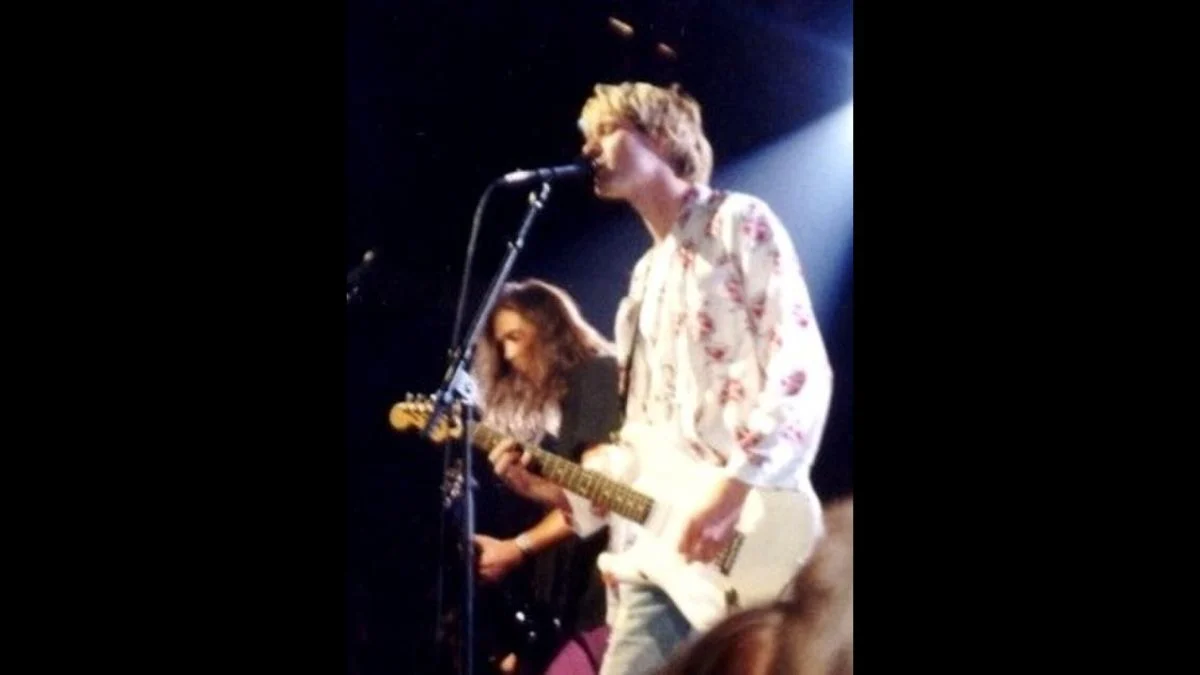
More than 30 years after Nirvana first stepped onto the MTV Video Music Awards stage, the band returned to the ceremony under very different circumstances. On Sunday, September 27, 2026, Dave Grohl, Krist Novoselic and Pat Smear reunited at the Peacock Theater in Los Angeles to accept the Video Vanguard Award, bringing one of the most recognisable stories of the MTV era back into focus.
The award was about Nirvana’s influence on music videos, MTV and popular culture, but the emotional centre of the moment was impossible to separate from Kurt Cobain. The singer, songwriter and guitarist died in 1994, yet his creative vision remains deeply connected to the band’s identity. As Novoselic spoke from the stage, the ceremony became not just a celebration of what Nirvana achieved, but also a reminder of the artistic force that helped shape it.
Nirvana returns to the MTV VMAs for a major career honor
The 2026 Video Vanguard Award recognised Nirvana’s particularly strong relationship with the music-video era. Grohl, Novoselic and Smear accepted the honour on the band’s behalf, while Public Enemy’s Chuck D presented the award.
The ceremony also revisited Nirvana’s music-video history through archival footage connected to Cobain. The group did not perform during the ceremony, making the appearance focused instead on recognition, reflection and the band’s lasting cultural impact.
The timing added another layer to the moment.
Nirvana’s relationship with the VMAs goes all the way back to 1992, when Cobain, Grohl and Novoselic appeared at the ceremony during the height of the band’s rise. More than three decades later, the three surviving members stood on the same awards-show stage to receive one of its biggest career honours.
| Key detail | Information |
| Award | MTV Video Music Awards Video Vanguard Award |
| Ceremony date | Sunday, September 27, 2026 |
| Venue | Peacock Theater, Los Angeles |
| Nirvana members accepting | Dave Grohl, Krist Novoselic and Pat Smear |
| Presenter | Public Enemy’s Chuck D |
| Performance | Nirvana did not perform |
| Earlier VMA appearance | 1992, with Kurt Cobain, Dave Grohl and Krist Novoselic |
That full-circle connection made the 2026 appearance particularly striking. The same awards show that had once been part of Nirvana’s explosive MTV-era rise was now honouring the broader legacy created by the band.
Nirvana wasn’t the only headline-grabbing moment at the Peacock Theater:
The ceremony’s opening act made just as much noise, with a career-spanning comeback of its own. To check the highlights of the event, read our piece on Madonna’s 2026 MTV VMAs Return Steals the Spotlight as Taylor Swift Makes History and LISA, RAYE Deliver Major Moments.
Krist Novoselic’s emotional Kurt Cobain tribute at the 2026 VMAs
As the acceptance speech unfolded, Krist Novoselic made it clear that Cobain remained central to the story behind Nirvana’s achievement.
Novoselic described his former bandmate as “one of the greatest artists of all time” and later offered another striking description: “Kurt was one of one.”
The comments placed Cobain’s creative influence firmly at the centre of the band’s Video Vanguard recognition.
Novoselic also reflected on why Nirvana’s music continues to connect with audiences decades after the group’s original run. His explanation focused on something that remains surprisingly powerful in an era filled with rapidly changing music trends: authenticity.
“People are still hungry for authenticity,” Novoselic said. “For something real, something uncompromising. Something that tells you it’s just ok to ‘come as you are.’ Kurt would have loved that legacy.”
The remark also connected directly to Nirvana’s visual identity.
Cobain was not simply the frontman appearing in the band’s videos. His creative vision helped shape how Nirvana presented itself, allowing the group to remain deliberately unconventional while reaching an enormous mainstream audience.
The VMAs weren’t the only ceremony making history this month:
In case you missed the Emmy, Linda Cardellini’s achievement is worth check out too. Read our story on Linda Cardellini Wins Her First Emmy for ‘DTF St. Louis’ to know more.
How Nirvana changed MTV during the music-video era
To understand why the Video Vanguard Award carries such significance for Nirvana, it helps to look back at the period when MTV remained one of the most influential platforms for bringing music to a mass television audience.
Nirvana’s breakthrough came with Nevermind in 1991, particularly through the lead single “Smells Like Teen Spirit.” Its accompanying music video became a major part of the song’s cultural impact and helped bring Nirvana’s grunge aesthetic to an enormous television audience.
The Rock & Roll Hall of Fame describes Nirvana’s arrival with Nevermind as a cultural revolution emerging from the Pacific Northwest. The institution also highlights the band’s combination of punk-inspired intensity, melodic songwriting and rejection of dominant musical conventions of the late 1980s.
The “Smells Like Teen Spirit” video premiered on September 29, 1991. Its chaotic performance footage, unconventional imagery and deliberately rough-edged styling quickly became closely associated with Nirvana’s public identity.
The band followed that breakthrough with other visually distinctive videos, including “Come as You Are,” “Lithium,” “In Bloom” and “Heart-Shaped Box.”
Together, those videos helped transform Nirvana from a successful rock band into a major part of the visual language of alternative music in the early 1990s.
Nirvana and MTV had a complicated relationship
There was always a fascinating contradiction at the heart of Nirvana’s mainstream success.
The band became enormously successful through the same commercial music industry that Cobain frequently challenged. MTV helped transform Nirvana into a household name, while Cobain was also known for pushing back against expectations surrounding how a hugely successful rock band was supposed to behave.
That tension became part of Nirvana’s identity.
Their 1992 VMAs appearance remains one of the clearest examples. Nirvana’s performance began with the opening bars of “Rape Me,” a song MTV had reportedly prohibited the band from performing, before the group shifted into “Lithium.”
The appearance also became memorable because of the confrontation surrounding Guns N’ Roses and Axl Rose.
The episode captured the uneasy relationship between Nirvana’s alternative-rock identity and the increasingly mainstream platform that had helped make the band famous.
MTV Unplugged revealed another side of Nirvana
Nirvana’s connection with MTV did not end with its chaotic relationship with the network’s mainstream spotlight.
In November 1993, the band recorded its famous MTV Unplugged in New York performance.
Rather than relying on a conventional greatest-hits set, the performance included unexpected choices, featuring songs by artists including David Bowie, Lead Belly, The Vaselines and the Meat Puppets.
The Rock & Roll Hall of Fame identifies the performance as an important part of Nirvana’s artistic legacy and records that it was originally broadcast on MTV in December 1993.
The performance eventually became one of the band’s most enduring pieces of filmed musical history.
Its stripped-back presentation revealed a different side of Nirvana from the aggressive live shows and heavily distorted sound that had become closely associated with grunge. The contrast mattered because the band could occupy MTV’s mainstream spotlight without completely giving up the unpredictability that had made it distinctive.
Kurt Cobain’s creative influence went far beyond the songs
The 2026 Video Vanguard ceremony also brought renewed attention to another important part of Nirvana’s story: Cobain’s involvement in the band’s visual presentation.
His complicated relationship with fame has followed Nirvana’s legacy for decades. The band’s music had moved from the alternative scene into the mainstream at remarkable speed, while Nirvana’s sound and public image repeatedly challenged the conventional expectations attached to mainstream rock stardom.
Cobain’s influence was not limited to songwriting.
Directors who worked with Nirvana have previously described how extensively he contributed to the band’s visual concepts. Anton Corbijn, who directed “Heart-Shaped Box,” previously described Cobain’s involvement as unusually detailed.
Corbijn said:
“The whole concept is Kurt’s.”
He also said Cobain’s ability to write a song while simultaneously having a detailed vision for its video was exceptionally rare.
That involvement helps explain why Nirvana’s videos remain such an important part of the band’s history. The visual work was not simply an accessory to the music. It became another space where Cobain and the band could shape how Nirvana was understood.
Why Nirvana’s 2026 Video Vanguard Award matters
Nirvana’s return to the 2026 VMAs took place in a music landscape almost unrecognisable from the one that produced the band’s breakthrough.
In the early 1990s, MTV could turn a music video into a cultural event. Today, artists operate in an environment shaped by streaming platforms, social media and short-form video, where music can spread globally without relying on a single television network.
That difference gives Nirvana’s Video Vanguard recognition an especially reflective quality.
The band did not simply benefit from MTV. Nirvana helped change what MTV’s mainstream audience could look and sound like. Its rise showed that an alternative-rock act with an intentionally unconventional image could become one of the biggest musical forces in popular culture.
But the band’s legacy cannot be separated from Cobain’s absence.
The surviving members accepting the award decades after Nirvana’s original run created a tribute to a musical partnership that ended long ago while also highlighting the continued reach of the work they created together.
And Novoselic’s words brought the moment back to the quality he believes remains central to Nirvana’s appeal: authenticity.
“People are still hungry for authenticity,” he said.
More than 30 years after Nirvana first appeared at the VMAs, that idea remains at the heart of why the band’s music and imagery continue to be revisited.
Emmy Night Two Highlights:
Much like Nirvana’s landmark win, Emmy Night Two was stolen by Widow’s Bay. Check our article on Creative Arts Emmys 2026: Widow’s Bay Dominates Night Two — But Did Spider-Noir’s 5 Wins Change the Emmy Race? in case you missed this news!
Conclusion
Nirvana’s 2026 Video Vanguard Award was ultimately a celebration of a legacy that reaches beyond one era, one television network or one collection of iconic music videos.
Dave Grohl, Krist Novoselic and Pat Smear returned to the VMAs stage to accept an honour recognising Nirvana’s impact on music videos, MTV and popular culture. Yet the ceremony also inevitably brought Kurt Cobain back into the conversation.
From Nevermind and “Smells Like Teen Spirit” to “Come as You Are,” “Lithium,” “In Bloom” and “Heart-Shaped Box,” and from the band’s complicated MTV history to MTV Unplugged in New York, Nirvana’s visual and musical identity remains deeply connected to the MTV era.
Novoselic’s tribute to Cobain added an emotional final note. His description of Cobain as “one of the greatest artists of all time” and “one of one” placed the late musician at the centre of the band’s enduring story.
Decades after Nirvana first entered the VMAs spotlight, the band’s return showed how strongly that story continues to resonate — with authenticity remaining one of the defining ideas at its heart.
Source Disclaimer
This article has been prepared based on thorough research of the sources provided with the original verified information, including MTV, the Rock & Roll Hall of Fame, Billboard, The Hollywood Reporter, Yahoo Entertainment and NME. It reflects the information available from those sources and the material supplied for this article and does not imply independent verification beyond what that material supports.
Sources
- Rock & Roll Hall of Fame — Nirvana
- Billboard — Nirvana accepts the 2026 MTV VMAs Video Vanguard Award
- The Hollywood Reporter — Nirvana pays homage to Kurt Cobain while accepting the Video Vanguard Award
- NME — Nirvana accepts the Video Vanguard Award at the 2026 VMAs
Featured Image Credit: P.B. Rage / Creative Commons Attribution-Share Alike 2.0


Leave a Reply