

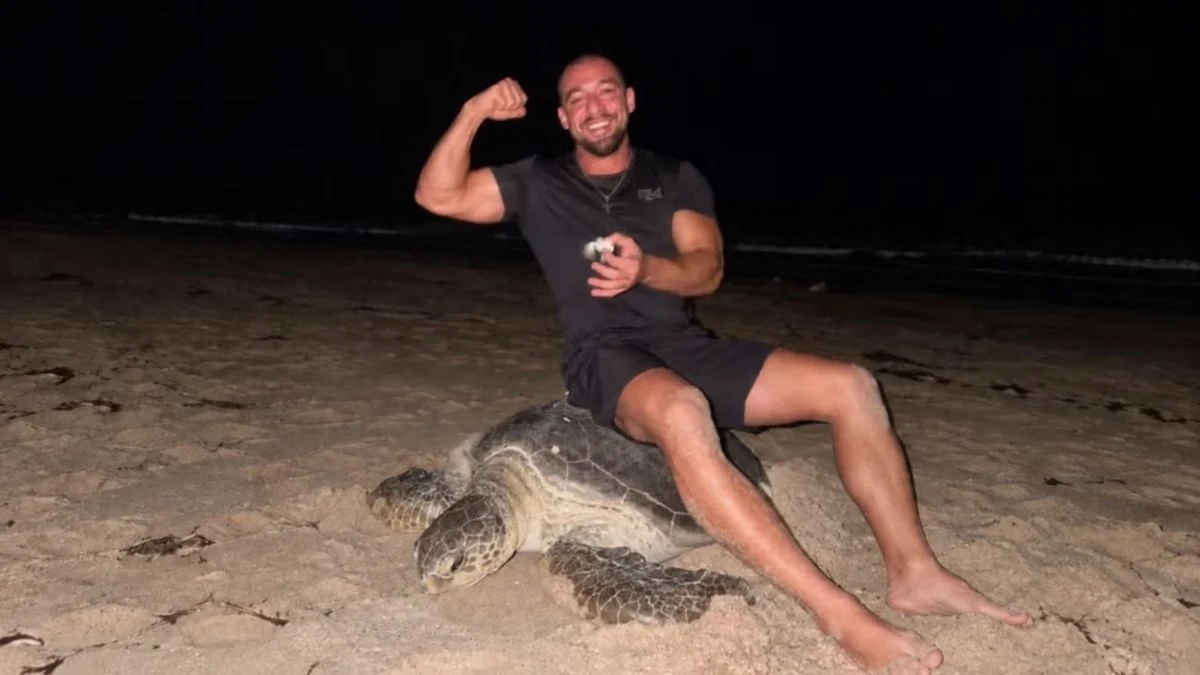
A beach that should have been quiet suddenly became the backdrop for a bizarre social-media moment. Ukrainian fitness influencer Vadym Oleynik and his partner, Olena Kravchenko, were visiting Oman’s Ras Al Hadd area when a camera captured something conservationists found deeply troubling: the pair posing with a sea turtle on the beach, including sitting on its shell.
Then the footage spread.
What made the incident particularly serious was the reported timing. The adult turtle appeared to be in the process of laying eggs, while separate footage reportedly showed Oleynik holding a newly hatched turtle. What followed was a wave of criticism, an official response from Oman’s Environment Authority, and an apology from Oleynik, who said he had not understood the rules and had made a mistake.
What happened at the Ras Al Hadd turtle nesting site?
Oleynik, 32, was visiting Oman with Kravchenko when they were photographed and filmed interacting with a sea turtle in the Ras Al Hadd area of South Al Sharqiyah Governorate.
The animal was identified in reports as a green sea turtle, Chelonia mydas, a species that nests extensively around Ras Al Hadd and the nearby Ras Al Jinz area.
The footage was reportedly first shared through Oleynik’s social-media accounts before being deleted. That might have ended the moment for the people involved, but social media had other plans. Other accounts recirculated the images and video, bringing the interaction to a much larger audience.
The footage showed the couple sitting and posing on the shell of an adult sea turtle on the beach.
And then came the detail that made the situation considerably more serious.
The turtle appeared to be engaged in nesting activity.
According to reports, Oleynik repeatedly placed his weight on the turtle’s shell. He was also reportedly seen holding a newly hatched turtle while posing for the camera. The couple were subsequently accused of interfering with hatchlings as well as disturbing the adult turtle.
It was the kind of wildlife encounter that can look like an unusual holiday photograph at first glance, until the conservation context becomes impossible to ignore.
A Reported £50 Million Bet on Blocks: Where in Surrey will guests ride through a Minecraft Nether portal and then check in for the night without leaving the game? Step inside the plans in our Minecraft World at Chessington: Escape the Nether Rollercoaster and 69-Room Hotel Coming in 2027 report.
Why the turtle interaction triggered such a strong reaction
The incident took place in an area known for turtle nesting, rather than an ordinary tourist beach.
The Italian conservation project Biologicamente was among the groups that highlighted the footage and criticised the treatment of the animals. The group argued that sea turtles should not be touched or used as props for photographs and questioned how such an interaction could have been permitted at a location where volunteers and conservation personnel were present.
The criticism was especially focused on the adult turtle’s apparent nesting behaviour.
Visitors at turtle nesting beaches are expected to observe the animals without touching, approaching or interfering with their natural behaviour. That distinction matters because the purpose of controlled turtle tourism is not simply to get closer to wildlife. It is intended to allow people to observe these animals while reducing disruption to them.
The situation therefore raised questions about both the conduct of the tourists and the way visitors are supervised around sensitive nesting sites.
Oleynik apologizes after the viral footage
As criticism spread across social media, Oleynik issued an apology.
He said:
“I didn’t see the rules. I made a mistake and apologize to everyone,” he said.
Oleynik claimed that he had been misled about what was permitted and said he had not intended to hurt the turtle.
Reports said the couple believed their interaction was acceptable because they were accompanied by people connected with monitoring turtle nesting activity.
Conservation advocates disputed the idea that the presence of volunteers could make physically interacting with a wild turtle acceptable.
That disagreement became an important part of the controversy. The question was no longer simply why the tourists interacted with the animals, but also how such an interaction could have taken place in a protected and conservation-focused environment.
Elephants Share 99.6% of a Mammoth’s DNA: How did a project that began with about 65 target genes balloon to roughly 150, pushing a 2028 birth into the next decade? Follow the science behind the shifting timeline in our Woolly Mammoth Revival Delayed: Why Colossal Now Expects a Mammoth-Like Calf in the Early 2030s feature.
Oman Environment Authority confirms legal action
The controversy moved beyond social media criticism when Oman’s Environment Authority confirmed that it had been monitoring the circulating footage.
The authority determined that the conduct shown in the footage constituted a violation of laws and regulations protecting wildlife.
In its statement, the authority said:
“The Authority confirms that it has taken the necessary legal action against the individual concerned, in accordance with applicable legislation.”
The authority also warned that it would not tolerate practices that could harm wildlife or threaten natural habitats.
Citizens, residents and tourists visiting turtle nesting areas were urged to follow the applicable rules. The authority specifically called on visitors to refrain from touching, approaching or disturbing sea turtles.
What is officially confirmed?
| Detail | Information available |
| Influencer | Vadym Oleynik |
| Age | 32 |
| Partner | Olena Kravchenko |
| Location | Ras Al Hadd area, South Al Sharqiyah Governorate, Oman |
| Turtle | Reported as a green sea turtle, Chelonia mydas |
| Reported conduct | Sitting and posing on the adult turtle’s shell; reportedly holding a hatchling |
| Wildlife status | Turtle reportedly in the process of laying eggs |
| Authority response | Oman’s Environment Authority confirmed legal action |
| Specific penalty | Not publicly confirmed in the available statements |
| Detention reports | Not officially confirmed |
| Oleynik’s response | Apology and statement that he had not understood the rules |
Importantly, the Environment Authority has not publicly confirmed a specific fine, criminal penalty or other final punishment for Oleynik in the statements currently available.
Likewise, reports circulating online that Oleynik and Kravchenko were detained have not been officially confirmed.
Those claims should therefore be treated cautiously.
The confirmed position from the authority is that legal action was taken over conduct that violated wildlife-protection laws and regulations. The precise outcome of that legal process has not yet been publicly detailed.
Ras Al Hadd is a major green turtle nesting area
The location itself explains why the incident attracted such intense attention.
Ras Al Hadd and the nearby Ras Al Jinz area are among Oman’s most significant locations for marine turtle nesting, particularly for green turtles.
Oman’s Environment Authority says green turtles (Chelonia mydas) nest along the country’s coastline, with Ras Al Hadd being a major nesting area. Its published data also tracks green turtle nesting activity within the Ras Al Hadd reserve.
The official Ras Al Jinz Turtle Reserve describes the area as a globally significant nesting location for endangered green turtles.
The reserve was established by Royal Decree in 1996. The Ras Al Jinz Turtle Centre was later established in 2008 as an ecotourism and conservation project.
That means the beach is not simply a scenic place where visitors happen to encounter turtles.
It is part of a conservation environment where human behaviour around nesting animals is specifically controlled.
What are visitors allowed to do around nesting turtles?
The Ras Al Jinz Turtle Reserve states that access to its nesting beach is controlled and that visitors must comply with the reserve’s policies.
Its official information says beach access is restricted, and violations of beach-entry policies can result in fines.
Oman’s Environment Authority has separately urged visitors to nesting sites not to touch, approach or disturb sea turtles. It has also called on the public to report activities that could threaten wildlife or their habitats.
That guidance becomes particularly important during nesting season.
Female turtles come ashore to lay their eggs and later return to the sea. Human interference can disrupt that natural process.
The reserve also identifies human activity as one of the threats that conservation efforts are designed to control, including habitat disturbance and artificial light from photography and vehicles. Visitors are required to follow restrictions governing access to the nesting beach.
Oman’s Environment Authority has previously warned that inappropriate pursuit and filming of wild animals for social-media content can cause stress, disrupt natural behaviour and increase the risk of harm to wildlife.
The authority has also said that photographing or pursuing wild animals without the required authorization can violate Oman’s wildlife-protection regulations.
Conservation groups condemn the incident
The footage prompted condemnation from wildlife advocates in Ukraine and elsewhere.
Ukrainian charity United For Animals said:
“They demonstrated savagery and a total disregard for life: the abuse of a sea turtle while it was laying eggs.”
The criticism centred particularly on the fact that the interaction apparently occurred while the adult turtle was nesting.
Conservationists have repeatedly stressed that visitors at turtle nesting beaches should watch the animals without touching them, approaching them or interfering with their behaviour.
Biologicamente also questioned the role of the people accompanying the tourists. The conservation project argued that a conservation-oriented organisation should not permit visitors to sit on a wild turtle for photographs.
The group said it had contacted relevant authorities over the incident.
The uncomfortable question behind wildlife content
The backlash against Oleynik also connects to a wider debate about social-media creators interacting with animals for entertainment or viral content.
The supplied report referenced several other controversies, including criticism directed at YouTuber Ross Creations over an “opossum launcher” video, allegations involving Twitch streamer Hasan and his dog, and a separate incident involving French TikToker Cyril Schreiner, who apologised after staging a fake kidnapping involving his dog.
Those cases differ in their circumstances and should not be treated as equivalent incidents.
But together, they have contributed to broader discussion about the responsibilities of content creators when filming animals and the risks of turning wildlife encounters into social-media entertainment.
The Oman incident has its own specific facts.
Footage showing a tourist disturbing sea turtles circulated online. Oman’s Environment Authority said the conduct violated wildlife-protection laws and regulations. The authority confirmed that legal action had been taken. Oleynik subsequently apologised and said he had made a mistake.
The final legal outcome, however, has not been publicly detailed.
He Bought a Reading, Not a Spell: What happened to a former safari driver’s job search after his followers jokingly urged him to consult an online tarot reader? Read how the whole TikTok saga unfolded in our Florida Job Seeker Says Etsy Tarot Reading Came Before Nine Job Interviews in One Week post.
Conclusion
What began as a holiday encounter at an Omani turtle nesting beach became an international social-media controversy after footage showed Vadym Oleynik and Olena Kravchenko interacting with a sea turtle, including sitting and posing on its shell while the animal was reportedly nesting.
The reported handling of a hatchling added another layer to the backlash, while conservation groups questioned how the interaction could have happened at a protected and carefully managed nesting location.
Oleynik apologised and said he had not understood the rules. Oman’s Environment Authority subsequently confirmed that legal action had been taken for conduct that violated wildlife-protection regulations.
The specific punishment, if any, has not been publicly confirmed, and reports of detention remain unconfirmed.
For now, the most firmly established part of the story is also the simplest: in a place built around protecting nesting sea turtles, visitors are expected to watch the animals without touching, approaching or disturbing them.
Source Disclaimer
This article has been prepared based on thorough research of the sources provided above, including official information and statements from Oman’s Environment Authority and the Ras Al Jinz Turtle Reserve, alongside the supplied reporting from Times of Oman, India Today, PEOPLE and Need To Know. Allegations and unconfirmed reports have been identified as such, while information concerning legal consequences has been limited to what Omani authorities have publicly confirmed. The article reflects the information available from those provided sources as of September 30, 2026, and does not imply independent verification beyond the material supplied.
Sources
- Oman Environment Authority – official statement on legal action over the Ras Al Hadd turtle incident
- Oman Environment Authority – green turtle statistics for Ras Al Hadd
- Oman Environment Authority – biodiversity and marine turtle information
- Ras Al Jinz Turtle Reserve – official information and visitor policies
- Ras Al Jinz Turtle Reserve – official facilities and beach-access information
- Times of Oman – tourist faces legal action for disturbing sea turtles at Ras Al Hadd
- India Today – report on Vadym Oleynik and the viral turtle footage
- PEOPLE – report on Oleynik’s apology and Oman legal action
- Need To Know – report on the incident and Environment Authority response
Featured Image Credit: Instagram / Vadym Oleynik


Leave a Reply