

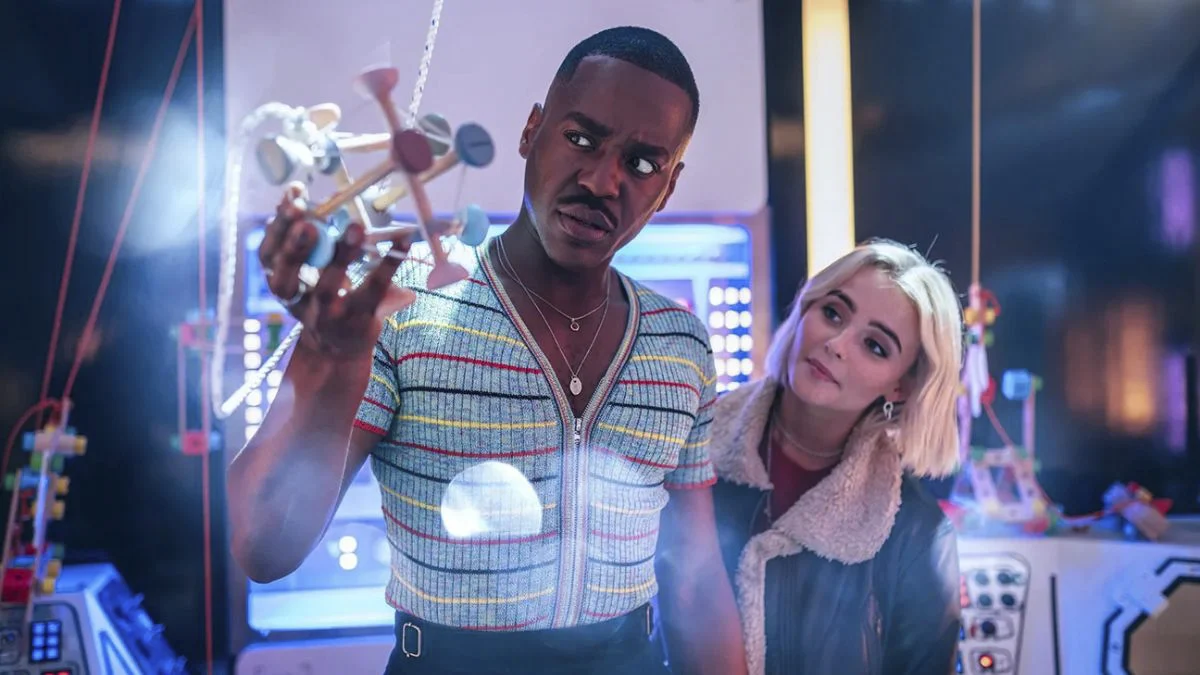
A surprising new AI revelation has thrown Doctor Who into an already complicated moment. BBC Director-General Matt Brittin has revealed that he was recently sent a 50-minute episode of the iconic sci-fi series created entirely with artificial intelligence — and his reaction was strikingly positive.
Brittin described the AI-generated episode as “pretty good” during a conversation at the Royal Television Society’s London Convention on September 29. But the revelation landed very differently with parts of the Doctor Who fanbase, with some viewers immediately questioning what the growing power of generative AI could mean for the future of one of television’s most recognisable franchises.
BBC boss Matt Brittin reveals he watched an AI-generated Doctor Who episode
The revelation came during Brittin’s discussion with broadcaster Kirsty Young at the RTS London Convention, where artificial intelligence and the rapidly changing television industry were major subjects.
While explaining how quickly generative AI is developing, Brittin pointed to the increasing ability of ordinary people to create sophisticated audiovisual material.
He said:
“Everyone’s got the ability in their hands, or six billion people have, to create content at the standard of a Hollywood studio.”
He then revealed something far more directly connected to Doctor Who.
“Somebody sent me a 50-minute episode of Doctor Who that was AI-generated the other day. It’s pretty good.”
The comment immediately creates an obvious question: was this an official BBC experiment?
The answer, based on the information currently available, is no.
Brittin was talking about an episode that somebody sent to him. The BBC has not announced it as an official production, and there is no confirmed information identifying the person who created it.
There are also no publicly disclosed details about exactly how the episode was produced, whether it used the likenesses or voices of existing Doctor Who performers, or whether it was intended to be an unofficial fan production.
That distinction is crucial.
Brittin’s comments confirm that he watched a 50-minute AI-generated Doctor Who episode. They do not confirm that the BBC has commissioned an AI-generated episode or decided that artificial intelligence will produce future official instalments of the series.
100% From Nine Critics, Still No Renewal: Why did the franchise’s content chief hedge on The Walking Dead: Dead City returning by calling this “a different time”? Read what he said about ratings, streaming and Maggie and Negan’s future in our The Walking Dead: Dead City Season 4 Could Happen as Scott Gimple Gives Renewal Hope story.
Why Matt Brittin’s AI comments have sparked such a strong reaction
Brittin did not present AI as a replacement for human creativity during the discussion.
After describing the AI-made episode as “pretty good,” he sought to make his position clear:
“I mean, it’s not going to replace humans. So, everyone’s a creator.”
He also added:
“Not all the creativity is bad.”
Even with those qualifications, the comments struck a nerve among some Doctor Who fans.
The timing is particularly significant. The BBC remains committed to Doctor Who, but the franchise is currently between major production arrangements. The previous Disney+ partnership has ended, Russell T Davies and production company Bad Wolf have exited, and the BBC has put the next production arrangement out to competitive tender.
The previously announced 2026 Christmas special has also been scrapped.
That wider uncertainty means that an apparently positive comment from the BBC’s director-general about an AI-generated Doctor Who episode has landed in an unusually sensitive environment.
Doctor Who fans react to the BBC boss’s AI revelation
Fan responses highlighted by ComicBook.com ranged from outright rejection of generative AI to concerns about the consequences of the technology for writers, actors, artists and other creative professionals.
Some reactions were blunt.
One fan wrote:
“Tasteless f–king loser”
Another responded:
“Don’t fucking let him anywhere near that fucking show then”
A different fan expressed concern about the implications of senior creative decision-makers embracing the technology:
“Jesus. If actual people in charge of creatives are saying this we are screwed.”
Another fan took an even stronger position on the future of Doctor Who and generative AI:
“If Doctor Who ever uses generative ai I’d consider the show to be dead”
That fan also argued that the Doctor Who universe already contains enough material across its classic episodes, revived series and expanded media to continue enjoying the franchise without AI-generated new material.
Another fan approached the controversy with dark humour:
“The only case when Doctor Who and AI should be used in the same sentence is when destroying AI is part of the plot”
These are individual fan reactions, rather than an official measurement of the wider Doctor Who audience. Still, they demonstrate how quickly the subject can become contentious when AI is discussed in connection with a major television franchise.
Three Episodes on Premiere Night: Why is American Horror Story squeezing a season of half-hour episodes into six Thursdays, with the finale landing two days before Halloween? Get every episode title and air date in our American Horror Story: 13 Release Schedule, Cast and 13-Episode Guide for FX and Hulu post.
AI is becoming a bigger television industry conversation
The Doctor Who revelation was not an isolated announcement about the BBC series. Brittin’s comments came during a broader discussion about how artificial intelligence could change television production.
The RTS London Convention, titled “United in Change: If Not Now, When?”, brought together television executives and creative figures to discuss the industry’s changing landscape.
Brittin appeared in a keynote conversation with Kirsty Young, while Prime Video International Vice President Kelly Day also discussed AI’s potential impact on television production.
Day argued that AI could reduce production costs while allowing studios to produce more stories and take greater creative risks.
She said:
“For a studio like us, AI enables us to bring down the cost of production while maintaining quality, meaning more stories get made, more creative risks get taken, and more diverse voices get heard. That is not a threat to creativity. That’s creativity unleashed.”
That context matters when considering Brittin’s comments.
The discussion was about the rapidly expanding capabilities of AI and its possible role in television. It was not an announcement that the BBC intends to replace Doctor Who writers, actors or conventional production teams with artificial intelligence.
Key confirmed details surrounding the AI Doctor Who revelation
| Detail | Confirmed information |
| BBC executive | Matt Brittin |
| BBC role | Director-General |
| Conversation | Kirsty Young at the RTS London Convention |
| Date of comments | September 29, 2026 |
| AI material discussed | A 50-minute AI-generated Doctor Who episode |
| Brittin’s assessment | “It’s pretty good.” |
| Official BBC episode? | No such announcement has been made |
| Creator | Unidentified person |
| Production details | Not publicly disclosed |
| Official AI replacement announced? | No |
Doctor Who was already facing a major production shake-up
The AI controversy arrives while Doctor Who is already navigating a major transition.
In October 2025, the BBC announced that Disney+ would not continue its partnership on the next season of Doctor Who. At the time, the BBC said it remained committed to the franchise and initially announced a 2026 Christmas special written by Russell T Davies.
That plan later changed.
In June 2026, the BBC confirmed that Doctor Who was being put out to competitive tender as it searched for a new production arrangement.
Davies and Bad Wolf exited the series, while the previously announced Christmas special was cancelled.
The BBC said:
“’Doctor Who’ remains an important part of the BBC and this tender underpins the BBC’s continued commitment to ‘Doctor Who’ ensuring audiences will enjoy the show for years to come.”
The broadcaster also explained why it decided not to use the Christmas special as a temporary bridge between eras:
“This decision was not taken lightly, and we know it will be disappointing for fans, but in order to set the show up for future series, it was decided that rather than bridge the gap with a one-off special, we are choosing to push forward to invest in the long-term future of the show which ensures that when the TARDIS lands once more, it does so in all its glory.”
Davies also addressed the situation after leaving the series.
He wrote:
“And so GOODBYE from me to Doctor Who but HELLO to a big new future for the show, as the BBC announces it’s putting the show out to tender. As a result, there won’t be a Christmas Special — we only cooked that up to guarantee a future when no one knew what would happen, but now we do know, there’s no need for it,”
He continued:
“You’ll have to wait a bit longer for new Doctor Who… but you’ll be waiting for MORE Doctor Who than a one-off. So it’s worth it!”
Davies also clarified that there was no secret completed production waiting to be released:
“For the record: there was no script, I never wrote it, and no actor was ever approached to play the next Doctor.”
That makes the current situation much clearer. The uncertainty surrounding Doctor Who concerns its future production structure and creative direction — not evidence that the BBC has decided to make the next series using AI.
Matt Brittin’s Google background makes the comments especially notable
Brittin’s comments have also attracted attention because of his unusual route into BBC leadership.
Before becoming BBC director-general, he spent 18 years at Google and served as the company’s president for Europe, the Middle East and Africa. He left Google in 2024 before later taking the BBC role.
Brittin officially became BBC director-general on May 18, 2026, after taking over the position in May.
His technology background makes his comments about generative AI particularly relevant as the BBC considers how emerging technologies could affect television production, distribution and the economics of broadcasting.
At the RTS convention, Brittin discussed the perspective he brings from the technology sector and acknowledged that he initially questioned whether he had the right background for the BBC role.
His arrival also comes as the broadcaster faces substantial financial and structural pressures, including a major savings programme. Reports surrounding the convention connected the AI discussion with wider questions about how the BBC can use new technology while maintaining human-led creative operations.
There is still no official AI-generated Doctor Who
For Doctor Who fans, one distinction remains at the centre of the story.
An AI-generated Doctor Who episode exists somewhere and was sent to Matt Brittin. That has now been confirmed directly by the BBC director-general.
But that is very different from the BBC announcing an official AI-generated Doctor Who production.
There has been no announcement that an official episode will be entirely generated by AI, and the BBC has not announced that generative AI will replace the show’s writers, actors or conventional production teams.
The BBC’s confirmed direction is to find a new production arrangement for Doctor Who following the end of the Disney+ partnership and the departure of Davies and Bad Wolf.
The corporation has continued to describe Doctor Who as an important part of its future.
That means Brittin’s “pretty good” assessment should currently be understood as a comment about what AI technology is capable of producing — not as confirmation of what the next official Doctor Who episode will look like.
What Brittin’s comments could mean for Doctor Who’s future
The timing ensures that artificial intelligence is now part of the wider conversation surrounding the franchise.
Doctor Who has lost its Disney+ production partnership, Davies and Bad Wolf have departed, the BBC is seeking a new production arrangement, and the 2026 Christmas special is no longer happening.
At the same time, senior television executives are openly discussing AI as a technology that could potentially reduce production costs and increase the amount of television that can be made.
For now, however, there is no evidence in the verified material that the BBC has chosen an AI-generated future for Doctor Who.
What has been confirmed is considerably narrower — but still striking: the BBC’s director-general was sent a 50-minute AI-generated Doctor Who episode, watched it, and considered it “pretty good.”
That single comment has now triggered a wave of fan concern at precisely the moment when the franchise is searching for its next chapter.
Cast Options Expired the Same Night a New Drama Was Picked Up: Which winery drama did Netflix choose instead of sending Sweet Magnolias back to Serenity? Meet the team behind the replacement in our Sweet Magnolias Cancelled After Season 5: Why Netflix Chose Ladies of the House Instead of Season 6 report.
Conclusion
The Doctor Who AI controversy is ultimately about a distinction that has become increasingly important in television: what technology can create versus what a broadcaster actually intends to commission.
Matt Brittin’s remarks confirm that he has seen a 50-minute AI-generated Doctor Who episode and was impressed by what he watched. His comments came during a wider industry conversation about AI’s rapidly expanding creative capabilities, while other television executives are also discussing its potential to lower production costs and expand storytelling.
But there is currently no confirmed BBC decision to make official Doctor Who episodes entirely with AI.
For now, the franchise remains in a major transition, with its Disney+ partnership ended, Russell T Davies and Bad Wolf departed, the 2026 Christmas special cancelled, and the BBC searching for a new production arrangement through competitive tender.
The next chapter of Doctor Who therefore remains unwritten — and, as Davies himself confirmed, there is not even a completed script or an actor approached to play the next Doctor. What fans now know is that AI has entered the conversation, and some of them are already making their feelings very clear.
Source/Research Disclaimer: This article has been prepared based on thorough research of the sources provided below and the verified information supplied for this report. It reflects information and statements available as of September 30, 2026, and should not be interpreted as independent verification beyond what those sources and the supplied material support. The BBC’s plans for Doctor Who remain subject to change as the competitive tender and future production process continue.
Sources
- Royal Television Society — RTS London Convention 2026 programme
- Royal Television Society — RTS London Convention 2026
- Variety — BBC Director-General Matt Brittin appointment
- Variety — Doctor Who Christmas special cancelled as BBC seeks new production partner
- Variety — Prime Video executive Kelly Day on AI and television production
- Doctor Who official site — BBC confirms future of Doctor Who
- The Irish News / PA — Matt Brittin’s AI and Doctor Who comments
- ComicBook.com — Fan reactions and original report supplied for this article
Featured Image Credit: BBC / Disney+


Leave a Reply