

In an era where mega-mergers and political power plays dominate headlines on both sides of the Atlantic, a two-minute comedy skit has ignited fierce debate about the future of creative freedom in Hollywood.
Released on February 27, 2026, the satirical video titled “Auditions in a World Where Corporations Let the President Dictate Their Content Decisions” comes from the Committee for the First Amendment—and it wastes no time making its target clear.
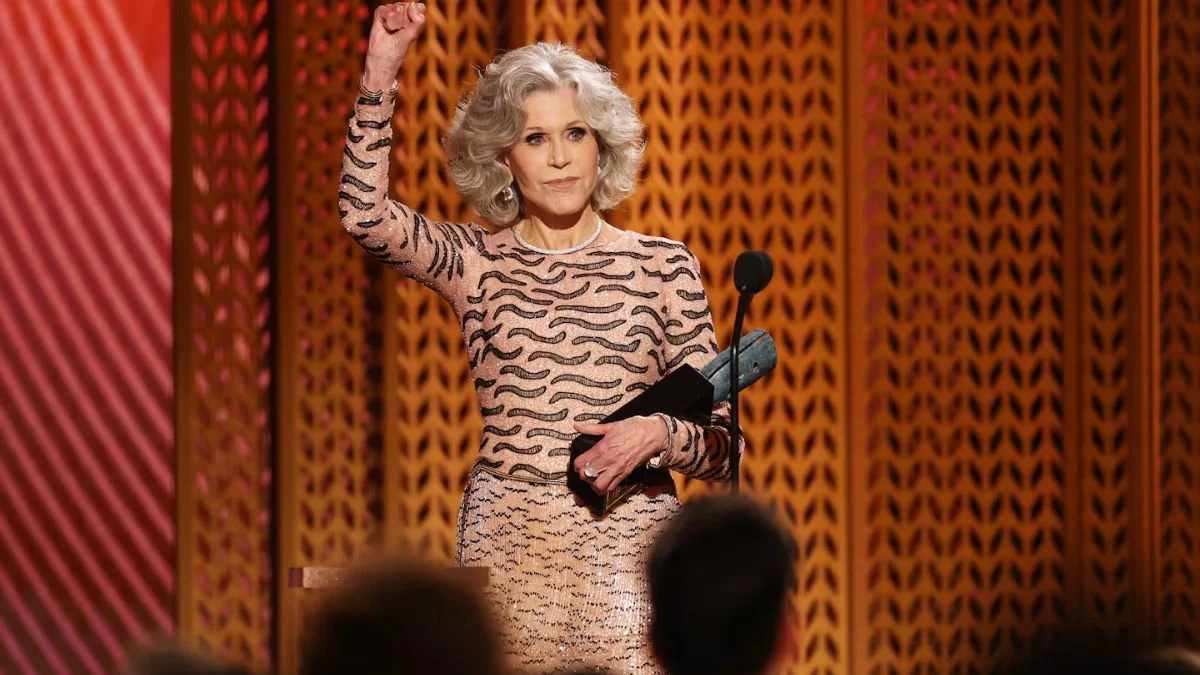
Led by two-time Oscar winner Jane Fonda, the skit imagines a dystopian entertainment industry where corporate mergers and political pressure—specifically from President Donald Trump—have narrowed all creative output to one franchise: Rush Hour.
Why Jane Fonda’s ‘Rush Hour Only’ Skit Is Going Viral in the UK and USA
The premise is deceptively simple. Actors audition in a bleak future Hollywood where only content set within the Rush Hour universe gets greenlit. Every agency, management company, and casting office has rebranded accordingly.
“Rush Hour Agency.”
“Rush Hour Management.”
“Tucker & Chan Talent.”
“I am Rush Hour eligible!”
It’s absurd. It’s repetitive. And that’s precisely the point.
The video mocks reports that Paramount greenlit Rush Hour 4 at Trump’s personal request shortly after his re-election in November 2025. In doing so, it spotlights mounting fears about political interference in media decisions—especially as one of the biggest corporate takeover battles in Hollywood history unfolds.

The Paramount-Warner Bros. Takeover: What’s Really at Stake?
Behind the satire lies a very real corporate drama.
In late 2025, Paramount Pictures launched a hostile takeover bid for Warner Bros. Discovery (WBD). By early 2026, the offer ballooned to an estimated $108–111 billion, outpacing Netflix’s earlier $83 billion proposal.
On February 26, 2026, Netflix withdrew from the race, clearing the way for Paramount’s aggressive acquisition strategy.
If successful, the deal would merge:
| Paramount Assets | Warner Bros. Discovery Assets |
| Top Gun | DC Comics |
| Mission: Impossible | Harry Potter |
| Paramount+ | HBO Max |
| CBS | CNN |
| — | Game of Thrones |
The scale is staggering. The combined entity would control beloved franchises across cinema, television, streaming, and global news.
And that’s where regulatory red flags emerge.
The deal requires approval from the FCC and the U.S. Department of Justice. Critics warn that political alignment between Trump and billionaire backers of the acquisition could influence regulatory decisions—and, eventually, editorial direction.
The Trump–Ellison Connection and Media Influence Concerns

At the center of the acquisition is CEO David Ellison, son of Larry Ellison, the Oracle co-founder and prominent Trump supporter. Reports indicate significant financial backing from Middle Eastern sovereign wealth funds and Jared Kushner.
For critics, the optics are troubling.
Trump has publicly criticized networks like CNN in the past. If Paramount acquires WBD, control over CNN would shift under leadership perceived as politically aligned with the White House.
The skit exaggerates this fear into absurdity—portraying a world where only content that “pleases the right people” gets made.
Rush Hour 4: The Film That Sparked the Satire
Reports state that President Trump personally requested a revival of the Rush Hour franchise in November 2025.
Paramount agreed to distribute Rush Hour 4, reviving the buddy-cop series starring Jackie Chan and Chris Tucker. The studio will reportedly receive a flat distribution fee, without financing or marketing responsibilities.
The decision coincided with Paramount’s $8 billion merger with Skydance—another deal requiring Trump administration approval.
To critics, the timing suggests potential quid pro quo dynamics.
The skit imagines what happens if that precedent becomes standard operating procedure.

Inside the Skit: A 2-Minute Masterclass in Political Satire
Filmed in a stark audition-room format, actors rotate through quick cuts, introducing themselves in a world dominated by “Rush Hour” branding.
Participants include:
- Jane Fonda
- Yvette Nicole Brown
- Ed Begley Jr.
- Kirsten Vangsness
- Jodie Sweetin
- Anthony Roy Davis
Notable Moments
Ed Begley Jr. laments:
“It’s been slow… there are only the Rush Hour movies and it is just that one flavor.”
Yvette Nicole Brown riffs on franchise racial dynamics:
“Never touch a black man’s radio… Oh wait, should I say woman?”
Jane Fonda, playing an exasperated industry veteran, delivers the sharpest blow:
“I can’t get any of the movies that I want made. I’m hoping Rush Hour will please the right people and maybe I’ll get a job.”
The repetition builds toward chaos. Actors deliver variations of the famous line:
“Do you understand the words that are coming out of my mouth?”
It’s funny. But it’s also pointed.
Historical Echoes: From McCarthyism to Modern Media Consolidation
The Committee for the First Amendment name carries symbolic weight.
In the 1940s, Hollywood faced blacklisting during the McCarthy era. Jane Fonda’s father, Henry Fonda, was associated with free speech advocacy during that time.
By framing the skit within that historical context, Fonda and her collaborators suggest parallels between past ideological suppression and modern fears of political-media consolidation.
For UK viewers familiar with debates over BBC independence—and US audiences watching corporate media consolidation—the message resonates beyond partisan lines.

Social Media Reaction: X, Instagram & Growing Debate
The video was posted to Instagram and later shared widely on X (formerly Twitter), including by user @Victorshi2020.
Engagement snapshot:
| Platform | Views | Likes | Reposts |
| Growing daily | — | — | |
| X | 78,000+ | 2,597 | 652 |
Comments largely praise the skit as a timely warning about authoritarianism and corporate consolidation. Others criticize Fonda, underscoring her longstanding polarizing presence in American politics.
Meanwhile, coverage from outlets including Variety, NPR, and The Atlantic situates the satire within broader concerns about Trump’s influence on entertainment and news media.
Is Hollywood at Risk of Political Content Control?
While the skit exaggerates reality for comedic effect, legitimate questions remain:
- How much influence should elected officials have over private media companies?
- Can mega-mergers preserve editorial independence?
- Will regulators remain neutral in politically sensitive acquisitions?
In the UK and US alike, media independence is foundational to democratic discourse.
The satire’s final moments underscore that message.
“I am 87 years old and won two Oscars,” Fonda says. “I have not been taking any acting classes.”
Pause.
“Okay, that’s fair. So let me get ready to do it.”
It’s a punchline—but also a commentary on adapting to survive in a shifting industry landscape.
Why This Story Matters Beyond Hollywood
This isn’t just about one franchise or one merger.
It’s about:
- Corporate consolidation at unprecedented scale
- Political influence over cultural production
- The future of diverse storytelling
For American audiences, it touches on First Amendment values.
For British viewers, it mirrors ongoing debates over media plurality and ownership concentration.
In just two minutes, the skit accomplishes what hours of panel discussions often cannot: it makes the stakes digestible—and laughable—before they become normalized.

Final Thoughts: Satire as a Warning Shot
Whether you see it as comedic overreach or necessary political commentary, one fact is undeniable:
The video has sparked conversation.
As Paramount’s bid for Warner Bros. Discovery moves through regulatory scrutiny, and as Rush Hour 4 inches closer to production, the intersection of politics and entertainment will remain under a microscope.
The question posed by Jane Fonda and her collaborators lingers:
If corporations begin shaping content to please political power, what stories never get told?
And in a media landscape increasingly dominated by mergers and mega-franchises, that may be the most important audition of all.


Leave a Reply