

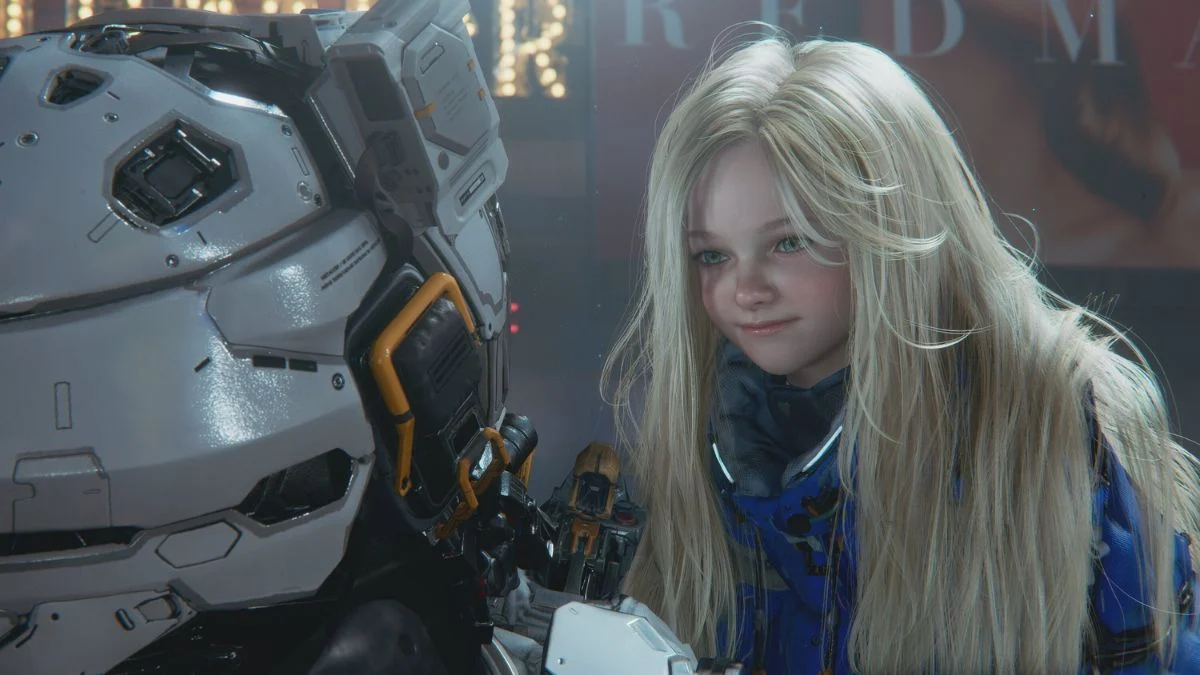
Since Pragmata launched to widespread acclaim in April 2026, one question has come up repeatedly in gaming communities: did Hideo Kojima make this? The sci-fi aesthetic, the mysterious android companion, and the cinematic style have drawn comparisons to Kojima’s work from players who had not looked into the game’s development. The answer is straightforward, however, it is worth understanding who actually made Pragmata and what the real story behind the game is.
Did Hideo Kojima Make Pragmata?
No. Pragmata was not made by Hideo Kojima. The game was developed and published entirely by Capcom, using their in-house RE Engine. Kojima Productions had no involvement in the game’s creation.
The director of Pragmata is Cho Yonghee, who also served as the game’s art director. The producers are Naoto Oyama, Edvin Edsö, and Masachika Kawata. The game was written by Haruo Murata and composed by Yasumasa Kitagawa. Pragmata represents Capcom’s first original franchise in eight years, developed by a team that included new staff at the studio rather than veterans of existing Capcom franchises.

Why Do People Think Kojima Made Pragmata?
The comparison is understandable. Pragmata shares several surface-level similarities with Death Stranding and other Kojima projects: a lone protagonist in advanced protective gear, a child-like companion with mysterious origins, a sci-fi setting with strong visual identity, and a tone that blends action with emotional storytelling. One Steam discussion thread even prompted a player to ask directly:
“Is this a Hideo Kojima game? It looks like Hideo Kojima made it.”
However, visual and thematic similarities between games do not indicate a shared creator. Capcom developed Pragmata entirely independently, and the team has spoken in detail about the game’s creative origins.
There is one genuine indirect connection worth noting. The animation director of Metal Gear Rising, a game developed under Kojima, later worked on Pragmata. However, this is a career connection rather than any creative collaboration with Kojima himself.
Who Actually Made Pragmata?
| Role | Name |
| Director | Cho Yonghee |
| Producers | Naoto Oyama, Edvin Edsö, Masachika Kawata |
| Writer | Haruo Murata |
| Composer | Yasumasa Kitagawa |
| Developer | Capcom |
| Publisher | Capcom |
| Engine | RE Engine |
World building in Pragmata was supervised by Shoji Kawamori, the creator of the Macross anime series, which helped shape the game’s distinct sci-fi aesthetic and near-future tone. Kawamori’s influence — he is also well known for his mecha design work on franchises like Armored Core — is central to why the game’s visual language feels so rooted in anime and Japanese sci-fi tradition. Capcom publicly thanked Kawamori following the game’s launch.
A Closer Look at Director Cho Yonghee
Cho Yonghee brings a rich and varied background to Pragmata. Before joining Capcom, he contributed to several landmark projects: he worked in the animation department on Metal Gear Rising: Revengeance, contributed weapon design and art to NieR: Automata, and served as art director on the Resident Evil 3 remake. His dual role as both director and art director on Pragmata reflects an approach to game-making that fuses visual identity with gameplay vision from the ground up — a sensibility that drew praise from figures like Yoko Taro, director of NieR: Automata, who celebrated the game’s release publicly.
What Is Pragmata and When Did It Release?
Pragmata is a single-player, third-person sci-fi action-adventure game set on a lunar research station. Players control spacefarer Hugh Williams and his android companion Diana as they fight through a facility overrun by hostile AI robots controlled by a rogue system called IDUS.
| Detail | Information |
| Developer | Capcom |
| Release Date | April 17, 2026 (PS5, Xbox Series X/S, PC, Switch 2 worldwide) |
| Japan Switch 2 Release | April 24, 2026 |
| Platforms | PS5, Xbox Series X/S, PC (Steam), Nintendo Switch 2 |
| Genre | Sci-fi action-adventure |
| Players | Single-player only |
| Rating | ESRB T |
You can purchase Pragmata via the PlayStation Store, Xbox Store, Steam, or Nintendo eShop depending on your platform. A free demo titled Pragmata: Sketchbook is also available across all platforms.

How the Game Actually Plays
Pragmata’s structure gives players a central hub — a shelter aboard the station — where they manage resources, upgrade their equipment, and prepare for each mission. The core loop blends third-person shooting with a real-time hacking system involving Diana, who acts as a strategic partner rather than simply a passenger. Players must coordinate combat and hacking in tandem, making encounters more tactical than a straightforward action game might suggest.
One of the most distinctive levels in the game, “Fake New York,” was intentionally designed to look as though it had been generated by AI. Human developers at Capcom spent significant time engineering distortions such as taxis sinking into floors and buses emerging from walls, while carefully balancing the visual strangeness so players would not mistake environmental anomalies for gameplay clues. It is a standout sequence that has drawn particular attention in post-launch coverage.
How Long Has Pragmata Been in Development?
Pragmata had one of the longer and more turbulent development histories in recent memory. Here is a timeline of the key milestones:
| Date | Event |
| June 11, 2020 | Pragmata announced during Sony’s PS5 reveal stream, targeting a 2022 release |
| January 2021 | Capcom delays the game to 2023 |
| June 2023 | Game delayed indefinitely with no new release window |
| June 2025 | Capcom announces 2026 release window at State of Play |
| December 2025 | Nintendo Switch 2 version confirmed, April 24 release date announced at The Game Awards |
| March 5, 2026 | Release date moved forward one week to April 17, 2026 |
| April 17, 2026 | Game launches worldwide on PS5, Xbox, and PC |
Development took roughly six years in total. Director Cho Yonghee confirmed that while the core vision of the game remained consistent throughout, the team went through extensive trial and error, particularly around the hacking puzzle system that became central to the gameplay. The team also faced significant challenges in conveying Diana’s android nature in a way that would resonate across different cultures — balancing her child-like presence against her robotic origins without stumbling into cultural missteps required careful iteration. Cho has spoken in interviews about the “difficult times” during the delay periods, though the team’s commitment to the project never wavered.
What Makes Pragmata Stand Out as a New IP?
Rather than borrowing from an existing franchise, Capcom built Pragmata from the ground up with new development staff. A few things set it apart technically and creatively:
The RE Engine was significantly updated for this project. Capcom implemented a strand-based hair rendering system to handle Diana’s long hair with physics-based simulation, a feature that required direct collaboration between the Pragmata team and RE Engine developers. This technology has since been adopted by other Capcom titles including Resident Evil Requiem.
Path tracing on PC was developed in partnership with Nvidia over 18 months, enabling cinematic-quality lighting described by Capcom as “reminiscent of high-end sci-fi films.” Path tracing is available exclusively on Nvidia GPUs due to the use of DLSS Ray Reconstruction, though basic ray tracing options are available more broadly.
The game’s sci-fi and anime inspirations run deep throughout — Kawamori’s Macross DNA is visible in the mecha design sensibility, and Cho’s own history working on projects like NieR: Automata gives the game a tone that feels informed by Japanese genre traditions while remaining accessible to a global audience.

How Has Pragmata Been Received?
The game launched to strong critical and commercial reception across all platforms:
| Aggregator | Score |
| Metacritic (PS5) | 86/100 |
| Metacritic (PC) | 87/100 |
| Metacritic (Xbox Series X/S) | 87/100 |
| Metacritic (Nintendo Switch 2) | 88/100 |
| OpenCritic | 95% of critics recommend |
| Steam user reviews | 97% positive |
Pragmata sold over one million copies worldwide in just two days after launch, a remarkable result for a completely original IP with no established fan base to draw from.
Individual review scores include a 9.5 from Destructoid, a 9 from GameSpot, a 9 from Shacknews, an 8 from IGN, and four stars from both Eurogamer and The Guardian.
Critics and players alike have noted that the game feels like a return to the kind of focused, single-player Capcom experience the studio built its reputation on — a sentiment that places Pragmata alongside Resident Evil Requiem and Monster Hunter Stories 3 as part of one of the stronger years in Capcom’s recent history.

The Bottom Line
Pragmata is entirely a Capcom game, directed by Cho Yonghee and built by a dedicated team using the RE Engine over six years of development. Hideo Kojima had no involvement in the project. The visual and thematic similarities some players notice reflect broader trends in sci-fi action games — and the influence of shared inspirations like anime and Japanese genre fiction — rather than any shared authorship. What Pragmata does represent is Capcom proving that a brand new IP with no established audience can launch successfully and resonate with players globally, which is an achievement worth recognising on its own terms.


Leave a Reply