

When news broke that Ayatollah Ali Khamenei, Iran’s Supreme Leader since 1989, had been killed in coordinated U.S.–Israeli airstrikes on 28 February 2026, the shockwaves were immediate and global.
Within hours, world leaders were issuing statements, Iranian state television anchors were visibly emotional on air, and geopolitical analysts were warning of regional escalation. By Saturday night in New York, the story had already reached American living rooms again — this time through satire — as Saturday Night Live opened its live broadcast with a sharply rewritten cold open addressing the unfolding crisis.
This is the full, verified breakdown of what happened, how governments around the world reacted, and how late-night television moved at lightning speed to process one of the most consequential geopolitical moments of 2026.
What Happened on 28 February 2026? Timeline of the Iran Strike and Khamenei’s Death

Reports confirmed that on 28 February 2026, coordinated military strikes carried out by the United States and Israel targeted high-ranking Iranian leadership. Among those killed was Ayatollah Ali Khamenei, Iran’s most powerful political and religious authority for nearly four decades.
Below is a structured summary of key confirmed developments:
| Date | Event | Key Figures | Official Reaction |
| 28 Feb 2026 | Coordinated U.S.–Israeli airstrikes on Iran | Ayatollah Ali Khamenei | Iranian state media confirms death |
| 28 Feb 2026 | Iranian national mourning declared | President Masoud Pezeshkian | 40-day mourning period announced |
| 29 Feb 2026 | Global diplomatic responses begin | Vladimir Putin, Kaja Kallas, Anwar Ibrahim, Shehbaz Sharif | Mixed condemnation, caution, geopolitical warnings |
| 1 Mar 2026 | Public reactions and protests emerge globally | Shia communities in western Uttar Pradesh | Demonstrations reported |
Iranian state media described the killing as a “criminal assault,” broadcasting coverage with visible grief. President Masoud Pezeshkian labelled it a declaration of war and promised consequences.
The Islamic Revolutionary Guard Corps (IRGC) vowed strong retaliation, warning that the United States and Israel “cannot hit and run.”
The international community immediately recognised that this was not merely a targeted strike — it was a pivotal geopolitical event.

Inside Iran: Mourning, Anger, and Divided Public Reaction
Within Iran, state television anchors were visibly emotional while announcing Khamenei’s death. A 40-day national mourning period was declared.
President Pezeshkian described the strike as a declaration of war against Muslims, framing it in religious and geopolitical terms. Iranian officials characterised Khamenei as a martyr and vowed retaliation.
However, observers reported a more nuanced domestic picture. While many mourned, small pockets of celebration reportedly emerged in certain cities — highlighting longstanding divisions within Iranian society regarding Khamenei’s leadership.
The emotional intensity of official broadcasts contrasted sharply with the complexity of public reaction, underscoring how transformative this moment could be for Iran’s political future.
Middle East and Muslim World Reaction: Hezbollah, Hamas and Regional Tensions
Groups aligned with Iran, including Hezbollah and Hamas, condemned the strike and expressed mourning.
They described the killing as aggression and called on Muslim and Arab states to respond.
Protests were reported among Shia communities in parts of western Uttar Pradesh in India, demonstrating how deeply the event resonated beyond Iran’s borders.
The fear across the region was not simply political instability — but escalation. With Iran’s regional influence stretching across Lebanon, Syria, Iraq and Gaza, analysts warned that retaliatory networks could trigger a wider confrontation.
Russia, China, UK and EU: How Major Powers Responded to Khamenei’s Killing
The reaction from global powers revealed sharp geopolitical divides.
Russia
Vladimir Putin condemned the killing as a “cynical violation of international law and human morality.” Moscow emphasised sovereignty concerns and international norms.
China
Beijing described the strike as a serious breach of Iran’s sovereignty and called for de-escalation.
European Union
EU foreign policy chief Kaja Kallas characterised Khamenei’s death as a defining moment for Iran but stressed that the Iranian people must determine their own future.
United Kingdom and France
Officials acknowledged Khamenei’s controversial legacy while warning of regional instability and urging restraint.
The European tone was cautious — neither celebratory nor openly endorsing the strike — instead focusing on stability and diplomatic containment.

United States and Israel: Justification and Strategic Framing
In Washington, President Donald Trump portrayed Khamenei as one of history’s most dangerous figures and justified the strike as necessary.
Israeli officials welcomed the outcome, arguing it dealt a significant blow to forces hostile to Israel.
For American audiences, particularly in the UK and US political space, the justification debate quickly became central: Was this a strategic necessity or a destabilising gamble?
That debate would not remain confined to news panels.
How Saturday Night Live Rewrote Its Cold Open to Address Iran in Real Time
By Saturday evening in New York, writers at Saturday Night Live were racing against the clock.
The show’s cold open — traditionally focused on the week’s biggest political story — had to respond to one of the most dramatic geopolitical developments in years.
How SNL Handles Breaking News
The writing process for SNL’s cold open is notoriously fluid:
- Writers monitor news throughout the week.
- Drafts are created based on expected political developments.
- If a major story breaks late — even Friday — the cold open may be rewritten entirely.
- Revisions can continue until dress rehearsal.
- Studio audience feedback influences final edits.
This rapid adaptation ensures the show remains culturally relevant, especially during crises.
The Iran Strike Cold Open: Satire Meets Escalation Fears
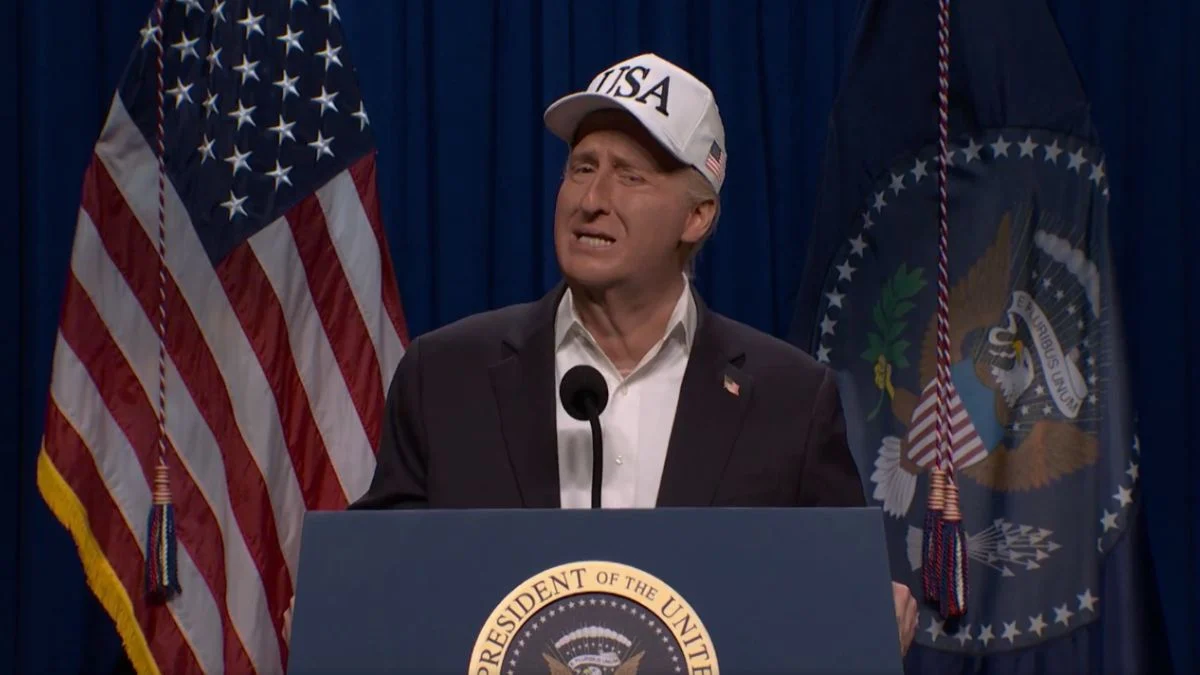
In the episode following the strike, SNL’s cold open directly addressed the Iran situation.
The sketch featured cast portrayals of political figures and referenced:
- The outbreak of conflict.
- The killing of Khamenei.
- Political messaging contradictions.
- Concerns about escalation.
The approach blended satire with commentary, focusing less on the violence itself and more on leadership rhetoric and public perception.
The show aimed to balance humor with sensitivity — a difficult line when global tensions are high.
Why This Matters to UK and US Audiences
For American viewers, the story raised immediate concerns about military escalation and foreign policy credibility.
For UK audiences, it reignited debates around:
- International law.
- NATO dynamics.
- Middle East stability.
- Energy security implications.
When SNL addresses such a story in real time, it reflects how deeply the event has penetrated public consciousness.
Late-night satire often serves as a cultural processing mechanism — helping audiences interpret political shock through humor.
Escalation Risks and What Comes Next
With the IRGC promising retaliation and global powers divided in response, analysts warn of:
- Proxy conflicts intensifying.
- Cyber warfare escalation.
- Energy market disruption.
- Diplomatic standoffs at the United Nations.
At the same time, some European officials cautiously noted that Khamenei’s death could represent a turning point for Iran’s internal political evolution — though outcomes remain uncertain.

From Tehran to Studio 8H: A World Reacts
The killing of Ayatollah Ali Khamenei is more than a headline — it is a geopolitical rupture with consequences that are still unfolding.
Inside Iran: mourning and anger.
Across the Middle East: tension and mobilisation.
In Moscow and Beijing: condemnation.
In Washington and Jerusalem: justification.
In London and Brussels: caution.
And in New York, under studio lights, writers worked until the final moments to reflect the shock, fear, and confusion of the week.
The world watched history shift in real time — and then watched satire attempt to make sense of it.
What happens next may shape the geopolitical landscape for years to come.


Leave a Reply