

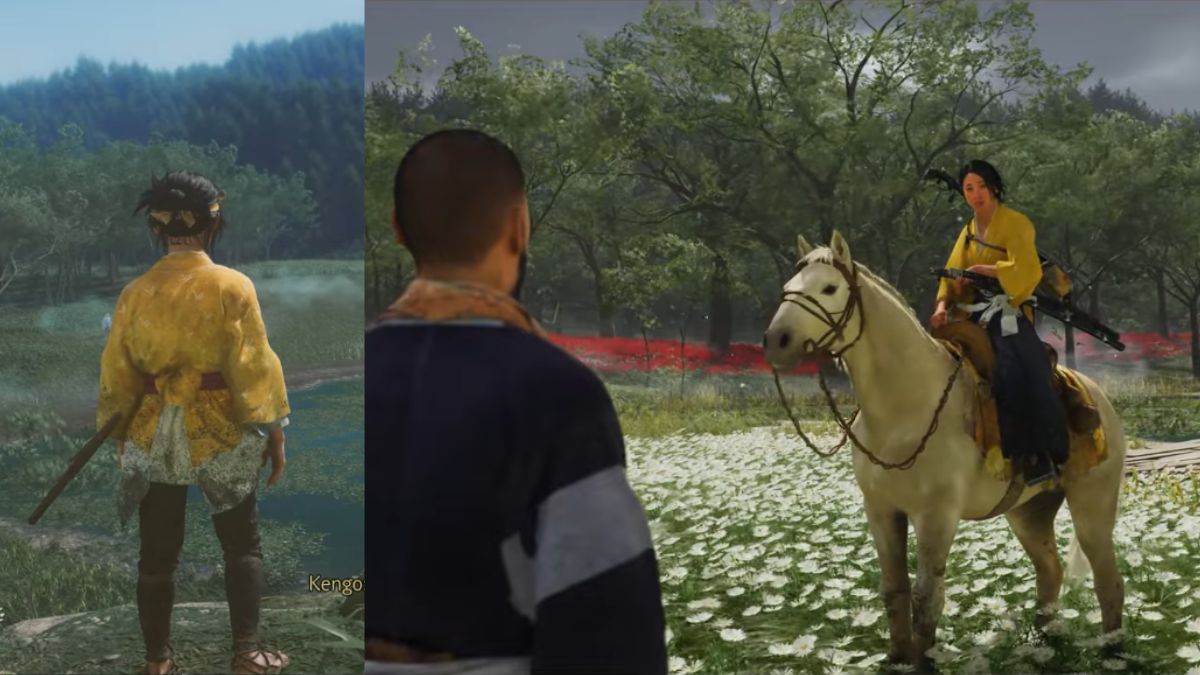
One of Ghost of Yotei’s earliest meaningful choices comes in the form of an easily missable side quest that lets you select a permanent mount companion. While Atsu begins her journey with a reliable white horse, the “Old Trails” quest offers an opportunity to choose from several different steeds—or stick with your original companion. This decision, though ultimately cosmetic, carries surprising emotional weight for many players who find themselves genuinely torn between loyalty and aesthetics.
In This Guide:
Quick Quest Overview
- Quest Name: Old Trails
- Location: West of Atsu’s childhood home, near Sarubetsu River
- Availability: After visiting Atsu’s home and triggering specific memories
- Quest Type: Missable side quest (can complete game without it)
- Difficulty: Low – Minimal combat encounter
- Primary Reward: Choice of permanent horse mount
- Secondary Rewards: Charm of Bountiful Harvest, Trophy “Naming a Friend”
- Important Note: This is your only opportunity to change horses
Understanding Old Trails: A Missable Opportunity
What makes Old Trails unique among Ghost of Yotei’s side content is its hidden nature. The game never explicitly tells you this quest exists—there’s no quest marker waiting at your home, no NPC urgently requesting your attention. Instead, the quest emerges organically from exploring Atsu’s past, rewarding players who take time to engage with the memory system rather than rushing through main objectives.
Can You Complete the Game Without This Quest?
Absolutely. Atsu’s starting horse remains perfectly functional throughout the entire campaign. The white steed you begin with offers identical performance to any horse you might choose later, and many players complete their entire playthrough without ever discovering the stables.

Triggering the Old Trails Quest

Starting Point: Atsu’s Childhood Home
The quest becomes available after you reach Atsu’s childhood home as part of the main story progression. This location sits in the southeastern region of the map, serving as an emotional anchor for Atsu’s narrative arc. The home itself bears the scars of tragedy, but scattered throughout the property are memory fragments that let you experience moments from Atsu’s past.
The Critical Memory Trigger
To unlock Old Trails, you need to relive specific memories at the home. The quest doesn’t activate through just any memory—you must experience the one where Atsu tells Jubei she’s meeting their father at the stables. For many players, this trigger occurs after revisiting the memory near the tree where Atsu recalls Jubei burying money, though the exact sequence can vary based on exploration patterns.
How to Identify the Right Memory:
- Look for memory triggers (shimmering visual effects) around the property
- The relevant memory involves dialogue between Atsu and her sibling Jubei
- Atsu specifically mentions the stables and her father in this memory
- The conversation has a casual, everyday quality rather than dramatic tension
Quest Activation Confirmation:
When you exit the correct memory, watch the bottom of your screen. A stylized horse card will appear momentarily, confirming that Old Trails has activated. Simultaneously, your map updates with a new point of interest marker positioned just west of Atsu’s home. This marker bears no quest name initially—it simply prompts you to “find the stables,” maintaining the quest’s organic, discovery-based nature.

Journey to the Stables: Navigation Guide
Location Details
Geographic Position:
- West of Atsu’s childhood home
- Between Sarubetsu River and Shikotsu River
- On the western side of Sarubetsu River, before reaching Shikotsu River
- Appears as a house-like structure on the edge of an open field
Navigation Steps:
- Open your map and locate the unnamed point of interest west of home
- Head west from Atsu’s property toward Sarubetsu River
- Cross the river using available fording points or bridges
- Continue west but stop before reaching Shikotsu River
- Look for a building resembling a farmhouse adjacent to an open field
Visual Landmarks: The stables don’t look like traditional horse barns you might expect. Instead, the structure resembles a settler’s home with attached fencing and field space. The open area where horses graze is the key identifier—you’ll spot the field before you see the building clearly. A wanted poster near the entrance provides confirmation you’ve reached the correct location.
Initial Exploration
Before the quest’s main events trigger, take a moment to explore the immediate area. The wanted poster near the entryway can be examined for additional context about the region’s lawlessness. Inside the structure, you might find minor supplies or environmental details that flesh out the settler’s life. However, the quest truly begins when you approach the open field where horses graze.
The Stables Encounter: Combat and Memories
Meeting the Stable Master
As Atsu approaches the field, she’ll comment on a horse running wild—an observation that serves as the narrative trigger for what follows. The stable master, a settler trying to maintain his livelihood in dangerous territory, emerges to greet you. This brief introduction establishes the character’s vulnerability and sets up the interruption that follows.

Lord Saito’s Men: Combat Encounter
The peaceful moment shatters when several of Lord Saito’s soldiers arrive, seeking new mounts for their forces. This encounter introduces the quest’s only combat sequence, though it remains manageable even for players still learning the game’s systems.
Combat Approach Options:
Stealth Assassination Route:
- Immediately move to nearby bushes when soldiers appear
- The game provides tall grass and vegetation for concealment
- Wait for soldiers to disperse slightly rather than standing in a group
- Target isolated enemies with assassination prompts (approach from behind, press Square)
- Eliminate the group silently one by one to avoid alerting others
- This method rewards patience and observation of patrol patterns
Direct Combat Route:
- Rush the soldiers as they arrive and engage in open melee combat
- The group typically consists of 3-4 standard enemies
- Use basic combos, parries, and dodges to overwhelm them
- Focus on one enemy at a time to prevent being surrounded
- Quickfire weapons like kunai can help control spacing
- This approach is faster but more chaotic, suitable for confident players
Combat Tips:
- The soldiers aren’t particularly tough compared to later encounters
- They employ basic attack patterns without complex unblockables
- Perfect parries will stagger them quickly for counterattack opportunities
- The stable master won’t engage in combat—he’s purely a civilian
- Environmental hazards are minimal, so focus on the enemies themselves
Return to the Settler: Triggering the Memory
After defeating Lord Saito’s men, the stable master expresses gratitude for your intervention. Follow him as he leads you away from the immediate area toward a nearby pond. This walk provides a moment of calm after the violence, allowing the narrative to shift from action to reflection.

Upon reaching the pond, the environment shimmers and transforms—you’re pulled into another of Atsu’s childhood memories. This flashback sequence forms the emotional core of the Old Trails quest, revealing a treasured moment between Atsu and her father Kengo.
The Memory Sequence: Following Kengo’s Trail
Investigating the Horse Manure
The memory begins with young Atsu near the pond. Your first objective involves locating and inspecting horse manure on the ground—a humble but practical detail that grounds the flashback in everyday reality. This isn’t a dramatic moment; it’s teaching a child basic tracking skills.

What to Do:
- Scan the ground near where you appeared in the memory
- Look for the distinct visual indicator marking the horse droppings
- Interact with them to examine (press R3 or the examine button)
- Notice how Kengo explains what fresh tracks look like
Once examined, horse tracks become visible, creating a trail you can follow. These tracks lead around the pond toward the opposite side, where Kengo awaits with further instruction. The act of following these tracks mirrors the tracking mechanics you use throughout Ghost of Yotei’s exploration, creating a nice meta-textual moment where you learn alongside young Atsu.
The Mound and Kengo’s Discussion
Following the tracks brings you to a small mound or raised area where Kengo stands. As you approach, he engages young Atsu in conversation about a “charm”—this dialogue foreshadows a collectible you’ll obtain at the quest’s conclusion.
Key Dialogue Elements:
- Kengo speaks about leaving something special at this location
- The charm represents a connection between father and daughter
- His tone is warm and instructional, showing their close relationship
- This memory predates the tragedy that destroyed Atsu’s family
The conversation reveals Kengo as a thoughtful, caring father who took time to share skills and create meaningful moments with his daughter. For players invested in Atsu’s narrative, this glimpse into her past adds depth to her present-day quest for justice and closure.
Climbing the Rock Formation
After the conversation at the mound concludes, Kengo directs young Atsu to climb a nearby rock formation. This section tests basic traversal skills in a low-stakes environment, though the memory won’t fail if you struggle with the climbing.
Climbing Process:
- Approach the rock formation Kengo indicates
- Look for ledges and handholds marked with white paint or natural variations
- Jump and grab onto the first handhold
- Climb upward using the analog stick and jump button
- Reach the top where a flat area provides a vantage point
Once at the summit, wait for Kengo to speak to Atsu again. He shares wisdom about perspective—how viewing things from different heights changes your understanding. This simple lesson carries thematic weight, mirroring Atsu’s journey of seeing her past and present from new angles as she travels through Ezo.
Returning to the Stable Master
The final step in the memory sequence requires you to make your way back to where the stable master stood at the memory’s beginning. The exact path doesn’t matter—the objective simply asks you to return to that general area. As you approach, the memory begins to fade, transitioning back to the present day at the pond.
This conclusion reinforces that the flashback serves as both character development and narrative bridge. You’ve experienced a moment of peace from Atsu’s childhood, providing contrast to the violence and loss that define her current circumstances.
The Horse Selection: Your Choice Matters (Sort Of)

The Moment of Choice
As the memory fades and present-day Atsu returns to focus, she whistles—a clear, sharp sound that carries across the field. In response, horses gallop into view, assembling in the clearing before you. This cinematic moment frames the choice with appropriate significance, even though the mechanical differences prove minimal.

Available Horse Options
Standard Edition Horses (Three Choices):
1. White Horse (Your Starting Mount)
- The horse Atsu began the game with
- Clean white coat with subtle variations in shading
- Represents continuity and loyalty to your original companion
- Atsu’s comment: Acknowledges the bond already formed through shared experiences
- Player sentiment: Many choose this option feeling guilty about abandoning a loyal friend
2. Black Horse
- Solid black coat that catches light dramatically
- Atsu’s comment: Reminds her of the coals from her father’s forge
- Thematic connection: Links to Kengo through the blacksmith imagery
- Player sentiment: Popular choice for those wanting a visual connection to Atsu’s motivation and heritage
- The forge connection also subtly references the flames that destroyed her home, creating bittersweet symbolism
3. Dappled Horse
- Gray coat with distinctive dappling pattern resembling storm clouds
- The most visually unique option with varied coloration
- Atsu’s comment: Notes the pattern’s beauty and wild nature
- Player sentiment: Appeals to those wanting something different from typical horse colors
- The graphics showcase the dappling pattern particularly well, with individual spots visible during gameplay
Digital Deluxe Edition Exclusive:
4. Brown Horse
- Reddish-brown coat with blonde mane and tail
- Only available to Digital Deluxe Edition owners
- Replaces the standard white horse as the default mount for deluxe players
- Atsu’s comment: Similar appreciation for strength and reliability
- Creates a visual distinction for premium edition owners
Horse Stats: The Truth About Performance
Here’s the critical information that might surprise you: all horses perform identically. There are no hidden stats differentiating the horses from one another. Speed, stamina, handling, bravery—every performance metric remains constant regardless of which horse you select.
What This Means:
- Your choice is purely aesthetic and emotional
- No competitive advantage or disadvantage exists
- The “best” horse is simply the one you like looking at
- Gameplay remains unchanged regardless of selection
This design decision prioritizes player expression over min-maxing. Ghost of Yotei wants you to choose based on personal preference, roleplay considerations, or emotional connection rather than worrying about optimal stats. It’s a refreshing approach that respects both casual and serious players equally.
Making Your Decision: Factors to Consider
Roleplay Considerations:
The game encourages you to approach this choice through Atsu’s perspective. Press R2 while standing near each horse to hear Atsu’s thoughts about them. These comments provide personality and context, helping you make a decision that feels right for your interpretation of the character.
Emotional Weight:
Many players report genuine difficulty choosing, particularly when considering the white horse. You’ve already spent time with this mount—saving it from Snake’s soldiers early in the game, riding through dangerous territory together, forming an unspoken bond. Choosing a different horse feels like abandonment to some players, even though it’s just pixels and code.
Conversely, selecting a new horse can symbolize Atsu’s growth and change. She’s not the same person who began this journey, so perhaps her mount should reflect that evolution.
Visual Preference:
Since performance is identical, visual appeal becomes paramount. Consider:
- Which color complements Atsu’s armor and clothing
- How the horse looks in different lighting conditions and weather
- Whether you prefer subtle elegance (white) or dramatic contrast (black)
- If unique patterns (dappled) appeal more than solid colors
Naming Your Horse: The Final Personal Touch

After selecting your mount, Atsu must choose a name. The game provides three traditional Japanese options, each carrying specific meaning and symbolism.
Name Options and Meanings
Shimaki (Tornado):
- Represents speed, force, and untamed natural power
- Evokes the guiding wind mechanic central to Ghost of Yotei’s gameplay
- Best suited for: Dappled horse (storm imagery) or players who value the wind as a thematic element
- Character interpretation: Suggests Atsu sees her journey as a force of nature, unstoppable and fierce
Mochizuki (Full Moon):
- Symbolizes beauty, completeness, and illumination in darkness
- Creates poetic contrast with Atsu’s role as a warrior in shadow
- Best suited for: White horse (visual match) or black horse (contrast symbolism)
- Character interpretation: Implies hope and clarity amid the darkness of revenge and violence
- Popular choice among players for its aesthetic sound and deeper meaning
Homura (Flame):
- Represents passion, destruction, and transformation through fire
- Direct connection to the burning of Atsu’s home and family
- Best suited for: Black horse (forge connection) or players embracing revenge themes
- Character interpretation: Channels Atsu’s burning desire for justice into her mount’s identity
- Creates bittersweet reminder of loss while symbolizing her determination
Name Selection Philosophy
Like the horse choice itself, naming carries no mechanical impact. The name appears occasionally in dialogue and when you summon your mount, but it doesn’t affect gameplay. Choose based on what resonates emotionally or what sounds most appealing to you.
No Fourth Name for Deluxe Edition:
Interestingly, Digital Deluxe Edition owners receive an exclusive horse option but no unique name. The three naming choices remain constant across all editions, suggesting the developers wanted naming to feel universal regardless of purchase tier.
Quest Completion and Rewards
Trophy Unlocked: “Naming a Friend”
Once you’ve selected and named your horse, the game awards the “Naming a Friend” trophy. This achievement marks the official completion of Old Trails, though the quest name itself only appears in your journal after this moment—a quirky design choice that reinforces the organic, discovery-based nature of this side story.

The Quest Name Reveal
Only after completing all objectives does “Old Trails” actually register as a named quest in your journal. Prior to this, it existed as an unmarked series of objectives triggered by environmental exploration. This unusual approach makes Old Trails feel more like a natural discovery than a checked-off task.
Additional Rewards: Don’t Leave Yet
The Old Trails quest offers more than just horse selection. Before leaving the stables area, take time to collect two valuable items revealed during Atsu’s flashback.
Charm of Bountiful Harvest
Location: The tree trunk from Atsu’s memory, near where Kengo spoke about leaving something special
Return to the mound area where Kengo discussed the charm during your flashback. Look for a distinctive tree trunk—it’s the same location young Atsu visited during the memory sequence. Interact with it to receive the Charm of Bountiful Harvest.
Charm Benefits:
- Increases the amount of wood collected when chopping trees
- Boosts flower yields when gathering from plants
- Enhances general plant material collection
- Essential for players who craft frequently or want to upgrade gear efficiently
This charm proves particularly valuable in the early-to-mid game when resources feel scarce and every upgrade requires significant material investment. The increased gathering efficiency saves considerable time over a full playthrough, making this a reward that impacts gameplay far more than the horse selection itself.
Shadow of Yōtei Hot Spring
Location: In the vicinity of the stables, near the pond from Atsu’s memory
While exploring the area, watch for steam rising from water—this indicates a hot spring location. The Shadow of Yōtei hot spring sits nearby, offering immediate and permanent benefits.
Hot Spring Benefits:
- Increases Atsu’s maximum health permanently
- Provides immediate full healing upon first visit
- Adds to your overall health pool for the remainder of the game
- No cost or resource requirement—simply discover and bathe
Hot springs represent one of Ghost of Yotei’s most valuable collectibles. Each one you discover makes Atsu more resilient, allowing you to survive encounters that might otherwise prove lethal. Since you’re already in the area for Old Trails, claiming this hot spring requires minimal extra effort while providing substantial benefit.
Strategic Timing: When to Complete Old Trails
Early Game Benefits
Old Trails becomes available relatively early in Ghost of Yotei’s campaign, shortly after reaching Atsu’s childhood home. Completing it immediately offers several advantages:
Immediate Rewards:
- Claim the Charm of Bountiful Harvest before you’ve gathered many materials, maximizing its impact
- Increase your health via the hot spring when it matters most for survival
- Select your preferred horse early, ensuring your entire playthrough features your chosen mount
- Unlock the trophy early for completion-focused players
Emotional Investment: Choosing your horse early means you spend more time bonding with that specific mount, making the choice feel more meaningful over dozens of hours of gameplay.
Late Game Considerations
Some players prefer to delay Old Trails until they’ve explored more of the game:
Knowledge-Based Choice:
- Experience different lighting conditions and environments before choosing horse color
- Better understand your playstyle and whether you prefer subtle or bold aesthetics
- Make a more informed decision about which horse “fits” your version of Atsu
No Penalty for Waiting: The quest doesn’t disappear or become more difficult if delayed. Your starting white horse remains viable, and Old Trails waits patiently whenever you’re ready to engage with it.
More Ghost of Yotei Guides for You:


Leave a Reply