

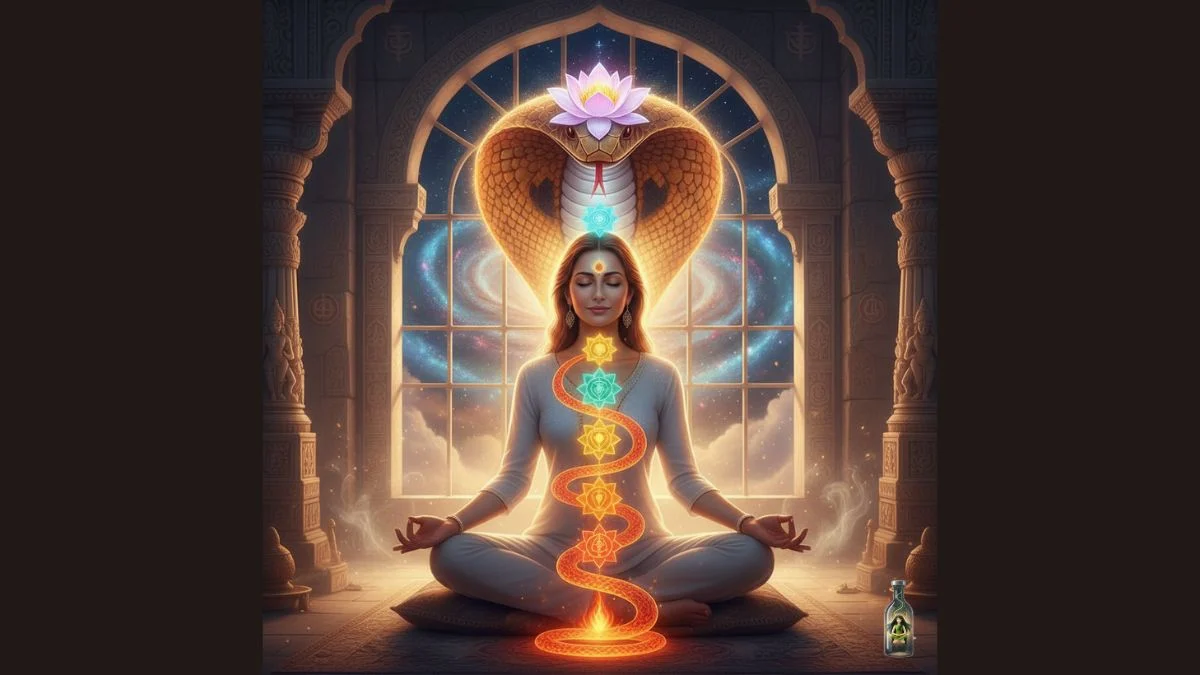
The Hidden Power at the Base of Consciousness
Across ancient temples, yogic traditions, and modern spiritual conversations, one idea continues to fascinate seekers worldwide: Kundalini Shakti. Often described as a dormant spiritual force within the human body, Kundalini represents the potential for profound transformation, expanded awareness, and union with the divine. In an era where mindfulness, yoga, and spiritual self-discovery are gaining renewed global attention, Kundalini remains both deeply ancient and strikingly relevant.
Rooted in Hindu philosophy and later adopted across yogic, tantric, and modern spiritual movements, Kundalini is not merely a metaphor—it is a central pillar of India’s esoteric spiritual heritage that continues to shape global consciousness practices today.
In This Post:
What Is Kundalini? Understanding the Core Concept

Kundalini is a foundational concept in Hindu spiritual traditions, symbolizing a form of divine feminine energy known as Shakti. This energy is believed to lie dormant at the base of the spine, specifically in the Muladhara (root) chakra, coiled like a serpent.
When awakened, Kundalini energy ascends through the sushumna nadi, the central channel of the subtle body, activating various chakras along the spine. This upward movement is said to result in spiritual enlightenment, heightened awareness, blissful states, and ultimately, union with the divine consciousness.
While the awakening process is associated with mystical experiences such as visions, profound joy, and intuitive insight, traditional texts caution that it also carries risks if approached without proper preparation or guidance. Over centuries, this concept has deeply influenced yogic, tantric, and meditative practices, later evolving into modern spiritual interpretations worldwide.
The Meaning Behind the Word “Kundalini”: Etymology and Symbolism

The term “Kundalini” originates from the Sanskrit word “kuṇḍalinī,” meaning coiled, circular, or ring-shaped. The imagery reflects a serpent resting in a spiral, symbolizing latent power and potential.
Linguistically, the word derives from “kuṇḍa,” meaning a bowl or vessel. Early historical usage appears in the 12th-century Rajatarangini, while by the 8th century, texts such as the Tantrasadbhava Tantra described Kundalini as “she who is ring-shaped,” associating her with the goddess Durga.
Over time, Kundalini evolved from poetic symbolism into a technical spiritual term, representing latent cosmic energy. Within Hinduism, it is regarded as the feminine aspect of the Divine, embodying creativity, compassion, and dynamic force, often linked with Shakti, Parvati, or Adi Parashakti.
Ancient Indian Origins: How Kundalini Emerged in Spiritual History
The roots of Kundalini trace back to ancient Indian spiritual traditions, gaining prominence within Shaiva Tantra and Shakta sects around the 8th century CE, although related concepts appeared earlier.
The Tantrasadbhāva-tantra is the first known text to explicitly describe Kundalini as a coiled power linked to Shakti and consciousness. The concept reflects tantric philosophy’s goal of unifying mind and body to achieve liberation.
Renowned tantric philosopher Abhinavagupta (10th–11th century) described two expressions of Kundalini:
- An upward-expanding force driving spiritual ascent
- A downward-contracting force associated with worldly experience
By the 9th century, Kundalini became integrated into Hatha Yoga, and by the 16th century, it appeared extensively in Yoga Upanishads. Western awareness expanded in the early 20th century through translations such as Sir John Woodroffe’s The Serpent Power, introducing Kundalini to global spiritual discourse.
Kundalini in Sacred Hindu Texts: Scriptural Evolution from the Vedas to the Yoga Upanishads

References to Kundalini appear across a broad range of Hindu scriptures, developing gradually from symbolic metaphysical ideas into precise yogic and tantric doctrines. Rather than originating in a single moment or text, Kundalini represents a continuous refinement of ancient Indian understandings of energy, consciousness, and liberation.

Vedic Foundations: Prana, Agni, and Inner Sacred Fire
The Vedas (c. 1500–500 BCE) do not explicitly use the term Kundalini, yet they establish the energetic worldview from which the concept later emerged. Central to Vedic thought is prana, the vital life force that sustains both the cosmos and the individual (Rig Veda 1.164.15).
The inner fire (Agni) is repeatedly described as dwelling within the human being, not merely in ritual altars. The Rig Veda speaks of Agni as “hidden in the secret place” (Rig Veda 3.1.3), a phrase later interpreted by yogic commentators as referring to internal spiritual heat.
The Atharva Veda introduces early references to bodily channels and life currents, describing the movement of vital energy within the human frame (Atharva Veda 10.2.31). Concepts such as tapas (inner heat) and breath regulation appear as early precursors to later Kundalini physiology.
Upanishadic Philosophy: Subtle Body, Energy Ascent, and Moksha
The Upanishads (c. 900–700 BCE) shift focus from external ritual to inner realization, forming the philosophical backbone of Kundalini theory. The Brihadaranyaka Upanishad describes prana as the force that holds the body and mind together (Brihadaranyaka Upanishad 1.3.7).
The Katha Upanishad presents one of the earliest symbolic models of inner ascent, describing the body as a chariot and the Self as its master (Katha Upanishad 1.3.3–9), implying a hierarchy of inner control that later aligns with chakra-based ascent.
More explicitly, the Shvetashvatara Upanishad outlines yogic techniques central to Kundalini awakening, including breath restraint, spinal alignment, and inward concentration (Shvetashvatara Upanishad 2.8–10). It also speaks of a divine power hidden within the individual that leads to liberation when realized (Shvetashvatara Upanishad 1.3).
While the term Kundalini is not consistently used, these texts clearly establish the necessity of an inner rising force for achieving moksha.
Tantric Revelation: Kundalini as Shakti and Goddess Power

Kundalini becomes explicitly defined in Shaiva and Shakta Tantric texts (7th–11th century CE). The Tantrasadbhāva Tantra describes Kundalini as a coiled Shakti residing at the base of the spine, the source of both worldly experience and liberation (Tantrasadbhāva Tantra 13.28–30).
The Śaradatilaka Tantra (11th century) identifies Kundalini with Durga and Kubjika, portraying her as the living goddess within the subtle body (Śaradatilaka Tantra 1.105–110). Her ascent through the chakras via the sushumna nadi is described as the means by which the practitioner attains union with Shiva.
Tantric master Abhinavagupta elaborates on Kundalini’s dual movement in the Tantraloka, describing:
- Unmeṣa (upward expansion) toward transcendence
- Nimeṣa (downward contraction) toward manifestation
(Tantraloka 5.82–85)
This framework presents Kundalini as both cosmic creative force and individual spiritual power.
Yoga Upanishads and Hatha Yoga Texts: Precise Yogic Science
By the 16th century, Kundalini doctrine appears in detailed, technical form within the Yoga Upanishads. The Yoga-Kundalini Upanishad describes Kundalini as a serpent power coiled three-and-a-half times at the Muladhara chakra, whose awakening leads to enlightenment (Yoga-Kundalini Upanishad 1.82–90).
The Shandilya Upanishad and Varaha Upanishad further explain the purification of nadis and the piercing of chakras (Shandilya Upanishad 1.10.1–12).
Classical Hatha Yoga texts provide practical methodologies:
- The Hatha Yoga Pradipika states that awakening Kundalini is essential for Raja Yoga (Hatha Yoga Pradipika 3.1–5).
- The Shiva Samhita describes Kundalini rising through the central channel to confer divine knowledge (Shiva Samhita 5.82–90).
- The Gorakṣaśataka outlines mudras and bandhas specifically intended to raise Kundalini (Gorakṣaśataka 10–14).
Modern Spiritual Interpretation Rooted in Scripture
Modern spiritual teachers reinterpreted Kundalini using classical sources. Swami Vivekananda described it as a dormant power at the base of the spine rising through the chakras (Raja Yoga, Lectures 6–7).
Paramahansa Yogananda identified Kundalini with a divine current flowing through the cerebrospinal axis (Autobiography of a Yogi, Chapter 26).
Later thinkers such as Gopi Krishna framed Kundalini as an evolutionary force, while Sri Aurobindo expanded the doctrine to include the descent of higher consciousness (The Synthesis of Yoga, Part I).
A Continuous Scriptural Tradition
From the symbolic fires of the Rig Veda to the precise yogic manuals of the Yoga Upanishads, Kundalini emerges as a continuous inner science, refined across millennia. It represents one of the most sophisticated spiritual models ever developed—uniting metaphysics, physiology, psychology, and liberation into a single transformative path.
Kundalini Across Hinduism, Yoga, and Tantra

Shaktism: The Source of All Power
In Shaktism, Kundalini is the ultimate source of energy, bliss, mantras, and cosmic creation, representing the living presence of the goddess within the human body.
Shaivism: Union with Shiva
Shaiva traditions view Kundalini as the force enabling union with Shiva, achieved through rituals, pranayama (breath control), mantra chanting, and meditation.
Yoga Traditions: Purification and Enlightenment
Hatha Yoga and Kundalini Yoga emphasize awakening this energy to purify the body and mind, integrating tantric methods to harmonize physical and spiritual dimensions.
Tantra: Transcending Duality
Tantric paths, including Kaula traditions, focus on Kundalini awakening to transcend duality, sometimes through ritualistic or symbolic sexual practices.
Modern thinkers such as Gopi Krishna and Sri Aurobindo linked Kundalini with prana, moral evolution, and even the descent of divine consciousness.
Awakening Kundalini: Practices, Chakras, and Inner Transformation
Kundalini awakening is traditionally approached through disciplined spiritual practice, including:
- Asanas (yogic postures)
- Pranayama (breath regulation)
- Bandhas (energy locks)
- Mudras (symbolic gestures)
- Meditation and mantra chanting
In some traditions, awakening occurs through shaktipat, the transmission of spiritual energy from a realized guru.
As Kundalini rises, it activates the chakras, producing experiences such as insight, visions, heightened awareness, and bliss, culminating in union at the Sahasrara (crown) chakra.
Texts caution that improper awakening may result in “Kundalini syndrome,” involving physical or psychological disturbances, emphasizing the need for preparation and guidance.
Kundalini Beyond Hinduism: Global Spiritual Parallels
Although rooted in Hinduism, Kundalini-like concepts appear across world traditions:
- Buddhism: Vajrayana practices such as Tummo (inner heat) work with energy channels and chakras to generate bliss and realization.
- Taoism: Qi (Chi) functions as a vital life force cultivated through Qigong, paralleling Kundalini’s flow.
- Christian Mysticism: Symbolism like the serpent, breath of life, and the Holy Spirit’s descent at Pentecost is sometimes interpreted as Kundalini-like awakening.
- Islamic Sufism: Lataif (subtle centers) resemble chakras, though interpretations differ.
- Judaism (Kabbalah): The Tree of Life and divine emanations echo ascending spiritual energy.
- Psychology: Carl Jung viewed Kundalini as symbolic of individuation and unconscious transformation.
Why is the Concept of Kundalini Still Relevant Today?
Kundalini remains a bridge between personal transformation and cosmic understanding, connecting ancient Indian wisdom with modern spiritual exploration. Its enduring presence across cultures highlights humanity’s shared quest for meaning, balance, and transcendence.
The Timeless Power of Kundalini Shakti
From the earliest tantric scriptures to contemporary global spirituality, Kundalini Shakti stands as one of the most profound concepts in human spiritual history. It represents not only latent energy within the body but also the possibility of awakening higher consciousness, compassion, and unity.
As interest in yoga, meditation, and inner transformation continues to grow worldwide, Kundalini remains a timeless reminder that the journey to the divine often begins within.
More Interesting Reads:


Leave a Reply