

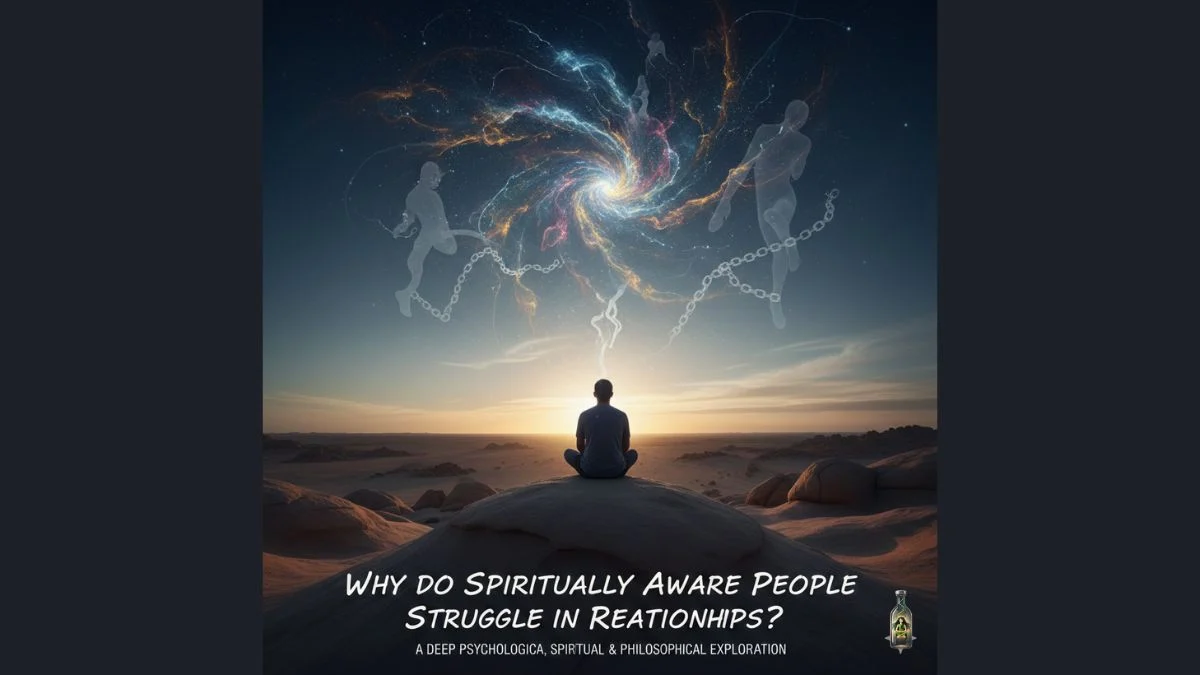
Why Does Awakening Feel Like It Changes Everything—Including Love?
Spiritually aware individuals—often described as those who have experienced a spiritual awakening, pursued enlightenment, or cultivated heightened self-awareness—frequently encounter unexpected difficulties in romantic relationships. While awakening is often portrayed as a path to peace, clarity, and love, many find that intimacy becomes more complex rather than easier.
This struggle does not arise from emotional incapacity or detachment. Instead, it stems from profound shifts in perception, values, emotional processing, and interpersonal dynamics. As awareness deepens, relationships are no longer approached through habit, illusion, or unconscious need—but through truth, presence, and responsibility. And that shift can feel destabilizing, both for the individual and their partner.
To fully understand why spiritually aware people struggle in relationships, we must look through three deeply interconnected lenses: psychological, spiritual, and philosophical. Each perspective reveals a layer of tension between inner evolution and shared intimacy—and together, they tell a nuanced story about love, growth, and human connection.
In This Post:

What Happens Psychologically When Awareness Rewrites the Rules of Love?

From a psychological perspective, spiritual awareness often triggers intense internal transformation. Heightened introspection, emotional sensitivity, and deep self-inquiry become central to daily life. While these qualities foster growth, they can disrupt conventional relationship patterns built on routine, compromise, or unspoken expectations.
One of the most common challenges is a sudden intolerance for inauthenticity. After a spiritual awakening, individuals often struggle to maintain superficial or performative relationships. Interactions that once felt normal may now feel hollow or “fake.” As a result, spiritually aware people may lose friends or romantic partners—not because of rejection, but because they prioritize genuine connection over convenience or social comfort.
This aligns closely with psychological concepts such as shadow work, where individuals confront unconscious patterns, suppressed emotions, and unresolved wounds. Carl Jung’s ideas on conscious love emphasize that awakened individuals must integrate their shadows, making ego-driven or illusory romances deeply unsatisfying. Relationships that avoid emotional depth or self-examination can feel psychologically draining rather than nourishing.
Why Does Emotional Sensitivity Make Dating Feel Harder, Not Easier?

Spiritual awareness often sharpens intuition and emotional perception. While this can enhance empathy, it can also lead to overthinking, caution, and emotional complexity—especially in romantic contexts.
Spiritually aware individuals may approach dating analytically, sensing subtle emotional undercurrents, unspoken tensions, or unresolved trauma in potential partners. This heightened awareness can create internal conflict between the instinctive flow of love and a cautious mind seeking emotional safety.
For spiritually attuned women in particular, there is often a deep need for energetic and emotional protection. When partners project unresolved chaos, instability, or emotional volatility, these women may be pushed into survival mode rather than openness. Instead of feeling held, they feel required to self-regulate both themselves and the relationship, which blocks intimacy.
Additionally, relationships are sometimes unconsciously used as coping mechanisms—to escape unresolved grief, loneliness, or inner turmoil. Rather than serving as spaces for mutual evolution, these connections become distractions from personal growth, breeding chaos instead of clarity.
Can Growth Become a Source of Relationship Conflict?
Yes—and often, it does.
Compatibility issues arise when one partner’s appetite for growth far outpaces the other’s. A spiritually aware, growth-oriented individual may begin to view a comfort-seeking partner as a limitation. Over time, this imbalance can create resentment, repression, or emotional stagnation.
Psychologically, this conflict may manifest as anxiety, emotional exhaustion, or even physical symptoms, as the body mirrors unresolved inner tension. The awakened individual experiences cognitive dissonance—the psychological discomfort that arises when thoughts, emotions, and actions no longer align. When personal evolution feels restricted by a relationship, the strain intensifies.
Time constraints also add pressure. Spiritual practices such as meditation, reflection, solitude, and self-study demand energy and presence. When relational expectations compete with inner work, relationships may feel like obstacles rather than support systems.
Spiritually Speaking, Why Does Love Feel So Different After Awakening?
From a spiritual perspective, awakening fundamentally alters how love, selfhood, and attachment are perceived. Ego-based needs dissolve, revealing a sense of inner completeness that transforms relational dynamics.
One of the most significant shifts is the incompatibility between wholeness and neediness. Spiritually aware individuals no longer seek relationships to fill emotional voids. Traditional “falling in love,” often driven by dependency, fantasy, or emotional games, becomes nearly impossible. Awareness exposes illusion, making superficial dating dynamics feel misaligned.
This clarity can make it difficult to find partners who resonate at the same level of authenticity. Even spiritual concepts like twin flames or soul mates, when overemphasized, can block love by creating unrealistic expectations or spiritual bypassing.

Why Do Awakened People Often Lose Relationships Along the Way?
As consciousness expands, relationships built on shared identities, habits, or ego structures may begin to dissolve. Spiritually aware individuals no longer identify primarily with mental constructs, instead perceiving others as souls rather than roles.
This shift can be deeply unsettling for partners who resist change. Shared frameworks break down, creating discomfort or distance. Many awakened individuals lose friends or romantic relationships—not out of superiority, but because mutual evolution is no longer present.
In contrast, holy or spiritual relationships emphasize shared growth. These partnerships function as mirrors, encouraging accountability, responsibility, and emotional maturity. Intimacy becomes a tool for evolution rather than escapism.
Can Loneliness Be a Spiritual Lesson Rather Than a Failure?
Yes—but only when understood correctly.
Over-focusing on love as a need can distract from spiritual paths, creating imbalance. Sometimes, stepping back from relationships is necessary to reconnect inwardly. However, prolonged isolation can turn spirituality into a form of emotional withdrawal or even subtle narcissism.
Deep loneliness may signal not spiritual superiority, but the need to reconnect with like-minded individuals who support shared growth. True spiritual relationships dissolve fear and sadness, fostering compassion, forgiveness, and presence rather than emotional avoidance.
What Do Philosophers Say About Love, Truth, and Awakening?

Philosophically, spiritual awareness exposes tensions between individual truth-seeking and relational harmony.
In Western philosophy, love is often framed as the “wisdom of love”, addressing human alienation beyond knowledge or metaphysics. Spiritually aware individuals may struggle because their pursuit of truth dissoulrupts romantic ideals. Awareness requires acknowledging separation—within the self and between partners—before genuine unity can emerge.
Romantic philosophers like Schelling viewed spirit as intertwined with nature. Awakening, however, can highlight disharmony in relationships not aligned with this dynamic force.
Eastern traditions, such as yoga philosophy, emphasize aligning romance with spiritual values. When partners’ dharma (life purpose) misalign, friction arises. The soul acts not as a matchmaker but as an instrument of discernment, requiring self-knowledge and maturity for harmony.
Christian philosophy frames longing for relationship as part of the divine story, where moral well-being depends on desires aligned with faith. Misalignment leads to instability, not punishment.
Does Shared Spirituality Make Relationships Stronger?

Research suggests that shared spiritual or religious involvement is linked to higher marital satisfaction. This indicates that spiritual awareness can enhance relationships—when it is mutual. Solo spiritual paths, however, may feel isolating.
Philosophically, unconditional love demands presence, vulnerability, and alignment. Boundaries must serve growth, not control. Blind faith in concepts like “trust the universe” can mask avoidance or hidden manipulation if not grounded in responsibility.
Ultimately, spiritual relationships are not fantasies—they are practices of refinement. They invite partners to explore the self through intimacy, transforming alienation into connection through mutual elevation.

Conclusion: Is Relationship Struggle a Sign of Spiritual Failure—or Growth?
Spiritually aware people struggle in relationships due to a convergence of forces:
- Psychological shifts toward authenticity, growth, and emotional depth
- Spiritual transformations emphasizing wholeness, presence, and mutual evolution
- Philosophical tensions between individual truth-seeking and shared harmony
These challenges are not indicators of emotional incapacity. They are invitations—to practice patience, self-responsibility, compassion, and openness.
Whether through finding partners who resonate at similar levels or embracing periods of solitude as part of the journey, spiritually aware individuals are not doomed to loneliness. Instead, they are called to redefine love—not as attachment, fantasy, or escape—but as a conscious path of shared awakening.
When approached with humility and presence, relationships become not obstacles to enlightenment, but mirrors through which truth deepens and love matures.


Leave a Reply