

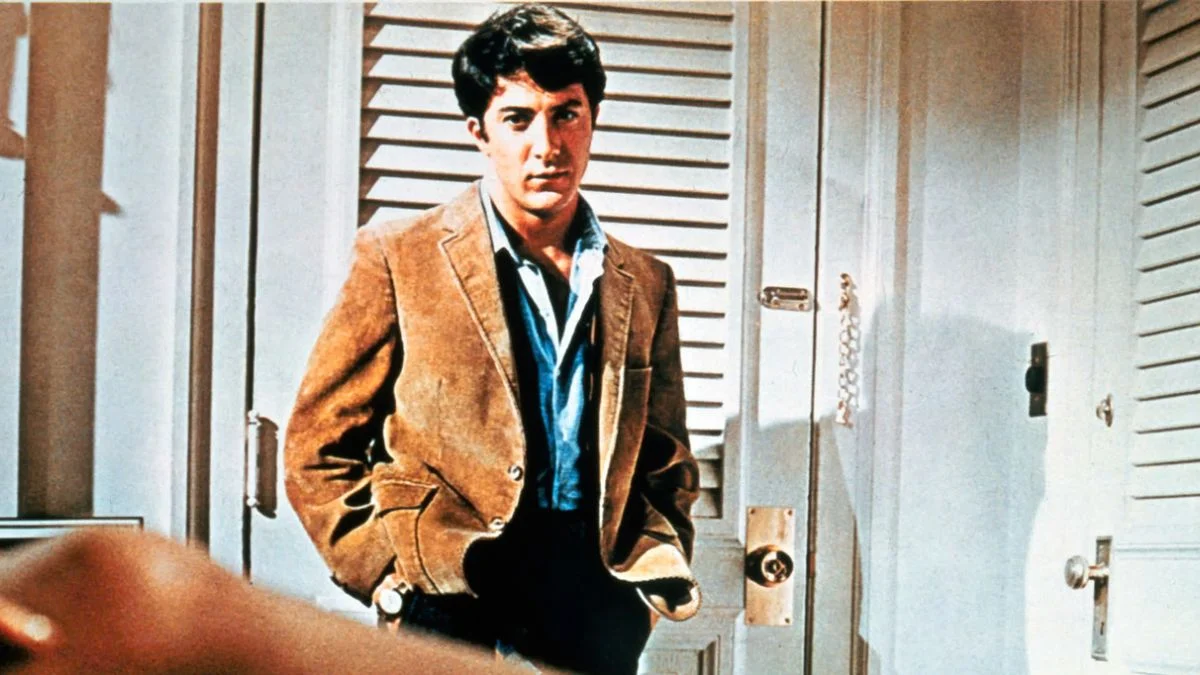
Dustin Hoffman may have become one of Hollywood’s most recognisable actors through The Graduate, but making the 1967 classic was far from the career-defining experience he might have imagined. Nearly six decades later, the actor is revisiting the production and revealing just how uncertain, physically demanding and emotionally exhausting the experience became.
In an essay adapted from his forthcoming memoir, Look at Me, Hoffman reflects on his complicated relationship with director Mike Nichols, his initial belief that he was completely wrong for Benjamin Braddock and several incidents that made filming particularly difficult. His recollections also reveal a surprising connection between Nichols and the character that Hoffman only came to understand much later.
Why Dustin Hoffman thought he was wrong for The Graduate
Long before filming began, Hoffman had serious reservations about playing Benjamin Braddock in The Graduate. Based on Charles Webb’s novel, the story follows a recent college graduate struggling to find direction in life before becoming involved with Mrs Robinson, an older married woman, and subsequently developing a relationship with her daughter, Elaine Robinson.
Hoffman believed he was an unlikely choice for the central role. Benjamin was imagined as an affluent, academically accomplished young man from a conventional background, whereas Hoffman saw himself as an obviously Jewish New Yorker who did not fit the character’s expected appearance or identity.
He remembered thinking that Benjamin was “so not Jewish.”
When Hoffman expressed his concerns during a telephone conversation, Nichols offered an unexpected response:
“Maybe he’s Jewish inside.”
The casting process had already continued for almost two years. Robert Redford and Candice Bergen had been among the people associated with the filmmakers’ original conception of Benjamin and Elaine, while numerous other actors had been considered.
Hoffman, meanwhile, was primarily established in theatre. He had spent nearly a decade working on stage and was appearing in the Off Broadway production Eh?. Hollywood leading-man status was not something he particularly wanted, as he considered theatre his principal artistic world.
Nevertheless, his agent persuaded him to audition.
Another actor injury story
Hoffman’s account focuses on the physical demands and injuries that emerged during a famous film production. Readers interested in another recent actor injury story can explore this Oliver Stark 9-1-1 injury report.
The Graduate screen test left Hoffman feeling even more insecure
Preparing for the screen test was another challenging experience. Hoffman had to learn ten pages of material in less than 48 hours and spent the night rehearsing. By the time he arrived in Los Angeles, he had reportedly gone two days without sleeping.
He also had to perform opposite Katharine Ross, whom he remembers finding exceptionally beautiful and intimidating.
The makeup test added to his discomfort. The famous Westmore makeup artists spent hours working on his appearance while Nichols observed. Hoffman recalls the director questioning his eyebrows, the appearance of his neck and eventually his nose.
He interpreted these changes through his existing concerns about his Jewish identity, believing that the production was attempting to remove the features that made him look Jewish.
Despite his insecurities, Nichols saw something compelling in the screen test.
Hoffman later recalled that Nichols described him as:
“compelling and hilarious and impassive”
The director believed he had found the qualities of a great movie actor, something he had not recognised in the other performers who auditioned. Nichols subsequently offered Hoffman the role.
Mike Nichols initially helped Hoffman discover Benjamin Braddock
Interestingly, the relationship between the actor and director did not begin with the difficulties Hoffman would later describe.
Before principal photography, the production arranged three weeks of rehearsal. Hoffman remembers Nichols during this period as perceptive, open and particularly helpful.
Rather than asking the actors to construct conventional characters, Nichols encouraged them to explore emotional experiences that could inform their performances.
He questioned Hoffman about adolescence, relationships, sexual embarrassment and personal memories.
One exercise involved Hoffman’s brother Ronny, whom the actor had identified as a childhood role model. Nichols asked him to imitate his brother and reproduce the way Ronny behaved when nervous.
Hoffman says he naturally held his breath when nervous, creating small squeaks. Nichols liked the detail and incorporated it into Benjamin’s recurring physical behaviour.
The director also helped Hoffman understand the hotel-lobby sequence involving Benjamin’s first encounter with Mrs Robinson by drawing on his personal memories and anxieties.
For Hoffman, these rehearsals suggested that Nichols understood him as an actor. However, the atmosphere changed considerably once filming started.
Why filming The Graduate became a stressful experience
Hoffman writes that Nichols seemed like “an entirely different person” when principal photography began.
The cast was not shown daily footage, leaving Hoffman with little direct feedback about how his performance or the film was developing. Instead, he became increasingly focused on interpreting Nichols’ mood.
He remembers the director as frequently irritable and says he often feared that he was about to be fired.
One of the earliest sequences involved Benjamin sitting in his bedroom in front of a fish tank after escaping from a graduation party. Hoffman recalls spending much of a day filming the scene while Nichols gave him basic physical instructions, leaving him uncertain about what the director wanted emotionally.
Occasionally, Hoffman managed to make Nichols laugh, which reassured him that his performance was working. But that approval did not always last.
After one take, Nichols questioned what Hoffman had been doing. When the actor attempted to explain his understanding of playing subtext rather than simply following the dialogue, the director responded sarcastically that he should do the opposite the next time he had a thought.
Hoffman says these interactions kept him in a “state of constant anxiety.”
Katharine Ross slapped Hoffman 27 times in a scene that was cut
One of Hoffman’s most physically difficult memories involved a confrontation between Benjamin and Elaine.
In the scene, Benjamin enters Elaine’s room soaking wet after running through the rain. He confesses that he has been having an affair with an older woman, and Elaine realises that the woman is her mother, Mrs Robinson.
According to Hoffman, Nichols repeatedly instructed Ross to slap him harder.
The scene required 27 takes.
Ross was concerned about hurting her co-star, while Hoffman repeatedly reassured her that he was fine. However, he specifically asked her to avoid hitting his ear.
Hoffman recalls that she missed the target several times, leaving him dizzy by the end of the filming day.
There was another surprising detail: the slap was ultimately removed from the finished movie.
The incident is described in Hoffman’s retrospective account rather than presented as an independently documented production record.
Hoffman recalls suffering an ear injury during an underwater scene
The following day, Hoffman filmed the sequence in which Benjamin wears the scuba equipment his father has purchased for him.
The scene carried a deeper meaning for the character. Hoffman explains that it represented how Benjamin’s parents provide material possessions instead of emotional connection.
Nichols did not want Hoffman repeatedly surfacing during filming. The actor therefore held himself underwater by gripping a ladder behind him, with his hand apparently visible in the finished movie.
After several takes, Hoffman surfaced and noticed blood coming from his ear.
He attributes the injury to a combination of the previous day’s repeated slapping and water pressure during the underwater sequence.
He was taken to an ear specialist in Beverly Hills, who reportedly told him that part of his eardrum was missing. The doctor explained the injury using a pie analogy, describing the eardrum as a pie with a slice missing.
Hoffman’s account does not establish a more precise medical explanation beyond the connection he personally makes between the two incidents.
Extreme California heat created further problems during production
The physical challenges continued when filming moved to La Verne, California, during the summer.
Hoffman recalls that the production arrived during the Six-Day War, which began on June 5, 1967. Members of the cast and crew were deeply concerned about the international situation.
The weather also became a serious problem.
Hoffman remembers Anne Bancroft fainting during a scene and requiring oxygen. Production subsequently stopped for several days while she recovered.
Bancroft played Mrs Robinson. She was 35 during production, while Hoffman was approaching 30, and Nichols needed the five-year difference between the actors to appear substantially larger on screen.
Another demanding sequence involved Benjamin attempting to stop Elaine’s wedding. After his Alfa Romeo runs out of petrol, Benjamin abandons the vehicle and runs from the highway towards the church.
Hoffman says Nichols repeatedly requested additional takes despite the extreme heat. Cinematographer Robert Surtees reportedly became concerned about the actor’s ability to continue.
The repeated running left Hoffman exhausted and dehydrated. He eventually lay down in the grass outside the church because he feared he might lose consciousness.
Hoffman believed Mike Nichols regretted casting him
By the end of production, Hoffman had become convinced that Nichols was unhappy with his performance.
He feared the director believed he was doing something wrong and had eventually concluded that he had miscast the lead.
Hoffman describes the experience as “a terrible experience”, despite acknowledging that the film would eventually change his life.
His friend Ulu Grosbard, a theatre director, visited the production during this period. Hoffman told him that if making films was always going to be like this, he would never work in movies again.
He also asked Grosbard to find out whether Nichols regretted hiring him. According to Hoffman’s recollection, Grosbard later returned and told him that Nichols had indicated that he did.
This remains Hoffman’s account of a conversation relayed through his friend, rather than a contemporaneous statement independently attributed to Nichols.
The surprising connection between Mike Nichols and Benjamin Braddock
Hoffman’s understanding of his director’s behaviour changed considerably over the following decades.
He writes that, after years and therapy, Nichols developed a different understanding of his relationship with Benjamin.
According to Hoffman, Nichols eventually recognised that he had unconsciously made the character Jewish.
Nichols was born Mikhail Igor Peschkowsky into a Jewish family in Germany. He fled the country with his family in 1939 and arrived in the United States at seven years old without speaking English.
Hoffman connects this personal history with Nichols’ later interpretation of Benjamin as an expression of his own experience as a Jewish person living in predominantly non-Jewish American society.
Nichols ultimately described The Graduate as a kind of self-portrait, according to Hoffman’s account. He believed he had been searching for an alter ego when developing the film, potentially explaining the unusually long casting process.
Hoffman suggests that he may have become a stand-in for Nichols, absorbing some of the director’s unresolved feelings.
This is Hoffman’s retrospective interpretation of their relationship, not an independently established explanation for Nichols’ behaviour during filming.
The Graduate’s first audience screening changed everything
Despite leaving production convinced that he had struggled, Hoffman received a very different response when he finally watched the completed film with an audience.
He attended a sneak preview with his girlfriend at a theatre on 86th Street in Manhattan. He was so nervous that his teeth were literally chattering when the screening began.
Initially, the audience reaction was relatively muted. Hoffman heard scattered laughter and worried that the film was not connecting with viewers.
Gradually, however, the response grew stronger.
As the story progressed, audiences increasingly understood its tone and perspective. By the time Benjamin reached Elaine at the church during the film’s famous climax, Hoffman recalls people standing and shouting along with the characters.
The reaction was particularly meaningful for an actor who had spent months questioning his performance.
Hoffman says that throughout his six decades of acting, he has not experienced anything comparable since.
The Graduate earned Dustin Hoffman his first Oscar nomination
Released in 1967, The Graduate became the film that established Hoffman as a major screen actor.
At the 1968 Academy Awards, it received seven nominations, including Best Picture, Directing for Mike Nichols, Actor for Hoffman, Actress for Anne Bancroft, Supporting Actress for Katharine Ross, Cinematography and Adapted Screenplay.
Nichols won the Oscar for Best Director, while Hoffman received his first Academy Award nomination.
His subsequent career included two Best Actor Oscar victories for Kramer vs. Kramer and Rain Man, alongside performances in films such as Midnight Cowboy and Tootsie. Simon & Schuster describes him as a two-time Academy Award winner and seven-time nominee.
When will Dustin Hoffman’s memoir Look at Me be released?
Hoffman’s reflections on The Graduate appear in material adapted from his forthcoming memoir, Look at Me, written with Ariel Levy, a staff writer at The New Yorker.
Simon & Schuster lists the book under its Simon Six imprint, with publication scheduled for November 10, 2026.
The publisher lists the memoir at 320 pages. It covers Hoffman’s career, relationships, family, aging, identity and creative life.
It also revisits his experiences working with prominent figures including Laurence Olivier, Maggie Smith, Steve McQueen, Robert Duvall, Arthur Miller, Gene Hackman and Mike Nichols.
Conclusion
Dustin Hoffman’s recollections reveal a very different side of The Graduate from the celebrated film audiences eventually embraced. What became his breakthrough performance was accompanied by casting insecurities, a difficult working relationship, physically demanding filming conditions and persistent doubts about whether he belonged in the role.
Nearly six decades later, his perspective has changed. The actor who once believed Mike Nichols had made a mistake by casting him ultimately became the face of one of the most influential films of his career. With Look at Me arriving on November 10, 2026, Hoffman is revisiting the uncertainty behind a success that transformed his professional life.
Another movie behind-the-scenes story
Hoffman’s memories offer a look at what can happen away from the finished screen performance. Readers can explore another production-related entertainment story in this Emma Stone Juan Soto filming explainer.
Source and research disclaimer
This article has been prepared based on research of the sources provided below, including Dustin Hoffman’s retrospective essay in The New Yorker, the official Simon & Schuster publisher information for Look at Me and the Academy of Motion Picture Arts and Sciences’ 1968 awards records. Personal recollections, private conversations and interpretations are attributed to Hoffman and are not presented as independently established facts beyond what the cited material supports.
Sources
- The New Yorker – Surviving ‘The Graduate’: Dustin Hoffman
- Simon & Schuster – Look at Me by Dustin Hoffman
- Academy of Motion Picture Arts and Sciences – 1968 Academy Awards
Featured Image Credit: Embassy Pictures / United Artists


Leave a Reply