

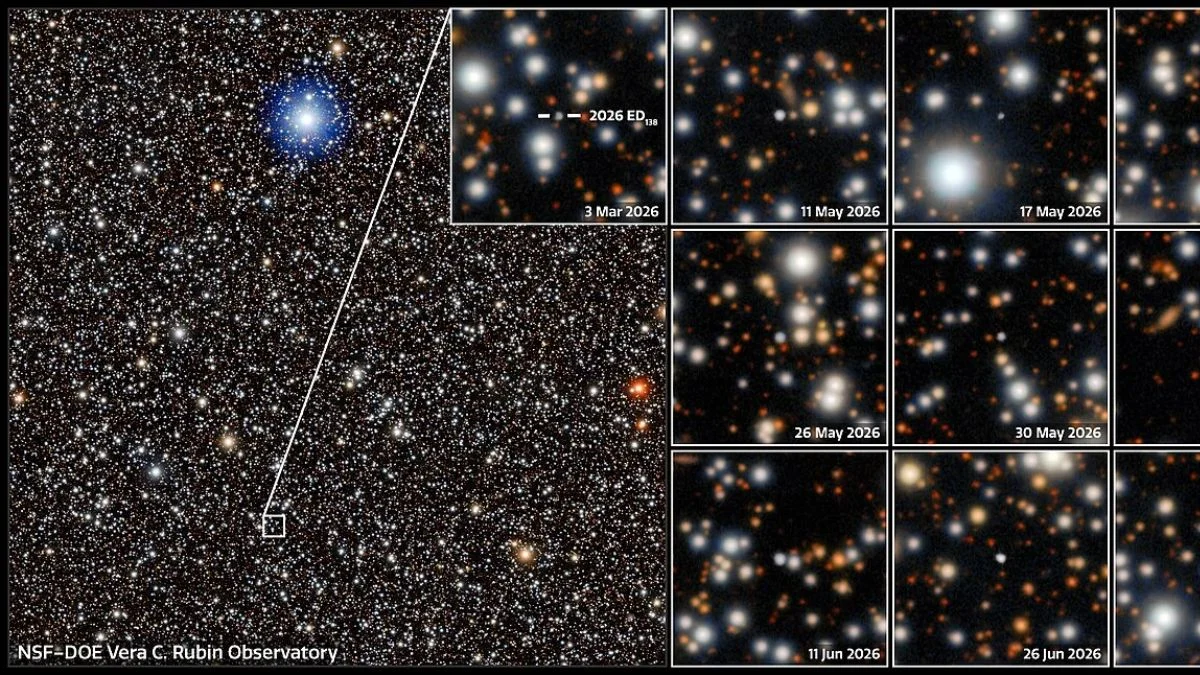
A distant object hiding beyond Neptune has caught astronomers’ attention after observations from the Vera C. Rubin Observatory revealed just how unusual it might be. Designated 2026 ED138, the newly identified trans-Neptunian object is now being investigated as a potential addition to the Solar System’s small group of dwarf planets.
But there is an important catch: scientists have not officially classified it as a dwarf planet. Its estimated dimensions are promising, and years of previously overlooked observations are helping researchers understand its journey through space. The next challenge is establishing whether this distant world meets the physical requirements for that classification.
What Is 2026 ED138? The New Dwarf Planet Candidate Explained
2026 ED138 is a trans-Neptunian object (TNO), meaning it orbits the Sun beyond Neptune. It is currently located approximately 46 astronomical units (AU) from the Sun. One AU represents the average distance between Earth and the Sun, while Pluto has an average orbital distance of approximately 40 AU.
Its orbit is also unusual. Researchers have calculated an orbital inclination of approximately 24.4 degrees relative to the main plane of the Solar System. Its orbit places ED138 near Neptune’s 12:7 mean-motion resonance, although researchers have not yet established whether the object is genuinely in this resonance.
The International Astronomical Union’s Minor Planet Center announced the object’s provisional designation on October 27, 2026, through Minor Planet Electronic Circular MPEC 2026-U85.
However, receiving an official provisional designation does not mean receiving dwarf-planet recognition. ED138 remains a candidate while researchers investigate its physical properties.
Another unusual astronomical discovery
Readers interested in newly discovered objects and unexpected findings can also explore the Quebec meteorite crater Google Maps discovery report for another unusual scientific discovery involving evidence hidden in plain sight. It offers a different look at how researchers can uncover clues about Earth’s cosmic history.
How the Vera C. Rubin Observatory Discovered 2026 ED138
The discovery emerged from observations collected by the NSF–DOE Vera C. Rubin Observatory’s Simonyi Survey Telescope in Chile.
On October 13, 2026, Matthew Holman, a Rubin Operations team member and astronomer associated with the Center for Astrophysics | Harvard & Smithsonian, was processing observations using a search programme developed with his CfA colleague Kevin Napier.
The software examines enormous numbers of astronomical detections to identify observations that belong to the same moving Solar System object.
During this process, Holman noticed an unusually bright object at a considerable distance from the Sun. Its brightness immediately suggested that it might be unusually large for something so far away.
Holman recalled his reaction:
“My first reaction was one of excited disbelief. Objects like this are very rare, so I immediately started checking whether I or the code had done something wrong.”
Rather than relying on the initial detection, the researchers began looking for additional observations to establish the object’s identity and movement.
Mario Jurić, a University of Washington professor who leads Rubin’s Solar System team, located 20 additional Rubin observations, extending the record back to March 4, 2026.
The telescope ultimately recorded ED138 30 times across 20 nights between March 4 and July 11, 2026. Researchers also located older observations from the Dark Energy Camera, extending the record back to 2016.
That discovery transformed an interesting detection into a much more substantial astronomical investigation.
2026 ED138 Was Hiding in Telescope Images for Years
One particularly interesting aspect of this discovery is that ED138 was not necessarily a completely unknown object before October 2026.
Researchers found it in archival observations dating back to 2016, years before Rubin’s discovery announcement.
These earlier detections are known as precovery observations. The term describes situations in which astronomers identify an object in older images after discovering and recognising it through newer observations.
The Dark Energy Camera data provided an observational arc of more than 10 years, approximately 3,789 days. This extended record gives researchers a stronger foundation for calculating the object’s orbit.
Why was it missed for so long?
One major difficulty was its position close to the plane of the Milky Way. This region of the sky is crowded with enormous numbers of background stars, making it challenging to distinguish a faint, slowly moving Solar System object from stationary sources.
Rubin’s repeated observations and specialised detection software helped researchers identify the object among that crowded background.
NASA’s TESS Found More Evidence of ED138
The investigation did not stop with Rubin and the Dark Energy Camera.
A research team led by MIT scientists examined seven years of observations from NASA’s Transiting Exoplanet Survey Satellite (TESS) and identified ED138 in five separate month-long observing periods between 2019 and 2026.
Four of those observing periods occurred before Rubin identified the object in 2026.
ED138 is too faint to stand out clearly in individual TESS images, particularly against crowded stellar fields. To overcome this problem, researchers removed known stars from the images and combined thousands of observations while shifting them according to the object’s predicted movement.
The technique revealed detections across all five observing periods, producing a combined detection significance of 34 sigma in the team’s analysis.
The TESS positions were also consistent with ED138’s established orbital solution.
These observations provide an independent set of measurements supporting its orbit and add further historical evidence of its movement. However, they do not independently establish that ED138 qualifies as a dwarf planet.
How Big Is 2026 ED138? Scientists Estimate Up to 1,530 Kilometres
The object’s physical dimensions are among the most important unanswered questions.
Researchers calculated an absolute visual magnitude of approximately Hᵥ = 3.19. Based on different possible surface reflectivities, known as geometric albedo, they estimated its diameter could fall between approximately 612 and 1,530 kilometres (380 to 950 miles).
Rubin Observatory describes the preliminary estimate more generally as 600 to 1,500 kilometres (approximately 370 to 930 miles).
The wide range exists because brightness does not directly reveal physical size.
A smaller object with a highly reflective surface can appear as bright as a considerably larger object with a darker surface. Consequently, astronomers need better information about ED138’s reflectivity before they can establish its dimensions more precisely.
Infrared observations are expected to help narrow down the estimate and provide further evidence about its physical characteristics.
If ED138 is near the upper end of the estimated range, it would rank among the largest known trans-Neptunian objects.
Why Could 2026 ED138 Become the Sixth Recognised Dwarf Planet?
The International Astronomical Union (IAU) has established specific requirements for dwarf-planet classification.
A dwarf planet must:
- Orbit the Sun.
- Have sufficient mass for its own gravity to make it approximately round.
- Not have cleared the neighbourhood around its orbit.
- Not be a satellite of another celestial body.
For ED138, the central question is whether its gravity is strong enough to have pulled it into an approximately spherical shape.
This condition is associated with hydrostatic equilibrium, the state in which an object’s own gravity shapes it into a roughly round form.
Based on its preliminary size estimate, researchers believe ED138 could satisfy this physical requirement. Icy objects of this scale are expected to be capable of becoming approximately spherical under their own gravity.
Nevertheless, the necessary physical evidence has not yet been established.
ED138 is therefore a dwarf-planet candidate, not an officially recognised dwarf planet.
How ED138 Compares With Pluto and Other Dwarf Planets
The IAU currently recognises five dwarf planets: Ceres, Pluto, Eris, Haumea and Makemake.
Ceres orbits in the asteroid belt between Mars and Jupiter, while Pluto, Eris, Haumea and Makemake belong to the distant outer Solar System.
If ED138 eventually receives dwarf-planet classification, it could join this small group. Its final position among these worlds would depend on its confirmed diameter.
For comparison, Pluto measures approximately 2,370 kilometres across. Even at the upper end of its preliminary estimate, ED138 would be substantially smaller.
However, an object does not need to be Pluto-sized to qualify as a dwarf planet. Its physical characteristics and compliance with the IAU’s definition are what matter.
ED138’s Orbit Could Reveal More About the Early Solar System
Beyond its potential classification, ED138 offers researchers another opportunity to investigate the history of the outer Solar System.
Trans-Neptunian objects preserve information about the material that existed during planetary formation. Studying their orbits, sizes, colours and compositions can help astronomers understand how the giant planets migrated and how gravitational interactions redistributed smaller bodies.
ED138’s calculated barycentric orbital parameters include:
| Orbital characteristic | Estimated value |
| Semi-major axis | 43.09 AU |
| Eccentricity | 0.139 |
| Inclination | 24.4 degrees |
| Distance from the Sun | Approximately 46 AU |
| Possible resonance | Near Neptune’s 12:7 mean-motion resonance |
Researchers say its orbit lies near the 12:7 mean-motion resonance with Neptune, although its exact resonant status requires further consideration.
These characteristics distinguish ED138 from a straightforward distant version of Pluto’s orbit and place it within a particular population of outer Solar System objects.
Why ED138’s Brightness and Colour Are Important
ED138 is also unusual because of its intrinsic brightness.
The research team reports that it is among the ten intrinsically brightest known trans-Neptunian objects.
Its measured colour, with a g-r value of approximately 0.63, is relatively red. However, researchers say it is too red to belong to the collisional family associated with Haumea.
Its brightness makes it accessible to further investigation using ground-based telescopes and more powerful astronomical facilities.
Researchers have identified opportunities for ground-based spectroscopy and light-curve observations, alongside more detailed investigations using the Hubble Space Telescope and James Webb Space Telescope.
These observations could reveal additional information about its surface, composition, rotation and physical dimensions.
Could More Undiscovered Dwarf Planet Candidates Be Hiding Beyond Neptune?
ED138’s discovery raises another important question: how many large trans-Neptunian objects have previous surveys failed to identify?
The research team examined how effectively earlier searches had recovered known bright TNOs. Based on this analysis, researchers estimate that approximately three more objects comparable to the known population of very bright TNOs could remain undiscovered outside the most difficult regions of the Galactic plane.
There could potentially be additional objects in areas within approximately 10 degrees of the Galactic plane that have not been searched to comparable depth.
This is an estimate of potentially missing bright trans-Neptunian objects, not confirmation that three additional dwarf planets have already been found.
Rubin Observatory’s ongoing 10-year Legacy Survey of Space and Time (LSST) could help address this gap by repeatedly imaging the southern sky.
Holman explained the significance of the survey:
“If confirmed as a dwarf planet, ED138 would join a very small family of worlds. Rubin will image the whole southern sky again and again for ten years, so any others hiding in the places earlier surveys skipped are now within reach.”
Rubin Observatory Has Already Identified Thousands of Solar System Objects
ED138 is part of a much broader effort to discover previously unknown Solar System objects.
Before the Legacy Survey of Space and Time formally began in June 2026, Rubin’s Solar System team submitted observations of more than 11,000 new asteroids to the International Astronomical Union’s Minor Planet Center.
The submission included approximately 380 new trans-Neptunian objects.
These discoveries demonstrated the observatory’s potential to identify previously unknown objects across the Solar System. ED138 stands out because its brightness and estimated dimensions make it a potential dwarf planet.
The wider survey is expected to provide researchers with further opportunities to study different populations of Solar System bodies.
What Happens Next for Dwarf Planet Candidate 2026 ED138?
The next stage involves follow-up observations, particularly those capable of improving estimates of ED138’s physical size and surface reflectivity.
Infrared observations will be important in narrowing down its dimensions. Researchers can also investigate its brightness variations, colour and spectrum to learn more about its composition, rotation and surface characteristics.
Meanwhile, the existing observations from Rubin, the Dark Energy Camera and NASA’s TESS are already providing a substantial record of its movement through the Solar System.
Further measurements will improve its orbital solution and help astronomers understand where it belongs among the known trans-Neptunian population.
Another scientific discovery
Scientific discoveries can also reveal unexpected details about the distant human past, offering a very different perspective on how researchers piece together evidence from incomplete records. Explore the Denisovan fossils appearance explainer to see what scientists have learned from ancient human remains.
Conclusion: Is 2026 ED138 Officially a Dwarf Planet?
No. 2026 ED138 has not yet been officially recognised as a dwarf planet.
For now, it remains a large and unusually bright trans-Neptunian object and a promising dwarf-planet candidate. Its estimated diameter of approximately 600 to 1,500 kilometres makes it scientifically significant, while observations stretching back to 2016 provide valuable evidence about its orbit.
The possibility of a sixth recognised dwarf planet is certainly intriguing, but further physical measurements are necessary before its classification can change.
For the moment, Ceres, Pluto, Eris, Haumea and Makemake remain the five officially recognised dwarf planets. Whether ED138 eventually joins them will depend on what astronomers discover through their next round of observations.
Source and Research Disclaimer: This article has been prepared through research of the sources provided, including the NSF–DOE Vera C. Rubin Observatory, the research papers published on arXiv, MIT’s TESS research findings, the International Astronomical Union’s Minor Planet Center and NASA. It reflects the scientific information, measurements and findings available in those sources at the time of writing. The object’s physical dimensions, orbital parameters and potential classification may be refined as additional observations and research become available.
Sources
- NSF–DOE Vera C. Rubin Observatory: First dwarf planet candidate
- 2026 ED138 research paper, arXiv
- MIT TESS: Seven years of precovery observations of 2026 ED138
- TESS precovery research paper, arXiv
- International Astronomical Union Minor Planet Center MPEC records
- International Astronomical Union: definition of planet and dwarf planet
- NASA Solar System planets and dwarf planets
Featured Image Credit: NOIRLab / CC BY 4.0 / Wikimedia Commons


Leave a Reply