


Why Do the Same Life Lessons Keep Repeating? A Modern Exploration of Karma
In an era where mindfulness, therapy, and neuroscience intersect with spirituality, karmic cycles are being re-examined not as cosmic punishment, but as internal psychological mechanisms shaping human experience. This evolving perspective bridges Eastern wisdom and Western science, offering insight into why personal transformation feels so difficult—and why it is still possible.

In This Post:
From Ancient Karma to Modern Psychology: A Shared Language of Cause and Effect
Traditionally rooted in Hinduism and Buddhism, karma refers to the principle that actions create consequences that unfold across time, sometimes extending beyond a single lifetime. In Indian philosophical systems, karma explains suffering, growth, rebirth, and liberation through moral causality.
Psychology reframes this ancient idea in observable terms. Instead of metaphysical forces, karmic cycles are understood as repetitive patterns of thought, emotion, and behavior shaped by conditioning, trauma, and learning. These cycles unfold within the mind and social environment, creating outcomes that feel fated, even though they emerge from internal processes.
In both systems, the essence remains the same:
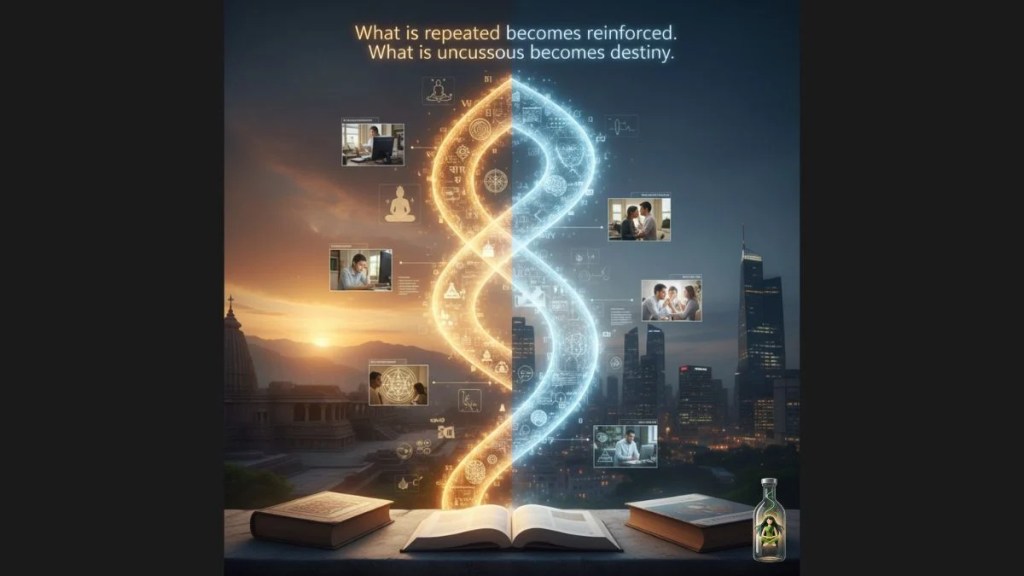
What is repeated becomes reinforced. What is unconscious becomes destiny.
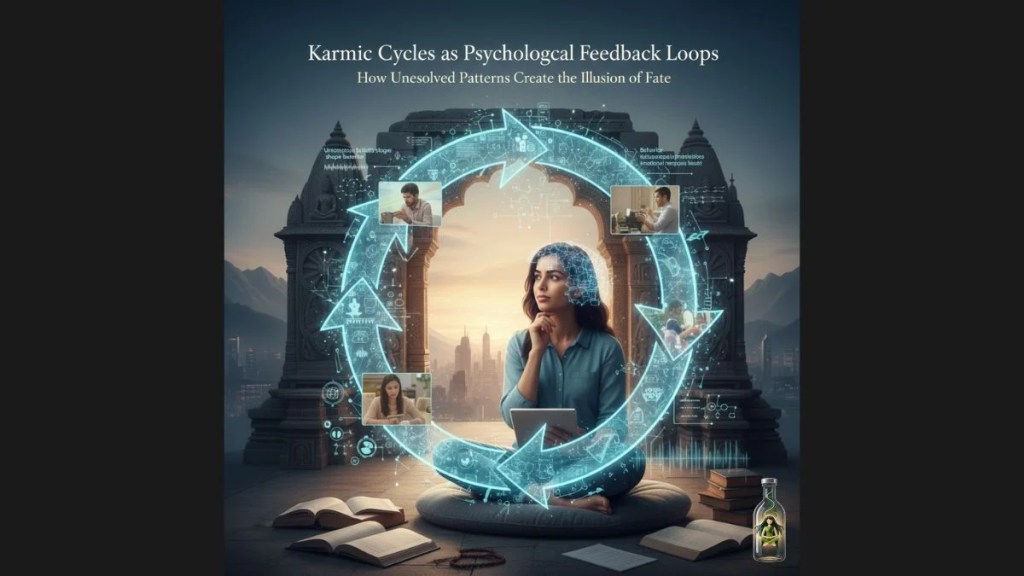
Karmic Cycles as Psychological Feedback Loops
How Unresolved Patterns Create the Illusion of Fate
From a psychological standpoint, karmic cycles manifest as self-perpetuating loops:
- Unconscious beliefs shape behavior
- Behavior influences emotional responses
- Emotions reinforce perception
- Perception strengthens the original belief
This loop mirrors what ancient traditions described symbolically as karma unfolding through time.
For example, unresolved childhood trauma may lead to self-sabotaging choices in adulthood. These choices produce predictable outcomes—failed relationships, professional stagnation, emotional distress—which then appear as “bad karma” or unavoidable destiny.
In reality, psychology explains this through neuroplasticity, where repeated thoughts and actions strengthen neural pathways, making patterns harder to break without conscious intervention.
Cognitive-Behavioral Therapy and the Science Behind Karmic Repetition
Modern therapeutic models, especially Cognitive-Behavioral Therapy (CBT), describe cycles strikingly similar to karmic frameworks.
CBT identifies behavioral loops in which negative actions lead to negative outcomes, reinforcing the original belief system. Without awareness or intervention, these loops repeat indefinitely.
This scientific explanation reframes karma not as external judgment, but as an internal cause-and-effect system operating through habit, perception, and conditioning.
When awareness enters the loop—through therapy, mindfulness, or self-reflection—the cycle can be interrupted, allowing transformation.
The Just-World Hypothesis: Why the Mind Believes in Karma
One of the most relevant psychological theories supporting karmic thinking is the Just-World Hypothesis. This theory suggests that humans have a deep need to believe the world is fair—that good actions are rewarded and bad actions are punished.
This mirrors karmic belief systems almost exactly.
Research shows that people who hold strong karmic or just-world beliefs tend to:
- Engage in more altruistic behavior
- Show greater restraint in excessive consumption
- Focus on long-term well-being rather than short-term gratification
Studies linking mortality salience (awareness of death) to reduced materialism demonstrate that karmic thinking can psychologically encourage ethical and prosocial choices, even without metaphysical proof.
How the Brain Constructs Karma: Cognitive Pathways to Moral Causality
Psychological studies across diverse populations reveal that belief in karma operates similarly to belief in God—through intuitive causal reasoning.
People mentally connect present outcomes to past actions, forming internal moral narratives. Scholars such as Karl Potter and Harold Coward describe karma not as a cosmic law, but as a principle of psychology, shaped by conditioned responses and learned moral frameworks.
In this view, karma becomes a mental model—a way the brain organizes experience, responsibility, and consequence to maintain social harmony and personal accountability.
Is Karma an Internal Psychological Mechanism? Emerging Theories Say Yes
A growing body of psychological thought proposes that karma functions as an internal psychological process, not an external force.
According to this hypothesis:
- Actions leave psychological imprints
- These imprints influence perception and behavior
- Prosocial actions improve self-image and reduce stress
- Reduced stress leads to better outcomes, reinforcing the cycle
This aligns closely with positive psychology, where ethical behavior enhances mental well-being and resilience. What is traditionally called “good karma” becomes a feedback loop of healthy cognition and emotional regulation.
Karmic Thinking and Prosocial Behavior in Entrepreneurship
Interestingly, psychological research has explored karmic causality in entrepreneurship and social innovation, particularly in cultures where karma is a dominant belief.
These studies identify two stages:
- Performing good deeds
- Expecting positive returns, which motivates further prosocial action
Karmic beliefs were found to moderate intentions toward social entrepreneurship, encouraging individuals to pursue ventures that benefit society, not just personal gain.
In this way, karma functions as a motivational psychology, shaping ethical ambition and long-term thinking.
Neuroscience, Mindfulness, and the Breaking of Karmic Loops
From a neuroscientific perspective, karmic cycles resemble loops of unconscious thought and behavior stored in the brain’s default patterns.
Mindfulness-based practices—widely used in Indian spiritual traditions and modern therapy—bring these loops into conscious awareness. Once observed, they can be disrupted.
Some interdisciplinary thinkers extend this idea metaphorically into quantum or deterministic frameworks, framing karma as a natural law of habit and choice interacting with environmental feedback. While intriguing, these interpretations remain philosophical rather than scientific.
Why Karma Cannot Be Fully Explained by Psychology or Science
Despite these parallels, karmic cycles cannot be fully defined or validated through psychology or science.
The Limits of Empirical Research
Concepts like:
- Reincarnation
- Past-life consequences
- Cosmic justice across lifetimes
are untestable and unfalsifiable, placing them outside scientific methodology. There is no peer-reviewed medical or psychological evidence supporting karmic relationships or soul-level atonement.
Where Psychology Ends and Faith Begins
Psychology explains mental cause and effect, but extending this to universal moral accounting exceeds empirical boundaries. Karma’s broader claims rely on belief, not data.
Over-fixation on karmic interpretation can even reinforce psychological entanglement, where individuals attribute all suffering to fate rather than agency.
Karma as an Independent Philosophical System
Ultimately, karma remains a self-contained spiritual and philosophical framework, developed long before modern science. While psychology offers metaphors and parallels, it cannot replace or prove karma’s metaphysical dimensions.
Attempts to validate karma through neuroscience or quantum physics often stretch interpretation beyond evidence. The core elements—multi-lifetime consequences and cosmic moral balance—resist scientific measurement.
The Deeper Truth: Where Psychology and Karma Quietly Meet
While psychology may never define karma completely, it reveals something equally powerful: what we repeatedly think and do becomes the architecture of our lives.
Whether seen as neural pathways or karmic imprints, cycles persist until awareness transforms them. Within this quiet overlap between science and spirituality lies a shared wisdom—growth begins where unconscious repetition ends.
In modern India and across the world, this integrated understanding allows ancient insight and contemporary psychology to coexist, not as rivals, but as complementary lenses through which human experience can be understood.
In the end, karma may not be provable—but patterns are. And patterns, once seen, can be changed.
More Interesting Reads:


Leave a Reply