

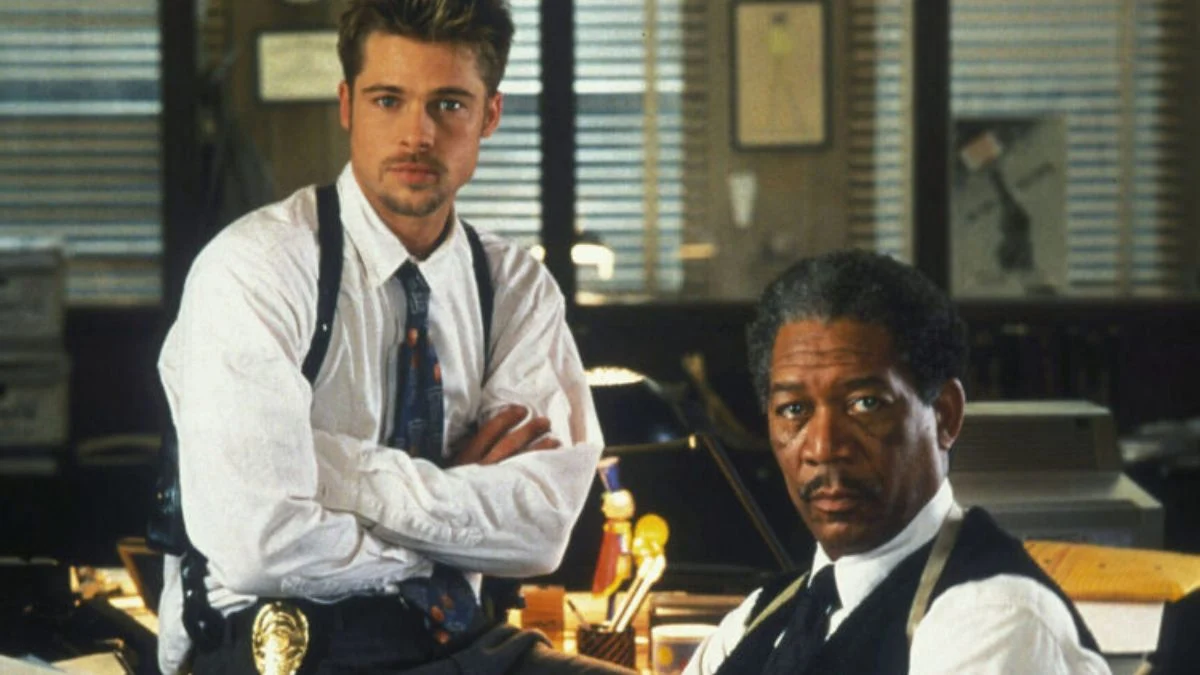
More than three decades after its release, Se7en remains one of the most unforgettable psychological crime thrillers ever made. Directed by David Fincher and written by Andrew Kevin Walker, the 1995 classic is far more than a serial killer mystery—it is a chilling exploration of morality, justice, human weakness, and the darkness lurking beneath society’s surface.
Starring Morgan Freeman as Detective Lieutenant William Somerset, Brad Pitt as Detective David Mills, Kevin Spacey as the enigmatic serial killer John Doe, and Gwyneth Paltrow as Tracy Mills, the film unfolds inside a perpetually rainy, unnamed American city consumed by crime, corruption, and indifference.
Unlike conventional detective stories, Se7en doesn’t simply ask viewers to identify a murderer. Instead, it gradually reveals a carefully orchestrated philosophical nightmare in which every murder serves a larger purpose. The film’s disturbing atmosphere, psychological storytelling, and one of cinema’s most shocking endings continue to spark discussions decades later.
Here’s a complete breakdown of the film, including its ending explained, hidden themes, psychological analysis, production facts, and why Se7en continues to be regarded as a masterpiece.
Se7en Plot Summary: How the Seven Deadly Sins Drive Every Murder
The story begins with Detective Lieutenant William Somerset, an experienced, intellectual detective who is only one week away from retirement. Calm, methodical, and emotionally exhausted by years of witnessing humanity’s worst crimes, Somerset is assigned a final partner—young detective David Mills.
Unlike Somerset, Mills is energetic, impulsive, and idealistic. Having recently moved to the city with his wife Tracy, he believes determination can still make a difference.
Their first investigation immediately suggests otherwise.
An extremely obese man is discovered dead after being forced to eat until his stomach ruptures. Hidden behind a refrigerator at the crime scene is a single word:
Gluttony.
The detectives initially view the murder as unusually grotesque, but the following crime changes everything.
A wealthy defense attorney is found murdered after being forced to cut a pound of flesh from his own body. Written nearby in blood is another word:
Greed.

While Mills initially questions whether the murders are connected, Somerset begins researching the concept of the Seven Deadly Sins, recognizing a disturbing pattern.

The Seven Deadly Sins Murders Explained
As the investigation unfolds, each new victim represents another deadly sin, revealing the killer’s carefully constructed moral crusade.
| Sin | Victim | What Happens |
| Gluttony | Obese man | Forced to eat until his stomach bursts |
| Greed | Wealthy defense attorney | Murder involving a pound of flesh cut from his body |
| Sloth | Drug dealer/pederast | Kept alive and tortured for an entire year, left emaciated but barely alive |
| Lust | Client of a prostitute | Forced into a horrific encounter using a bladed device, with the violence largely implied |
| Pride | Fashion model | Disfigured and given the choice to live permanently scarred or die; she chooses death |
Rather than creating random killings, every murder functions like a twisted sermon. Each crime is meticulously staged to represent one of humanity’s greatest moral failures.

The detectives soon realize they are hunting someone whose patience, intelligence, and planning far exceed that of an ordinary serial killer.

Inside John Doe’s Apartment: The Investigation Takes a Terrifying Turn
Eventually, Somerset and Mills discover John Doe’s apartment through fingerprints and an investigative tip.
What they find inside is deeply unsettling.
The apartment is almost completely minimalist, yet filled with journals, photographs, handwritten observations, and years of meticulous planning. Every detail reveals an obsessive individual who has devoted his entire existence to preparing his crimes.
Before they can fully investigate, Doe suddenly ambushes both detectives.
A tense foot chase follows through the city streets. Although Mills comes close to catching him, Doe ultimately escapes.
Interestingly, Brad Pitt performed his own stunts during this chase sequence and suffered a real injury while filming.
Despite escaping, John Doe is already several steps ahead.
John Doe’s Unexpected Surrender Changes Everything
Instead of remaining hidden, John Doe voluntarily walks into the police station covered in blood.
His surrender shocks everyone.
Rather than denying responsibility, he calmly admits to the murders but insists his work remains unfinished.
He explains that two final victims remain.
If Somerset and Mills agree to accompany him to a remote desert location, he promises to reveal everything and complete what he describes as his “masterpiece.”
Somerset immediately senses danger and believes the proposal is a carefully designed trap.
Nevertheless, under heavy police escort, the detectives travel with Doe into the desert.
Nothing prepares them for what awaits.

Se7en Ending Explained: What Was Inside the Box?
The film’s final act has become one of the most iconic endings in cinema history.
While standing in the isolated desert, a delivery truck unexpectedly approaches the investigators.
The driver hands over a mysterious package.
Somerset opens the box.
His expression instantly changes from confusion to horror.
John Doe calmly reveals the truth.
Earlier that day, he visited the Mills residence.
Consumed by envy over Mills’ seemingly normal family life—particularly his relationship with Tracy—Doe murdered her.
The box contains Tracy’s severed head.
Doe then reveals another devastating truth.
Tracy had been pregnant.
According to Doe, she begged for both her own life and the life of her unborn child.
Mills had never known she was expecting.
The revelation completely destroys him.
Doe calmly admits that he himself represents Envy.
All that remains is for Mills to embody Wrath.
Despite Somerset desperately pleading with him not to pull the trigger, Mills is overwhelmed by grief, rage, and unimaginable loss.
He shoots John Doe multiple times.
With that single act, Doe’s elaborate plan is completed.
The seven deadly sins have now come full circle.
Why John Doe’s Plan Succeeds
One reason the ending remains so disturbing is that John Doe never intended to escape punishment.
His objective was philosophical rather than practical.
By deliberately making himself the embodiment of Envy, and manipulating Mills into becoming Wrath, he transforms both hunter and hunted into participants in his moral design.
The earlier victims represent the remaining sins, but the final sequence expands the concept beyond simple murder.
Doe proves that even good people possess breaking points.
Mills, once driven by justice and idealism, ultimately becomes exactly what Doe predicted he would become.
In that sense, evil triumphs—not because Doe survives, but because his worldview is validated.

The Final Scene and Somerset’s Last Decision
As police officers arrive, Mills is led away in complete psychological shock.
His career, marriage, and future have all been destroyed within moments.
Somerset had planned to retire and leave the city forever.
Instead, witnessing the devastating conclusion convinces him to remain.
His decision suggests that despite overwhelming darkness, abandoning the fight against evil would represent another form of surrender.
The film concludes on an intentionally somber and ambiguous note, forever associated with the unforgettable question:
“What’s in the box?”
Interestingly, the relentless rain that dominates nearly the entire film finally stops as the sun begins to set.
Yet redemption never arrives.
The darkness has already won.
The Psychological Meaning Behind Se7en
Beyond its crime story, Se7en operates as a psychological examination of humanity itself.
Apathy and Moral Decay
The unnamed city functions almost like another character.
It is constantly rainy, overcrowded, noisy, violent, and emotionally detached.
Residents ignore suffering, overlook violence, and have become numb to horror.
Somerset’s use of a metronome to create moments of peace reflects his attempt to maintain order amid chaos.
Later destroying it symbolizes his acceptance that chaos cannot truly be controlled.
John Doe’s murders become twisted sermons intended to force society to acknowledge the sins it has learned to ignore.
Religion, Fanaticism, and Hypocrisy
Doe sees himself as a divine instrument carrying out justice against a modern version of Sodom and Gomorrah.
His philosophy draws upon Christian ideology and literature, including Milton.
Yet the film deliberately exposes his hypocrisy.
Although he claims moral superiority, Doe is arrogant, cruel, and clearly derives satisfaction from human suffering.
His self-righteousness ultimately becomes another form of evil.
Human Nature Under Pressure
One of the film’s central questions asks whether people remain moral only until they experience unbearable loss.
Somerset represents exhausted wisdom.
Mills symbolizes youthful idealism.
Doe carefully studies both detectives, recognizing Mills’ impulsive personality as the weakness that can complete his masterpiece.
The ending demonstrates how personal tragedy can overpower professional ethics and rational judgment.
Isolation and Loneliness
Every major character experiences profound loneliness.
Somerset isolates himself emotionally after years of witnessing violence.
Mills struggles to adapt to an unfamiliar city.
Tracy quietly suffers fear and isolation.
John Doe exists almost entirely outside normal human relationships.
Their emotional separation reinforces the film’s overwhelming atmosphere of despair.

Psychological Violence Over Graphic Gore
Although Se7en contains disturbing subject matter, David Fincher intentionally emphasizes psychological terror over graphic violence.
Many of the most horrifying events occur off-screen.
Instead of relying on explicit gore, the film builds dread through atmosphere, sound design, implication, and John Doe’s meticulous planning.
His journals alone reveal years of obsessive preparation and disturbing grandiosity.
Virtue Versus Sin
While Doe believes he represents divine justice, the film contrasts his destructive mission against Somerset’s quiet commitment to preserving order.
Meanwhile, Mills embodies passionate but deeply flawed justice.
These opposing worldviews create the film’s lasting moral complexity.
Behind the Scenes: Production Facts That Made Se7en a Classic
Several behind-the-scenes decisions contributed significantly to the film’s legendary status.
Andrew Kevin Walker wrote the screenplay after experiencing the grim atmosphere of New York City during the late 1980s crime wave.
David Fincher unexpectedly received Walker’s original bleak script rather than a revised version.
Instead of requesting changes, Fincher insisted on preserving the shocking ending despite considerable studio pressure.
Alternative concepts reportedly included a dog inside the box, Somerset killing Doe himself, or even a climactic confrontation inside a burning church.
Fortunately for audiences, Fincher remained committed to the darker conclusion.
Filming primarily took place in downtown Los Angeles, which doubled as the unnamed city.
Continuous rainfall throughout production wasn’t accidental—it became one of the film’s defining visual signatures, reinforcing themes of corruption, decay, and hopelessness.
Produced on an estimated budget of approximately $33–34 million, Se7en became a massive commercial success, earning more than $327 million worldwide.
Another memorable production decision involved Kevin Spacey’s billing.
His name was intentionally omitted from the opening credits to preserve the surprise surrounding John Doe’s identity.
Meanwhile, Brad Pitt sustained a genuine injury while filming the rooftop chase sequence, and Leland Orser, who portrayed the Sloth victim, reportedly stayed awake and hyperventilated to achieve the character’s haunting physical appearance.
Even the opening title sequence reflects the film’s unsettling vision, showing John Doe methodically cutting the word “God” from a dollar bill while establishing the obsessive psychology that defines the story.

Why Se7en Still Stands Among the Greatest Psychological Thrillers Ever Made
Few films balance atmosphere, suspense, philosophy, and emotional devastation as effectively as Se7en. Rather than offering audiences a comforting resolution, David Fincher delivers an uncompromising examination of evil, morality, and human vulnerability.
Its unforgettable ending, layered symbolism, meticulous production design, and psychologically driven storytelling ensure that Se7en remains a benchmark for crime thrillers. More than simply solving a series of murders, the film forces viewers to confront uncomfortable questions about justice, human nature, and the fragility of goodness in a deeply flawed world.
That lingering discomfort is precisely why Se7en continues to be regarded as one of the greatest and most influential thrillers ever made.


Leave a Reply