

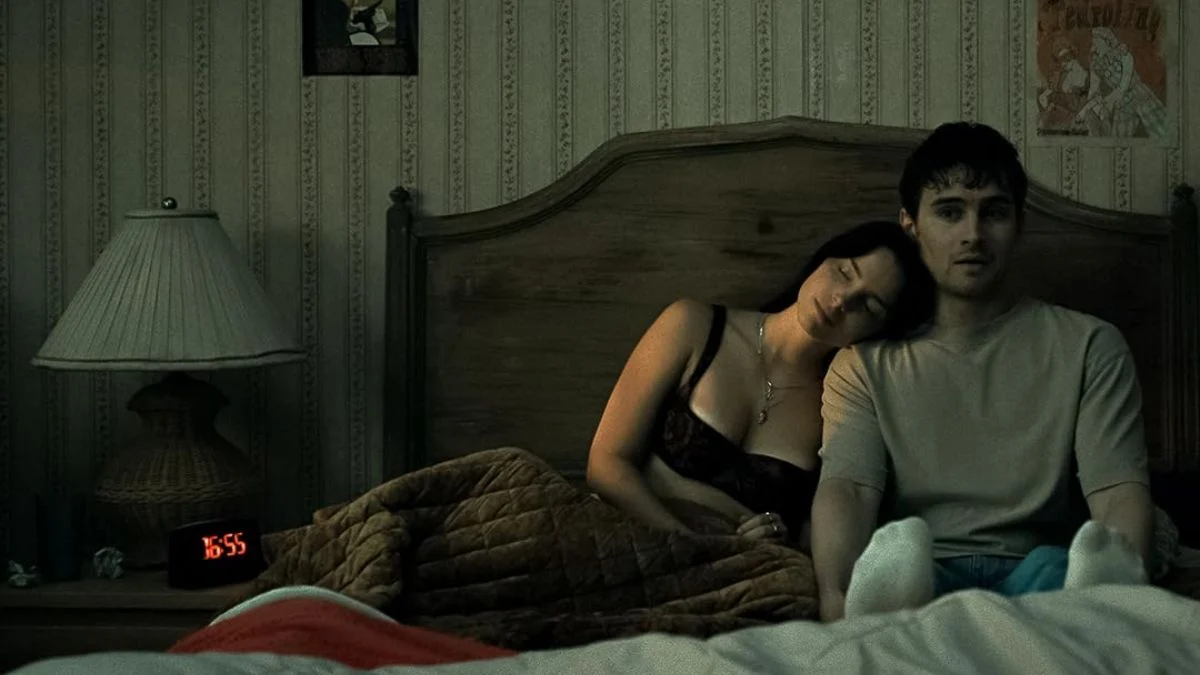
Nobody — not the studio, not the cast, not even director Curry Barker himself — expected a YouTube comedian’s low-budget horror film about a guy who can’t tell his crush he likes her to outgross blockbusters ten times its size. And yet here we are. Obsession didn’t just sneak into theaters; it kicked the door in, and it hasn’t left since.
If you’ve scrolled past the breathless box-office headlines, the “highest-grossing horror movie of the year” chatter, or the now-infamous billboards reading “Text Nikki,” and you’re wondering what on earth this movie is actually about — buckle in. What starts as an awkward will-they-won’t-they romance between two coworkers at a small music shop spirals into one of the most unsettling, talked-about psychological horror stories in years. And the deeper you go, the darker — and more human — it gets.
What Is Obsession About? A Modern Monkey’s Paw Story With a Disturbing Twist
At its core, Obsession is a be-careful-what-you-wish-for fable, the kind your grandparents told around campfires, except dragged into 2026 and dressed in the anxieties of modern dating, consent, and male loneliness. Barker has said the project was sparked by a rewatch of a classic 1990s Simpsons Halloween segment built around a cursed monkey’s paw — and that DNA is unmistakable here.
But where most wish-gone-wrong stories punish the wisher with irony, Obsession does something nastier: it takes the wish completely literally, and lets the horror grow out of the wisher’s own character flaws rather than random bad luck. That choice is what’s made critics and audiences alike unable to stop dissecting it.

Obsession (2026) Movie Details: Full Cast, Release Date & Box Office at a Glance
Before we dive into the spoiler-heavy plot breakdown, here’s a quick reference table covering the essential, verified details of the film.
| Detail | Information |
| Title | Obsession |
| Director / Writer | Curry Barker |
| Release Date | May 15, 2026 (U.S. theatrical); TIFF premiere September 5, 2025 |
| Studio / Distributor | Focus Features, with Blumhouse Productions as executive producer |
| Runtime | 1 hour 49–50 minutes |
| Rating | R |
| Lead Cast | Michael Johnston (Baron “Bear” Bailey), Inde Navarrette (Nikki Freeman) |
| Supporting Cast | Cooper Tomlinson (Ian), Megan Lawless (Sarah), Andy Richter |
| Production Budget | Roughly $750,000–$1 million |
| Worldwide Box Office | Over $370 million |
| Critical Reception | 94% on Rotten Tomatoes; “A-” CinemaScore |
For context on just how absurd that return on investment is: Obsession became Focus Features’ highest-grossing film of all time worldwide, ahead of even Downton Abbey. It’s the kind of numbers that turn a niche festival horror film into an industry case study.
The Setup: A Timid Music Store Clerk, a Grieving Heart, and a Crush He Won’t Confess
The story is anchored at Cassell’s Music, a small, family-owned shop where a tight-knit friend group works together. Bear is a shy, socially awkward young man still grieving his grandmother’s death. He’s been quietly in love with his childhood friend and coworker Nikki for what feels like forever — but in his mind, she’s too smart, too sharp, too ambitious (she dreams of being a writer) to ever look at him that way. His best friend Ian is louder and more confident, while their other coworker Sarah harbors a quiet interest in Bear that nobody — including Bear — seems to notice.
Then tragedy strikes close to home: Bear’s beloved cat, Sandy, dies after accidentally swallowing his late grandmother’s leftover oxycodone pills — a small, sad detail that becomes horrifyingly relevant later. Shopping for a gift for Nikki, Bear wanders into a crystal shop and buys a “One Wish Willow,” a kitschy novelty twig sold with a wink and a disclaimer that it’s just for fun. He never actually gives it to her.

The Wish That Changes Everything
During a group hangout that leads into a trivia night, Nikki — driving home with Bear — directly asks if he has feelings for her. He freezes. He lies. And in a moment of pure frustration at his own cowardice, he snaps the willow in half and makes a wish: that Nikki would love him more than anyone else in the world.
It works instantly. Nikki shows up at his door that same night, suddenly desperate to be close to him, telling him (falsely) that her estranged father is dying. They almost kiss — until she suddenly screams and pulls away, the first crack in what’s coming.
Full Plot Breakdown: What Really Happens After the Willow Breaks (Spoilers Ahead)
From here, the story turns from awkward rom-com into full-blown nightmare, and it does so in stages designed to make Bear — and the audience — question what’s actually happening to the woman he loves.
The morning after, Nikki’s behavior curdles. She builds an unsettling memorial to Sandy the cat and, in a moment that’s become one of the film’s most talked-about scenes, presents Bear with a sandwich made from the animal’s remains as a twisted gesture of love. She blames her erratic behavior on MDMA, and Bear — wanting to believe his fantasy is real — accepts the excuse. They begin an intense, all-consuming relationship. Nikki watches him sleep, grows violently jealous, and slowly isolates him from his friends.
Ian, suspicious, eventually confronts Bear and reveals that Nikki once described him as being like a little brother — and that the dying-father story was a lie. At a party at Ian’s house, the tension detonates: during a game of Jenga, Nikki recites a warped, taboo retelling of Hansel and Gretel (a real piece written by the director’s own father), symbolizing her forced transformation from sisterly affection into something romantic and violating. When Bear is dared to kiss Sarah, Nikki explodes, then injures her own face with a broken bottle.
In a brief, devastating moment of clarity, the real Nikki breaks through and begs Bear to kill her — describing herself as trapped and screaming inside her own body while something else controls it. Bear, hurt and self-pitying, refuses, more concerned with his own feelings than her suffering. Soon after, Sarah secretly meets Bear to confess that she and Ian have been hooking up — and that she’s worried about him, and drawn to him herself. Nikki, now fully possessed, kills Sarah by smashing her head against a brick wall, then calmly tells Bear to go home while she deals with the body.

Panicking, Bear tries everything to undo the wish. He calls the willow’s “customer service” line (voiced by Barker himself), which confirms the curse only ends with his death, and briefly patches him through to Nikki’s real, terrified voice. He buys every remaining willow from the shop, desperate for another way out, and confesses everything to Ian — who, skeptical, breaks his own willow and wishes for a billion dollars. Cash literally rains from the sky, proving the magic is devastatingly real and sealing Ian’s fate.
The Ending of Obsession Explained: Who Lives, Who Dies, and What It Means
Back at home, Bear discovers Nikki has skinned Sarah’s body and is wearing her scalp and dress, grotesquely trying to “perfect” herself for him by eliminating any rival. She threatens to harm herself and him. Ian arrives, cash in hand, and is shot dead almost instantly. Cornered, Bear locks himself in the bathroom, attempts suicide by gun but can’t go through with it, then swallows his grandmother’s remaining oxycodone pills, frantically trying to vomit them back up once panic sets in.
In the climax, the possessed Nikki snaps the final willow and wishes for Bear to love her with the same overwhelming intensity. The curse transfers instantly: Bear calms, walks out, embraces her — and dies from the overdose in her arms. The moment he dies, the curse lifts, and the real Nikki regains full control of her body. She wakes up surrounded by the wreckage of her friends’ deaths, free at last, but utterly shattered by what’s been done in her name. The film ends there, on her horrified, traumatized realization rather than any tidy resolution.
It’s a finish that’s split audiences — some find it a gut-punch of poetic justice, others (including several critics) have argued it leaves Nikki’s suffering under-explored compared to Bear’s arc. Either way, it’s rarely the ending people expect from a “wish gone wrong” movie.

The Psychology Behind Obsession: Why It’s So Much More Than a Jump-Scare Movie
What’s made Obsession a genuine talking point isn’t the gore — it’s how accurately it maps onto real psychological dynamics. The film functions as a modern Monkey’s Paw tale where the curse reads intent, not just words: Bear’s wish wasn’t innocent romance; it was a demand that Nikki’s entire being orbit around him, stripping her of autonomy entirely.
Bear himself is a textbook “nice guy” archetype, a dynamic that’s been heavily examined in feminist psychology and discussions of entitlement: a man who idealizes a woman as the solution to his loneliness rather than as a full, autonomous person with her own ambitions. He keeps the relationship going even as the warning signs pile up — dissociation, self-harm, violence — because doing so serves his fantasy. That’s textbook cognitive dissonance, the kind attachment researchers associate with anxious or fearful patterns of bonding.
Possessed Nikki, meanwhile, becomes a stand-in for psychological dissociation in abusive or controlling relationships — a person trapped and screaming behind their own eyes while someone else pulls the strings. Her brief lucid moments, and the disturbing Hansel-and-Gretel monologue, underline themes of trauma bonding and non-consensual intimacy that go far beyond typical horror-movie shock value.
There’s also a sharp critique of codependency baked in: Bear’s passivity doesn’t just allow the obsession to happen, it actively amplifies it, echoing real-world theories of toxic enmeshment where one partner’s needs swallow the other’s identity whole — and drag bystanders down with them. Friends notice something is wrong throughout, but fail to intervene in time, a quiet jab at how society tends to write off “nice guy” fixation as harmless until it very much isn’t.
At its bleakest, the film is staring directly at one of the most uncomfortable human fantasies there is: love without the risk of rejection, a partner who exists purely for you. Obsession argues, convincingly and uncomfortably, that getting exactly that isn’t romance — it’s annihilation for everyone involved.

Final Thoughts: Is Obsession Worth Watching?
For horror fans craving something with actual psychological teeth rather than just jump scares, Obsession delivers — uncomfortably, deliberately, and unforgettably. It’s a film about the terrifying gap between wanting to be loved and wanting to own someone, and it refuses to let its protagonist — or its audience — off the hook for confusing the two. Whether you walk away calling it a modern classic or an over-praised provocation, one thing’s certain: months after release, people are still arguing about what it means. That, more than any box-office number, might be its biggest achievement.


Leave a Reply