

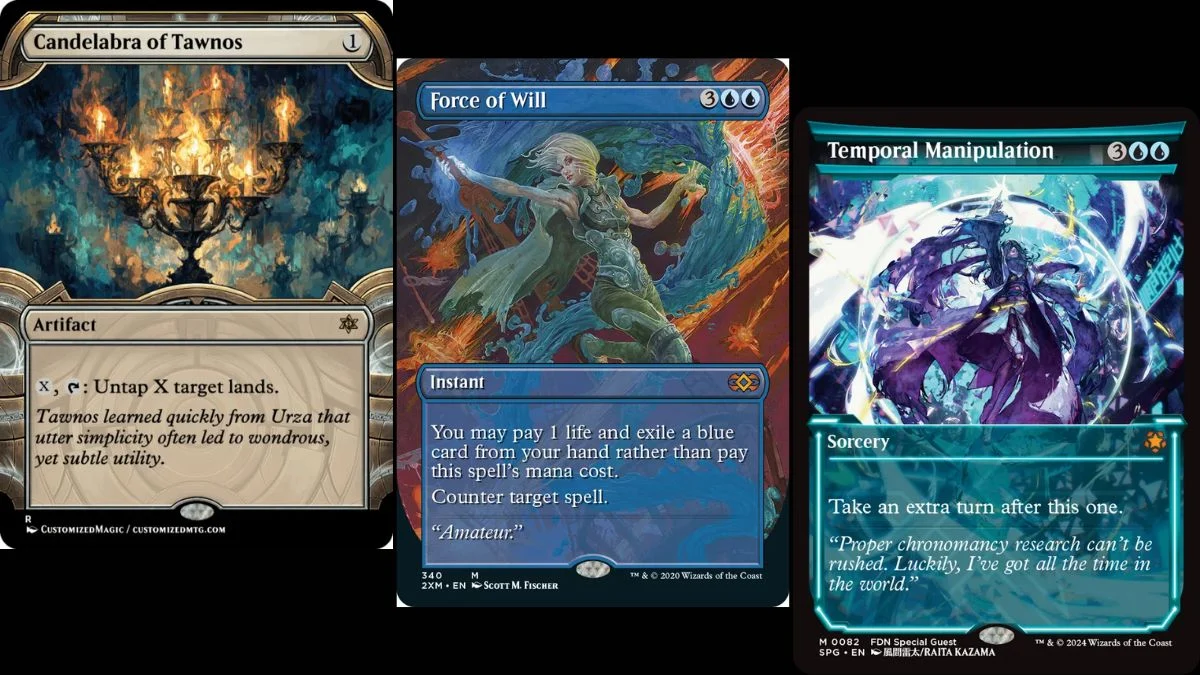

Wizards of the Coast just swung the ban hammer again, and this time it hit eight cards across three formats. The fourth Banned and Restricted announcement of 2026 landed on June 29, 2026, and while Standard players can breathe easy, Legacy, Pauper, and Brawl players are staring down some serious losses. Here is the full breakdown of what got cut, why it happened, and what it means for your decks.
Full List of Changes: MTG June 29, 2026 B&R
| Format | Card | Status |
| Legacy | Candelabra of Tawnos | Banned |
| Pauper | Seeker of Skybreak | Banned |
| Brawl | Force of Will | Banned |
| Brawl | Subtlety | Banned |
| Brawl | Wash Away | Banned |
| Brawl | Ugin’s Labyrinth | Banned |
| Brawl | Time Warp | Banned |
| Brawl | Temporal Manipulation | Banned |
Standard, Pioneer, Modern, Vintage, Alchemy, Historic, Timeless, and Competitive Brawl all received no changes. The next announcement is scheduled for August 10, 2026.

Legacy: Candelabra of Tawnos Banned After 27 Years
This one is genuinely historic. Candelabra of Tawnos was on the very first Legacy banned list when the format launched back in 1996 under the name “Type 1.5.” It got unbanned in early 1999, and now, 27 years later, it is banned again. That gap between unban and re-ban is almost certainly a record.
The culprit this time around is Colorless Tron, which had been climbing Legacy’s metagame at an alarming rate. Two copies of the deck met in the finals of the Legacy Showcase Challenge, with a third in the Top 8. More worrying to Wizards was that the deck’s win rate stayed high even as more players picked it up, a sign that the rest of the format simply had no reliable answer for it.
Wizards targeted Candelabra specifically because it almost never appears outside of broken combo strategies. Rather than banning around it and risking the same situation cropping up again with a different shell, they went straight to the source.
Key points:
- Candelabra of Tawnos is banned in Legacy effective immediately
- Colorless Tron’s rising metagame dominance drove the decision
- High Tide also loses a key piece, though most recent builds had already moved away from the card
- If a version of Tron without Candelabra remains viable, Wizards confirmed they are fine with that outcome
Separately, Wizards flagged The Fantasticar from the Magic: The Gathering | Marvel Super Heroes set as a card under active monitoring. The card can threaten 16 damage on very early turns and is immediately castable off Mishra’s Workshop mana. No ban yet, but Wizards made it clear they will act fast if it becomes a genuine issue in Legacy or Vintage.

Pauper: Seeker of Skybreak Combo Shut Down Immediately
Wizards did not wait around on this one. Seeker of Skybreak is banned in Pauper, and the reason is a two-card infinite combo with Hawkeye’s Bow from the Marvel Super Heroes set.
The combo works like this:
- Seeker of Skybreak taps to untap another creature, and crucially, it can target itself
- Hawkeye’s Bow deals 1 damage to any target whenever the equipped creature becomes tapped
- Equip Hawkeye’s Bow to Seeker of Skybreak, and you have an infinite loop that can kill as early as turn 2
Wizards chose to ban Seeker rather than Hawkeye’s Bow because Seeker’s ability creates a long-term design risk. Any future common with a “when this creature becomes tapped” effect would immediately need to be checked against Seeker. Banning Seeker removes that risk entirely. Hawkeye’s Bow, by contrast, needs very specific conditions to become broken and stays legal.
The decision to move fast was deliberate, with Wizards specifically citing upcoming large Pauper tournaments as a reason to act now rather than let the combo run through July.
Key points:
- Seeker of Skybreak is banned in Pauper effective immediately
- The infinite combo with Hawkeye’s Bow was the direct cause
- Hawkeye’s Bow remains legal
- Wizards moved early to protect upcoming large Pauper events

Brawl: Six Cards Gone in a Major Format Reset
Brawl took the biggest hit of any format this announcement, with six cards banned across three distinct problem categories. The context here is important: the recent launch of Competitive Brawl as a separate ladder allowed Wizards to reposition regular Brawl as a more casual, commander-focused play space. That shift came with a firmer approach to problematic cards.
Fast Mana
Ugin’s Labyrinth is banned, joining Chrome Mox and Ancient Tomb on the Brawl banlist. Colorless mana acceleration is a particular problem in Brawl because every single deck can run it regardless of commander color identity. When that mana comes too fast, cheaper commanders get squeezed out and the whole format speeds up beyond what casual play should feel like.
Free Interaction
Force of Will, Subtlety, and Wash Away are all banned. The number of powerful free counterspells in Brawl had grown to a point where it changed the fundamental calculus of when it was safe to play your commander. Wash Away was a particular offender since it specifically hosses commanders, the very cards that define the format. Wizards noted Force of Negation and Snuff Out are still under review but wanted to evaluate this first wave before making further cuts.
Extra Turn Spells
Time Warp and Temporal Manipulation are both banned. Unlike extra turn spells that exile themselves on use, these two can recur through loops, producing repetitive game patterns that Wizards confirmed hurt the overall experience for all players at the table. Match data supported that conclusion.
Key points:
- Six cards banned in Brawl across fast mana, free spells, and extra turns
- Competitive Brawl is a separate format with its own banlist and received no changes this cycle
- Force of Negation and Snuff Out remain under review
- Wizards signalled they expect to iterate more quickly on Brawl going forward
Standard, Pioneer, and Modern: No Changes
Wizards made no changes to Standard, Pioneer, or Modern, though for different reasons in each case.
Standard remains a topic of ongoing debate. Wizards acknowledged that Izzet Prowess and Badgermole Cub still sit at the top of the format and that the overall pace of the game is faster than they would like. However, they pointed to the emergence of Four-Color Control, Mardu Discard, Azorius Momo, and Dimir Excruciator, each of which has won a recent Regional Championship, as evidence that the format still supports multiple viable strategies. No ban incoming for now, though Wizards confirmed they are paying attention.
Pioneer has been in a healthier place since the earlier ban of Cori-Steel Cutter, with Badgermole Cub midrange leading a well-spread metagame and no single strategy running away with things.
Modern has an upcoming Pro Tour in Amsterdam and recently went through its own round of changes. Affinity has emerged as the standout deck in the early post-change period, but Top 8 diversity at recent events has remained solid. Wizards plan to watch the Pro Tour closely before taking any action.

Format Snapshot
| Format | Change | What to Know |
| Standard | No changes | Fast meta noted, no bans yet |
| Pioneer | No changes | Stable post-Cori-Steel Cutter ban |
| Modern | No changes | Pro Tour Amsterdam on the horizon |
| Legacy | Candelabra of Tawnos banned | Colorless Tron reined in |
| Vintage | No changes | Fantasticar being monitored |
| Pauper | Seeker of Skybreak banned | Hawkeye’s Bow infinite combo ended |
| Brawl | 6 cards banned | Format repositioned as casual post-Competitive Brawl launch |
| Competitive Brawl | No changes | New format, early development phase |
The next MTG Banned and Restricted announcement arrives on August 10, 2026, right before The Hobbit set releases on August 14, 2026. If The Fantasticar keeps posting strong results in Legacy and Vintage before then, that August date could bring another wave of cuts.
Source: MTG Official Press Release June 30, 2026


Leave a Reply