


Christopher Nolan has built a reputation for delivering some of the most acclaimed blockbusters of the modern era, with films that often dominate both the box office and awards season. But months before The Odyssey reaches cinemas, the Oscar-winning filmmaker is facing an unusually intense online controversy.
The final “countdown” trailer for The Odyssey (2026), released by Universal Pictures around July 1, 2026, has sparked one of the biggest trailer backlashes seen for a major Hollywood release in recent years. While anticipation for Nolan’s ambitious adaptation of Homer’s legendary epic remains extremely high, YouTube engagement tells a very different story.
From criticism over casting choices and dialogue to debates about historical authenticity and modern adaptations of classical mythology, the trailer has ignited discussions across YouTube, X (formerly Twitter), Reddit, Instagram, and Facebook. Yet despite the controversy, industry expectations for the film’s theatrical debut remain remarkably strong.
Christopher Nolan’s ‘The Odyssey’ Trailer Becomes His Most Disliked Ever
One of the biggest talking points surrounding The Odyssey isn’t its IMAX cinematography or star-studded cast—it’s the trailer’s overwhelming dislike ratio.
According to Return YouTube Dislike estimates and multiple reports, the final/countdown trailer uploaded by Universal Pictures initially received approximately 39,000 likes compared to around 118,000 dislikes, nearly a 3:1 negative ratio.
As engagement continued to grow over the following days, estimates climbed dramatically to roughly:
| Timeline | Estimated Likes | Estimated Dislikes | Key Observation |
| Early engagement | ~39K | ~118K | Nearly 3:1 dislike ratio |
| Early July 2026 | ~50–55K | ~230K–350K+ | Around 80–86% negative engagement |
The trailer accumulated millions of views while becoming what many observers describe as Christopher Nolan’s most disliked trailer by a wide margin.
The contrast with Nolan’s previous projects is especially striking. For comparison, trailers for Oppenheimer reportedly enjoyed overwhelmingly positive engagement, with approximately 836,000 likes versus only around 6,000 dislikes.
Unlike many promotional campaigns that restrict discussion, comments on The Odyssey trailer remained enabled, producing an extremely active comment section filled with criticism, jokes, and ongoing debate.
It is important to note that YouTube officially hides public dislike counts, meaning all available figures rely on browser extensions and third-party estimation tools. Although the exact numbers fluctuate, reports consistently indicate overwhelmingly negative engagement.

What Is Christopher Nolan’s ‘The Odyssey’ About?
Despite the online debate, The Odyssey remains one of the year’s biggest cinematic releases.
Directed by Christopher Nolan, who also serves as co-writer and producer alongside Emma Thomas through Syncopy, the film adapts Homer’s ancient Greek epic poem into a large-scale fantasy action spectacle.
Shot entirely with IMAX film cameras across multiple international locations, the production reportedly carries a budget of approximately $250 million.
The film is scheduled for:
| Official Detail | Information |
| Final trailer release | Around July 1, 2026 |
| London premiere | Around July 6, 2026 |
| Wide theatrical release (US & UK) | July 17, 2026 |
| Director | Christopher Nolan |
| Producers | Christopher Nolan & Emma Thomas |
| Production company | Syncopy |
| Estimated budget | Approximately $250 million |
| Format | Shot entirely with IMAX film cameras |
The story follows Odysseus, king of Ithaca, as he struggles to return home after the Trojan War while confronting gods, monsters including the Cyclops and Sirens, and countless deadly trials.
Meanwhile, the narrative also focuses heavily on Ithaca itself, where Penelope fights to protect the kingdom from aggressive suitors while Telemachus waits for his father’s long-awaited return.
Promotional material emphasizes themes of defying the gods, vengeance, and the journey home.

Star-Studded Cast Draws Both Excitement and Criticism
The ensemble cast assembled by Nolan is among the strongest of 2026.
Major roles include:
| Actor | Role |
| Matt Damon | Odysseus |
| Anne Hathaway | Penelope |
| Tom Holland | Telemachus |
| Robert Pattinson | Antinous |
| Lupita Nyong’o | Reportedly Helen of Troy |
| Zendaya | Athena |
| Charlize Theron | Calypso |
| Samantha Morton | Circe |
| Elliot Page | Rumored/associated with Sinon or similar Greek role |
| Jon Bernthal | Supporting role |
| Travis Scott | Bard |
Ironically, this impressive cast has also become one of the central sources of criticism surrounding the trailer.
Why Is ‘The Odyssey’ Trailer Facing Backlash?
The criticism surrounding the trailer has developed through several interconnected debates rather than one single issue.
Casting Choices Become the Biggest Flashpoint
Perhaps the most discussed issue involves the film’s casting.
Many critics questioned Lupita Nyong’o being cast as Helen of Troy, a character traditionally described as fair-skinned and remembered as “the face that launched a thousand ships.” Some viewers described the decision as race-swapping or a departure from traditional interpretations.
Others focused on Zendaya portraying Athena and Elliot Page appearing in a Greek warrior or mythological role associated with Sinon or longstanding Achilles rumours. These choices were criticised by some viewers as gender- or identity-related changes.
Another recurring complaint involved the perceived lack of prominent Greek or Mediterranean actors in major ancient Greek roles, with critics instead pointing to a cast dominated by American and British stars using modern accents.
Even Matt Damon received mixed reactions. While some praised his appearance, others dismissed the look as simply “Matt Damon with a beard,” arguing it lacked the transformation expected for such an iconic mythological figure.

Modern Dialogue Sparks Another Wave of Debate
Beyond casting, many viewers focused on the trailer’s dialogue.
Several lines delivered by Tom Holland’s Telemachus, including “My dad is coming home”, along with references to “daddy” or “pining for a daddy,” were widely criticised as sounding too modern for an ancient Greek epic.
Some viewers argued that the dialogue resembled contemporary teen drama rather than Homer’s poetic storytelling.
The trailer also faced criticism over what some audiences described as generic Hollywood action dialogue combined with modern American accents that, in their view, clashed with the mythological setting.
Visual Authenticity Also Comes Under Fire
The debate did not stop with dialogue.
Viewers also criticised elements including:
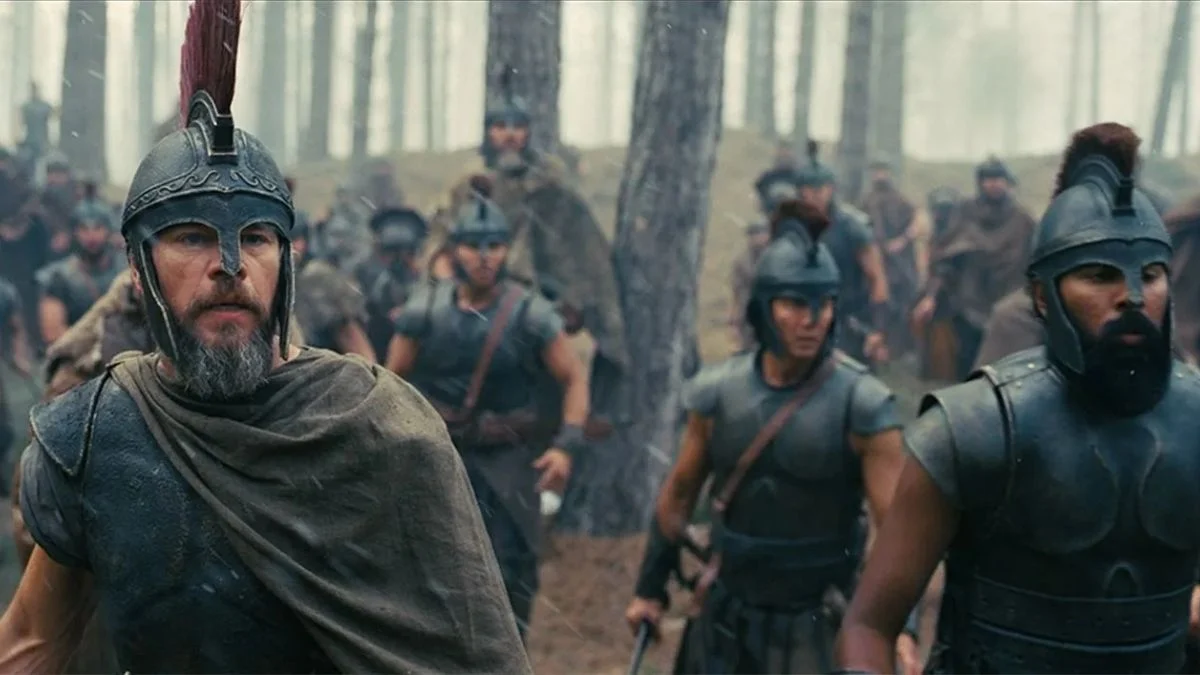
- Armour and weapons that some felt looked modern, inexpensive, or even Batman-inspired rather than historically authentic Bronze Age equipment.
- Locations that, according to critics, failed to evoke ancient Greece convincingly.
- Broader accusations describing the adaptation as “woke” or an example of “Netflix-ification.”
- Some critics additionally referred to the production as a “humiliation ritual” or an act of cultural disrespect.
Together, these concerns have fueled weeks of online discussion surrounding the film’s creative direction.
Christopher Nolan Defends His Creative Decisions
Despite the criticism, Christopher Nolan has defended several of the creative choices behind the production.
He has explained choices such as casting Lupita Nyong’o, citing her strength and poise while viewing mythology as something that should not necessarily be interpreted literally.
Nolan has also defended certain creative liberties involving elements such as armour materials.
At the same time, many supporters continue praising the film’s large-scale IMAX presentation, ambitious visual scope, and Nolan’s long-established filmmaking record.

Online Debate Continues Across Social Media
Discussion surrounding the trailer quickly spread well beyond YouTube.
The controversy has become particularly active across X (Twitter), Reddit (including r/CosmicBookNews), YouTube reaction channels, Instagram, and Facebook.
Some commentators argue the backlash reflects coordinated review bombing or campaigns driven by far-right groups.
Others insist the negative reaction represents genuine disappointment from fans concerned about remaining faithful to Homer’s original work.
The discussion has also attracted criticism from some Greek viewers and classics enthusiasts, many of whom expressed frustration over the adaptation’s interpretation of Greek mythology.
Meanwhile, industry reports indicate Universal reportedly skipped some influencer screenings, although the trailer continued trending despite the negative engagement.
Many industry observers also point to Christopher Nolan’s proven commercial success, particularly following Oppenheimer, as evidence that online controversy may not ultimately determine box office performance.
The situation has also drawn comparisons with broader culture-war debates surrounding casting and diversity in modern adaptations, including recent Disney remake controversies.
Notably, earlier trailers for The Odyssey reportedly received much more favourable engagement before backlash intensified following additional casting reveals and the release of the final trailer.

Can Trailer Backlash Hurt Christopher Nolan’s Box Office Success?
Despite becoming one of the year’s most controversial trailers, The Odyssey is still projected to perform strongly upon release.
Current tracking suggests the film could open with $80–100 million or more domestically, driven by Christopher Nolan’s reputation, the film’s star power, premium IMAX presentation, and its prime summer release window.
Many moviegoers continue withholding judgment until they see the completed film, noting that trailers often provide only a limited representation of the finished product.
Whether the controversy ultimately affects long-term audience reception remains uncertain. For now, The Odyssey stands at the centre of one of Hollywood’s biggest pre-release debates, highlighting the continuing tensions surrounding modern mythological adaptations, historical fidelity, diversity in casting, and audience expectations in contemporary blockbuster filmmaking.


Leave a Reply