

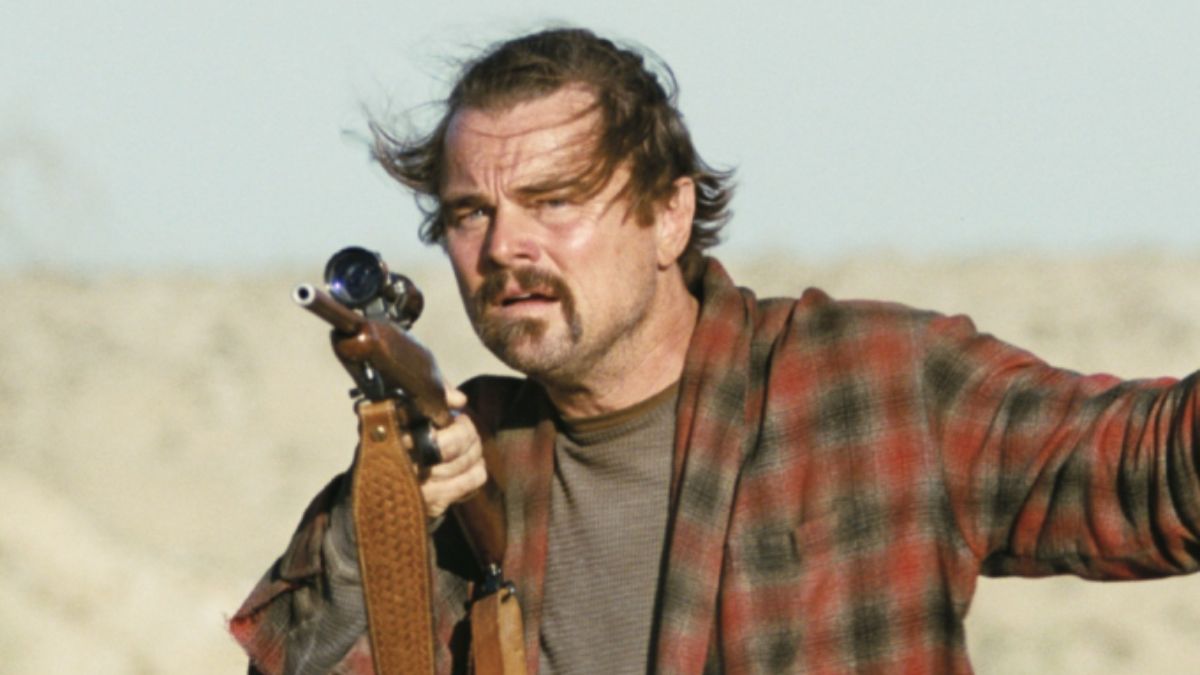
Paul Thomas Anderson’s One Battle After Another (2025) is not just another Hollywood release — it’s a daring mix of action spectacle, political satire, and intimate family drama. Headlined by Leonardo DiCaprio and featuring standout turns from Sean Penn, Benicio del Toro, Regina Hall, Teyana Taylor, and breakout star Chase Infiniti, the film takes audiences on a high-stakes journey that’s as explosive as it is emotional. For Indian cinephiles, the movie lands in theatres and IMAX formats on September 26, 2025, promising an experience that blends large-scale action with Anderson’s trademark storytelling depth.
One Battle After Another: Quick film at-a-glance

- Director / Writer: Paul Thomas Anderson.
- Stars: Leonardo DiCaprio (Bob Ferguson), Sean Penn (Col. Steven J. Lockjaw), Teyana Taylor (Perfidia), Benicio del Toro (Sergio), Regina Hall (Deandra), Chase Infiniti (Willa).
- Runtime / Format: ~162 minutes; released in VistaVision/70mm and IMAX presentations.
- Release (India): Theatrical release on 26 September 2025 (international rollout began Sept 24).
Lead — What the movie is doing?
One Battle After Another is Paul Thomas Anderson’s high-wire attempt to convert Pynchonesque paranoia and political satire into a propulsive, often violent father-daughter rescue thriller. The film follows Bob Ferguson (DiCaprio), a former revolutionary living off-grid, whose life is upended when an old nemesis resurfaces and his teenage daughter Willa is pulled into a dangerous conspiracy — forcing ex-comrades to reassemble and face a culture of erasure and righteous violence. Early critics hail the film as both wildly entertaining and thematically urgent.

One Battle After Another Act-by-act breakdown (Spoiler-Full)
Act I — Set pieces and the wound
The film opens with a violent, bold operation by an activist cell (the French 75) at the Mexico–U.S. border. Teyana Taylor’s Perfidia is magnetic, and an early humiliation of Col. Lockjaw (Sean Penn) plants the seed of a personal vendetta. The first act establishes Bob and Perfidia as charismatic radicals whose personal lives are entangled with their politics; they form a family and go underground when the state’s response grows personal. The tone is fast, darkly comic, and bitterly satirical.
Act II — Sixteen years later: paranoia, fatherhood, and the abduction
Sixteen years on, Bob is a single father to Willa (Chase Infiniti). The film doubles as a father-daughter drama: Bob’s stoner, defensive parenting and Willa’s hunger for a normal social life are contrasted against the persistent threat of Lockjaw’s obsessive campaign. When Lockjaw re-surfaces (with larger institutional resources and an obsessive, racialized fixation), the story flips into an on-the-run, cross-country rescue: Bob reconnects with old allies (Regina Hall, Benicio del Toro) and must remember codes, rendezvous points and a way to operate that exists in his memory but not in his present life. This middle section is kinetic — part action set-piece, part memory play — and it’s where PTA balances pulse-pounding set pieces with quieter family beats.
Act III — Confrontation, erasure, and Willa’s agency
The climax is less a single gun battle than a collision of motives: Lockjaw’s need to control narrative and lineage (he wants to possess or erase what Willa represents) runs up against the defenders’ loyalty and Willa’s own resourcefulness. Crucially, Willa is not merely the passive object to be rescued — she proves decisive in the finale, forcing a re-reading of who “saves” whom. The ending resolves the immediate physical threat but leaves the ideological battle — what we teach, what we forget, who gets erased from history — deliberately unsettled. Critics emphasize that the final notes are humanist rather than nihilistic: the film closes on a sense of continuity (the fight continues) and the possibility of repair, not simple victory.
One Battle After Another Ending — Explained Plainly (SPOILERS)
At its core, the film’s outcome can be read on two levels:
- Plot resolution: Willa’s disappearance culminates in a sequence of misdirection, memory-based puzzles and a direct confrontation with Lockjaw’s forces. Willa’s arc transforms from being the child of radicals to an agent of her own fate — she makes choices that directly shape the final outcome. Bob’s role shifts from lone survivalist to a father who must reckon with what his past has cost his daughter and how to protect her without consuming her identity. The immediate physical threat is neutralized by the actions of the ensemble — but PTA avoids tying everything up with a neat bow.
- Thematic resolution: The “victory” is partial and moral rather than total. The film ends by foregrounding erasure — who writes history, who gets remembered, and how institutions weaponize lineage and myth. Anderson gives us a hopeful tether: new generations (Willa and her peers) will take up pieces of the fight but will do so on different terms. That bittersweet, forward-looking note is what many critics have described as the film’s humane core.
In short: yes, the immediate kidnapping plot concludes (Willa survives and the threat is confronted), but the film’s central “outcome” is thematic — it asks whether cycles of revenge and control can be broken, and it suggests that breaking them requires memory, honesty, and the messy work of survival.
Key performances & technical highlights
- DiCaprio anchors the film with a surprisingly muted, weary performance that balances mania with paternal tenderness. Sean Penn is monstrously charismatic as Lockjaw — equal parts comic-book villain and unsettling real-world menace. Chase Infiniti (Willa) is the revelation — handling action, comedic timing and emotional beats with a steadiness that makes the film land.
- Jonny Greenwood’s score, Michael Bauman’s cinematography (VistaVision / 35mm / IMAX moments) and PTA’s kinetic editing make the movie feel like an art house blockbuster — broad in scale but intimate in emotional scope.
Why India should care about this Film Release?
- Release & format: The film opens in India on 26 September 2025 in regular IMAX and premium formats — an experience that benefits from large-format projection and Greenwood’s score. Book early for IMAX showings if you want the full sensory ride.
- Cultural resonance: India’s audiences have shown an appetite for politically textured blockbusters (and auteur-driven studio films) that balance spectacle with social commentary. PTA’s film, which riffs on identity, race, and institutional memory, will spark strong word-of-mouth debates here — especially among cinephiles and urban multiplex crowds.
Awards, box-office & what to expect next
- Critics’ early reception skews very positive (high Rotten Tomatoes/Metacritic snapshots reported during the press run), and awards season chatter is already in play for PTA and lead players. Expect festival noms and an awards push if momentum holds.
- Commercially, this is PTA’s most ambitious/expensive film to date. Trade coverage suggests Warner Bros. is positioning it for both box-office and awards — so expect a wide release strategy and an aggressive marketing push in key global territories (including India).
Bottom line — Should you watch it?
If you like intelligent action that rewards attention, care about contemporary sociopolitical storytelling, and want to see a director take studio scale and run with it, One Battle After Another is one of 2025’s must-see theatrical experiences. It’s big, messy, funny, violent and emotionally candid — and its ending refuses to let you leave the theatre thinking the film offered an easy answer
Catch up with Similar Stories Here:


Leave a Reply