

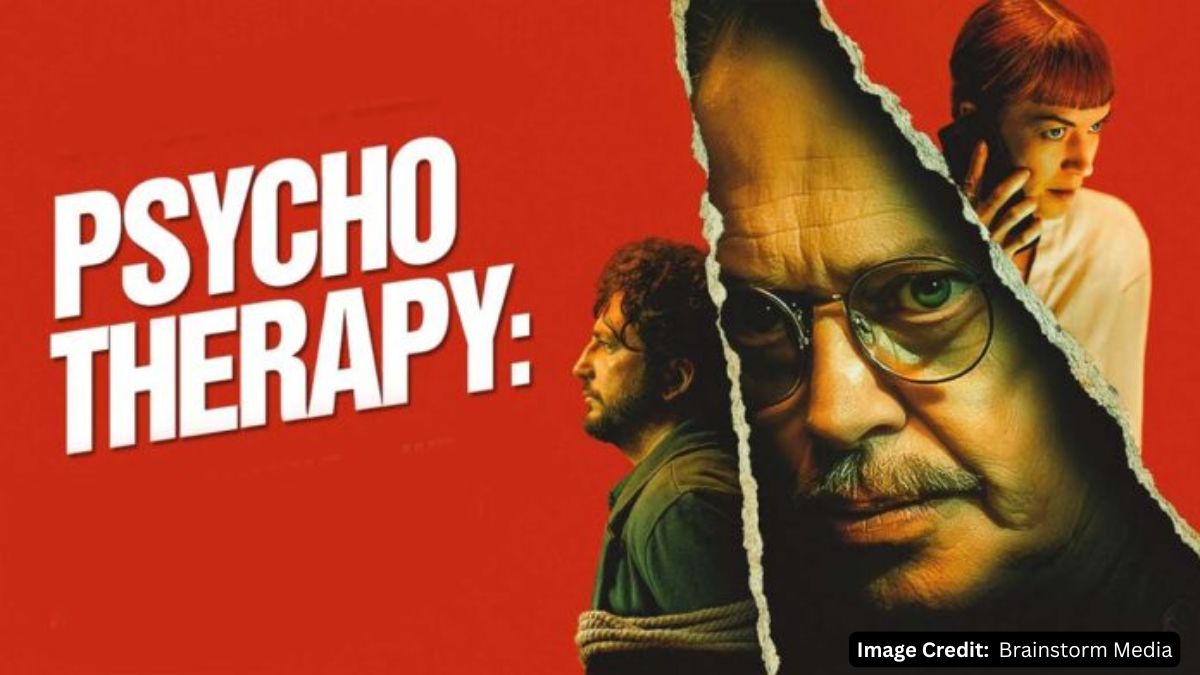

Spoiler warning: this is a complete scene-by-scene breakdown of Psycho Therapy: The Shallow Tale of a Writer Who Decided to Write About a Serial Killer — major twists and the final outcome are revealed and analyzed below. If you haven’t watched it yet, stop here.
Psycho Therapy Quick Overview (The Facts)
Psycho Therapy is Tolga Karaçelik’s English-language dark comedy/thriller about a struggling writer, his fracturing marriage, and the retired serial killer who becomes both his “consultant” and the catalyst for everything that follows. The film stars John Magaro (Keane), Britt Lower (Suzie) and Steve Buscemi (Kollmick), and opened in New York in April 2025 before expanding to VOD.
Act I — Setup: The marriage, the manuscript, the stranger

We meet Keane, an earnest-but-distant novelist who’s been stuck for years on a passion project (a prehistoric love story set ~40,000 BC). His career is stalled, his marriage to Suzie is brittle, and he’s oblivious to how far Suzie’s patience has worn thin. Small beats (Suzie lying about a traffic signal, the onion-slicing scene) establish that Suzie is furious, depressed, and borderline homicidal toward the life she’s been carrying alone — and Keane is shockingly unaware.
The inciting incident is perfectly weird: Kollmick (Buscemi) approaches Keane, claiming to be a “retired serial killer” and a fan of his work. He offers to be Keane’s living research for a new book — and, in the moment, Keane accepts. Kollmick then awkwardly doubles as a “marriage counselor” when Keane brings him home, and Suzie, fed up but oddly intrigued, agrees to let him run a few sessions. That casual acceptance (and Suzie’s later fascination) is what tips the story into its darkly comic second act.
Act II — Escalation: Research becomes rehearsal

Kollmick’s mentorship is not abstract. He literally demonstrates abduction, domination, and the logistics of killing. Keane — an intellectual, not a criminal — finds himself dragged deeper into staged crimes designed to teach him “authenticity” for the book: meeting with unreliable gun dealers, a bungled chloroform scene, and, crucially, the kidnapping/drugging of Keane’s agent, David, and the Albanian gun dealer. The film plays these sequences as escalating farce that turns progressively more dangerous — the safety net of satire frays as real bodies pile into the trunk.
Suzie’s arc in Act II is the engine of tension: she tails Keane, spies on motel surveillance, and increasingly interprets what she sees through a lens of vindication rather than fear. She believes Keane might be plotting to kill her (she admits later she’d rather die than stay with him). This misreading leads her to confrontations and, ultimately, to a point of radical transformation. The audience, nudged by the film, starts to wonder whether the “teacher” (Kollmick) is grooming a protégé — and if so, which of Keane or Suzie will be the pupil.

The Climax — The motel, the misunderstanding, and the gun
Everything comes to a head in a Chinatown motel. Keane is tied and gagged as part of a “lesson” so he can understand the helplessness of victims; the other kidnapped men (the gun dealer and the agent) are present. Suzie — having tracked them — bursts in. Kollmick knocks her unconscious but then, when she revives, proves to be oddly impressed by her coolness. Suzie, who had earlier confessed to two attempts to “get rid of” Keane (the red/green light trick and leaking gas), reveals she has been harboring murderous impulses of her own.
The film’s most consequential moment is both comic and horrifying: Suzie, ordered to intimidate the captive receptionist and David, aims a gun. A misheard direction (“higher” → “fire”) and a snap reaction lead to the gun dealer being shot dead — an immediate, irreversible act. In that instant, Suzie “tastes” the power of violence; Kollmick — the retired killer who wanted a story — watches the emergence of a natural predator. The film suggests the mentorship has accidentally created a new killer in Suzie, not Keane.
The Ending Explained (In Depth)

The final stretch alternates between literal fallout and symbolic closure:
- Immediate aftermath: Kollmick tells the couple to go home while he takes care of the body. The receptionist is released under threat; a phone rings at the desk (a cliffhanger detail), and we are left with the implication that someone (a taxi driver who saw men moving bodies, or another witness) may call the cops — or be silenced. The film deliberately leaves that call unresolved, planting dread that the violence will ripple outward.
- Keane’s other book appears onscreen: We cut to Keane’s prehistoric manuscript — the Homo sapiens vs. Neanderthal tale. That story is a deliberate metaphor: it frames marriage as a cyclical, survivalist dance of violence and intimacy. Like the exiled Homo sapiens woman who finds the last Neanderthal and alternates between fight and closeness, Keane and Suzie oscillate between resentment, danger, and an oddly inextinguishable bond. The film uses this to suggest that their relationship will continue on a grim, intimate loop — now complicated by Suzie’s act.
- What the ending means: On the surface, the ending is bleakly comic — the “training” for a book has real victims, and the couple has been changed. Suzie’s impulsive killing indicates she’s not just a passive victim of Keane’s ineptitude; she’s energized by power and capable of lethal agency. Kollmick’s smug curiosity implies he may have succeeded in producing a student who has genuine cruelty, validating his twisted worldview. But the film refuses neat moral closure: did Keane become complicit? Is Suzie a full-on killer now or simply someone who defended herself and then crossed a line? The final images imply that the experiment (art as rehearsal for violence) has broken the boundary between story and life — and the consequences will persist.

Critics’ Read & Why Some Viewers Feel Shortchanged
Many reviews praise Buscemi and Britt Lower’s performances and the film’s tonal ambition (dark, Coen-ish misdirection), but several critics take issue with the abruptness of the final act: the movie builds toward a third-act reckoning that arrives and then essentially cuts to black, leaving some character arcs unresolved. Paste Magazine, for example, calls the ending “whiplash-inducing” and argues that the film runs out of steam right when it should deliver payoff. That criticism helps explain why the movie’s last choices feel provocative but also narratively incomplete to some viewers.
Character Arc Notes — Who changes, Who doesn’t
- Keane (John Magaro): He starts as a passive dreamer — an artist who hides behind craft. By the end he is traumatized, complicit, and still not the dominant force. The film uses Keane as a foil to Suzie’s awakening: he seeks to write truth but fails to see the cost.
- Suzie (Britt Lower): The emotional powerhouse of the film. She pivots from exhausted spouse to potential killer: her moral line moves, and she’s electrified by decisive, violent action. Her arc is the story’s most chilling transformation.
- Kollmick (Steve Buscemi): The mentor who may have once been monstrous and now wants legacy. He’s both facilitator and tempter; his greatest success may be discovering that murder can be contagious or generative when paired with someone already primed for violence.
Key Symbols & Small Details Worth Rewatching
- The green/red light lie — Suzie’s early “I said it was green” trick shows passive-aggressive suicidal/dangerous tendencies long before she pulls a trigger.
- Onion chopping — a domestic image that signals mourning, tears, or ritualized self-harm; it’s a quiet sign of Suzie’s inner state.
- Keane’s prehistoric manuscript — the explicit allegory for how relationships alternate between brutality and intimacy; its inclusion in the final moments reframes everything as primal.

Final Verdict — Who Should Watch this Film?
If you like black comedies that flirt with true-crime satire, or character pieces where performances and tonal leaps matter more than tidy resolution, Psycho Therapy will reward you — especially Buscemi’s small-screen menace and Britt Lower’s slowly feral turn. If you need tidy moral conclusions and fully realized third acts, be prepared for frustration: the film deliberately (and divisively) leaves threads dangling.
More Trending Stories:


Leave a Reply