

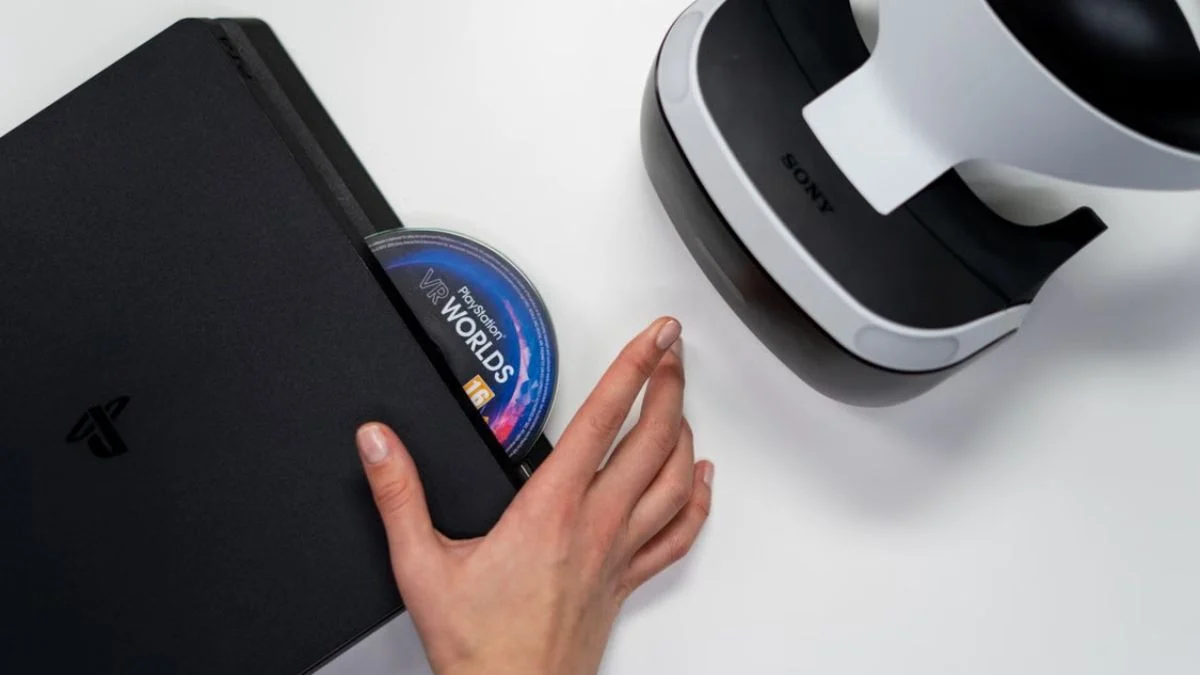
PlayStation players have spent months arguing over Sony’s plan to move away from physical game discs, but a new report has suddenly added another twist to the story. Sony is reportedly asking developers for feedback about the consequences of ending physical game releases, potentially opening the door to changes before the company’s January 2028 deadline.
The claim comes from tech analyst and YouTuber Tom of Moore’s Law Is Dead, who discussed an alleged Sony developer survey during Broken Silicon 380. According to Tom, the survey was unusually large and included a question that indirectly asked developers whether ending physical game sales could create problems.
That does not mean Sony is bringing discs back. There is currently no official confirmation that the company is reversing its decision. Sony’s public position remains that physical disc production for new PlayStation games will end in January 2028.
Sony’s 2028 PlayStation disc plan is still officially happening
Sony announced on July 1, 2026, that physical game disc production for all new games releasing on PlayStation consoles will be discontinued starting in January 2028.
Under the announced plan, new games released from January 2028 onward will be sold digitally through the PlayStation Store and through retailers offering digital formats. Games that have already released physically, along with titles scheduled to receive physical releases before the January 2028 cutoff, are not affected.
Sony said the decision reflects changing consumer behavior and the broader entertainment industry’s move away from physical media.
The company described the transition as a natural response to digital media becoming significantly more popular than physical discs and said it wanted to align with how most of its community now accesses and plays games. Sony also said it would continue giving players choices over where they purchase new games, including retailers and the PlayStation Store.
Sony later explained during a July 2026 earnings call that it had spent considerable time considering the decision and that digitalization across entertainment was a major factor. The company also acknowledged that the gaming community had expressed strong opinions about the change and said it would continue considering how to engage players within a future digital ecosystem.
So, officially, nothing has changed.
But that’s where the new rumor gets interesting.
Latest Xbox News: Microsoft’s long-awaited answer to the Platinum Trophy finally surfaces, complete with its own badge and sound. For more, read our story on the Xbox Mythic Achievement Reveal.
Sony reportedly sent developers a huge survey about killing physical games
According to Tom of Moore’s Law Is Dead, Sony recently sent developers what his contacts described as one of the company’s largest surveys.
During Broken Silicon 380, Tom claimed the questionnaire contained a question designed to indirectly determine whether developers saw problems with Sony abandoning physical game sales.
Tom said the survey was “a bigger survey than they’ve sent almost ever before” and described the question as Sony asking developers for feedback on the consequences of killing discs.
The report does not establish that Sony is preparing to reverse its policy. Instead, it suggests the company may be trying to understand how developers and publishers feel about the transition before the January 2028 deadline arrives.
Tom went further and speculated that significant negative feedback could potentially cause Sony to consider some kind of “mea culpa.”
That part is Tom’s speculation, not a statement from Sony.
No public copy of the alleged survey has been produced, and Sony has not announced any change to its physical-media plans. The current report should therefore be treated as an unconfirmed industry claim rather than confirmation that PlayStation discs are returning.
Why this survey matters to PlayStation players
At first glance, a developer survey might sound like routine corporate research.
But the timing makes it particularly interesting.
Sony announced the 2028 physical-media cutoff only a few months ago, and the decision immediately became a major discussion point among players, collectors, developers and industry observers.
The controversy isn’t simply about whether gamers like putting a disc into their console.
Physical games can be resold, traded, lent to friends and collected. They can also provide a tangible copy of a game outside the platform’s digital storefront.
Digital purchases work differently. They’re generally connected to a user’s account and depend on the platform’s digital ecosystem. That creates additional questions around ownership, preservation and long-term access, particularly when digital storefronts eventually close.
Modern physical games aren’t always completely independent either. Some require substantial downloads, patches or online services to deliver their full intended experience.
Still, a physical copy remains something players can physically keep, which is one reason the proposed transition has generated such a strong reaction.
More Xbox Headlines: A sweeping studio shake-up hands Halo’s future to Activision while Ninja Theory’s fate hangs in the balance. For more, check out our coverage of Xbox’s Studio Restructuring.
PlayStation reportedly knew the disc announcement would cause backlash
The controversy surrounding Sony’s decision also has another layer.
Former Sony Santa Monica writer Alanah Pearce previously discussed what she had heard from people working at PlayStation’s first-party studios. According to Pearce, Sony imposed unusually strict social-media guidelines around the announcement.
Pearce said Sony already knew people would be angry and described the communication restrictions as the strictest employees she had spoken with had seen.
She said the company would only have taken those measures if it knew the announcement could become a major public-relations issue.
Those comments suggest Sony expected a significant reaction before making the announcement. They do not, however, establish that the company’s expectations were exceeded or that the backlash has changed its plans.
That distinction becomes particularly important now that the alleged developer survey has surfaced.
Sony has a huge financial reason to keep moving toward digital
Here’s where things get complicated for physical-game fans.
Sony’s own financial data shows just how dramatically PlayStation has shifted toward digital purchases.
During FY2025’s fourth quarter, 85% of full-game software purchases on PS4 and PS5 were digital downloads. The figure was 83% in Q1, 72% in Q2, 76% in Q3 and 85% in Q4.
Across the entire FY2025, digital downloads represented 78% of full-game software purchases.
For comparison, Sony’s FY2015 digital ratio was only 19%.
That’s an enormous change over a decade.
The 85% number also needs to be understood correctly. It refers specifically to the digital download ratio for full-game software on PS4 and PS5. It does not mean 85% of all PlayStation consumer spending was digital, nor does it mean only 15% of every type of PlayStation purchase was physical.
Sony’s wider Game & Network Services business also includes add-on content, network services and other revenue categories.
Even with that context, the direction is obvious: digital has become the dominant way PlayStation players purchase full games.
More PlayStation Nostalgia: Two former Sony executives poke fun at a beloved disc-sharing meme, minus the actual disc. For more, read our post on Shuhei Yoshida and Adam Boyes’ PS4 Meme Recreation.
Sony is already making more money from each PlayStation user
Sony’s broader PlayStation strategy gives it another reason to continue pushing digital distribution.
The company has focused on generating more revenue from its existing audience through services such as PlayStation Plus, PlayStation Store spending, first-party software and other purchases while also controlling costs.
Niko Partners research and insights director Daniel Ahmad calculated that average annual revenue per active PlayStation user increased from 23,580 yen in FY2018 to 37,485 yen in FY2025.
That’s an increase of approximately 59%.
Ahmad attributed the longer-term growth to factors including higher-tier PlayStation Plus subscriptions, increased spending on software and additional content, and higher hardware prices. He also noted that the growth had been relatively flat during the past year or two.
The bigger picture is important: Sony doesn’t necessarily need to sell dramatically more consoles to grow its PlayStation business when the existing audience is already generating substantially more revenue per active user than it did during the PS4 era.
A digital-heavy ecosystem can further support that strategy because more purchases flow through Sony’s own storefront rather than through the traditional manufacturing, distribution and retail chain associated with physical games.
The Thalgau factory situation doesn’t mean new discs are coming back
Another major part of the physical-game debate involves Sony’s disc manufacturing infrastructure.
Earlier reporting suggested Sony’s Thalgau, Austria facility could see its production fall to just 10% of previous levels in 2028.
That sounded like Sony was preparing for an almost total collapse in physical-media manufacturing.
But that interpretation was later corrected.
Sony Digital Audio Disc Corporation clarified to journalist Brian Crecente that the figure referred to a 10% decline in overall product volume, rather than production falling to only 10% of its previous level.
That distinction is huge.
The Thalgau facility produces more than PlayStation game discs, and the clarification does not mean Sony has abandoned its January 2028 deadline for newly released PlayStation games.
Sony DADC has also indicated that existing PlayStation titles can continue to be reordered after the January 2028 cutoff.
So the factory is not simply shutting down every PlayStation-related disc operation overnight.
At the same time, its continued operation does not prove that Sony plans to resume physical manufacturing for new games.
The two situations can exist at the same time: Sony can keep physical-media infrastructure operating for existing products while still ending disc production for new PlayStation releases.
Marvel’s Wolverine could be part of the conversation
The reported developer survey also comes at an interesting time because Marvel’s Wolverine has been mentioned in discussions about continuing demand for physical games.
Tom reportedly pointed to Wolverine’s physical performance as evidence that there remains an audience for boxed PlayStation games.
That argument is worth keeping in context.
One successful game cannot overturn Sony’s broader software-sales data. Sony’s 85% digital figure covers full-game software purchases across PS4 and PS5 during FY2025’s fourth quarter, while individual games can have very different physical and digital splits depending on their audience, region, editions and marketing.
The Wolverine example therefore doesn’t prove that Sony’s digital strategy is failing.
What it does demonstrate is that physical demand has not simply vanished.
There are still players who want boxed games, and that audience could be commercially relevant to publishers and developers even as digital purchases dominate overall.
Developers may have reasons to view the transition differently
Sony asking developers for feedback would also make sense because the effects of ending physical releases won’t necessarily be identical across the entire industry.
Major publishers distributing games worldwide could have very different priorities from smaller developers that depend on specialist retailers, collectors’ editions or physical distribution in particular markets.
A boxed release can also provide marketing visibility and become part of a game’s identity among collectors.
There are additional regional considerations as well. Digital infrastructure, payment systems, broadband access and storefront availability can vary considerably between markets.
None of this proves developers oppose Sony’s plan.
It simply explains why Sony could have a reason to ask the people making and publishing games how they expect the transition to affect their businesses.
That’s what makes the alleged survey potentially significant.
Sony could theoretically compromise without completely abandoning digital
Even assuming the survey is real and Sony receives strong negative feedback, a reversal wouldn’t necessarily mean the company abandons its digital strategy.
There are several hypothetical ways Sony could modify the policy.
It could theoretically maintain limited physical production for major first-party games. It could potentially allow selected publishers to continue manufacturing discs through approved partners. It could also preserve boxed editions for collector-focused releases while keeping the majority of new games digital-only.
But these are possibilities, not announced plans.
There is currently no evidence that Sony has selected any of these approaches.
Calling the situation a confirmed PlayStation physical-media comeback would therefore go far beyond what the available evidence supports.
The more accurate takeaway is much simpler: Sony has reportedly been asking developers about the consequences of its physical-media strategy, while its official January 2028 plan remains unchanged.
The biggest issue is ownership, not just convenience
For many players, this debate isn’t really about whether digital downloads are easier.
It’s about what happens to game ownership when physical copies disappear.
A disc can be resold, traded, lent or collected. A digital purchase generally remains connected to an account and the platform’s storefront.
That difference becomes especially important for preservation.
Digital storefronts can eventually be changed or closed, creating questions about how players will access older purchases years or decades later.
Physical games aren’t immune to these issues because modern releases can require patches, downloads and online services. A disc doesn’t automatically guarantee that every part of a modern game will remain playable forever.
But the physical copy itself still exists independently of the storefront.
That’s why the January 2028 plan has become much bigger than a simple format change for many PlayStation players.
Sony’s official position still hasn’t changed
For now, there is one fact that matters more than all the speculation:
Sony has not announced a reversal.
The company’s official July 2026 announcement still states that physical disc production for new PlayStation games will end in January 2028.
New games released after that point are planned to be sold digitally through the PlayStation Store and through retailers offering digital formats. Existing physical releases and games scheduled for physical release before the cutoff are not affected.
The Thalgau factory clarification didn’t change that policy either. It corrected the expected production-volume figure but did not announce a return of physical discs for new games.
The alleged developer survey is therefore the intriguing new piece of the puzzle, not a confirmed U-turn.
PlayStation players shouldn’t assume discs are coming back yet
The possibility of Sony listening to developers will certainly give physical-media fans something to watch, but there’s still a long road between gathering feedback and changing a corporate strategy.
Sony has a powerful financial incentive to continue its digital push. Digital downloads already dominate full-game purchases, rising from 19% in FY2015 to 78% across FY2025 and reaching 85% during FY2025’s fourth quarter.
At the same time, physical games still represent a meaningful part of the market, and the continued demand for boxed releases — including discussion surrounding games such as Marvel’s Wolverine — shows why some developers and players may not be ready to completely abandon discs.
That’s the tension Sony now has to navigate.
The alleged survey could be routine research. It could be Sony genuinely investigating the consequences of its 2028 decision. Or it could eventually contribute to a compromise.
Right now, nobody outside Sony can say which one it is.
What we can say is that the report from Moore’s Law Is Dead has introduced a new wrinkle into PlayStation’s physical-media story. Sony may be gathering more feedback from developers before the 2028 transition becomes permanent, but there is no official evidence that new PlayStation games will continue receiving physical releases after the deadline.
For players who still collect discs, resell games, lend them to friends or simply want a physical copy sitting on a shelf, the fight over PlayStation’s future isn’t finished yet.
But for now, the official countdown to January 2028 is still running.
More PlayStation News: A multi-million dollar settlement could put PSN credit back in the pockets of eligible players. For more, read our report on Sony’s $7.85 Million PlayStation Settlement
Disclaimer
The alleged Sony developer survey and any suggestion that the company could reverse its physical-media strategy remain unconfirmed. Sony’s official position is still that physical disc production for new PlayStation games will end in January 2028. The survey claim is attributed to Moore’s Law Is Dead and should be treated as a rumor rather than a confirmed policy change.
Sources
- PlayStation Blog: Physical disc production ending in January 2028
- Sony Group: FY2025 financial and investor materials
- Sony Group: Historical financial data
- Game / Brian Crecente: Sony’s PlayStation disc plant is losing 10 percent of its volume in 2028, not 90
- The Verge: Sony isn’t phasing out discs quite as quickly as we thought
- ComicBook.com: New PlayStation rumor suggests Sony could reverse course on physical games
- Destructoid: Sony reportedly polling game developers about its disc decision
Featured Image Credit: cottonbro studio on Pexels


Leave a Reply