

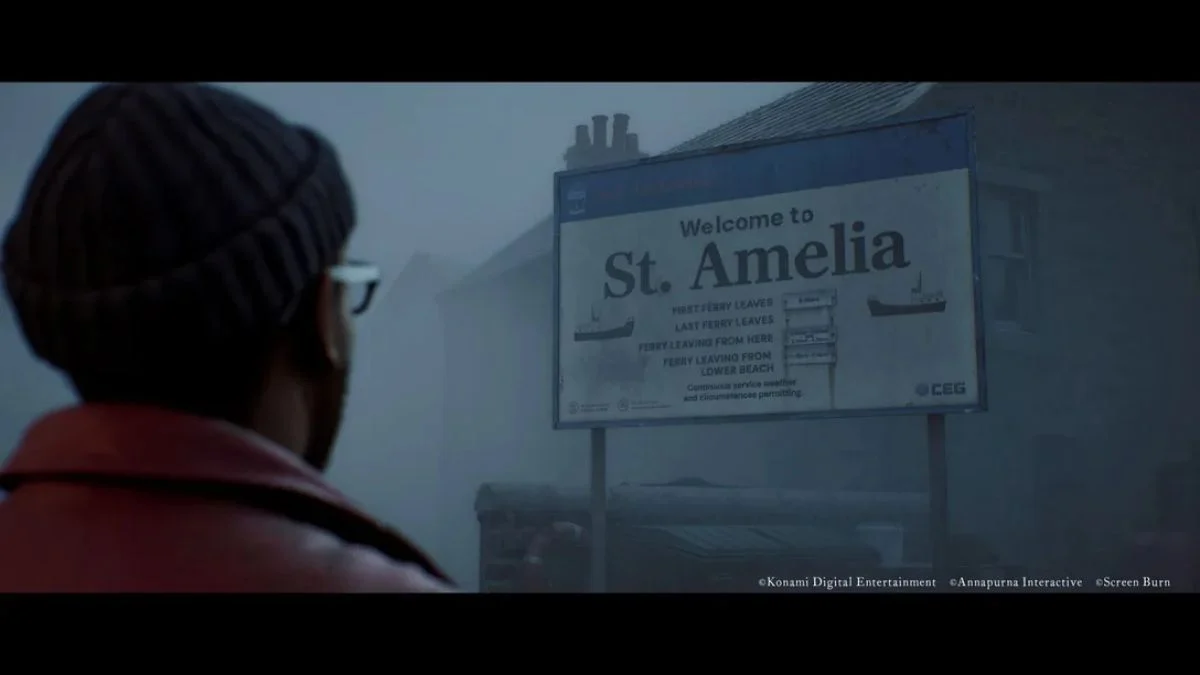
Silent Hill: Townfall is taking the series somewhere seriously different. Instead of returning to the franchise’s familiar American surroundings, the psychological horror game sends players deep into Scotland, where a remote island settlement called St. Amelia is buried beneath fog, silence and a disturbing mystery.
The twist? St. Amelia isn’t a real Scottish town.
The fictional settlement was created specifically for Silent Hill: Townfall, but Screen Burn didn’t build it from scratch without real-world inspiration. A real coastal fishing village called St. Monans, located in the East Neuk of Fife on Scotland’s east coast, became a major reference point for the game’s architecture, harbour, streets and overall coastal atmosphere.
That means players exploring St. Amelia are essentially stepping into a fictionalized version of a very real part of Scotland — one that looks considerably more peaceful in real life.
Where is Silent Hill: Townfall set?
Silent Hill: Townfall is set on the fictional Scottish island of St. Amelia in 1996.
KONAMI describes the game as a full-length, self-contained psychological horror experience set against the cold, isolated backdrop of Scotland. The story follows Simon Ordell, who is called back to St. Amelia to “put things right.”
But the island Simon returns to isn’t exactly welcoming.
The town sits beneath heavy fog and appears to have been abandoned, yet the silence doesn’t mean St. Amelia is empty of secrets. As Simon investigates the settlement, fragments of its past begin rising to the surface.
That Scottish setting is also a major departure for the franchise. Townfall isn’t simply taking the original Silent Hill concept and dropping it into another country. Screen Burn created an entirely new location, using recognizable characteristics of Scottish coastal communities to give St. Amelia its own identity.
KONAMI’s official material places the story firmly in Scotland in 1996, with Simon exploring the fog-covered island while trying to understand his connection to the place and its inhabitants.
More Game News: Jinwoo’s decades-long war against the Monarchs finally gets the gameplay details fans have been waiting for. For more, read our story on Solo Leveling: KARMA’s Monarch War Reveal.
Is St. Amelia a real Scottish town?
No. St. Amelia is fictional.
There is no real Scottish town or island called St. Amelia that serves as the game’s setting. Screen Burn created the settlement specifically for Silent Hill: Townfall.
However, the fictional location has a very real-world foundation.
St. Monans in Fife was a major inspiration for St. Amelia, and the connection goes far beyond the general idea of using a Scottish fishing village as visual inspiration.
CNET’s Andrew Lanxon visited St. Monans after playing Townfall and reported that Screen Burn had confirmed the fictional setting was based largely on the Scottish coastal village. His reporting highlighted similarities between the real location and the game, including architecture, harbour details, fishing equipment and shop fronts.
Some of the similarities are particularly striking around the harbour and surrounding streets. Buildings, shop facades, fishing equipment and specific environmental details reportedly carry over into St. Amelia, making the fictional settlement feel much more grounded in a recognizable Scottish location.
So, while St. Amelia isn’t a real place, players familiar with St. Monans may recognize more than a few details when they explore the game.
St. Monans is the real place behind St. Amelia
St. Monans is a small fishing village in the East Neuk of Fife on Scotland’s east coast.
It provided Screen Burn with the kind of environment the developers wanted for Townfall. That includes:
- A coastal harbour
- Narrow streets
- Traditional Scottish architecture
- Fishing equipment and harbour infrastructure
- Low buildings and shop fronts
- A distinctly Scottish coastal atmosphere
- Sea fog known locally as the “haar”
The real village, of course, is nowhere near as sinister as the version players encounter in Townfall.
During the day, St. Monans is a functioning community and tourist destination rather than a deserted psychological-horror nightmare. Visitors, fishermen, shops and cafes give the village a much more lively atmosphere.
That contrast is what makes the connection so interesting.
Screen Burn took recognizable elements from an ordinary Scottish coastal community and placed them inside the oppressive visual language of Silent Hill. Fog, darkness, isolation and the apparent disappearance of the local population transform familiar surroundings into something much more threatening.
CNET’s visit to St. Monans found that the real village looked remarkably different from St. Amelia during daylight. But once night fell, the empty streets and limited pools of streetlight created a much more unsettling atmosphere.
And that’s where the Townfall setting really gets interesting: the game doesn’t need to invent an entirely unfamiliar horror landscape. It can take somewhere that already exists and make players look at it completely differently.
More Gaming Headlines: A massive file size and a hidden Tifa secret suggest Square Enix isn’t holding back on scope. For more, check out our post on Final Fantasy 7 Revelation’s 200GB Leak.
Why did Screen Burn choose Scotland?
The Scottish setting wasn’t simply chosen because the developers wanted Silent Hill to look different.
For Screen Burn, Scotland was a familiar environment.
In an interview with PlayStation Blog, Townfall writer and director Jon McKellan explained the team’s reasoning:
“Scotland is where we grew up; it’s the environment most familiar and natural for us to depict. To create a meticulous, persuasive setting, we felt it was essential to build a world we knew inside and out. That’s why we chose Scotland.”
That familiarity gave Screen Burn a strong foundation for building the game’s world.
Instead of recreating a generic horror town, the developers could draw from places, landscapes and coastal communities they already understood. The result is a fictional location that still feels connected to a specific part of the United Kingdom.
The PlayStation Blog interview also identifies Jon McKellan as the writer and director at Scotland-based developer Screen Burn Interactive, with the team explaining that Scotland was the environment most familiar and natural for them to depict.
When is Silent Hill: Townfall set?
The events of Silent Hill: Townfall take place in 1996.
That era plays an important role in the game’s identity. The setting uses technology, architecture and everyday details associated with 1990s Britain, while the isolated island environment creates a strong feeling of separation from the modern world.
KONAMI describes Townfall as a psychological horror game set against the isolated Scottish backdrop of 1996, with promotional material centering on the fog-covered island of St. Amelia and Simon’s return to the settlement.
The period also gives Screen Burn room to incorporate older technology into the experience.
One of the most notable examples is the CRTV, a portable television that becomes an important tool during Simon’s journey. The strange device is used to tune into unstable signals, adding another layer to the game’s mystery as Simon tries to understand what happened in St. Amelia.
KONAMI’s official description similarly identifies the CRTV as a pocket television used to tune into unstable signals as Simon explores the island and uncovers fragments of the past.
More on the Crossover Front: Free EVE outfits and a surprise Switch 2 demo make this an unexpected team-up worth tracking. For more, read our coverage of the Stellar Blade x Bayonetta Collaboration.
How different are St. Monans and St. Amelia?
Players shouldn’t treat St. Amelia as a perfect one-to-one recreation of St. Monans.
Instead, St. Monans serves as a visual and atmospheric foundation for the fictional St. Amelia.
The similarities are most noticeable in the physical environment. CNET observed close parallels involving architecture, fishing equipment, shop facades and harbour details. Certain locations and angles reportedly appear remarkably close to their real-world counterparts.
But the atmosphere is where the two places truly separate.
St. Monans can be a bright and peaceful coastal community, particularly during the day. Townfall takes similar surroundings and strips away the sense of safety.
The crowds are gone. Fog covers the streets. Darkness limits visibility. The settlement feels isolated. Familiar locations suddenly become places where players have to question what might be waiting around the next corner.
That transformation fits one of the ideas that has always made Silent Hill so effective: a familiar environment can become deeply disturbing once its ordinary sense of safety disappears.
Does Simon actually visit St. Monans?
No.
Simon visits the fictional St. Amelia, not the real village of St. Monans.
St. Monans is the real-world inspiration Screen Burn used while creating the game’s fictional environment. The developers’ goal was to make St. Amelia feel like a believable Scottish coastal community rather than to place Simon directly inside the real village.
That distinction matters because St. Amelia has its own fictional history, characters and mysteries within Silent Hill: Townfall.
Simon is investigating the game’s fictional island settlement, while St. Monans exists separately as the real-world location that helped inspire its design.
KONAMI’s official description confirms that Simon is called back to St. Amelia, where he encounters a town beneath heavy fog and begins uncovering fragments of its past.
What makes St. Amelia different from the original Silent Hill?
Moving Silent Hill to Scotland gives Townfall an opportunity to explore how the franchise’s psychological-horror formula works outside its traditional American surroundings.
KONAMI describes the game as a standalone psychological horror story, with the fictional Scottish island of St. Amelia serving as its central location.
The developers’ decision to use Scotland also has a personal connection. Screen Burn chose the country because it was the environment its team knew best, allowing the studio to build the setting around landscapes and details it understood from experience.
That means Scotland isn’t simply a backdrop for the game.
Its coastal landscape, isolation, weather and 1990s British identity all contribute to the atmosphere surrounding St. Amelia.
The setting therefore becomes both a new location for Silent Hill and a fictionalized interpretation of a real part of Scotland.
The real Scottish village makes Townfall’s setting even more interesting
For players, the St. Amelia and St. Monans connection adds another layer to Silent Hill: Townfall.
On the surface, St. Amelia is an isolated fictional settlement where Simon Ordell returns to “put things right.” Beneath that, however, its visual identity is rooted in a real Scottish coastal village.
St. Monans supplies the real-world foundation: its harbour, streets, architecture, fishing infrastructure, shop fronts and coastal atmosphere. Screen Burn then transforms those recognizable elements into the fog-covered world of Townfall.
And the difference between the real and fictional versions is huge.
St. Monans can be lively, peaceful and welcoming. St. Amelia is presented as quiet, isolated and seemingly abandoned, with its fog and darkness turning familiar surroundings into something far more unsettling.
That makes the game’s Scottish setting more than a simple location change. It gives Townfall a fictional world that feels grounded in a real place while still having its own identity, history and mysteries.
So, where is Silent Hill: Townfall actually set?
The short answer is simple: Silent Hill: Townfall is set on the fictional Scottish island settlement of St. Amelia in 1996.
St. Amelia is not a real town.
Its design is heavily inspired by St. Monans, a real fishing village in the East Neuk of Fife, Scotland. Screen Burn drew from the area’s architecture, harbour, streets and coastal atmosphere while creating the game’s fictional setting.
So players can’t travel to the real “Silent Hill” of Townfall.
But they can visit the Scottish village that helped inspire it.
More Leak Coverage: A scrapped Liberty City expansion and early GTA 6 files surface in one of the biggest data leaks in years. For more, read our breakdown of the GTA 5 192GB Leak.
Disclaimer
This article distinguishes between the fictional setting described by KONAMI and the real-world locations reported as inspiration for Silent Hill: Townfall. Details are based on official game materials, developer interviews and relevant reporting available before publication.
Sources
- KONAMI – SILENT HILL: Townfall official information — Confirms St. Amelia as the setting and describes the game as taking place against the isolated backdrop of Scotland in 1996.
- KONAMI – SILENT HILL: Townfall release announcement — Official announcement confirming the Scottish setting and St. Amelia.
- PlayStation Blog – Townfall developers discuss the Scottish setting — Developer interview with Jon McKellan explaining why Screen Burn chose Scotland.
- CNET – I Visited the Real-Life Silent Hill Village in Scotland — On-location reporting confirming St. Monans as the real-world inspiration and documenting similarities between the village and St. Amelia.
- Glasgow City of Science and Innovation – Screen Burn and St. Monans — Relevant local reporting identifying St. Monans in the East Neuk of Fife as the inspiration for fictional St. Amelia.
Featured Image Credit: Konami / Screen Burn Interactive / Annapurna Interactive


Leave a Reply