

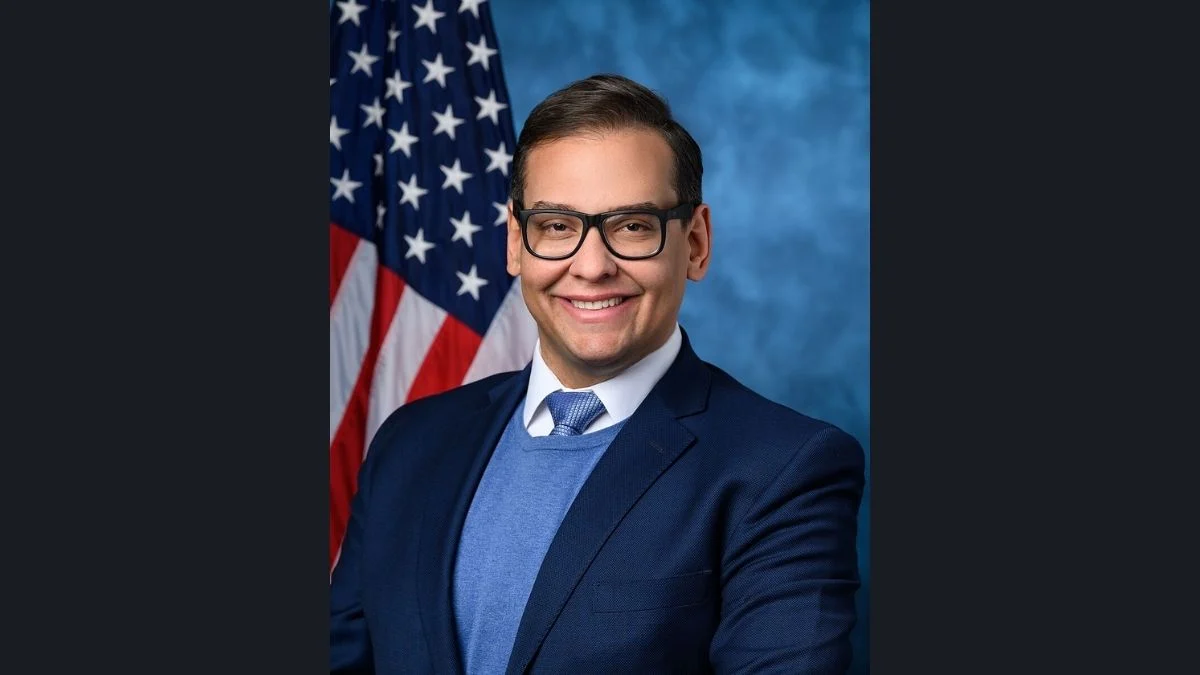
George Santos has just been handed the strongest punishment in Kalshi’s history. The former U.S. representative has been permanently banned from the prediction-market platform and hit with a $71,356 penalty after Kalshi concluded there was reasonable cause to believe he engaged in prohibited trading connected to his own attendance at President Donald Trump’s 2026 State of the Union address.
The decision follows a separate federal case. In July, the Commodity Futures Trading Commission (CFTC) ordered Santos to surrender $17,569.98 in trading profits, pay a $17,500 civil penalty and accept a three-year ban from trading prediction-market contracts. Santos settled without admitting the regulator’s findings or conclusions.
More Unusual Dispute Coverage: Betting scandals aren’t the only strange story making headlines this week, a Bangkok bar dispute over an unpaid bill has spiraled into its own police investigation. For more, read our story on Bangkok Host Bar Shaves 18-Year-Old Bald Over $1,800 Bill as Police Investigate Alleged Coercion.
George Santos’ Kalshi State of the Union bets turned into a market-manipulation case
The controversy began with a Kalshi event contract titled “Who will attend the State of the Union?”, including a market on whether Santos would attend Trump’s February 24, 2026 address.
The CFTC said Kalshi listed the contract on January 22. Santos opened his account on February 11 with $1,000 and deposited roughly another $6,000 between February 14 and February 22. His trading was exclusively focused on the contract concerning his own attendance.
| Date | Event | Key detail |
| Jan. 22 | Kalshi lists contract | State of the Union attendance market opens |
| Feb. 11 | Santos opens account | Initially funds it with $1,000 |
| Feb. 12–22 | “Yes” trades | Accumulates 30,874 contracts worth about $6,695.94 |
| Feb. 22 | X post | “Yes” contract rises from $0.15 to $0.70 |
| Feb. 23 | Travel uncertainty | Santos builds 23,855 “No” contracts |
| Feb. 24 | State of the Union | “Yes” price plunges from $0.73 to $0.02 |
| Feb. 25 | Position closed | Santos makes $14,390.57 on “No” trades |
Santos initially bet that he would attend, accumulating 30,874 “Yes” contracts. Then came a social-media post that changed everything.
“wear a muted or serious suit to the SOTU [State of the Union] or a bedazzled one?”
According to the CFTC, the price of “Yes” contracts jumped from $0.15 to $0.70 after the February 22 post. Santos then sold his entire position for a $3,448.43 profit and withdrew $10,146.07 to a Venmo account registered to the same phone number as his Kalshi account.
Later that day, his airline cancelled his Washington flight. Santos bought a train ticket instead, but that journey was also cancelled by weather around 7 p.m. on February 23.
Despite having no functioning flight or train reservation, Santos continued publicly suggesting he would attend.
“it’s annoying, but I’ll be there in the gallery haunting them all lol”
He followed that with a video explaining that, although he could not go onto the House floor while Congress was in session, he could attend from the gallery.
“To all of you like freaking out like ‘George Santos you can’t go on the House floor,’ I can’t go on the House floor when it is session, that is correct . . . you guys forget, I’m going to be in the gallery, I never said I was going to be on the floor. Or maybe. Hm. I am going to be there for the State of the Union in the gallery guys.”
The CFTC said “Yes” contracts subsequently climbed from $0.40 to $0.70. About 40 minutes later, Santos began building a “No” position, eventually accumulating 23,855 contracts worth $8,650.66.
Then, at around 8 p.m., someone asked him on X:
“So you are not actually going [to the State of the Union]?”
Santos replied:
“I am”
By then, according to the CFTC, both his plane and train reservations had been cancelled.
On February 24, records showed Santos accessed Kalshi from his home internet connection. At approximately 6:05 p.m., he posted:
“watching SOTU [the State of the Union] from an airport tv was not part of the plan.”
The market collapsed. “Yes” contracts fell from $0.73 to just $0.02, making Santos’ “No” position highly profitable. The CFTC noted that he had purchased no replacement ticket capable of getting him to Washington.
In the early hours of February 25, Santos closed the “No” position for a $14,390.57 profit. Combined with his earlier “Yes” gain, his trading profit was $17,839 before the figures used in the federal settlement. The CFTC ultimately ordered $17,569.98 in disgorgement.
More Police-Involved Sagas: Santos isn’t the only public figure whose own statements ended up complicating his legal troubles, a YouTuber recently found himself back in police custody just days after a bizarre excuse of his own. For more, check out our post on YouTuber Chris Sails Blames Brownies After Allegedly Telling Police His Kids Fell Into Water, Then Faces Second Arrest Days Later.
Why Kalshi banned Santos for life
The CFTC called the conduct manipulative, saying Santos made “a series of material misrepresentations and omissions” about his attendance and that his statements moved prices in directions favorable to his positions. His attorney, Joseph Murray, said there was “absolutely no intent to deceive any person, nor intent to manipulate any market.”
Kalshi went further than the federal settlement. Its Compliance Department said Santos violated platform rules by trading on an outcome he could influence and accused him of using false or misleading statements to move “Yes” and “No” prices.
The biggest difference was cooperation. While the CFTC settlement reflected Santos cooperating sufficiently with its investigation, Kalshi said he failed to cooperate with its compliance inquiry. Spokeswoman Elisabeth Diana said other people investigated at the same time cooperated and received temporary bans.
Santos received Kalshi’s first-ever lifetime ban, preventing him from accessing the platform directly or indirectly, alongside the $71,356 penalty.
His response was characteristically combative:
“Hey @Kalshi thanks for the lifetime ban from your gambling platform. Let’s see how much longer you guys are around for.”
He also called Kalshi an “unserious company” and described its action as “frivolous nonsense.”
The case is particularly notable because Santos’ political downfall was already extraordinary. Elected as a Republican to New York’s 3rd Congressional District in 2022, he entered Congress in January 2023 before being expelled on December 1, 2023, under H. Res. 878. House records cite findings involving false or incomplete FEC reports, personal campaign-fund use, fraudulent conduct and Ethics in Government Act violations.
Santos later pleaded guilty to federal wire fraud and aggravated identity theft. On April 25, 2025, he received an 87-month prison sentence, $373,749.97 in restitution and $205,002.97 in forfeiture. President Trump commuted the sentence on October 17, 2025. It was a commutation rather than a pardon, so Santos’ conviction remained intact.
Now, the Kalshi case has created another major test for prediction markets. The central question is simple: what happens when a trader is betting on an event they can personally influence?
For Santos, the answer is already clear. The CFTC imposed a three-year federal trading restriction, while Kalshi has shut its doors permanently. Together, the CFTC’s $17,569.98 disgorgement and $17,500 penalty, plus Kalshi’s $71,356 penalty, exceed $106,000.
Kalshi also announced temporary bans involving other traders who had bet on political outcomes connected to themselves. Santos, however, became the lone person to receive the platform’s ultimate punishment.
More Costly Losses: Six-figure penalties aren’t the only staggering losses making headlines lately, an Australian oyster farmer is facing his own massive financial hit after an alleged heist wiped out years of work. To learn more, read our feature on 400,000 Oysters Stolen in A$350,000 NSW Heist as Farmer Faces Years of Recovery.
Disclaimer: This article is based on a thorough review of the Commodity Futures Trading Commission’s July 31, 2026 enforcement order and related official records, U.S. House of Representatives records, U.S. Department of Justice records, and reporting from The Wall Street Journal, Associated Press, Reuters, CBS News and WIRED. The article distinguishes established findings from regulatory allegations and Santos’ own responses. Santos settled the CFTC case without admitting its findings or conclusions, while Kalshi’s lifetime ban is a separate private-platform disciplinary action. Details concerning any appeal or further proceedings may change.
Sources
- The Guardian
- BeInCrypto
- Engadget
- Gizmodo
- The Wall Street Journal
- Washington Examiner
- The Block
- CBS News
- Time
- U.S. House of Representatives — expulsion record
Featured Image Credit: U.S. House Office of Photography / Public domain


Leave a Reply