

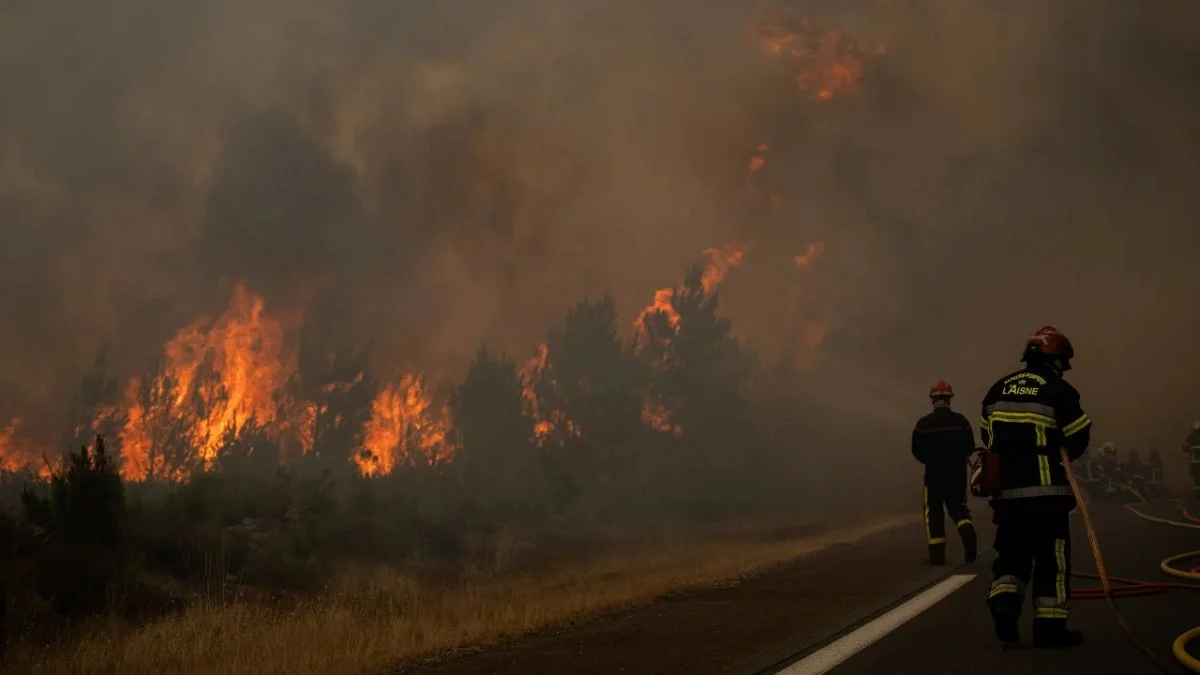
More than 300,000 people have been displaced across southwestern France and central Spain as devastating wildfires continue to spread through some of Europe’s most densely populated and environmentally significant regions. The crisis, unfolding amid record-breaking heat, prolonged drought, and powerful winds, has become one of the defining natural disasters of the 2026 European wildfire season.
For France, the evacuations represent one of the country’s largest peacetime civilian evacuations since World War II, while Spain has declared a national emergency as flames moved dangerously close to communities near Madrid.
The disaster is also drawing global attention because scientists and officials say it reflects the growing impact of climate change, with Europe continuing to warm more than twice as fast as the global average.
Wildfire smoke has also created serious problems far beyond Europe this year, drifting across the US and triggering widespread air quality alerts. To know more, read our article Why Are Skies Across the US Turning Orange? Canadian Wildfire Smoke Triggers Widespread Air Quality Alerts
How Europe’s extreme weather created a wildfire disaster
The current wildfire emergency did not begin with a single spark. An unusually wet winter encouraged dense vegetation growth across large parts of western Europe. That vegetation then rapidly dried during an intense period of extreme heat, creating what experts describe as a “flash drought.”
Combined with very low humidity, strong winds, and exceptionally dry forests, conditions became ideal for fast-moving wildfires capable of generating their own weather systems.
As of July 26, 2026, firefighters remain engaged in large-scale operations across France and Spain while authorities warn that hotter weather returning later in the week could reignite already dangerous fire conditions.

Fast-moving wildfires have also forced urgent evacuations closer to home this year, with one blaze near a major California city injuring a firefighter as it exploded in size. For more on that, read our post Firefighter Injured as California’s Little Fire Explodes Past 1,000 Acres Near Pleasanton, Triggering Urgent Evacuations
Timeline of the France and Spain wildfire emergency
| Date | Location | Major development |
| July 22–23, 2026 | Gironde, France | Wildfires ignite in pine forests north of Arcachon Bay and Cap Ferret. |
| July 23 onward | Madrid region & Ávila, Spain | Multiple fires merge west and northwest of Madrid. |
| July 24–25 | France | Evacuations rapidly expand into the hundreds of thousands. |
| July 25–26 | France | Overnight evacuation orders near Bordeaux push total French evacuations to roughly 220,000–250,000 people. |
| July 26 | France & Spain | Combined displacement exceeds 300,000 people, making it one of Europe’s largest wildfire evacuations in recent years. |
Fire emergencies elsewhere have also tested rapid-response systems this year, including a rooftop blaze in New York that was contained before it could disrupt a major public event. To learn more, check out our article Midtown Manhattan Rooftop Fire on St. Patrick’s Day 2026: FDNY Rapid Response Prevents Major Disruption Near NYC Parade
France’s Gironde and Landes wildfires: One of the country’s largest post-war fire disasters
The fires began around July 22–23 in the dense pine forests north of Arcachon Bay and Cap Ferret, a popular tourist destination along France’s Atlantic coast.
Driven by strong winds and intense firestorm-like behaviour, flames reportedly advanced at 800–1,000 hectares per hour, with some fires jumping up to one kilometre.
The scale has been extraordinary.
Across France, roughly 98,000–100,000 hectares have burned during 2026—far above a normal fire season. Earlier reports indicated more than 350 separate fires nationwide by late July.
The Gironde fire alone burned well over 12,500 hectares during its early stages before expanding significantly.
The destruction has been severe:
- More than 140 homes were destroyed in Gironde.
- Earlier assessments had reported 53–80+ structures, including a campsite.
- Communities such as Le Porge were left devastated, with residents describing ancestral homes reduced to ashes.
- Entire neighbourhoods were compared to ghost towns.
Evacuations escalated rapidly.
Initial evacuations affected 12,000–20,000 people, including many tourists camping around Cap Ferret, with some evacuated by boat.
By July 24–25, evacuation numbers climbed dramatically to 110,000–167,000+ people in Gironde and 23,000–31,000 in neighbouring Landes.
Additional overnight evacuation orders near Bordeaux increased the French total to approximately 220,000–250,000 displaced residents.
Although some residents in Biscarrosse were later permitted to return, authorities stressed that many dangerous areas remained inaccessible.
The fires also threatened Bordeaux, France’s sixth-largest city, approaching within 20–30 kilometres, while heavy smoke became visible across the region.
Emergency crews have paid a heavy price.

Another major fire incident disrupted a landmark celebration in the US earlier this month, coinciding with the country’s biggest fireworks display of the year. To see the details, read our article Brooklyn Bridge Fire During Macy’s July 4 Fireworks 2026: What Really Happened as America’s 250th Anniversary Celebration Lit Up New York
At least 68 firefighters have been injured, up from earlier reports of 42. No widespread civilian deaths have been directly linked to these specific Gironde and Landes fires, although one fatality has been referenced in the broader national wildfire season.
France mounted one of its largest firefighting operations in recent history.
More than 1,400 firefighters worked in Gironde at peak operations. President Emmanuel Macron ordered military mobilisation, deploying Civil Security aircraft, Canadairs, Dash aircraft, helicopters, and a large cargo aircraft capable of dropping fire retardant.
France also activated the EU Civil Protection Mechanism, receiving assistance from Croatia, Portugal, the Czech Republic, Slovakia, while Romania, Germany, Sweden, and Switzerland also contributed support.
Interior Minister Laurent Nuñez described the wildfire as unprecedented in intensity.
The emergency also forced security resources to be redirected, shortening the final stage of the Tour de France, while police guarding evacuated communities reported one arrest involving the theft of wine.
Extreme weather has been testing communities well beyond wildfire zones too, with a Gulf Coast state recently bracing for a tropical storm’s landfall. To know more, read our article Tropical Storm Bertha Nears Louisiana: Beaches Close, Sandbags Fill as Gulf Coast Braces for Flooding and Powerful Winds
Spain’s wildfire emergency spreads toward Madrid
Spain has simultaneously faced multiple fast-moving fires across the Madrid region and Ávila province, with some burning just 50 kilometres from the Spanish capital.
Several fires merged after igniting around July 23, fuelled by heat and strong winds.
Authorities declared a national emergency, the first linked to wildfire in this context.
The affected areas have burned an estimated 25,000–45,000 hectares, threatening residential communities, the Madrid Deep Space Communications Complex, and heavily populated areas.
Smoke significantly affected air quality across Madrid.
Evacuations followed a similar pattern to France.
Initial figures exceeded 10,000 people, before expanding into the tens of thousands.
By later reports, 50,000–90,000+ residents had either been evacuated or ordered to shelter in place across the Madrid region, Ávila, and parts of Toledo, while related reporting cited over 100,000 people impacted.
Among the communities evacuated were Cadalso de los Vidrios and Rozas de Puerto Real.
Spain has also recorded casualties during the broader wildfire season.
At least one person died in a related wildfire after being found in a vehicle near the Valencia/Manises area.
Earlier in July, a separate wildfire in Almería claimed 13 lives, most of them foreign nationals.
Prime Minister Pedro Sánchez warned the country faced “difficult hours” and “complex hours” ahead. After visiting affected areas, he urged residents to rely on official information and warned about the spread of fake news during the emergency.
Spain also requested international support through the EU Civil Protection Mechanism, receiving aircraft assistance from Italy, Greece, Portugal, and other partners.

Escalating tensions in other parts of the world have also been dominating headlines this summer, with US military operations expanding further into Iran. To see the details, read our article US Expands Iran Strikes Toward Tehran as Strait of Hormuz Crisis Deepens After Oil Tanker Is Disabled
Expert and official reaction
Officials across Europe have consistently linked the severity of the fires to climate change, which continues to intensify heatwaves, drought conditions, and wildfire behaviour.
Scientists note that Europe is warming more than twice as fast as the global average, making prolonged wildfire seasons increasingly likely.
Both Emmanuel Macron and Pedro Sánchez described the situation as unprecedented, while emergency officials continue coordinating national and international firefighting resources.
Data from the EU Joint Research Centre also shows significantly elevated burned areas across Europe during the 2026 wildfire season.
What’s next?
Although firefighters have benefited from slightly weaker winds, officials caution that the emergency is far from over.
Containment has improved in several locations, but authorities say key sectors remain far from full control.
Weather forecasts indicate temperatures could climb back to 39–42°C (102–107°F) during the coming week, with little or no rainfall expected across many of the affected regions.
That combination could allow existing fires to intensify again, prolonging evacuations, threatening more communities, disrupting tourism during the peak summer season, damaging forests, agriculture, homes, and infrastructure, and placing further strain on emergency services across Europe.

Conclusion
The wildfire emergency unfolding across France and Spain has become one of Europe’s most significant natural disasters of 2026. With more than 300,000 people displaced, vast areas of forest destroyed, hundreds of homes lost, and thousands of emergency personnel still battling the flames, the crisis highlights both the growing challenges of extreme weather and the scale of international cooperation required to confront it. While some residents have begun returning home, officials continue to warn that the combination of dry fuels, extreme heat, and limited rainfall means the danger has not yet passed.
Disclaimer: This article has been prepared following thorough research based on verified reporting and official information available from CNN, BBC News, Reuters, Xinhua News Agency, the 2026 France Wildfires documentation, and the European Commission Joint Research Centre (JRC). The information reflects the latest verified updates available as of July 26, 2026.
Sources:
Image Credit:
- Julien De Rosa/AFP via Getty Images


Leave a Reply