

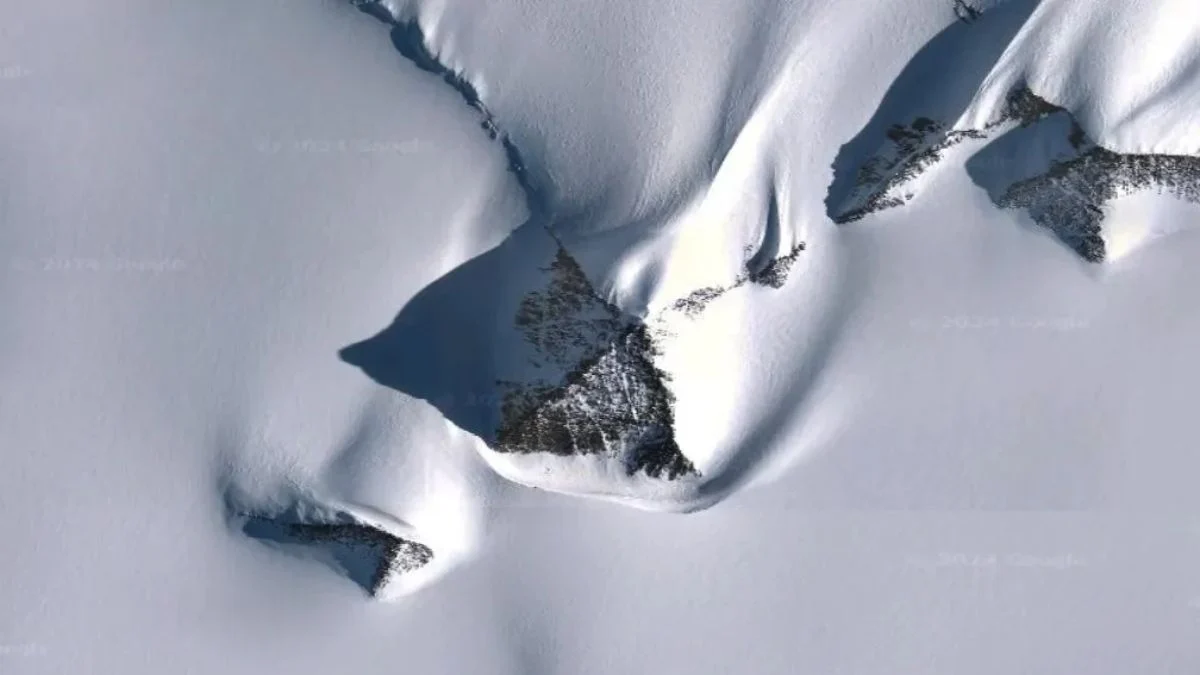
A mountain in Antarctica has a shape that seems almost too precise to be natural. Its steep faces meet at a pointed summit, creating a striking silhouette that resembles an ancient Egyptian pyramid. When satellite images of the formation spread across the internet in 2016, the remote peak became the centre of speculation about hidden civilisations, mysterious structures and even extraterrestrial activity.
But the story behind Antarctica’s so-called pyramid is more complicated than its unusual appearance suggests. The mountain sits in one of the continent’s most dramatic geological landscapes, where ice, rock and centuries of environmental change have helped shape extraordinary formations. Understanding why it looks so geometric means looking beyond the viral images and examining the science behind the landscape.
Where Is Antarctica’s Mysterious Pyramid Mountain?
The pyramid-shaped formation is an unnamed peak in the southern Ellsworth Mountains of Antarctica. According to Live Science, it stands approximately 1,265 metres (4,150 feet) above sea level, at coordinates around 79.977°S, 81.959°W.
Despite its popularity online, the mountain does not have an official geographical name corresponding to the description “Antarctic pyramid”. The term refers to its distinctive appearance rather than an established archaeological identity.
The peak forms part of a much larger mountain system in remote West Antarctica. The Ellsworth Mountains include the Sentinel Range and Heritage Range, among other geological features, and are known for their dramatic terrain and extensive evidence of glacial erosion.
The region also holds considerable scientific importance. The U.S. Geological Survey (USGS) has documented extensive geological and paleontological records in the Ellsworth Mountains, including nearly 150 identified fossil species dating from the Early Cambrian to the Permian.
That geological history provides an important starting point for understanding the mountain. Its setting is not an unexplained landscape but part of a region that has attracted scientific attention for decades.
When Unexplained Sightings Reach Congress
Reports of unusual orange orb sightings near a US military installation have drawn attention to questions about aerial phenomena and how such incidents are investigated. For another look at claims involving unexplained phenomena, explore our report on orange orb sightings and congressional testimony.
Was the Antarctic Pyramid Discovered in 2016?
The year 2016 frequently appears in online accounts of the mountain, but it marks the period when the formation gained widespread internet attention rather than a confirmed date of scientific discovery.
Satellite imagery showing the mountain circulated widely that year, encouraging comparisons with the pyramids of Egypt. Its apparent symmetry made it an easy target for speculation, particularly because the surrounding white landscape can make the peak appear isolated from other geological features.
However, Live Science reports that researchers likely knew about the mountain before it became an online phenomenon.
The broader Ellsworth Mountains were first spotted during a 1935 flight by American aviator Lincoln Ellsworth, according to a USGS publication cited by Live Science.
This historical detail also corrects a claim sometimes repeated online that the mountain range was first documented during the 1910–1913 British Antarctic Expedition. That expedition predates the documented aerial sighting of the Ellsworth Mountains and should not be credited with discovering the range.
The distinction matters: an image becoming popular online does not mean the geographical feature itself has only just been discovered.
Why Does the Mountain Look Like a Perfect Pyramid?
The peak’s appearance is genuinely striking. From above, it has four steep faces that converge towards a pointed summit, producing a geometric outline that resembles a constructed pyramid.
Satellite imagery can make this effect even more pronounced. Snow and ice conceal parts of the surrounding terrain, while the mountain’s prominent faces remain visible against the white landscape.
Yet a symmetrical shape does not automatically indicate human construction.
Geologists recognise a natural landform known as a pyramidal peak, or horn. These formations can develop when glaciers erode a mountain from several directions, carving steep slopes and ridges while leaving a pointed summit where the remaining faces converge.
Science Feedback identifies the Antarctic feature as a natural horn or pyramidal peak. Its explanation is that three or four intersecting glaciers can carve different sides of a mountain, gradually creating the characteristic pointed shape.
In other words, the geometry that makes the formation look artificial can emerge through natural processes.
How Glacial Erosion Could Have Created Antarctica’s Pyramid
The geology of the Ellsworth Mountains helps explain why such a formation is possible.
The USGS describes the range as containing rocks sculpted by glacial erosion into spectacular alpine topography. Rather than being an isolated object in a featureless landscape, the pyramid-shaped peak belongs to a mountain system with extensive evidence of glacial modification.
As glaciers move through mountainous terrain, they erode exposed rock, deepen valleys and help form steep ridges. When erosion affects several sides of a mountain, the remaining summit can become sharply pointed.
Over time, the interaction between the surrounding glaciers and the underlying rock can produce a dramatic pyramidal profile.
Similar formations exist elsewhere in the world, including the Matterhorn in Switzerland and Alpamayo in Peru. Science Feedback notes that comparable horns and pyramidal peaks also occur elsewhere in Antarctica.
These examples are important because they show that a pyramid-like appearance is not unique to the Antarctic formation and does not require an extraordinary explanation.
Did Freeze-Thaw Weathering Also Shape the Peak?
Glacial erosion may not be the only process responsible for the mountain’s distinctive appearance.
Live Science reported that environmental scientist Mauri Pelto identified freeze-thaw erosion as a likely contributor to its shape.
This process occurs when water and snow enter cracks in exposed rock. As water freezes, it expands and puts pressure on the surrounding material. Repeated freezing and thawing can gradually widen cracks, eventually causing pieces of rock to break away.
Over extremely long periods, this weathering can help reshape exposed mountain faces.
Pelto suggested that three of the mountain’s faces appear to have eroded at roughly similar rates, while the eastern ridge developed independently. That combination may help explain the formation’s unusual symmetry.
However, this should not be interpreted as a fully established account of every stage of the mountain’s development. The available information supports natural erosion as the explanation, while the precise contribution of individual processes remains a matter of geological interpretation.
The important point is that natural erosion can produce complex and remarkably regular shapes without any deliberate construction.
Is Antarctica’s Pyramid Evidence of an Ancient Civilisation?
The mountain’s appearance has fuelled online claims that an ancient civilisation once occupied Antarctica and built pyramids before the continent became ice-covered.
However, there is no credible archaeological evidence establishing an ancient civilisation at this location, and no evidence that the peak was constructed.
Antarctica’s geological past is real and scientifically significant, but it should not be confused with evidence of ancient human activity.
The Ellsworth Mountains contain fossils representing periods that include the Early Cambrian and Permian. These discoveries help scientists understand the region’s geological and biological history over hundreds of millions of years.
They also demonstrate that Antarctica’s environment has changed dramatically through geological time. But fossils and ancient rocks do not establish that humans built monuments in the region.
A claim of artificial construction would require physical evidence, such as worked materials, deliberately arranged blocks, archaeological artefacts or other identifiable traces of human activity.
No such evidence has been established for this peak.
The fact that Antarctica’s climate and ice coverage have changed throughout Earth’s history does not alter that conclusion.
What About Theories Linking the Mountain to Aliens?
Some online theories have gone further, suggesting that the pyramid-shaped mountain could be evidence of extraterrestrial activity.
Those claims are not supported by evidence from the formation.
The central argument behind these theories is its resemblance to a pyramid. But visual similarity alone cannot establish that two structures share the same origin.
Eric Rignot, a professor of Earth system science at the University of California, Irvine, and a senior research scientist at NASA’s Jet Propulsion Laboratory, previously explained the geological context to Live Science. His assessment was that the feature is simply a mountain with an unusually pyramid-like appearance.
Rignot also noted that pyramid-like peaks can form naturally. What makes this example unusual is its four particularly prominent faces, rather than the one or two faces commonly associated with many pyramidal-looking peaks.
That distinctive profile makes the mountain visually interesting, but it does not provide evidence of extraterrestrial involvement.
Antarctica’s Geological Past and the Pole-Shift Claims
The Ellsworth Mountains have a geological history considerably more substantial than the internet theories surrounding the pyramid-shaped peak.
Decades of scientific research have helped establish the region’s geological and paleontological record. Its rocks and fossils preserve evidence from vastly different periods in Earth’s history.
Antarctica has not always had the same climate or geographical position it has today. However, this fact is sometimes misrepresented online as evidence of a sudden catastrophe that transformed a warm, civilisation-filled continent into the frozen landscape known today.
Science Feedback found no evidence supporting claims that Antarctica suddenly shifted position or rapidly “flash-froze” because of a pole shift.
Instead, geological evidence shows that Antarctica moved towards its present position through plate tectonic processes over millions of years.
The distinction is essential: evidence of long-term environmental change does not establish the existence of an ancient civilisation or a sudden global catastrophe.
Why the Antarctic Pyramid Became an Internet Mystery
The mountain’s popularity reflects how easily satellite imagery can turn a genuine geographical feature into an online mystery.
Its four apparent faces, pointed summit and surrounding snow create an instantly recognisable resemblance to an Egyptian pyramid. From above, the image can appear unusually isolated because snow and ice obscure surrounding ridges, valleys and other geological structures.
Once the comparison gained attention, increasingly elaborate theories began circulating around it.
The underlying observation is accurate: Antarctica has a remarkably pyramid-shaped mountain in the Ellsworth Mountains. The unsupported leap is the conclusion that its appearance proves it was built.
Science Feedback has also documented other pyramid-shaped or semi-pyramid-shaped peaks in the Antarctic region. Their existence further demonstrates that this general form is not unique to the viral formation.
The wider landscape provides the context that isolated satellite images can hide: naturally sculpted peaks are part of the region’s established geological character.
Could Life Survive on Saturn’s Moon Enceladus?
Scientists investigating the possibility of life beyond Earth are studying how organisms respond to extreme environments that resemble conditions thought to exist on distant ocean worlds. Explore our analysis of an Earth microbe thriving in Enceladus-like ocean chemistry to see how this research relates to the search for potentially habitable environments.
Conclusion: What Is Antarctica’s Pyramid Mountain Really?
Antarctica’s pyramid-shaped mountain is a real and unusually symmetrical geological formation, but there is no credible evidence that it is an ancient monument or an extraterrestrial structure.
The unnamed peak rises approximately 1,265 metres (4,150 feet) in the Ellsworth Mountains and became widely known online in 2016. The strongest available explanation identifies it as a natural pyramidal peak, or horn, shaped by glacial erosion and other long-term weathering processes.
Comparable formations, including the Matterhorn in Switzerland and Alpamayo in Peru, demonstrate that nature can create strikingly geometric mountain profiles.
The Antarctic peak remains an intriguing example of how natural landscapes can resemble human architecture. Its real story lies in geology, glaciation, plate tectonics and the changing environments recorded in Antarctica’s rocks and fossils—not in an unproven claim of a hidden civilisation.
Source and Research Disclaimer
This article has been prepared based on thorough research of the sources provided below, including established reporting, scientific assessments and U.S. Geological Survey material. It reflects the information available in those sources and does not imply independent verification beyond the evidence they provide. Claims concerning artificial construction or extraterrestrial origins are not supported by the scientific evidence described in the cited material.
Sources
- Live Science: Antarctica’s pyramid-shaped peak and its geological explanation
- Science Feedback: Pyramid-shaped peaks in Antarctica are naturally carved by glaciers
- U.S. Geological Survey: Review of the geology and paleontology of the Ellsworth Mountains, Antarctica
- CBS News/Live Science: New pyramid in Antarctica? Not quite, say geologists
Featured Image Credit: Google Maps / Live Science


Leave a Reply