

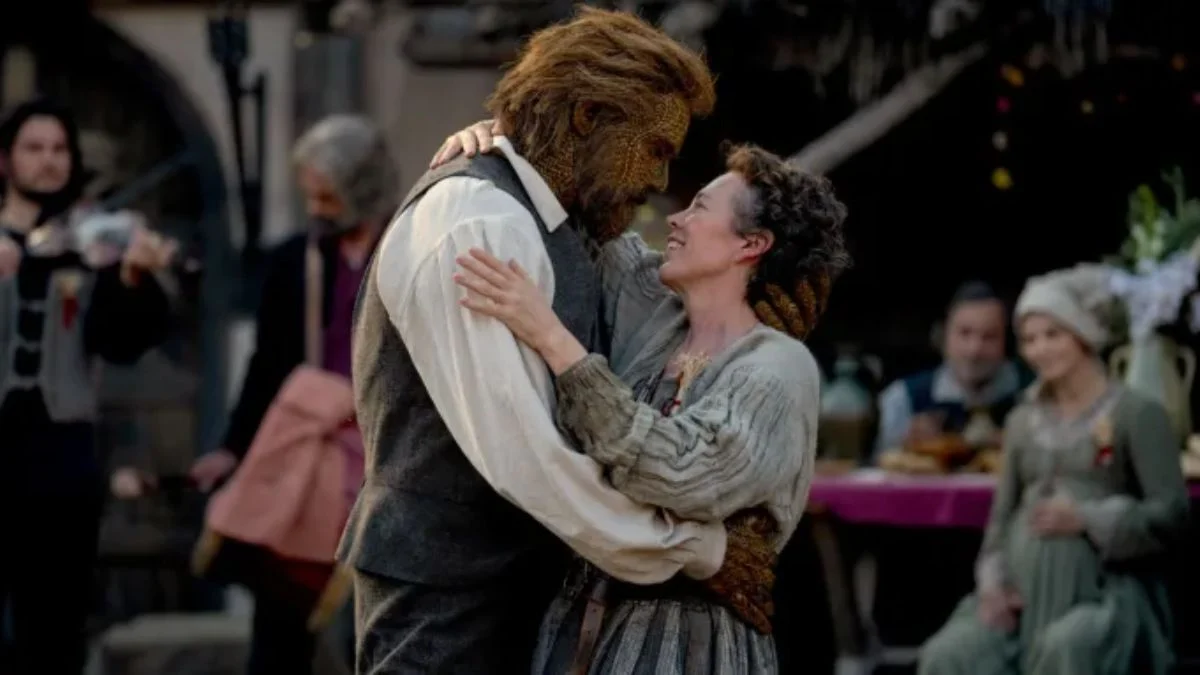
What happens when a woman decides that the expectations of an entire village matter less than her own happiness? In Wicker, that question takes an unexpected turn when an ostracized Fisherwoman commissions a husband made entirely from wicker. The premise sounds like the setup for an outrageous comedy, but the film uses its bizarre central relationship to explore something far more recognisable: the pressure to fit in and the freedom to choose your own path.
Written and directed by Alex Huston Fischer and Eleanor Wilson, Wicker transforms an eccentric fantasy into an adult fairy tale about romance, marriage and social conformity. With Olivia Colman, Alexander Skarsgård and Peter Dinklage bringing the unusual story to life, the film finds surprising emotional possibilities in an idea that could easily have remained a visual gimmick.
Wicker Review: A Strange Romantic Comedy With a Deeper Message
The premise of Wicker is certainly not your everyday romantic comedy setup. According to Black Bear Pictures’ official synopsis, the story unfolds on the outskirts of a seaside village where a Fisherwoman faces ridicule because she is single, looks different from what her neighbours expect and works in an occupation that attracts their judgment.
Eventually, she reaches her limit. Rather than continuing to tolerate the community’s narrow-minded expectations, she commissions a husband made from wicker.
His arrival changes everything. What initially appears to be a deeply personal decision soon triggers outrage, jealousy and chaos throughout the otherwise conservative village.
That is where the film’s central idea begins to take shape. The unusual husband attracts attention, but the real conflict concerns the people who cannot accept the Fisherwoman’s decision.
Instead of simply delivering jokes about an unconventional couple, the filmmakers use the fantasy to examine how communities respond when someone refuses to follow their rules.
The Fisherwoman does not wait for approval or a conventional romantic opportunity. She takes control of her future, setting the stage for a story that challenges assumptions about marriage, companionship and individuality.
The Sundance Institute describes Wicker as an allegorical adult fairy tale, exploring marriage, hidden desires, human flaws and the ways relationships expose people to one another.
Its central fantasy might be impossible, but the social pressure surrounding it feels familiar.
For Fans of Unconventional Film Stories
Some films use unusual premises to explore identity, survival and belonging. Explore our Animol prison drama review for another character-focused film review.
Olivia Colman Gives Wicker Its Emotional Heart
Olivia Colman’s performance is essential to making the film’s unusual premise work.
The Fisherwoman could easily have become a one-dimensional comic character, with the story relying entirely on the absurdity of her decision. Instead, Colman gives the character an emotional foundation built around loneliness, frustration and the desire to determine her own future.
Her performance helps the audience see the person behind the extraordinary choice.
The Fisherwoman’s appeal does not depend on being conventionally heroic or winning the approval of her neighbours. She becomes compelling because she refuses to let a community that ridicules her dictate what her life should look like.
That idea also connects with Elizabeth Debicki’s understanding of the screenplay. Sundance’s official coverage notes that Debicki viewed the story as an exploration of a woman’s discovery that she has the right to choose the path her life takes.
This theme gives the Fisherwoman’s journey greater significance than the film’s eccentric setup might initially suggest.
Her relationship with the wicker husband becomes an opportunity to explore what companionship means to her, rather than simply an attempt to satisfy the expectations of the people around her.
Alexander Skarsgård’s Wicker Husband Is Not Just a Gimmick
Alexander Skarsgård faces one of the film’s most unusual acting challenges. His character is constructed from wicker, meaning that his physical appearance is inseparable from the performance.
The production could have relied heavily on computer-generated imagery to create the character. Instead, it took a more practical approach.
According to Wētā Workshop’s official production account, the company created a fully practical fabricated suit and full facial prosthetic makeup for Skarsgård. The team also developed new materials and processes specifically for the character.
The Wicker Husband appears in a limited number of shots, all of which use fully practical effects according to Wētā Workshop. Limited visual effects were used for particular details, including points of light visible through the woven material.
This practical craftsmanship gives the character a tangible presence. Rather than looking like a digital creation inserted into a conventional film, he appears to have been genuinely constructed by hand.
That distinction matters because the audience needs to accept him as a character, not simply as an elaborate visual effect.
Skarsgård’s physical performance helps make the relationship believable within the film’s deliberately heightened reality. His appearance may initially attract attention, but the character has to function as more than a walking visual joke for the romance to have any emotional weight.
How Wētā Workshop’s Practical Effects Make the Fantasy Work
The Wicker Husband represents one of the production’s biggest technical challenges.
If the character feels artificial in the wrong way, the romantic storyline risks losing its credibility. Wētā Workshop’s work helps bridge that gap by taking the character from early concept design through construction and on-set performance.
The finished suit was designed to be worn by Skarsgård, allowing the character’s physical presence to remain central to the filmmaking process.
There is also a thematic connection between the practical effects and the story itself.
The Fisherwoman commissions a husband, and that husband is literally made by hand. His physical construction reflects the unusual nature of the relationship at the heart of the film.
Rather than attempting to make the fantasy look perfectly digital, the production embraces its handmade qualities.
That decision supports the film’s fairy-tale atmosphere while giving its central relationship something tangible around which to develop.
Peter Dinklage’s Basketmaker Gives the Story Another Dimension
Peter Dinklage plays the Basketmaker, the figure responsible for creating the Fisherwoman’s wicker husband.
His role gives the central fantasy a narrative foundation. The Wicker Husband does not simply appear without explanation; there is a person behind his creation and a process that brings him into the Fisherwoman’s life.
That introduces another dimension to the story, examining the relationship between a creator, a creation and the unexpected consequences that follow.
Sundance’s official coverage describes the Basketmaker as a kind of fairy godfather figure, while also noting his contribution to the disruption that follows.
His presence expands the film beyond a straightforward romance between two unconventional characters. The surrounding cast helps turn the central relationship into a broader fable about choices, consequences and the people affected by them.
Why the Conservative Village Turns Against the Couple
The village is more than a backdrop for Wicker. It is the source of much of the film’s conflict.
According to Black Bear Pictures’ official synopsis, the Wicker Husband’s arrival sparks outrage, jealousy and chaos among the conservative residents.
Their reaction creates the film’s satirical edge. The villagers are not merely confronted with an unusual man; they are forced to face a relationship that challenges the social rules they have accepted.
If the community responded only with curiosity, the story would lose much of its thematic purpose. Instead, the villagers’ behaviour reveals how strongly they believe that other people’s lives should conform to their expectations.
The central question is not simply whether a wicker man can be a husband, but why the people around the Fisherwoman believe they should have a say in her choice.
That tension allows the film to examine conformity without turning the story into a conventional social drama.
The more rigid the village’s expectations become, the more absurd those expectations appear when placed beside the Fisherwoman’s unusual decision.
Wicker Uses an Adult Fairy Tale to Explore Marriage and Desire
Sundance describes Wicker as a part-fairy-tale, part-fish-out-of-water fable, in which hidden desires and less flattering aspects of human behaviour gradually become visible.
That structure gives the film room to balance comedy with more serious ideas.
Rather than treating its strange premise as a marketing hook, the filmmakers use it to exaggerate familiar social dynamics. The fantasy becomes a way to examine what people want from relationships and how uncomfortable they can feel when their assumptions are challenged.
The romance is therefore not simply about finding a perfect partner.
It is also about being accepted without having to conform to someone else’s idea of who you should be.
Sundance’s official coverage highlights the filmmakers’ interest in the ways people are forced to confront aspects of themselves they would prefer to keep hidden. This gives the relationship an additional emotional dimension.
The characters are not only discovering what it means to love one another. They are also confronting the discomfort that comes with being seen more fully.
The Wicker Husband exists outside ordinary expectations, making him an effective contrast to the villagers who insist on enforcing them.
Budapest Creates an Otherworldly Setting for Wicker
The film’s visual environment reinforces its fairy-tale identity.
Wicker was filmed on location in Budapest, with the production creating an intentionally otherworldly atmosphere for the fictional village. Sundance’s official coverage also highlights the importance of the production and costume design in establishing the film’s visual identity.
The setting does not need to function as a historically precise location. Instead, it creates a distinct world in which social expectations can be exaggerated and the characters’ choices can take on a more symbolic quality.
That separation from contemporary reality gives the filmmakers room to examine recognisable ideas about relationships and conformity without presenting the story as a straightforward account of modern social life.
The film’s visual design therefore contributes to more than its appearance. It helps establish the heightened reality that makes the central fantasy possible.
Where Wicker Succeeds — and Why Its Unusual Tone May Divide Viewers
One of Wicker‘s strongest qualities is its willingness to trust the premise.
The film does not appear interested in building an elaborate scientific or mechanical explanation for how a wicker husband exists. Instead, it focuses on what happens when this impossible creation enters a rigid social environment.
That choice keeps the attention on the characters and their relationships.
Colman’s emotional performance, Skarsgård’s physical commitment and Dinklage’s role as the Basketmaker all help the film move beyond its initial novelty. Wētā Workshop’s practical craftsmanship further strengthens the central fantasy.
Together, these elements allow Wicker to operate as a romantic comedy, an eccentric fantasy and a social fable.
However, its distinctive approach will not appeal to everyone.
Viewers expecting a conventional romance may find the premise too strange, while those who prefer tightly explained fantasy worlds may struggle with its fairy-tale logic.
The film also attempts to balance humour, romance, eccentricity and thematic seriousness without neatly separating them into different sections.
Whether that combination works will depend on the viewer’s willingness to embrace the film’s unusual storytelling style.
For a movie built around such an unconventional idea, however, preserving its eccentric personality is part of the appeal.
Is Wicker Worth Watching? Final Verdict and Rating
Wicker is worth considering for viewers who enjoy unconventional romantic comedies and adult fairy tales.
Its premise could easily have supported one extended joke about a woman ordering a husband made from wicker. Instead, Alex Huston Fischer and Eleanor Wilson build a larger story around marriage, individuality, social pressure, hidden insecurities and the desire to be accepted without changing to satisfy everyone else.
Colman provides the emotional centre, Skarsgård commits to an extraordinary physical role, Dinklage gives the creation of the Wicker Husband a narrative foundation, and Wētā Workshop’s practical effects help make the central fantasy visually convincing.
The film’s greatest achievement is that its unusual character does not completely overwhelm the human story. The Wicker Husband remains memorable, but his real purpose is to reveal something about the people around him.
By placing an impossible relationship inside a conservative village, Wicker makes supposedly ordinary social rules look unexpectedly absurd. Its romance is unconventional, its humour grows from its unusual premise, and its adult fairy-tale structure gives it room to explore familiar anxieties from a different perspective.
Final rating: 4/5
Ultimately, Wicker is a deliberately strange but thoughtful romantic fairy tale. It embraces its eccentric premise and uses it to ask a straightforward question: what happens when someone chooses a form of happiness that other people cannot accept?
The answer makes this more than a story about a wicker husband. It becomes a fable about individuality, acceptance and the freedom to choose a life on your own terms.
For Fans of Dark Mysteries
Stories involving unsettling circumstances and complicated characters can offer a different kind of cinematic experience. Read our A Talent for Murder review starring Helen Mirren for another look at a mystery-driven film.
Source Disclaimer
This review has been prepared based on research using the official sources provided below, including Black Bear Pictures, the Sundance Institute and Wētā Workshop. The article reflects the information available from those sources and the critical interpretation presented in this review; it does not imply independent verification beyond the material supplied.
Sources
- Black Bear Pictures: Wicker Official Film Page
- Sundance Institute: Wicker at the 2026 Sundance Film Festival
- Wētā Workshop: Wicker Production and Practical Effects
Featured Image Credit: Black Bear Pictures


Leave a Reply