

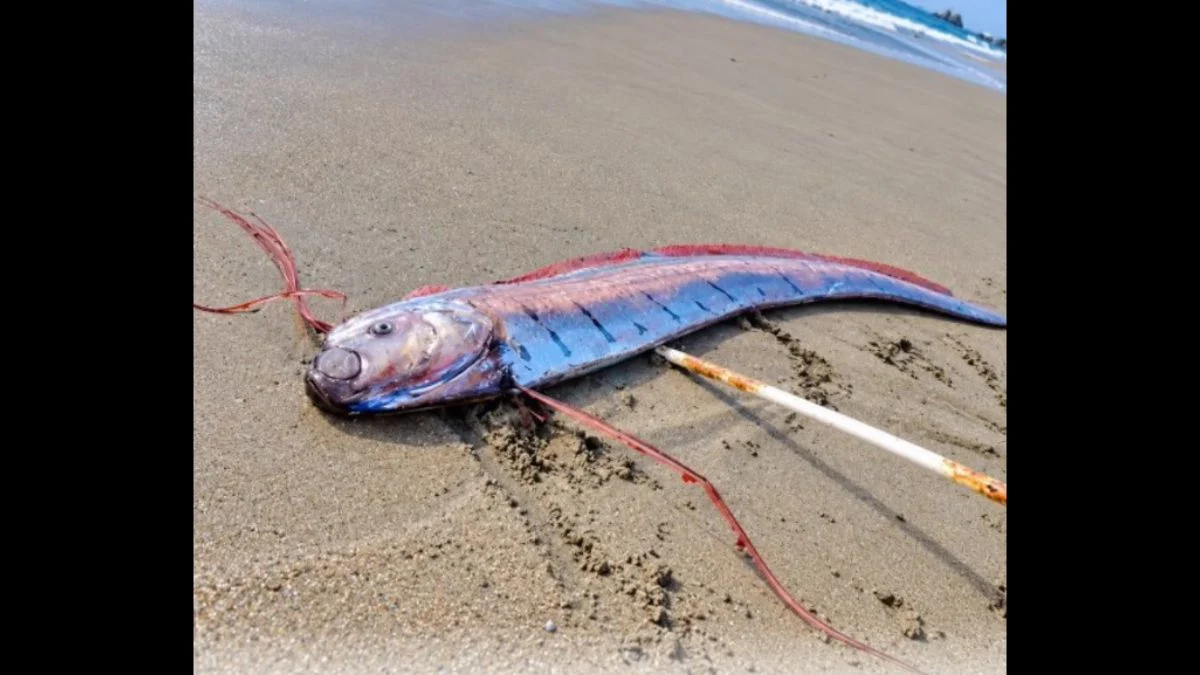
A mysterious deep-sea fish washing up on a beach is unusual enough to attract attention. But when the animal is known in folklore as a potential warning of earthquakes and tsunamis, even a single discovery can spark a much bigger conversation. That is exactly what happened in northern Chile, where a large oarfish was found dead along the coast, reviving an old belief that continues to fascinate people around the world.
The discovery has brought the so-called “doomsday fish” back into the spotlight, raising questions about why these deep-sea creatures sometimes appear near shore and whether their presence has any connection to natural disasters. The story has a fascinating cultural history, but the scientific evidence behind the earthquake theory tells a rather different story.
16-Foot Oarfish Found Dead at Chacaya Beach in Chile
The discovery took place on the afternoon of Tuesday, October 20, 2026, at Chacaya Beach in the commune of Mejillones, in Chile’s Antofagasta Region. The location is approximately 25 kilometres south of Mejillones, in northern Chile.
According to reporting by SoyChile, the dead oarfish measured approximately five metres (16 feet) long. Local fishermen alerted the Centro de Investigación de Fauna Marina y Avistamiento de Cetáceos (CIFAMAC), prompting members of the organisation to visit the site and examine the specimen.
Their observations revealed several striking physical details. The fish had a body width of approximately 47 centimetres, while its eyes measured around five centimetres in diameter. Those large eyes are consistent with the animal’s adaptation to the low-light conditions of its deep-water habitat.
CIFAMAC identified the animal as belonging to the Regalecus genus. The species is formally known as Regalecus glesne, according to the Integrated Taxonomic Information System.
Oarfish are recognisable by their unusually elongated, laterally compressed bodies, silvery appearance and long dorsal fin, which extends along much of the body. Their distinctive appearance has helped fuel stories about mysterious creatures emerging from the depths.
Although the fish itself is not necessarily exceptionally rare as an organism, encountering one stranded on a beach is unusual. Oarfish normally inhabit the open ocean at considerable depths, and people are more likely to encounter them after they wash ashore than during an ordinary coastal observation.
The Australian Museum similarly notes that encounters with live oarfish are rare and that individuals are most often seen after washing ashore.
When Doomsday Predictions Capture Public Attention
Claims about impending disasters often gain renewed attention when unusual events become a talking point. Explore our explainer on the November 2026 doomsday prediction for another look at a prediction and the claims behind it.
Why Is the Oarfish Known as the ‘Doomsday Fish’?
The nickname “doomsday fish” comes from a longstanding cultural association between oarfish and natural disasters. The idea is rooted in folklore rather than established marine biology or earthquake science.
In Japan, the oarfish is associated with the traditional name Ryugu no tsukai, commonly translated as “messenger from the palace of the sea god”. Stories surrounding deep-sea fish have contributed to the belief that their appearance near the surface or along beaches can precede earthquakes and tsunamis.
The legend received renewed attention following discussions about deep-sea fish sightings in connection with major Japanese earthquakes, particularly the 2011 earthquake and tsunami.
For believers, these unusual appearances can seem like warnings from the ocean. However, a fish being spotted before a disaster does not establish that it predicted the event.
Rare animal sightings can become particularly memorable when followed by dramatic natural events. When the two occur close together, people may connect them in hindsight, even without evidence of a meaningful relationship. Sightings that are not followed by earthquakes tend to attract much less attention, making isolated coincidences appear more significant than they are.
The discovery in Chile has revived this familiar debate, but determining whether the belief has scientific support requires more than anecdotal accounts.
What Scientists Discovered About Oarfish and Earthquake Predictions
The proposed connection between oarfish appearances and earthquakes has been investigated scientifically, including through a study published in 2019 in the Bulletin of the Seismological Society of America.
Titled “Is Japanese Folklore Concerning Deep-Sea Fish Appearance a Real Precursor of Earthquakes?”, the research examined whether historical reports of deep-sea fish appearances in Japan were associated with subsequent earthquakes.
Researchers assembled a database using reports from newspapers, academic literature and marine museums. Their analysis covered 336 cases of deep-sea fish appearances between November 1928 and March 2011.
They then compared those records with earthquake data, examining whether an earthquake of magnitude 6.0 or greater occurred within 100 kilometres of a reported fish appearance during the following 30 days.
The results did not support the popular theory.
Only one case met the specified criteria: the July 16, 2007 Niigata Chuetsu-oki earthquake, which had a magnitude of 6.8.
The researchers concluded that the historical data did not support the idea that deep-sea fish appearances were precursors to earthquakes.
The paper’s abstract stated that the spatiotemporal relationship between deep-sea fish appearances and earthquakes was hardly present, describing the folklore as a superstition arising from an illusory correlation between the two events.
This distinction matters. The research does not establish every possible reason why an individual oarfish might reach the surface, nor does it explain the cause of every stranding. Instead, it shows that the available historical evidence does not demonstrate a reliable relationship that would allow these appearances to be used for earthquake prediction.
Chilean Experts Reject the Earthquake Warning Theory
The discovery at Chacaya Beach has also drawn attention to the views of specialists in Chile, where earthquakes are a genuine and recurring natural hazard.
Marcelo Oliva, a biologist at the University of Antofagasta, rejected the idea that the stranding should be interpreted as a warning of an impending disaster.
In comments reported by SoyChile, Oliva said:
“La cultura popular habla que su varamiento es señal de desastres, pero eso no tiene asidero.”
The statement means that popular culture associates the fish’s stranding with disasters, but there is no basis for that interpretation.
Oliva also discussed oceanographic conditions, including the possibility that the movement of warmer ocean water associated with El Niño could contribute to unusual appearances. However, this was presented as a possible explanation for such occurrences, not as a confirmed cause of the Chacaya Beach stranding.
Ricardo Sáez, head of the Conservation and Biodiversity Unit at Chile’s National Fisheries and Aquaculture Service (Sernapesca), also noted that oarfish have been recorded in Chile before.
Previous records include incidental catches and dead specimens found in coastal areas such as Arica and San Antonio.
Sáez identified several possible factors that could contribute to strandings, including the end of an animal’s life cycle, reproductive processes and movements of water masses.
None of these possibilities has been established as the specific reason why the fish found at Chacaya Beach came ashore.
Why Do Deep-Sea Oarfish Sometimes Wash Ashore?
Despite their distinctive appearance, oarfish remain difficult to observe in their natural environment because they inhabit deep water.
There is no single confirmed explanation for every oarfish stranding. An animal found dead on a beach has already experienced an unusual change in circumstances, but the available information does not necessarily reveal what happened beforehand.
Possible contributing factors can include the animal’s physical condition, environmental conditions, currents and other oceanographic processes. The explanations discussed by Chilean specialists also include life-cycle changes, reproductive processes and movements of water masses.
The Florida Museum of Natural History notes that oarfish can be found at substantial depths and are occasionally discovered on beaches. Their unusual appearances near the surface have also contributed to historical sea-serpent stories.
For the specimen discovered in Chile, however, the cause of death and the reason it reached the coast have not been publicly established.
It would therefore be inaccurate to claim that illness, ocean currents, El Niño or any other individual factor definitely caused this particular stranding.
The distinction between a possible explanation and a confirmed cause is important, especially when an unusual wildlife event becomes the subject of widespread speculation.
Could the Chile Oarfish Sighting Mean an Earthquake Is Coming?
Chile’s seismic history helps explain why earthquake-related stories can attract attention, but the country’s genuine earthquake risk should not be confused with the oarfish legend.
Chile is one of the world’s most seismically active countries because of its tectonic setting. The Nazca Plate is being subducted beneath the South American Plate along the western margin of South America, generating significant tectonic activity.
This geological process makes earthquakes a real and recurring hazard. The appearance of an oarfish, however, has not been established as a signal that can forecast when an earthquake will occur.
Reports of oarfish appearing before disasters often rely on individual coincidences. An animal may appear, followed by an earthquake somewhere in the same country or region. Because earthquakes occur regularly in seismically active areas, some such coincidences are inevitable.
That does not show that the fish caused, detected or predicted the earthquake.
The 2019 study is especially relevant because researchers did not simply dismiss the folklore without testing it. They compared hundreds of historical fish appearances against earthquake records using defined geographical, temporal and magnitude criteria. Their findings did not establish a meaningful relationship that could support the proposed warning system.
Further expert assessments have reached the same broad conclusion.
In an August 2026 review of the claim, earthquake researcher Yoshiaki Orihara, who led the 2019 study, said there was no evidence from his statistical research that oarfish could detect or predict earthquakes.
Marine biologist Ben Frable, of Scripps Institution of Oceanography, also said there was no statistically supported relationship between oarfish strandings and earthquakes.
Together, these assessments reinforce the distinction between an intriguing cultural belief and a scientifically demonstrated prediction method.
What the Chacaya Beach Discovery Actually Tells Us
The confirmed discovery is striking enough without adding an unsupported disaster prediction to the story.
A dead oarfish measuring approximately five metres (16 feet) was found at Chacaya Beach near Mejillones on October 20, 2026. Its discovery attracted attention because oarfish are rarely encountered by people in ordinary coastal settings and because folklore has long associated them with earthquakes and tsunamis.
The animal’s appearance has revived the “doomsday fish” nickname, but Chilean specialists have rejected the interpretation that its stranding signals an impending disaster. Statistical research examining deep-sea fish appearances in Japan has likewise failed to establish a reliable predictive relationship.
The specific reason this specimen reached the shore remains unknown.
For people concerned about earthquake risks in Chile, official seismic monitoring and emergency authorities remain the appropriate sources of information, rather than animal sightings or social-media predictions.
Another Warning That Sparked Public Concern
Warnings about future disasters can spread widely before their evidence has been fully assessed. Read our report on Craig Hamilton-Parker’s second-pandemic warning for a separate story involving a widely discussed prediction.
Conclusion
The five-metre oarfish found dead at Chacaya Beach has brought an old earthquake myth back into public discussion, but the evidence does not support treating the discovery as a warning of an approaching earthquake or tsunami.
While the cultural connection between oarfish and disasters remains fascinating, scientific research has not established that these deep-sea fish can predict seismic events. The Chilean discovery is best understood as an unusual marine-wildlife event whose specific cause remains undetermined, not as evidence of an impending natural disaster.
Source Disclaimer
This article has been prepared based on research into the sources provided below, including reporting by SoyChile, scientific research, institutional information and expert statements cited in the supplied material. It reflects the information available as of October 24, 2026, and does not imply independent verification beyond what those sources support. The specific cause of the Chacaya Beach oarfish stranding has not been publicly established.
Sources
- SoyChile: Experts explain the oarfish found near Mejillones
- Tokai University: Research on deep-sea fish appearances and earthquakes
- University of Shizuoka: Statistical study of deep-sea fish and earthquakes
- Seismological Society of America: 2019 study, “Is Japanese Folklore Concerning Deep-Sea Fish Appearance a Real Precursor of Earthquakes?”
- Integrated Taxonomic Information System: Regalecus glesne
- Australian Museum: Oarfish species information
- Newtral: Scientific evidence concerning oarfish and earthquake prediction, updated August 2026
Featured Image Credit: CIFAMAC / SoyChile


Leave a Reply