

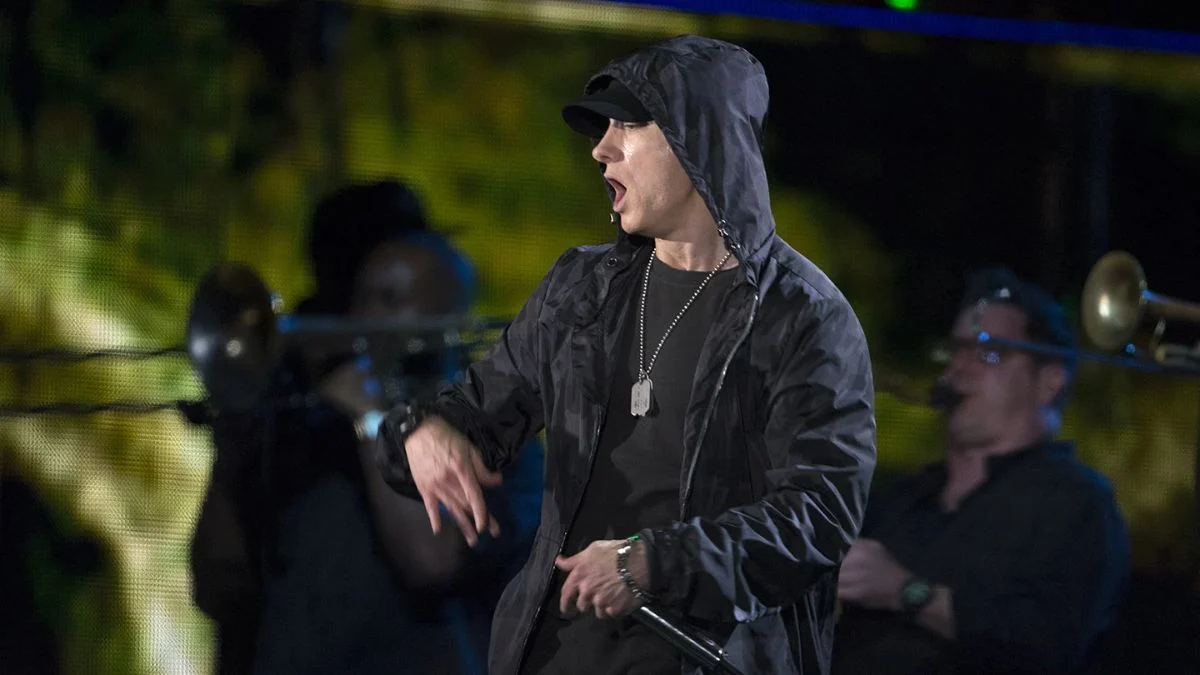
A breach of trust at Eminem’s recording studio has led to a federal guilty plea, bringing a long-running investigation into the unauthorised sale of the rapper’s unreleased music to a significant turning point. What began with studio employees discovering recordings circulating online eventually drew the FBI into a case involving password-protected hard drives, online buyers and music that had not been cleared for public release.
The case has also raised questions about the value of unreleased creative material and the distinction between songs prepared for possible release and recordings that an artist may never have intended to publish. Now, with the legal proceedings moving towards sentencing, attention is turning to what the former employee admitted, what remains part of the earlier allegations and what punishment could follow.
Joseph Strange Pleads Guilty in Eminem Unreleased Music Case
Joseph Strange, 48, of Holly, Michigan, has pleaded guilty to criminal copyright infringement after admitting that he copied and sold unreleased music created by Eminem without authorisation.
The U.S. Department of Justice announced the plea on October 22, 2026. Strange had worked for Marshall Mathers, professionally known as Eminem, from approximately 2007 until 2021. During that period, he helped establish and operate a computer system used to store music being developed for future sale and distribution.
According to the Justice Department, Strange had access to password-protected hard drives containing recordings and other material that had not been approved for public release. Prosecutors said he copied 10 or more audio files without permission and later sold and transmitted them to online buyers between July and August 2024.
The reported sales brought in approximately $50,000, without Mathers’ knowledge or authorisation.
The guilty plea marks a major development in the case, but it is important to distinguish the specific copyright offence Strange admitted from the broader allegations made during the original investigation in 2025.
Another Eminem Story
Eminem’s public-facing collaborations have also generated discussion among music fans. For more context on a separate development, see our report on Eminem and Kid Rock’s collaboration backlash.
What Was on the Hard Drives at Eminem’s Ferndale Studio?
The recordings at the centre of the case were stored on password-protected hard drives at a studio in Ferndale, Michigan, that Mathers used to create and develop music.
The Justice Department said Strange had helped set up and operate the computer system used to store the material. His access gave him the ability to handle recordings that were still in development and had not been authorised for distribution.
However, the status of the music requires an important distinction.
The Justice Department explained that a commercial release of the recordings was neither imminent nor certain. Some material had nevertheless undergone professional preparation for possible commercial release, including studio mastering in certain cases.
That means the case should not be interpreted as proof that every leaked recording was a finished song scheduled to appear in a future Eminem release. The material was unreleased, but its eventual commercial future was not established for every file.
Prosecutors’ case focused on the unauthorised copying, sale and transmission of the recordings, rather than on whether every track would eventually have reached the public.
How the FBI Investigation Into the Music Leak Began
The investigation began in January 2025, when employees at Mathers’ Ferndale studio contacted the FBI.
According to the original federal criminal complaint, studio employees reported the discovery of unreleased Eminem music circulating online on or about January 16, 2025. They also encountered an image displaying a list of unreleased music that they recognised as having come directly from a hard drive at the studio.
Investigators subsequently identified people who had purchased the material. According to the original complaint, those buyers identified Strange as the person who had sold them the music.
The 2025 court filing also described password-protected hard drives kept in a secure area of the Ferndale studio. Investigators alleged that files had been transferred from studio drives to an external drive during the period when Strange was employed there.
Those details formed part of the original complaint and supporting affidavit. They provide context for how investigators approached the case, but allegations in those documents should not automatically be treated as separate findings established by the later guilty plea.
The Original Charges Against Joseph Strange Explained
On March 19, 2025, federal prosecutors charged Strange by criminal complaint with two offences: criminal infringement of a copyright and interstate transportation of stolen goods.
At the time, the Justice Department made clear that the complaint contained charges and did not itself establish guilt.
The two offences initially carried combined statutory maximum penalties of up to 15 years in prison if Strange were convicted of both. That figure described his potential exposure when the original charges were announced, not the maximum penalty associated with the offence to which he ultimately pleaded guilty.
Reporting on the plea agreement says prosecutors agreed to drop the interstate transportation of stolen goods charge as part of the resolution.
Strange has pleaded guilty to the copyright infringement offence. Under the Justice Department’s October 22 announcement, that offence carries a statutory maximum of five years in prison.
The actual sentence remains undecided and will be determined by a federal judge after consideration of the U.S. Sentencing Guidelines and other statutory factors.
More Than 25 Songs Were Allegedly Circulated Online
The original investigation involved allegations extending beyond the 10 or more audio files identified in the current description of the conduct covered by the guilty plea.
When Strange was charged in 2025, federal prosecutors said more than 25 songs had been played or distributed online without permission.
The original complaint described buyers who investigators said had obtained unreleased Eminem songs from Strange. One purchaser reportedly told investigators that approximately $50,000 in Bitcoin had been paid for unreleased music.
The supporting affidavit also described investigators finding additional material during a search of Strange’s residence, including hard drives containing thousands of audio files and handwritten material associated with Eminem.
These details belong to the earlier investigation and the evidence described in the original complaint. They should not be confused with the narrower conduct summarised in the October 2026 guilty plea announcement.
The distinction is significant: Strange pleaded guilty to criminal copyright infringement after prosecutors said he copied and sold 10 or more audio files. The allegation concerning more than 25 songs came from the earlier stage of the case.
Eminem’s Leaked Music Was Accessed Millions of Times
The consequences of the alleged leak extended beyond the original transactions between Strange and the buyers.
According to the Justice Department, data supplied by several streaming providers showed that government-identified infringing audio files had been accessed more than eight million times as of November 2025.
Additional reporting on the plea agreement put the number of accesses between eight million and nine million.
The agreement also reportedly states that Strange accepted $1 million as a reasonable estimate of the infringement value of the files for purposes of the plea agreement.
The Justice Department’s public announcement separately described the infringement amount as at least $750,000. These figures should be attributed to their respective sources rather than presented as interchangeable calculations.
The approximately $50,000 Strange received from selling the recordings is a separate amount. It refers to the reported proceeds from the transactions, not either of the infringement-value figures.
The figures illustrate why the case attracted attention beyond the original studio breach: the files reportedly circulated on a scale far greater than the initial sales alone might suggest.
Eminem’s Representatives Responded After the Original Charges
When Strange was originally charged in 2025, an Eminem spokesperson expressed appreciation for the FBI’s investigation.
The representative described the alleged breach of trust as damaging to Eminem’s artistic legacy and creative integrity. The statement also referred to financial losses affecting creators and collaborators.
The latest Justice Department announcement did not include a new statement from Eminem himself.
Variety reported that an Eminem representative declined to comment for its October 22, 2026, report on Strange’s guilty plea.
Joseph Strange’s Attorney Disputes the Government’s Characterisation
Following the guilty plea, Strange’s attorney, Wade Fink, criticised the Justice Department’s public presentation of the case.
Fink described the government’s characterisation as “hyperbolic” and “self-congratulatory” and argued that its public statements could seriously affect Strange and his family.
In a statement to Variety, Fink said:
“Joe Strange is a good man whose children have suffered greatly in all of this,” Fink said in a statement to Variety. “And please be sure that the actual facts of this case bear little resemblance to the comments made to the public. It is a far more complicated and nuanced matter than a man just unabashedly stealing. Nevertheless, my client has taken accountability for what he has done, has tremendous remorse for what has happened to his family, and has great faith, as do I, in the judges of our district to see this case for what it is.”
The defence statement offers Strange’s attorney’s perspective on the circumstances surrounding the case. It does not undo the guilty plea, but it makes clear that Fink disputes the government’s broader characterisation of his client’s conduct and the circumstances surrounding it.
Justice Department Officials Address the Guilty Plea
Assistant Attorney General A. Tysen Duva of the Justice Department’s Criminal Division said Strange had abused a position of trust by copying and selling music that had not been authorised for public distribution.
“Joseph Strange abused a position of trust to unlawfully copy and sell unreleased music belonging to Eminem, profiting from works that were not yet authorized for public distribution,” Duva said. “His conduct undermined both legal and artistic rights.”
Duva added that the Criminal Division would continue working with law enforcement partners to pursue intellectual-property crimes involving creative works.
U.S. Attorney Jerome F. Gorgon Jr. for the Eastern District of Michigan also addressed the case, saying:
“Our republic is built on the right to property. We will protect that right by punishing criminals who steal the physical or intellectual property of Americans.”
FBI Detroit Special Agent in Charge Jennifer Runyan said the plea reinforced accountability for people who compromise another person’s creative work. She credited the FBI’s Oakland County Resident Agency, the wider investigative team and Mathers Music Studio for their cooperation.
Joseph Strange Sentencing Date: January 27, 2027
Strange is scheduled to be sentenced on January 27, 2027, in the U.S. District Court for the Eastern District of Michigan.
| Case detail | Information |
| Defendant | Joseph Strange, 48, of Holly, Michigan |
| Former employer | Marshall Mathers, professionally known as Eminem |
| Employment period | Approximately 2007–2021 |
| Guilty plea announced | October 22, 2026 |
| Offence admitted | Criminal infringement of a copyright |
| Reported sales proceeds | Approximately $50,000 |
| Statutory maximum for the pleaded offence | Five years in prison |
| Scheduled sentencing | January 27, 2027 |
| Investigating agency | FBI |
| Prosecuting agencies | Justice Department Criminal Division and U.S. Attorney’s Office for the Eastern District of Michigan |
The five-year term is the statutory maximum, not a prediction of the sentence Strange will receive.
Reporting on the plea agreement indicates that prosecutors agreed to recommend a substantial reduction in Strange’s offence level in recognition of his acceptance of responsibility. That recommendation forms part of the plea resolution but does not establish the final punishment.
The Justice Department has also said that the FBI investigation remains ongoing.
The case is being prosecuted by Senior Counsel Vasantha Rao of the Criminal Division’s Computer Crime and Intellectual Property Section, alongside Assistant U.S. Attorneys Timothy Wyse and Alyse Wu of the Eastern District of Michigan.
Conclusion: Eminem Music Leak Case Moves Towards Sentencing
Joseph Strange’s guilty plea marks a significant turning point in the federal case involving the unauthorised copying and sale of Eminem’s unreleased music. The plea establishes his admission to criminal copyright infringement, while the broader allegations from the original 2025 investigation remain distinct from the specific conduct covered by that admission.
The reported $50,000 in sales, millions of streaming-platform accesses and competing descriptions of the infringement’s value have all contributed to the case’s significance. However, the final punishment has not yet been determined.
With sentencing scheduled for January 27, 2027, the next major development will be the court’s decision on the penalty. For now, the case stands as a federal copyright prosecution that has moved from an initial investigation into a guilty plea, with sentencing still ahead.
Looking at earlier details of the Eminem and Kid Rock Collaboration
Eminem also appeared on Kid Rock’s Christian album Halfway 2 Jesus on the track “7 Sins,” bringing the two Detroit artists together for a notable collaboration. Revisit our Eminem and Kid Rock “7 Sins” collaboration update for more details about the release.
Source and Research Disclaimer
This article has been prepared based on thorough research of the sources provided, including U.S. Department of Justice announcements, federal charging information and reporting from Bloomberg Law, Variety, CBS Detroit, the Associated Press and The Detroit News. It reflects the information available in those sources as of October 24, 2026. Allegations from the original 2025 criminal complaint have been distinguished from the conduct admitted in the 2026 guilty plea. The article does not imply independent verification beyond the information contained in the cited source material.
Sources
- U.S. Department of Justice: Former Eminem Employee Pleads Guilty to Criminal Infringement of Copyright
- U.S. Department of Justice: Original 2025 Criminal Charges Against Joseph Strange
- Bloomberg Law: Ex-Eminem Employee Pleads Guilty to Leaking Unreleased Music
- Variety: Former Eminem Employee Pleads Guilty to Stealing and Selling Unreleased Music
- CBS Detroit: Ex-Eminem Employee Pleads Guilty to Selling Unreleased Tracks
- Associated Press: 2025 Report on the Original Charges and Investigation
- The Detroit News: September 2026 Report on the Plea Agreement
Featured Image Credit: DOD News Features / CC BY 2.0 via Wikimedia Commons


Leave a Reply