

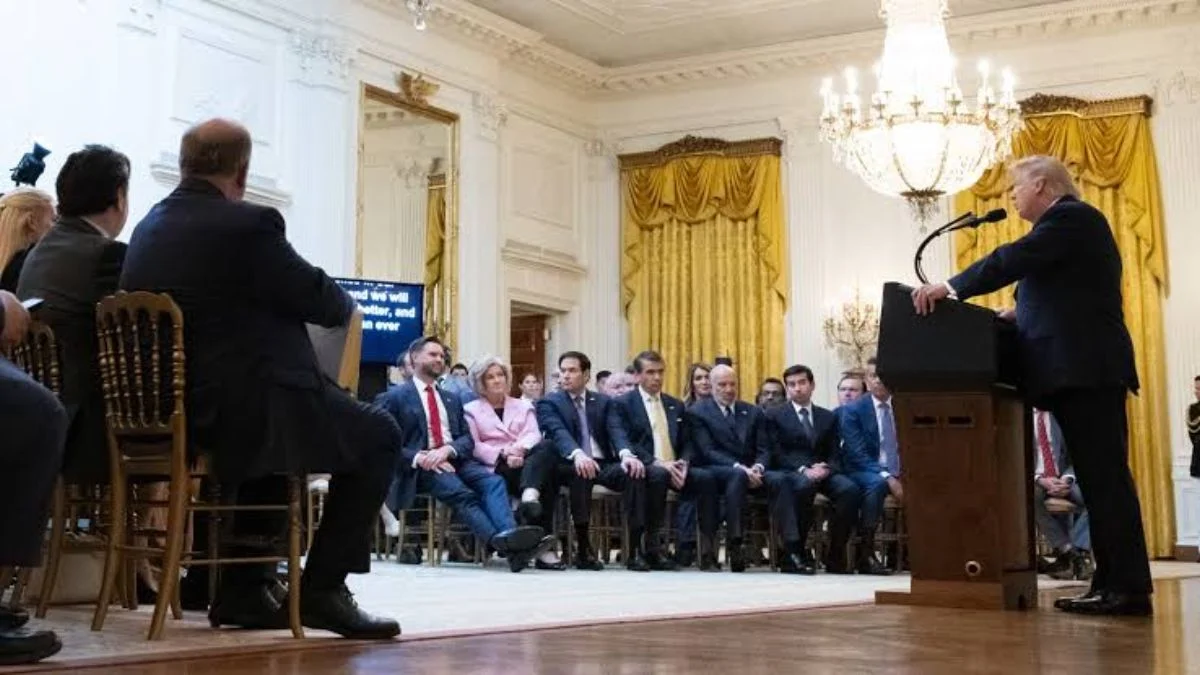
President Donald Trump used a nationally televised primetime address from the White House East Room on July 16, 2026, to unveil what he described as newly declassified intelligence on U.S. election security while renewing calls for sweeping voting reforms ahead of the 2026 midterm elections. The roughly 24-25 minute speech immediately reignited a familiar political divide, with supporters calling it a major transparency effort and critics accusing the president of reviving previously disputed election claims.
Congress has also been dealing with its own internal standoff over related legislation recently. To know more, read our article House Republicans End Weeks-Long Revolt After Mike Johnson’s Surprise SAVE America Act Deal.
Timeline of Trump’s July 16, 2026 Election Integrity Address
| Time/Date | Event | Official Details |
| July 16, 2026 (around 9 p.m. ET) | Primetime White House address | Trump spoke from the White House East Room on election security and integrity. |
| During the speech | Declassification announced | Trump said intelligence documents would be released through a new White House “Election Integrity” page. |
| Key legislative push | SAVE America Act | Trump urged Congress to pass the Safeguard American Voter Eligibility (SAVE America) Act. |
Sudden personnel moves have also drawn scrutiny elsewhere in the administration this year. To know more, read our piece Trump Fired a Court-Appointed U.S. Attorney Just 54 Minutes After His Swearing-In. Here’s Why It Happened.
Trump says declassified intelligence reveals major election vulnerabilities
During the address, Trump announced the immediate declassification and public release of intelligence documents through a newly created White House “Election Integrity” webpage. According to Trump, the material was gathered by a White House Government Transparency Task Force and reviewed by intelligence officials before release.
He argued the documents expose what he called “shocking vulnerabilities” in America’s election infrastructure, alleging that intelligence agencies and the “deep state” concealed critical information from both his administration and Congress.
One of the speech’s most significant claims centered on China. Trump alleged that the People’s Republic of China carried out what he described as the “largest compromise of election data in history,” claiming approximately 220 million U.S. voter files—including names, addresses, party affiliations, and other information—were obtained beginning around the 2020 election cycle.

Lawmakers have also been weighing a separate, unrelated proposal that would change how clocks are set nationwide. To know more, read our article US House Votes to End Daylight Saving Time Clock Changes Forever? What the Sunshine Protection Act Means Next.
According to Trump, voter data from at least 18 states was bought, stolen, or hacked. He further alleged China used that information to influence journalists and political leaders and even manufacture ballots, while accusing U.S. intelligence agencies of withholding those findings.
Trump also warned about vulnerabilities in electronic voting systems, referencing outdated election infrastructure and potential cyber threats from China, Russia, Iran, and North Korea. He additionally cited Venezuela’s alleged capability to manipulate electronic voting systems without detection.
Beyond foreign interference, Trump highlighted other election-related concerns, including hundreds of thousands of noncitizens and deceased individuals allegedly remaining on voter rolls. Citing a Department of Homeland Security review, he referenced approximately 278,000 noncitizens on voter rolls, raised concerns over mail-in voting, and pointed to voter registration fraud claims in Michigan.
SAVE America Act becomes centerpiece of Trump’s election reform push
Trump urged lawmakers to pass the Safeguard American Voter Eligibility (SAVE America) Act, which would require photo identification for voting, proof of citizenship for voter registration, and tighter restrictions on mail-in voting while allowing certain exceptions.
He argued the legislation would restore public confidence in elections, saying America’s election system is “so broken and so vulnerable that no one can possibly defend it,” while insisting the objective is to rebuild trust rather than undermine it. Trump also briefly touched on the Iran conflict during the address.

A separate incident involving a prominent senator has also generated its own wave of political questions recently. To know more, read our post Lindsey Graham Death Sparks FBI Questions as Trump Says Agents Are “Wasting Their Time” — What Really Happened?.
Released documents fuel political divide as critics reject Trump’s claims
The White House subsequently published the declassified material—including some heavily redacted documents and prior intelligence assessments—on its Election Integrity webpage. The documents discuss election-related cyber threats, foreign intelligence capabilities, data collection practices, and internal intelligence community debates. However, they do not present evidence that votes were altered or that election outcomes changed in U.S. elections.
Democrats and election experts sharply rejected Trump’s conclusions.
Sen. Mark Warner (D-VA), the ranking member of the Senate Intelligence Committee, called the claims “totally bogus.” He pointed to the longstanding intelligence community assessment that China did not attempt to change votes, while acknowledging previously disclosed findings that China may have pursued influence operations.
Other Democrats, including Sen. Andy Kim, Rep. Jim Himes, Chuck Schumer, Hakeem Jeffries, and Gavin Newsom, accused Trump of promoting conspiracy theories, laying the groundwork to dispute potential Republican losses in the 2026 midterms, and using election security concerns to justify restrictive federal voting laws.

Media consolidation has also been reshaping the entertainment industry through a massive recent deal. To know more, read our article Ellison Media Empire 2026: How Larry Ellison, David Ellison & Trump’s Backing Reshaped Hollywood in a $111 Billion Power Play.
Former Trump deputy Director of National Intelligence Sue Gordon described the address as “a dangerous speech” on an important subject. Election analysts similarly noted that while the released documents discuss genuine vulnerabilities—including underfunded election systems and foreign attempts to gather voter information—they do not provide new evidence that the 2020 election was manipulated or that vote tabulation was altered.
Fact-checks also concluded that several of Trump’s claims stretched existing data, noting that publicly available or commercially obtained voter information is not equivalent to changing election results. Previous intelligence assessments, court rulings, state certifications, reviews by Trump’s own Justice Department, and multiple audits have consistently found no evidence that foreign actors altered vote counts in the 2020 election, while audits have also found noncitizen voting to be rare.
The speech ultimately reinforced Trump’s long-running emphasis on election integrity by highlighting declassified material about vulnerabilities and foreign data collection, while critics argued it lacked evidence demonstrating decisive interference or changes to election outcomes. Supporters, meanwhile, viewed the document release as overdue transparency on election security concerns ahead of the 2026 midterms.


Leave a Reply