

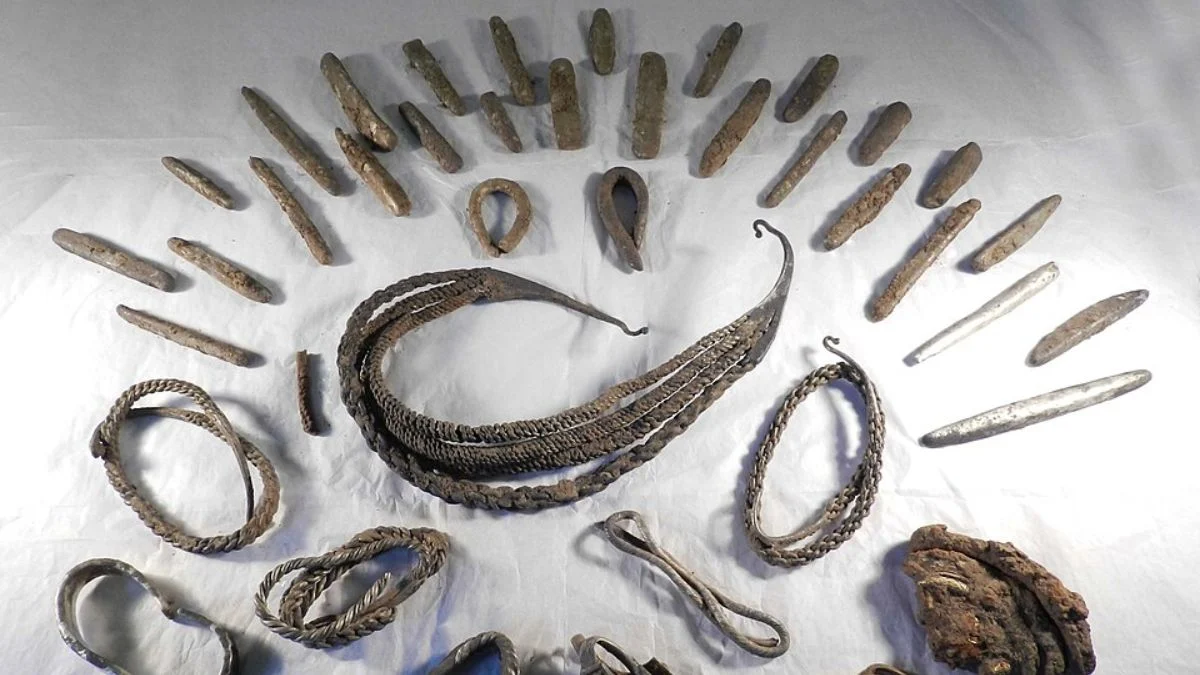
A few hours of ordinary gardening work in northern Denmark have turned into an archaeological story straight out of a Viking saga. A homeowner in Rebild was preparing the ground for a new tiled terrace when his garden fork struck something unexpected beneath the soil. What followed was the discovery of approximately 700 Viking Age silver objects and fragments weighing 18.5 kilograms, or about 40.8 pounds.
North Jutland Museums has identified the find
as Denmark’s largest known Viking Age silver hoard. Buried inside a clay vessel sometime during the 900s, the collection contains silver bars, bracelets, coins, cut silver and even a small Thor’s hammer. And while the sheer amount of precious metal is extraordinary, the objects themselves may tell an even bigger story about Viking Age trade, wealth, religion, and connections stretching from northern Europe to the Islamic world.
More Tech News: OpenAI’s CEO made a striking water-use comparison for a single ChatGPT query, but the figure is harder to verify than it sounds. For more, read our story on Sam Altman’s ChatGPT water-usage almond claim.
How a Backyard Terrace Project Uncovered a Viking Age Treasure in Denmark
The discovery began in a setting that could hardly have seemed less archaeological: a private garden in Rebild, in northern Jutland.
The anonymous homeowner was clearing stubborn grass, stones and gravel while preparing the property for a new tiled terrace. Then his garden fork hit something that produced a strange sound.
At first, he assumed he had encountered ordinary debris, perhaps old iron, fence wire or fragments from an earlier structure. But when he began digging by hand, the discovery quickly took a completely different turn.
He started pulling one metal object after another from the earth.
The homeowner recalled the moment in North Jutland Museums’ account:
“After half an hour of digging, my grip hit something that made a strange sound. At first I thought it was old iron or fence wire and some potsherds, but when I started digging with my hands, I was suddenly able to fish one metal object after another out of the ground. After a short period of careful work, I realized that it was jewelry, coins and silver bars.”
Instead of treating the find as buried valuables, the homeowner contacted North Jutland Museums, giving archaeologists the opportunity to investigate and document the discovery.
For the finder, the experience was almost surreal. What had started as preparation for a home improvement project became what he described as the biggest surprise of his life.
“It should have just been a few hours of hard gardening work removing stubborn grass, stones and gravel for a new tiled terrace, but it turned out to be the biggest surprise of my life.”
And that was only the beginning of the story.
More Travel News: A famous glacier campsite is drawing scrutiny of its own after researchers measured the heat its thousands of visitors add each season. For more, read our story on the environmental warning from Everest Base Camp.
What Was Found Inside Denmark’s Record-Breaking 18.5-Kilogram Viking Silver Hoard?
The scale of the discovery is difficult to ignore.
Archaeologists identified approximately 700 objects and fragments, together weighing around 18.5 kilograms (40.8 pounds). The collection is made up of different forms of Viking Age silver rather than one uniform type of treasure.
Among the discoveries are:
| Discovery | Details |
| Silver bars | Numerous bars of silver |
| Jewelry | Bracelets and other pieces |
| Coins | 47 whole coins and coin fragments |
| Religious object | A small silver Thor’s hammer |
| Cut silver | Pieces chopped into smaller portions |
| Other material | Additional silver objects and fragments |
| Total hoard | Approximately 700 objects and fragments |
| Total weight | Approximately 18.5 kg / 40.8 lb |
| Burial period | Sometime during the 900s |
One particularly important detail emerged when archaeologists examined the original container.
Around 320 objects weighing approximately 6.4 kilograms were still inside the clay vessel. The rest of the hoard had become dispersed through the surrounding soil.
That arrangement matters because it suggests this was not simply a pile of unwanted metal. The mixture of complete jewelry, bars, coins and deliberately cut pieces reflects the different ways silver could function as wealth and as a medium of exchange during the Viking Age.
More Travel News: Another famous historic site is tightening its rules this year, though it remains fully open to visitors. For more, read our story on Rome’s Colosseum becoming a security “red zone”.
Viking Silver Hoard From the 900s Reveals a Much Bigger European Trade Network
The Rebild treasure dates to the 10th century, a period of major transformation across Scandinavia.
During the 900s, Denmark was experiencing significant political, economic and religious changes. Danish power was becoming increasingly consolidated, while Scandinavian communities were deeply connected to trading networks extending across the Baltic and North Sea regions.
The Rebild hoard fits into that wider picture.
North Jutland Museums says the discovery demonstrates that the Rebild area was not some isolated corner of Viking Age Denmark. Instead, it was connected to economic and cultural networks reaching toward the Baltic region, the Islamic world to the east, the North Sea region, England and western Europe.
The coins make those connections especially visible.
More Gaming News: A relationship system between two fictional characters has somehow become a real-world dating debate. For more, read our story on the GTA 6 girlfriend controversy dividing TikTok.
Arab and Anglo-Saxon Coins Show How Far Viking Age Silver Traveled
Among the most important clues in the hoard are Arab and Anglo-Saxon coins.
Islamic silver coins, particularly dirhams, are well known from Viking Age archaeological discoveries across Scandinavia. Their presence reflects extensive trade routes that carried silver through eastern Europe and connections reaching into the Islamic world.
The Anglo-Saxon coins point in another direction, toward the close and often complicated connections between Scandinavia and England.
Together, these objects suggest that the silver accumulated in northern Denmark had traveled through extensive commercial networks rather than coming exclusively from a local source.
That makes the discovery about much more than precious metal.
The coins, jewelry, bars and pieces of cut silver provide another archaeological snapshot of how wealth moved through Viking Age Europe—and how Scandinavian communities participated in a huge international system of trade and exchange.
More Sports Setbacks: A missing passport just knocked one of women’s basketball’s biggest stars out of a World Cup opener. For more, read our story on Li Yueru’s passport disaster before China faced the USA.
A Tiny Thor’s Hammer Gives the Viking Hoard a Religious Dimension
Then there is the small object that gives the collection an entirely different layer of meaning: a silver Thor’s hammer, or Mjölnir pendant.
Thor was one of the most important gods in Norse mythology, making the hammer a distinctly recognizable symbol of the religious world of Viking Age Scandinavia.
Its presence is particularly intriguing because the hoard dates to a period when Christianity was becoming increasingly influential in Denmark, while older Norse religious traditions continued to exist within Scandinavian society.
The Thor’s hammer does not, however, provide a definitive explanation for why the hoard was buried.
Archaeologists have not established precisely who owned the silver, why it was hidden or what circumstances led to its deposition.
Those questions remain among the most fascinating mysteries surrounding the discovery.
More Tech News: A fresh AI model launch landed the same week Alphabet dodged a major courtroom breakup. For more, read our story on Google’s Gemini 3.8 Flash and the AdX antitrust ruling.
Rebild Viking Silver Hoard Is Nearly Three Times Heavier Than the Terslev Hoard
The true historical scale of the discovery becomes even clearer when it is compared with Denmark’s previous record.
Before the Rebild find, the country’s largest known Viking Age silver hoard was the Terslev hoard, discovered in Zealand by children digging in 1911.
According to the National Museum of Denmark, the Terslev hoard contained approximately 6.6 kilograms of silver, including 1,751 coins. Of those coins, 1,708 were Arab in origin. The latest-dated coin dates to AD 944, and the hoard was buried during the second half of the 10th century.
The difference is striking.
At approximately 18.5 kilograms, the Rebild discovery is nearly three times heavier than the Terslev hoard.
That is why North Jutland Museums has described the newly discovered collection as the largest known Viking Age silver hoard found in Denmark.
And the comparison also highlights how extraordinary Terslev already was. Its thousands of coins and other silver objects provide powerful evidence of the extensive connections between Viking Age Scandinavia and territories far beyond Denmark.
More Trending Stories: A routine unpaid bill in Bangkok escalated into an alleged public humiliation now under police scrutiny. For more, read our story on the host bar coercion investigation over an $1,800 bill.
Why Did Someone Bury 18.5 Kilograms of Viking Silver?
Perhaps the biggest mystery is also the simplest question: why was it buried?
There is currently no definitive answer.
The hoard could have been hidden for several possible reasons. It may have belonged to someone protecting accumulated wealth. It could have been deposited close to a Viking settlement, near an ancient travel route or in a secluded location deliberately chosen to conceal valuables.
But those remain possibilities.
North Jutland Museums points out that the discovery was made in a modern built-up area, meaning a large archaeological excavation around the original location is not possible. Without that broader archaeological context, researchers cannot yet determine exactly how the hoard fitted into the landscape around it.
That missing context leaves important questions unanswered: Who owned the silver? Was the person a trader, wealthy landowner or another member of Viking society? Was the hoard connected to a settlement or trading route? And why was it never recovered?
For now, the evidence cannot provide those answers.
More Odd-Theft News: Nearly half a million oysters disappeared overnight, leaving one farmer facing years of financial recovery. For more, read our post on the A$350,000 NSW oyster heist.
Another Major 2026 Discovery Makes Rebild a Viking Archaeology Hotspot
The silver hoard is not the only spectacular Viking Age discovery to emerge from the Rebild area.
North Jutland Museums has highlighted the region’s history of producing important Viking Age archaeological finds and its position within the wider economic and cultural networks linking Scandinavia with Europe and the Islamic world.
The discovery also follows another major find in the region in 2026: six gold arm rings from the Rold hoard.
North Jutland Museums hopes eventually to bring the newly discovered silver hoard together with those six gold arm rings at the Fyrkat Viking Museum.
The proposed exhibition could provide a larger picture of Viking Age wealth, Denmark’s political development and northern Jutland’s role in the period.
But there is an important catch: the exhibition has not yet been confirmed.
More Strange Sightings: A mysterious floating landmass appeared on a Canadian reservoir, baffled locals for weeks, then vanished without a trace. For more, read our story on the disappearing island at Williston Reservoir.
What Happens to Denmark’s Viking Silver Treasure Now?
The hoard has been classified as danefæ, the Danish term for archaeological treasure protected under Danish law and belonging to the state once formally declared danefæ.
The collection is now being submitted for assessment by the National Museum of Denmark, which will determine its appropriate treatment and valuation.
That assessment matters because the treasure cannot simply be valued according to the modern price of silver.
Its historical worth comes from far more than its weight. The coins, jewelry, religious object, inscriptions and archaeological context can all contribute to the collection’s significance.
For that reason, any claims assigning the hoard a specific dollar value should be treated cautiously until the official assessment is complete.
Could the Viking Silver Hoard Eventually Go on Display at Fyrkat?
There is a possibility that the public could eventually see the treasure at Fyrkat Viking Museum, potentially alongside the six gold arm rings from the Rold hoard.
But North Jutland Museums has made clear that this is still under consideration rather than a confirmed exhibition.
A collection this valuable and historically important would require serious conservation and security arrangements. Those considerations include security, surveillance, alarms, display cases and appropriate handling of the objects.
The National Museum of Denmark will establish the security requirements once the danefæ process and potential exhibition arrangements have been addressed.
Torben Sarauw, head of cultural heritage and an archaeologist at North Jutland Museums, has explained that the museum must first determine whether the necessary requirements can be fulfilled before the objects could potentially be exhibited at Fyrkat.
Denmark’s Largest Viking Silver Hoard Is More Than a Pile of Buried Treasure
The Rebild discovery is extraordinary because of its 18.5-kilogram weight and approximately 700 objects, but its real archaeological importance goes considerably deeper.
The collection captures multiple sides of Viking Age life at once. Silver was wealth, a means of exchange and a form of social value. The combination of coins, bars, jewelry and deliberately cut pieces shows how that wealth could exist in different forms.
The international character of the objects is just as revealing.
Arab coins and Anglo-Saxon coins demonstrate connections reaching across Europe and into the Islamic world, while the Thor’s hammer provides a glimpse into the religious culture of the society that used and valued the silver.
The find also strengthens the archaeological picture of northern Jutland as an active part of the Viking world’s economic and cultural networks rather than an isolated region.
For the anonymous homeowner, though, none of that was visible when he started clearing his garden.
He was simply preparing a patch of ground for a terrace.
Instead, his garden fork helped expose a treasure that had remained underground for more than a thousand years—and uncovered what is now Denmark’s largest known Viking Age silver hoard.
Disclaimer and Sources
This article is based on a thorough review of information released by North Jutland Museums, the National Museum of Denmark, Museum Rebild and contemporary reporting, including CNN and BroBible. The historical circumstances surrounding the hoard’s burial have not been definitively established. Its final official valuation is still subject to assessment, and a potential permanent display at Fyrkat Viking Museum has not yet been confirmed. Any monetary estimate based solely on the modern market price of silver should therefore not be considered the confirmed value of the archaeological collection.
Sources
- North Jutland Museums — Original announcement on Denmark’s largest Viking silver hoard
- National Museum of Denmark — The Silver Hoard from Terslev
- CNN — Denmark’s largest Viking Age silver hoard discovered in backyard
- Museum Rebild — Viking Age and the 2026 Rebild silver hoard
- BroBible — Man Uncovers Hundreds of Pieces of Viking Silver After Digging Up His Garden in Denmark
Featured Image Credit: Portable Antiquities Scheme from London, England / Creative Commons Attribution 2.0


Leave a Reply