

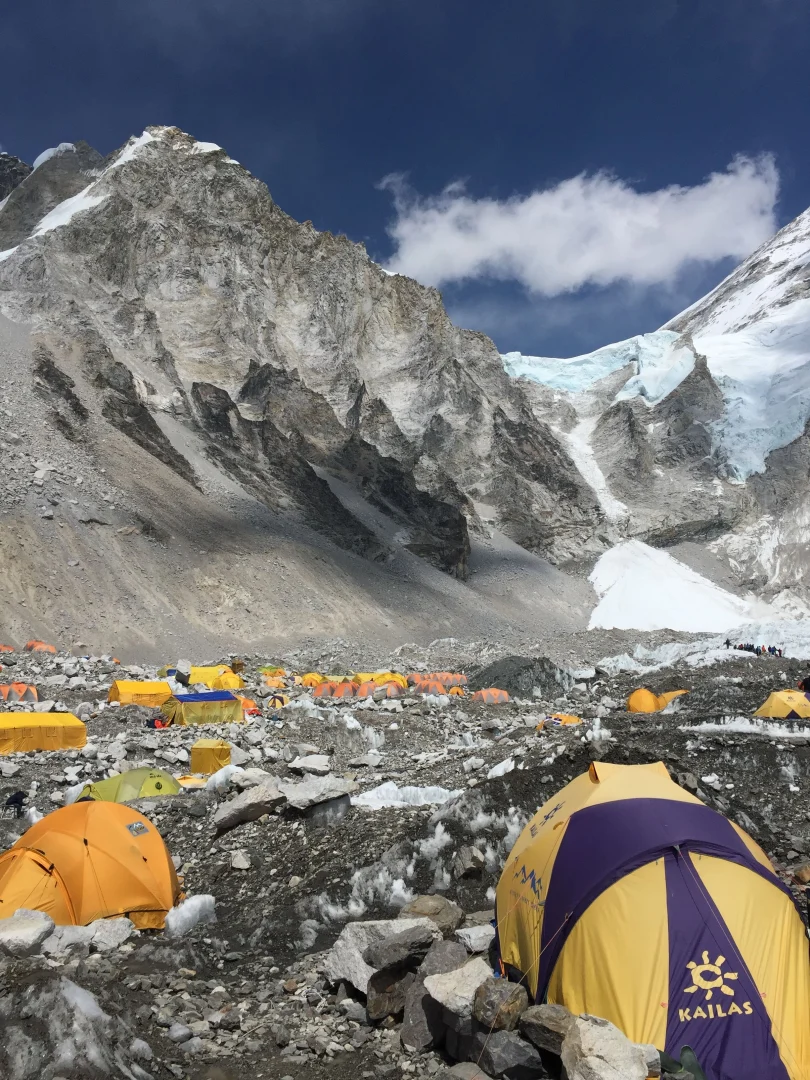
Everest Base Camp is supposed to be the starting point for one of the world’s most extreme adventures. But behind the tents, climbing gear and breathtaking Himalayan views, researchers have identified a surprisingly complex environmental problem: the heat generated by thousands of people living temporarily on the glacier.
A peer-reviewed study published in Regional Environmental Change estimates that human activity at Everest Base Camp during the spring 2023 climbing season produced enough thermal energy for a theoretical melt-equivalent of 2,492 ± 528 tonnes of glacier ice and snow. And yes, part of that calculation involves something far more ordinary than fuel or machinery: human urine.
Researchers estimate that climbers, guides and support workers collectively produce more than 6,000 litres of urine every day during the climbing season. The heat associated with that urine was calculated to equal approximately 154 tonnes of potential ice and snow melt during a single season. But before the headline gets too wild, there is an important scientific distinction: researchers are measuring heat energy and converting it into a theoretical melt-equivalent, not claiming they watched 154 tonnes of glacier physically disappear because of urine.
Other News: A relationship system between two fictional characters has somehow become a real-world dating debate. For more, read our story on the GTA 6 girlfriend controversy dividing TikTok.
Everest Base Camp Heat Study Reveals the Hidden Environmental Cost of Tourism
The research, titled “Effects of human activity on Khumbu Glacier: towards a sustainable Everest Base Camp,” was published in July 2026 in Regional Environmental Change.
The study was authored by Khim Lal Gautam, Virginia Burkett, George Xian, Mahesh Thapa, Anish Dahal and Sudeep Thakuri.
Rather than focusing on one unusual source of pollution, the researchers examined three major influences affecting the Everest Base Camp environment:
- Global climate change
- Local fossil-fuel consumption
- Human urinary discharge
Their field analysis centred on the spring 2023 climbing season, when Everest Base Camp functioned as a huge temporary settlement on the Khumbu Glacier.
Approximately 1,600 tents operated for around 50 days, creating an environment that was considerably more complex than the image of a few mountaineers pitching basic shelters before heading higher up the mountain.
Cooking, heating and electricity generation all required fuel, adding another layer to the camp’s environmental footprint.
More Sports News: A viral ring-light stunt inside Arthur Ashe Stadium is forcing tennis to confront its influencer problem. For more, read our story on the Naomi Osaka US Open photoshoot controversy.
Everest Base Camp Fuel Use in 2023
| Fuel or activity | Recorded amount |
| LPG cylinders | 824 |
| Kerosene | 18,935 litres |
| Petrol | 5,130 litres |
| Tents | Approximately 1,600 |
| Camp operation | Around 50 days |
| Estimated total thermal energy | 849,174 ± 179,774 megajoules |
| Theoretical ice/snow melt-equivalent | 2,492 ± 528 tonnes |
When the researchers combined the thermal energy associated with fuel consumption and human urinary discharge, they calculated an estimated 849,174 ± 179,774 megajoules.
Converted into an ice-and-snow melt-equivalent, that produced the striking 2,492 ± 528-tonne figure.
But there is already a major clue in the numbers: urine is not the biggest contributor.
More Sports Setbacks: A missing passport just knocked one of women’s basketball’s biggest stars out of a World Cup opener. For more, read our story on Li Yueru’s passport disaster before China faced the USA.
Human Urine Accounts for 154 Tonnes of Theoretical Ice Melt
This is the part of the study that has grabbed attention online.
At extreme altitude, staying hydrated is critical. Climbers are dealing with strenuous physical activity, a very dry environment and physiological effects associated with high elevation, all of which increase the need to consume fluids.
More water in means more water out.
The researchers estimate that more than 6,000 litres of urine are produced every day at Everest Base Camp during climbing season.
Lead author Khim Lal Gautam explained the basic reason:
“If you drink more water, you have to let it out,”
Historically, a substantial amount of liquid waste has been discharged directly onto the glacier. This differs from solid human waste, which is collected and transported away from the mountain.
Individually, the heat contained in one person’s urine is obviously tiny. But Everest Base Camp is not dealing with one person. It is dealing with thousands of climbers, guides and support workers over an entire climbing season.
The researchers therefore included the cumulative thermal energy from urinary discharge in their calculation.
Their estimate puts the heat associated with urine at a melt-equivalent of approximately 154 tonnes of ice and snow during one climbing season.
More Tech News: A fresh AI model launch landed the same week Alphabet dodged a major courtroom breakup. For more, read our story on Google’s Gemini 3.8 Flash and the AdX antitrust ruling.
Did Climbers’ Urine Actually Melt 154 Tonnes of the Khumbu Glacier?
This is where the viral version of the story can easily become misleading.
The researchers did not directly measure 154 tonnes of glacier ice physically disappearing because of urine.
Instead, they calculated the amount of thermal energy associated with the urine and then determined how much ice and snow that energy could theoretically melt.
So the 154-tonne figure is a melt-equivalent based on thermal energy, rather than a direct field measurement of glacier loss caused by urine.
The exact same qualification applies to the headline-grabbing 2,492 ± 528 tonnes figure.
It represents the theoretical amount of ice and snow that the calculated heat energy could melt under the assumptions used in the research. It is not a direct measurement showing that human activity physically melted that exact amount of glacier ice.
That distinction matters.
The scientifically accurate takeaway is that human urine contributes a measurable amount of heat to an already vulnerable glacier environment, and researchers estimate that the associated thermal energy corresponds to roughly 154 tonnes of potential ice and snow melt during the climbing season.
More Legal Battles: A defamation dispute tied to a teenager’s still-unexplained death is escalating rather than cooling off. For more, read our story on Al Sharpton’s defamation fight over the Nolan Wells case.
Everest Base Camp Is Now More Like a Temporary Mountain City
The study also reveals just how dramatically Everest Base Camp has evolved.
During climbing season, the site brings together climbers, guides, cooks and support workers on a scale that makes it much more than a collection of expedition shelters.
Modern operations require cooking facilities, heating, electricity, communications equipment and other services. Those activities consume energy and create heat.
That means Everest’s environmental footprint does not stop with rubbish.
Fuel combustion releases heat into the surrounding environment. Warm liquid waste can transfer heat to snow and ice. Human activity can also alter the immediate surface environment.
Researchers therefore looked at the base camp as a concentrated source of additional thermal energy operating directly on a glacier system already experiencing much larger climate-driven changes.
And that leads to another striking part of the study.
Satellite Data Show Everest Base Camp Surface Temperatures Are Rising
The researchers did not base their conclusions solely on fuel-use and urine calculations.
They also examined Landsat satellite observations from 1991 through 2023 to investigate land-surface temperature changes around Everest Base Camp and nearby areas.
Their analysis found that surface temperature at Everest Base Camp increased at an average rate of approximately 0.28°C per year over the 32-year period.
According to the study, that rate was roughly twice the warming rate observed at the surface of the adjacent Khumbu Glacier.
It was also approximately 15% higher than the temperature increase recorded over the debris-covered terrain immediately north of the base camp.
The findings point to a pronounced local warming signal around the heavily occupied base camp.
However, the satellite data do not by themselves prove that climbers, tents or urine caused the difference.
Satellite observations can reveal changes in surface temperature, but determining exactly which human activities caused those changes requires additional analysis. The researchers use the satellite findings as evidence that the heavily occupied base-camp environment deserves greater attention as a localized human influence on the glacier.
More Travel Alerts: A cross-country flight suddenly reversed course minutes after takeoff, and the reason has raised serious safety questions. For more, read our story on Delta Flight 1208’s emergency return to Minneapolis.
The 2,492-Tonne Calculation Does Not Include Every Human Heat Source
There is another important limitation hidden inside the headline figure.
The study’s estimate does not account for every possible source of heat generated by human activity at Everest Base Camp.
Researchers excluded heat associated with:
- Helicopter operations
- The body heat of climbers and support personnel
- Yaks used to transport supplies
That means 2,492 ± 528 tonnes is not a complete measurement of the entire thermal footprint of human activity at the base camp.
It is an estimate based on the specific heat sources included in the research.
The distinction is crucial when interpreting the study because the number should not be presented as a direct measurement of total human-caused glacier loss.
Climate Change Is Still the Main Driver of Khumbu Glacier Loss
Despite the extraordinary attention surrounding the urine calculation, the researchers are not arguing that human waste is responsible for the retreat of the Khumbu Glacier.
Global climate change remains the dominant driver of glacier loss.
The Khumbu Glacier is part of a much wider Himalayan cryosphere that is experiencing rapid changes as temperatures rise.
The International Centre for Integrated Mountain Development, or ICIMOD, reported in March 2026 that ice-loss rates across the Hindu Kush Himalaya have doubled since 2000.
Its regional assessments have documented significant reductions in glacier area and ice reserves over recent decades and warned that accelerating glacier loss creates serious risks for water security, ecosystems and downstream communities.
The Khumbu Glacier’s vulnerability, therefore, existed long before the modern Everest tourism industry expanded.
Human activity at Base Camp represents an additional localized pressure on a glacier already being affected by a much larger global climate crisis.
More Political News: A push to freeze the size of the nation’s highest court has stalled in the House, but the underlying fight is far from over. For more, read our story on the rejected Supreme Court nine-justice amendment.
Could Everest Base Camp Eventually Move Off the Glacier?
The study’s most consequential recommendation goes beyond urine, fuel or rubbish.
Everest Base Camp currently occupies a supraglacial location, meaning it sits directly on the glacier.
As climate change accelerates and the glacier becomes increasingly vulnerable, researchers considered whether the camp should eventually be relocated to more stable terrain.
Their analysis identified two potential sites southwest of the existing base camp that are located on stable ground rather than directly on the glacier.
The researchers argue that relocating the camp could reduce the environmental pressure created by maintaining a large temporary settlement on moving ice. It could also provide a more sustainable long-term setting for mountaineering operations.
The authors put the idea clearly:
“In the long term, relocating the base camp from the glacier to a stable nearby area should be considered.”
That recommendation shifts the conversation from simply managing waste to questioning whether a large, energy-intensive settlement should continue operating directly on an increasingly unstable glacier.
Everest’s Urine Story Is Really a Bigger Warning About Human Footprint
The idea that thousands of litres of urine are being released onto Everest’s glacier sounds bizarre enough to become an instant headline.
But the deeper story is much bigger.
Everest Base Camp has become a concentrated human settlement in one of the planet’s most environmentally sensitive landscapes. Thousands of people, around 1,600 tents, fuel supplies, cooking operations, electricity generation, waste and transportation activity are packed into a temporary community on a glacier system already changing because of global warming.
The study demonstrates that even relatively small sources of heat can become significant when multiplied across thousands of people and sustained throughout an entire climbing season.
And the researchers’ calculations reveal something even more important: fuel consumption, not urine, accounts for the overwhelming majority of the estimated thermal footprint included in the study.
The fuel component corresponds to approximately 2,338 tonnes of potential ice and snow melt, compared with approximately 154 tonnes associated with urine.
The study ultimately calls for more sustainable management of Everest Base Camp, including improved liquid-waste handling and serious consideration of alternative locations.
More Viral Shockers: A Ring camera caught a delivery driver’s shocking wardrobe malfunction — and it cost him his job on the platform for good. For more, read our story on the naked DoorDash driver Houston family caught on camera.
What the Everest Base Camp Glacier Study Actually Shows
The headline may make it sound like climbers are literally “peeing away” the world’s highest mountain.
That is not what the research proves.
Instead, the study establishes a more nuanced picture:
- Human activity at Everest Base Camp creates a measurable thermal footprint.
- Fuel combustion was by far the largest heat source examined.
- Human urine represents a smaller but measurable additional source of heat.
- Researchers estimate that urine-associated heat has a melt-equivalent of approximately 154 tonnes of ice and snow per climbing season.
- The combined heat from the human activities examined corresponds to approximately 2,492 ± 528 tonnes of potential ice and snow melt.
- These figures are based on thermal-energy calculations rather than direct measurements of ice physically melted by urine or fuel.
- The researchers did not include helicopters, human metabolic heat or yaks in their calculation.
- Landsat satellite observations from 1991 to 2023 show that surface temperatures around Everest Base Camp have increased substantially.
- Base Camp’s surface temperature increased by approximately 0.28°C per year, according to the study.
- That warming rate was roughly twice that observed at the surface of the adjacent Khumbu Glacier and approximately 15% higher than the increase over debris-covered terrain immediately north of the camp.
- Global climate change remains the primary driver of broader glacier retreat.
- The researchers identified two potential stable-ground locations southwest of the current base camp.
- They believe relocating the camp away from the glacier should be considered as part of long-term sustainability planning.
The real warning from Everest is therefore not simply about urine.
It is about what happens when a large human settlement, energy consumption and waste production are concentrated on an already vulnerable glacier. The numbers may make for an unusual headline, but the bigger issue is much harder to dismiss: how long can Everest Base Camp continue operating on the Khumbu Glacier as climate change makes the environment increasingly unstable?
Disclaimer
This article is based on a thorough review of the research and background information provided from the following sources: the peer-reviewed Regional Environmental Change study “Effects of human activity on Khumbu Glacier: towards a sustainable Everest Base Camp”, published by Springer Nature; International Centre for Integrated Mountain Development (ICIMOD) reporting on accelerated glacier loss across the Hindu Kush Himalaya; the HKH Glacier Outlook 2026; the ICIMOD assessment “Changing dynamics of glaciers in the Hindu Kush Himalayan region from 1990 to 2020”; and relevant reporting on the study, including comments from lead author Khim Lal Gautam.
The figures discussed in this article represent researchers’ calculations of thermal energy and its theoretical ice-melt equivalent. They should not be interpreted as direct measurements of glacier ice physically melted by urine, fuel or any individual human activity. Global climate change remains the principal driver of long-term glacier loss in the Everest region.
Sources
- Springer Nature — “Effects of human activity on Khumbu Glacier: towards a sustainable Everest Base Camp” — Peer-reviewed study and primary source for the research findings.
- ICIMOD — “Hindu Kush Himalaya glaciers losing ice at double the rate since 2000” — Regional glacier-loss and climate context.
- ICIMOD — “HKH Glacier Outlook 2026” — Long-term observations and assessment of glacier change across the Hindu Kush Himalaya.
- ICIMOD — “Changing dynamics of glaciers in the Hindu Kush Himalayan region from 1990 to 2020” — Multidecadal assessment of regional glacier change.
Featured Image Credit: Sherine on Pexels


Leave a Reply