

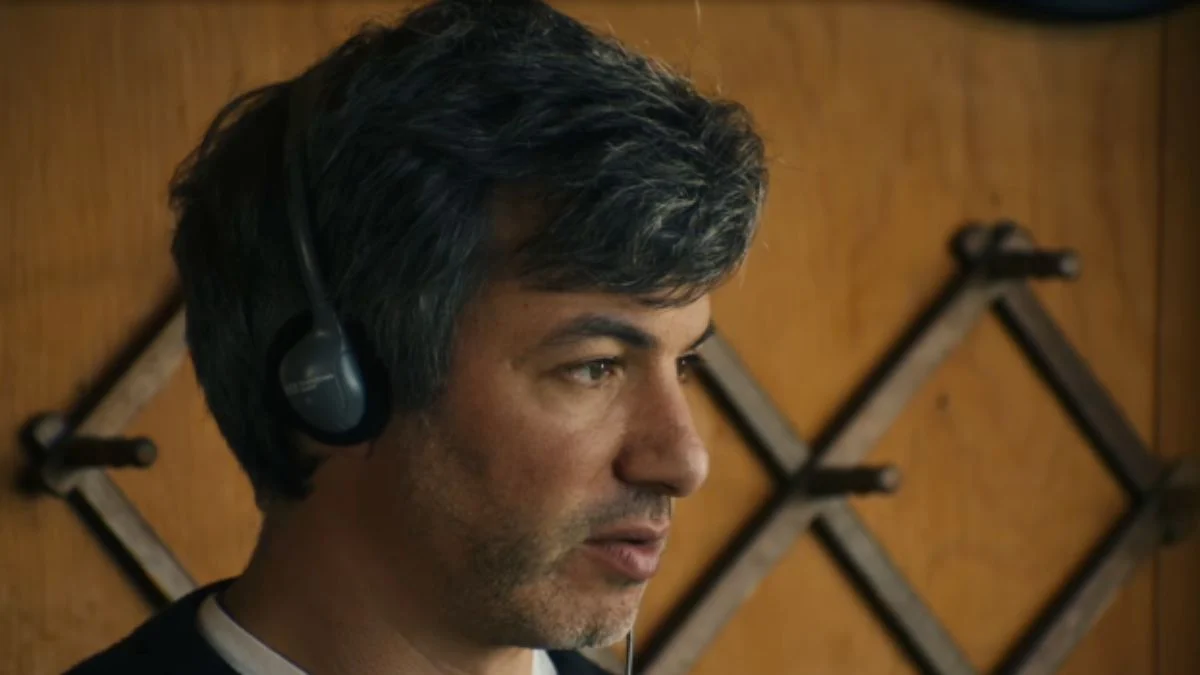
Nathan Fielder was not convinced that Elizabeth Holmes’ story needed another documentary. The Theranos scandal had already been examined through investigative journalism, books, podcasts, documentaries and television, leaving the filmmaker with a difficult question: could another film uncover something genuinely different?
That uncertainty became the starting point for You Can See Everything, the documentary co-directed by Fielder and Lance Oppenheim. Rather than commit to a conventional production with a predetermined narrative, Fielder wanted the freedom to investigate Holmes’ life and abandon the project if the material failed to justify a film. What followed was a much longer and more complicated filmmaking journey than the original experiment might have suggested.
Why Nathan Fielder Questioned Whether Elizabeth Holmes’ Story Needed Another Documentary
By the time Fielder and Oppenheim began exploring the project, Holmes’ rise and fall had become a familiar story.
Holmes founded Theranos, a blood-testing company that claimed it could perform a broad range of tests using very small amounts of blood. The company attracted major investment and widespread attention before investigative reporting exposed serious problems with its technology and business practices.
Holmes was subsequently convicted of fraud-related charges and sentenced to more than 11 years in federal prison. Her story had already inspired John Carreyrou’s book Bad Blood, the podcast The Dropout, Alex Gibney’s documentary The Inventor: Out for Blood in Silicon Valley, and Hulu’s scripted series The Dropout, starring Amanda Seyfried as Holmes.
With so much coverage already available, Fielder was concerned that another documentary might struggle to offer a fresh perspective.
According to co-director Lance Oppenheim, Fielder was interested in working on the project but questioned whether the story had enough unexplored territory to sustain another film.
Speaking to IndieWire, Oppenheim explained that Fielder was concerned “the story had been told so many times already.”
Instead of assuming that access to Holmes would automatically produce a worthwhile documentary, Fielder wanted to find out whether there was a genuinely compelling story to tell.
That question led to an unusual request to A24.
Want Another Take on the Film?
The documentary’s unusual approach to Elizabeth Holmes raises questions about trust, truth and the relationship between a filmmaker and their subject. For a closer look at the film itself, read our You Can See Everything documentary review.
Nathan Fielder Negotiated a ‘Kill Switch’ With A24
Fielder wanted the opportunity to begin filming without promising that the footage would eventually become a finished documentary.
According to Oppenheim, the proposal was simple: A24 would give the filmmakers the resources to explore the subject, but they would retain the option to stop the project if their initial investigation failed to uncover anything worth pursuing.
Oppenheim recalled Fielder asking whether they could “go and see if there was something there” before deciding whether to continue.
Fielder also wanted the freedom to “kill it” if the experiment did not work.
A24 agreed to the arrangement.
Oppenheim described the provision as a “kill switch”, explaining that it “changed everything” about their approach to the documentary.
The agreement mattered because it removed some of the pressure to deliver a particular story. Rather than following a fixed narrative structure, the filmmakers could investigate Holmes and her circumstances, observe what happened and determine whether the material justified a feature-length film.
Oppenheim said the arrangement allowed them to work “purely out of curiosity” and effectively “fish” for a story.
For a project built around a public figure whose story had already received extensive attention, that freedom was particularly important.
Holmes Was Just 34 Days Away From Prison When Filming Began
The timing of the filmmakers’ access to Holmes provided an unusual starting point.
According to A24’s official description, Holmes invited a skeptical film crew to document her life 30-plus days before she was due to enter prison. The more precise figure provided in the film’s description is 34 days.
The New York Film Festival also describes Holmes inviting Fielder into her home to live with the family and begin recording their lives shortly before her incarceration.
The documentary follows Holmes, her partner William “Billy” Evans and their family as the production develops.
This period gave the filmmakers access to Holmes during a major turning point in her life. However, they did not begin with a complete plan for what the documentary would ultimately become.
The initial premise was to document the weeks leading up to her imprisonment. What happened after that period would help determine whether the project had enough depth to continue.
What Nathan Fielder told WIRED about the agreement
Fielder discussed the arrangement directly in an interview with WIRED, explaining that he did not know what the documentary’s angle would be.
He felt there was something about the situation that interested him, particularly because Holmes was approaching her prison sentence. But he did not want to pretend that he already understood what the finished film should look like.
The agreement meant that the filmmakers could deliver nothing rather than force the material into a predetermined movie if the experiment failed.
Fielder also explained that he and Oppenheim believed they could at least produce an interesting week or two of material, even if the larger documentary did not work.
That uncertainty was present from the beginning. They were not simply filling an established documentary blueprint with footage. They were testing whether there was a new story to discover.
How a Short Experiment Became a Three-Year Documentary
The kill switch was ultimately unnecessary.
Instead of abandoning the project, the filmmakers continued working with Holmes and Evans, allowing the initial investigation to grow into a much larger production.
A24 describes You Can See Everything as a three-year journey, while the New York Film Festival describes the documentary as having been created in secret over the preceding four years. These descriptions reflect the broader period of development and filmmaking associated with the project.
The Associated Press also reported that the documentary was filmed secretly over three years.
The distinction is important: although the film began with the 34 days before Holmes’ incarceration, the finished documentary is not limited to those weeks.
The project eventually became a nearly three-hour feature, with the New York Film Festival listing its runtime as 174 minutes.
Rather than simply retelling the chronology of the Theranos scandal, the documentary examines the people involved and the increasingly complicated relationship between the filmmakers and their subjects.
The Associated Press reported that the film follows Holmes and Evans during the period surrounding her imprisonment while examining how the relationship between the filmmakers and the family developed.
The production’s extended timeline gave the documentary room to move beyond the initial premise.
Why Nathan Fielder Became Part of the Documentary
Another significant development was Fielder’s changing role in front of the camera.
According to Oppenheim’s account to IndieWire, Fielder was not initially intended to become the on-camera presence he eventually became. The original conception involved Oppenheim directing while Fielder worked behind the scenes.
That arrangement changed as filming continued.
Fielder became increasingly involved in the interactions taking place in front of the camera. His relationship with Holmes and Evans became part of the documentary itself, rather than remaining a background element of the production.
The filmmakers initially approached the situation as observers, but their experiences increasingly raised questions about how Holmes and Evans presented themselves and how much control they exercised over the narrative.
As a result, You Can See Everything developed into a more self-reflexive documentary than the straightforward account of Holmes’ life that Fielder had initially worried about making.
The evolving role of the filmmaker became part of the story, adding another layer to a production that had begun without a fixed narrative.
‘You Can See Everything’ Examines Documentary Objectivity
The uncertainty surrounding the production also shaped the film’s broader approach.
The New York Film Festival describes You Can See Everything as an examination of documentary objectivity and the boundaries between reality and constructed storytelling.
The festival notes that the filmmakers encountered situations in which they could not easily agree about what they had witnessed.
Oppenheim described the experience as disorienting, explaining that he and the people around him could sometimes disagree about what had just happened, even during seemingly ordinary moments.
Rather than removing that uncertainty entirely during editing, the filmmakers allowed it to become part of the filmmaking process.
Fielder has similarly discussed his continuing uncertainty about how to interpret everything he experienced while making the documentary.
WIRED’s profile of the director describes the film as emerging from a production in which the absence of a fixed premise allowed events and contradictions to shape the eventual result.
This approach helps explain why the original agreement with A24 was so significant. Had Fielder been required to deliver a conventional documentary about Holmes from the outset, the filmmakers would have had less freedom to follow unexpected developments.
Why the Filmmakers’ Approach Was Different From Earlier Theranos Documentaries
Holmes’ story had already been explored through multiple formats, each offering an established way to examine the Theranos scandal.
John Carreyrou’s Bad Blood examined the company through investigative reporting. Alex Gibney’s The Inventor: Out for Blood in Silicon Valley approached the subject as a documentary, while Hulu’s The Dropout dramatized the rise and collapse of Theranos with Amanda Seyfried portraying Holmes.
You Can See Everything did not need to establish the scandal’s basic chronology from scratch to justify its existence.
Instead, its approach developed around the filmmakers’ access to Holmes and her family, the relationship between subject and filmmaker, and the uncertainty surrounding what they were witnessing.
The New York Film Festival describes the film as moving away from Holmes’ familiar public image towards a different examination of her as a camera subject.
This shift also connects directly to Fielder’s initial concern. Rather than simply repeat what audiences already knew, the filmmakers allowed their access and experiences during production to shape the documentary.
Secret Production Led to a Surprise Festival Debut
The project was filmed largely in secret, adding another unusual element to its development.
You Can See Everything eventually made a surprise appearance at the Telluride Film Festival in September 2026.
The Los Angeles Times reported that the festival kept the screening confidential and required attendees to use phone-locking pouches before entering the screening.
The secrecy helped preserve the experience of discovering the documentary without revealing its major developments in advance.
Following its Telluride debut, the film screened at the 64th New York Film Festival, where it was presented as a Spotlight selection.
A24 subsequently released the documentary theatrically on October 16, 2026.
The film’s official credits list Nathan Fielder and Lance Oppenheim as directors.
You Can See Everything: Key Details
| Detail | Information |
| Documentary title | You Can See Everything |
| Directors | Nathan Fielder and Lance Oppenheim |
| Central subject | Elizabeth Holmes and her family |
| Holmes’ partner | William “Billy” Evans |
| Initial filming period | 34 days before Holmes was due to enter prison |
| Production timeline | Described by A24 as a three-year journey |
| Runtime | 174 minutes |
| Festival debut | Telluride Film Festival, September 2026 |
| New York screening | 64th New York Film Festival, Spotlight selection |
| Theatrical distributor | A24 |
| Theatrical release date | October 16, 2026 |
Conclusion: Why the ‘Kill Switch’ Mattered
Nathan Fielder’s agreement with A24 was significant because it gave You Can See Everything room to develop without requiring the filmmakers to know the ending before they began.
Fielder questioned whether Elizabeth Holmes’ story could offer anything genuinely new, and he wanted the freedom to abandon the project if the material failed to justify a film. Lance Oppenheim later described the arrangement as transformative, while Fielder explained that it allowed them to explore the situation without forcing it into a predetermined narrative.
The project ultimately continued, expanding from an initial period of access before Holmes’ incarceration into a feature-length documentary examining both its subjects and the complicated process of documenting them.
The kill switch was never used. Instead, the freedom to walk away helped the filmmakers discover what the film could become.
Following the Awards Conversation
The film’s unconventional storytelling has also drawn attention to its potential awards prospects. Explore our You Can See Everything Oscars 2027 analysis for a look at the Best Picture discussion.
Source and Research Disclaimer
This article has been prepared based on research of the sources provided, including A24, Variety, IndieWire, WIRED, Film at Lincoln Center, the Associated Press and the Los Angeles Times. It reflects the information available in those sources and the supplied material as of October 25, 2026. The article does not imply independent verification beyond the information contained in those sources, and further details may emerge through official updates or additional reporting.
Sources
- A24 — You Can See Everything official film page
- Variety — Nathan Fielder Negotiated a ‘Kill Switch’ on You Can See Everything
- IndieWire — You Can See Everything: Nathan Fielder Negotiated a Kill Switch with A24
- IndieWire — Nathan Fielder Was Not Supposed to Be in You Can See Everything
- WIRED — Nathan Fielder Tells Us Everything
- Film at Lincoln Center — You Can See Everything at NYFF64
- Film at Lincoln Center — Nathan Fielder and Lance Oppenheim on You Can See Everything
- Associated Press — You Can See Everything at the New York Film Festival
- Los Angeles Times — Inside Telluride’s Secret Screening of You Can See Everything
Featured Image Credit: A24


Leave a Reply