

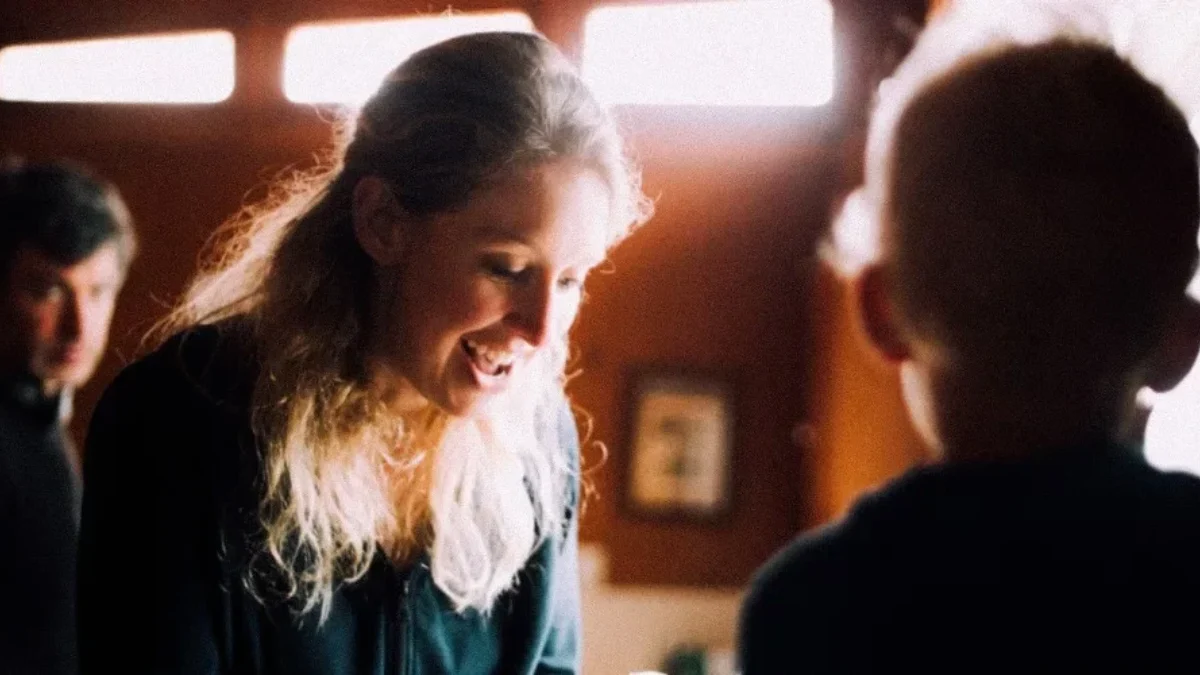
A camera enters a private home, conversations unfold, and a woman whose name became synonymous with one of Silicon Valley’s most notorious scandals prepares for a radically different chapter of her life. But how much can a documentary really reveal about someone when the public already believes it knows her story?
Nathan Fielder and Lance Oppenheim’s You Can See Everything revisits Elizabeth Holmes in the 34 days before she was due to enter federal prison. Rather than simply retelling the Theranos scandal, the documentary turns its attention to the uneasy space between what people show the world and what audiences believe they are seeing.
You Can See Everything: Inside Elizabeth Holmes’s Life Before Prison
By the time You Can See Everything begins, the central facts of the Theranos scandal have already been examined through years of reporting, court proceedings and screen adaptations. Holmes, the company’s former chief executive, had promised to transform medical testing with technology designed to analyse small blood samples. The company attracted substantial investment and widespread attention before investigations exposed serious problems with its testing capabilities and business practices.
Its collapse, followed by Holmes’s criminal trial, made her the subject of extensive public scrutiny. The documentary takes a different route, focusing on the person behind that familiar story rather than attempting another conventional reconstruction of the scandal.
Fielder and Oppenheim follow Holmes and her partner, Billy Evans, as they spend time with their two young children at a rented beachfront property in Del Mar, California.
The contrast is difficult to ignore. Holmes is preparing to surrender to federal authorities, yet the footage also captures the routines and conversations of a family approaching a major change in its life.
This domestic setting becomes central to the film. The camera is not simply revisiting a corporate controversy; it is observing how someone presents herself while living with the consequences of an established legal record.
The result is an intimate portrait that leaves audiences to consider the difference between seeing a person in private and understanding the choices that brought them into the public eye.
Want to Know What Critics Think?
For movie fans, the critical response to Elizabeth Holmes’s latest documentary offers another perspective on its unusual approach to real-life storytelling. Explore our You Can See Everything critical reception report to discover what critics are saying about the film.
Nathan Fielder’s Uncomfortable Interviews Change the Documentary
Fielder brings an unusual filmmaking background to the project. Known for Nathan for You and The Rehearsal, he has built his work around carefully constructed situations, awkward encounters and the uncertain boundary between reality and performance.
That experience shapes his interactions with Holmes. Rather than relying exclusively on formal questioning, Fielder uses restrained, sometimes disarmingly direct conversations that allow pauses, facial expressions and ordinary exchanges to become part of the investigation.
At one point, he tells Holmes:
“But you’re smart!”
The remark carries a different weight when viewed against her conviction and the decisions that led to Theranos’s downfall. Its significance comes not from the words alone, but from the uncomfortable context in which they are delivered.
Humour becomes part of the documentary’s method. It influences how audiences interpret the people on screen and how quickly they form judgments about them.
However, Fielder’s presence creates an important complication. A filmmaker known for manipulating situations for comic or dramatic effect cannot be treated as an invisible observer. His questions, reactions and interactions help shape the very encounters the camera records.
That makes You Can See Everything an examination of two things at once: Elizabeth Holmes and the filmmaking techniques used to observe her.
Elizabeth Holmes’s Conviction and Continued Claims of Innocence
Holmes continues to maintain her innocence in the documentary. Her position, however, must be understood alongside the findings of her criminal trial.
The legal record establishes specific convictions, acquittals and unresolved counts. These distinctions matter because the film gives Holmes space to explain her own understanding of the scandal, but her statements do not replace the jury’s findings.
The key legal details are summarised below.
| Date | Official detail |
| January 3, 2022 | A federal jury convicted Holmes of one count of conspiracy to commit fraud against investors and three counts of wire fraud involving individual investors. |
| January 3, 2022 | The jury acquitted Holmes of the patient-related fraud conspiracy charge and three counts of fraud involving individual patients. |
| January 3, 2022 | The jury could not reach unanimous verdicts on three additional investor-fraud counts. |
| November 18, 2022 | Holmes was sentenced to 135 months, equivalent to 11 years and three months, in federal prison. |
| April 27, 2023 | Holmes was ordered to surrender to federal authorities. |
These outcomes are essential to understanding the documentary’s central tension. Holmes’s account of events exists alongside a legal record that cannot simply be set aside.
The Theranos technology is also part of that tension. The company promoted a system intended to perform a broad range of medical analyses using very small blood samples. Evidence presented at trial established that Holmes made materially false representations to investors about the company’s technology and capabilities.
The film raises a broader question about personal narratives: how does someone understand their own actions after a public scandal, particularly when that understanding conflicts with evidence established in court?
Rather than claiming definitive access to Holmes’s inner thoughts, the documentary asks viewers to distinguish between what they can observe, what she says and what the legal record establishes.
The Meaning of “Radical Transparency” Comes Under Question
Evans’s stated commitment to openness introduces another layer to the film. The phrase “radical transparency” captures the apparent premise behind allowing a documentary crew into the couple’s domestic life.
At first glance, greater access might seem to promise greater understanding. If cameras can record conversations and everyday behaviour, audiences may feel they are getting closer to the truth about a person whose public reputation has been shaped by scandal.
But access is not the same as complete transparency.
The people being filmed decide what access to permit. Filmmakers choose what to record, while editors determine which moments appear in the finished documentary. Each decision affects the story that ultimately reaches the audience, even when the footage feels intimate or spontaneous.
In You Can See Everything, small expressions, pauses and inconsistencies may appear unusually significant because viewers already know the history surrounding Holmes.
Yet an expression does not conclusively establish dishonesty, just as a seemingly sincere conversation cannot independently settle questions about someone’s character.
The film’s title becomes particularly relevant here. Seeing more footage does not necessarily mean possessing complete knowledge. A camera can document behaviour, but it cannot automatically explain motivation.
The documentary consequently challenges both the couple’s presentation of themselves and the audience’s confidence in interpreting what it sees.
Lance Oppenheim’s Direction Focuses on Behaviour
Oppenheim reinforces these questions through a visual approach that keeps attention close to the people being filmed.
Close framing makes conversations feel immediate and draws attention to faces and reactions. At the same time, it limits the distance viewers might otherwise have from the encounters.
In a documentary about credibility, that closeness can make a pause, smile or change in expression feel loaded with meaning. But none of those details provides definitive evidence of sincerity, dishonesty or intention.
The film also extends its scrutiny beyond Holmes. Evans’s participation makes his relationship with her, as well as his role in presenting their private life, part of the larger examination.
This creates a complicated relationship between the people being observed, the filmmaker behind the camera and the audience watching the finished work.
Oppenheim’s direction does not require every scene to deliver a conclusive answer. Instead, it makes the process of observation itself part of the story.
Elizabeth Holmes Watches Amanda Seyfried in The Dropout
One of the documentary’s revealing elements involves Holmes watching Amanda Seyfried portray her in Hulu’s 2022 miniseries The Dropout.
The scene introduces a different kind of scrutiny. Holmes is no longer simply the subject of Fielder and Oppenheim’s camera; she is also watching an actor interpret her life and behaviour.
The Dropout brought the Theranos scandal to television through a scripted account of Holmes’s career and the events surrounding the company. Like other dramatisations of real events, it organised a complicated history into a narrative designed for viewers.
Watching that portrayal places Holmes on the other side of the screen. Her experience highlights the difference between a person’s own account and the versions of that person created by journalists, filmmakers and audiences.
The moment also complicates the documentary’s promise of access. Even when a subject can speak directly to viewers, audiences must decide how to evaluate that account alongside other evidence.
The film does not suggest that every interpretation deserves equal credibility. Instead, it demonstrates why understanding a public figure requires more than accepting either a personal explanation or a screen portrayal without scrutiny.
Why You Can See Everything Avoids a Conventional Documentary Structure
Running approximately 175 minutes, or two hours and 55 minutes, You Can See Everything asks audiences to remain attentive to its unfolding conversations rather than relying on a straightforward chronological account of Theranos.
The meaning of individual scenes develops as the documentary progresses. Information introduced later can change how viewers interpret earlier interactions, encouraging them to reconsider judgments they may have formed too quickly.
The filmmakers have asked critics to avoid revealing major developments, and the documentary is best approached with as little advance knowledge of its key turns as possible.
That approach supports the film’s wider examination of perception. Unexpected information can expose the limitations of an initial judgment, particularly when audiences enter a story believing they already understand its central figure.
There is a trade-off, however. Viewers seeking a direct investigative account of Theranos may find the sustained attention to behaviour and perception less immediate than a conventional documentary. The extended runtime also requires patience, especially when scenes leave their significance uncertain.
For audiences willing to engage with its structure, that uncertainty forms part of the film’s approach rather than simply standing in the way of understanding.
Conclusion: Can a Camera Really Reveal the Truth About Elizabeth Holmes?
You Can See Everything revisits the Elizabeth Holmes scandal by shifting attention from the familiar chronology of Theranos to the difficult relationship between observation, performance and trust.
Fielder’s uncomfortable questioning and Oppenheim’s close visual approach encourage audiences to examine details that might otherwise go unnoticed. Yet the documentary also makes an important distinction: noticing more does not necessarily mean understanding someone completely.
Holmes’s willingness to appear on camera offers access to her perspective, but that perspective must still be considered alongside the established legal record. The filmmakers’ involvement also reminds viewers that documentaries are shaped by the people recording, selecting and presenting the material.
Some audiences may prefer a more direct investigation of Theranos’s technology, business decisions and legal history. Others may find the film’s focus on human behaviour and uncertainty a different way to revisit a familiar controversy.
Ultimately, the documentary’s central question reaches beyond Holmes herself. Even when a camera appears to show everything, how much can we truly know about the person in front of it?
Into Documentaries About Powerful Figures?
Documentaries about influential technology leaders often raise questions about power, accountability, and public image. Explore our Alex Gibney Musk documentary breakdown for another examination of a controversial Silicon Valley figure.
Source and Research Disclaimer
This article has been prepared based on research using the sources listed below and the information available in those materials at the time of writing. The film analysis represents critical interpretation, while legal details are presented in accordance with the cited court and official records. The article does not imply independent verification beyond what the referenced sources support.
Sources
- A24 — You Can See Everything Official Film Page: Official synopsis, directors, US release date and runtime.
- U.S. Department of Justice — United States v. Elizabeth Holmes: Official case information, verdicts and sentencing details.
- U.S. Department of Justice — Elizabeth Holmes Sentenced to More Than 11 Years: Official sentencing announcement and summary of the verdict.
- Associated Press — You Can See Everything Review: Reporting on the film’s production, participants and approach.
- Financial Times — You Can See Everything Film Review: Review and reported UK theatrical release date.
- The Guardian — Lance Oppenheim’s 2026 Films: Background on Oppenheim’s filmmaking career and documentary approach.
Featured Image Credit: A24


Leave a Reply