

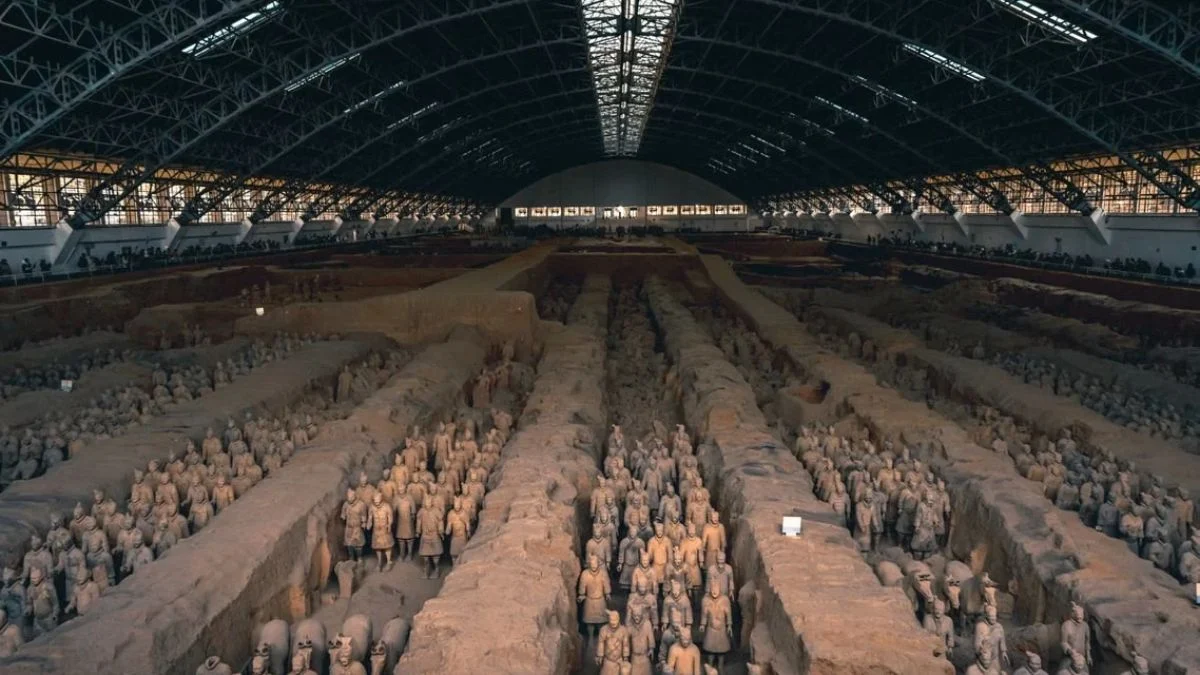
More than two millennia after China’s first emperor was buried, one of the world’s most remarkable archaeological sites still holds a secret that researchers have yet to uncover. The enormous mausoleum of Qin Shi Huang has yielded thousands of terracotta warriors, ancient weapons and evidence of an empire built on an extraordinary scale. Yet its central burial chamber remains unopened.
Ancient historical accounts describe hidden crossbows, underground rivers of mercury and a burial complex designed to mirror an entire empire. Some modern scientific findings have added weight to parts of that story, but they have not confirmed everything. So why has the tomb remained sealed for more than 2,200 years, despite decades of archaeological research?
Who Was Qin Shi Huang, China’s First Emperor?
Qin Shi Huang, also known as Qin Shihuang, became the first emperor to unify China in 221 BC, after the Qin state conquered its rivals during the Warring States period.
Construction of his mausoleum had already begun in 246 BC, when he was still the king of Qin. According to UNESCO, work on the enormous complex continued until his death in 210 BC.
Located at the northern foot of Mount Li, approximately 35 kilometres northeast of modern Xi’an in Shaanxi Province, the mausoleum was designed on an extraordinary scale. It was not simply a burial chamber but an extensive funerary landscape intended to reflect the organisation and grandeur of the emperor’s realm.
| Key detail | Information |
| Emperor | Qin Shi Huang, also known as Qin Shihuang |
| Unification of China | 221 BC |
| Mausoleum construction began | 246 BC |
| Emperor’s death | 210 BC |
| Location | Near Xi’an, Shaanxi Province, China |
| Main burial mound | Approximately 51.3 metres high |
| UNESCO World Heritage listing | 1987 |
UNESCO describes the property as an archaeological complex containing more than 600 sites, including burial pits, tombs and architectural remains. The protected area covers approximately 56.25 square kilometres, while nearly 200 accompanying pits and thousands of funerary objects demonstrate the extraordinary resources devoted to preparing the emperor for the afterlife.
For Readers Exploring Ancient Chinese Philosophy
Ancient Chinese history offers plenty of stories that explore the relationship between reality, perception and the unknown. Our Zhuangzi butterfly dream explainer examines one of the best-known philosophical puzzles from the tradition.
The Terracotta Army Revealed Only Part of the Mausoleum
The world first became aware of the mausoleum’s remarkable scale in 1974, when local farmers in the Lintong area discovered fragments of terracotta figures while digging a well.
The discovery led archaeologists to enormous underground pits containing thousands of life-sized terracotta warriors, horses and other military figures. The Terracotta Army subsequently became the most recognisable feature of the site.
However, the warriors are not the emperor’s central burial chamber. They form part of the wider funerary complex surrounding the main tomb.
Further archaeological work has uncovered additional pits, tombs, workshops, architectural remains, bronze chariots, weapons and other objects. These discoveries have helped researchers investigate Qin military organisation, craftsmanship, technology, social structures and burial practices.
A 2026 scholarly overview published by Oxford Academic, titled The Mausoleum Complex of Emperor Qin Shihuang: A Major Discovery and Its Impacts, discusses how five decades of archaeological research have transformed understanding of the mausoleum and the Qin period.
The findings have also challenged interpretations based solely on ancient written accounts. Researchers continue to use archaeological surveys, excavation, conservation and multidisciplinary approaches to investigate the site without necessarily disturbing its most sensitive area.
What Did Ancient Historians Say Was Inside Qin Shi Huang’s Tomb?
Much of the mystery surrounding the sealed chamber comes from Sima Qian, the Han-dynasty historian who wrote Shiji, or Records of the Grand Historian, roughly a century after Qin Shi Huang’s death.
His account describes an underground world containing palaces, towers, valuable objects and representations of the empire. It also refers to protective mechanisms intended to stop intruders from entering.
Among the most striking details are crossbows reportedly prepared to fire at anyone attempting to penetrate the burial chamber. Sima Qian also described mercury being used to represent major waterways, including the Yangtze and Yellow rivers.
These descriptions have inspired dramatic retellings, but there is an important distinction between an ancient account and a modern archaeological finding.
Because the central burial chamber has never been excavated, researchers have not independently verified its interior. The reported crossbows have not been established as functioning weapons, and their presence should not be presented as a scientifically confirmed danger to modern archaeologists.
The same caution applies to the alleged underground rivers. Sima Qian’s account offers valuable historical evidence, but it cannot substitute for direct examination of the chamber.
Mercury Detected Around the Tomb Adds to the Mystery
The mercury question received renewed scientific attention through a 2020 study published in Scientific Reports.
Researchers used laser-based measurements to examine atmospheric mercury above the burial mound. They detected localised concentrations reaching approximately 27 nanograms per cubic metre, compared with measured background levels of around 5 to 10 nanograms per cubic metre.
The researchers proposed that mercury could be escaping through cracks that developed in the structure over time.
Importantly, the study did not involve opening the tomb. Instead, the scientists examined mercury in the surrounding environment as a possible indicator of what might remain underground.
The measurements support the possibility that substantial mercury is associated with the sealed mausoleum. However, they cannot establish the exact quantity, location or physical arrangement of mercury inside the burial chamber.
The findings make Sima Qian’s description more scientifically intriguing, but they do not confirm every detail of his account.
Could Ancient Cinnabar Mines Explain the Mercury?
The question of where the mercury originated attracted further attention in 2026, following reporting about archaeological discoveries in Xunyang, Shaanxi Province.
Researchers have investigated ancient sites associated with cinnabar mining, processing and transportation. Cinnabar, a mercury sulfide mineral, was an important source of mercury in antiquity.
The sites discussed in recent research include locations in the Shengjia River valley, where archaeological evidence indicates long-term activity connected with cinnabar.
These findings have renewed discussion about whether mercury associated with Qin Shi Huang’s mausoleum could have originated from mining areas elsewhere in Shaanxi.
However, researchers have not directly demonstrated that a particular Xunyang mine supplied the mercury inside the emperor’s tomb. The discoveries provide evidence about ancient cinnabar production and supply networks, rather than a confirmed origin for the material inside the sealed chamber.
The distinction is important: the tomb remains unopened, and its contents have not been directly examined.
Why Archaeologists Have Not Opened the Tomb
The central reason for leaving Qin Shi Huang’s tomb sealed is conservation, not simply fear of ancient traps.
Opening a burial chamber that has remained underground for more than two thousand years could dramatically alter its internal environment. Changes in air, humidity, temperature and light can affect fragile organic materials, pigments, metals, textiles and other archaeological remains.
Researchers also do not know precisely what materials survive inside the chamber, how vulnerable they might be or how they would respond to exposure.
The Terracotta Army has already demonstrated the challenges involved. When the figures were excavated, researchers found traces of their original painted decoration. Much of this fragile surface material was vulnerable to deterioration after exposure to the modern environment.
That experience does not mean everything inside Qin Shi Huang’s tomb would necessarily be destroyed if it were opened. It does show why researchers cannot assume that modern conservation techniques would automatically preserve everything they discovered.
Finding an archaeological object and preserving it successfully are two different challenges. An excavation that permanently damaged the materials it was intended to reveal could result in an irreversible loss of historical evidence.
What the Ming Emperor’s Tomb Taught Chinese Archaeologists
China’s broader experience with imperial burials has also influenced the cautious approach.
The excavation of the Dingling tomb of the Ming emperor Wanli in the 1950s became an important example of the difficulties involved in opening major imperial tombs.
That experience contributed to a more conservative approach to excavating large imperial burials when suitable conservation techniques are not available.
For Qin Shi Huang’s mausoleum, the challenge is therefore not merely whether archaeologists can physically reach the central chamber. They must also be able to document, stabilise and preserve what they find without causing irreversible damage.
Given the site’s historical importance, the threshold for proceeding is exceptionally high.
How Researchers Study the Sealed Tomb Without Opening It
Keeping the central chamber closed does not mean archaeological research has stopped.
Researchers have used archaeological surveys, remote sensing and other non-destructive or minimally invasive methods to investigate buried structures and understand the mausoleum’s layout.
These approaches allow scientists to build a more detailed picture of the underground complex while protecting its physical integrity.
The 2026 Oxford Academic overview highlights the role of archaeological surveys, excavation, conservation and multidisciplinary collaboration in advancing research on the Qin mausoleum. Discoveries across the wider complex continue to provide evidence about the period without requiring the central chamber to be opened.
The mausoleum was added to the UNESCO World Heritage List in 1987. UNESCO identifies it as an exceptionally important archaeological site associated with the formation of China’s first unified empire. Its protected landscape includes the grave mound, burial pits, archaeological remains and wider setting.
The site’s heritage status and conservation needs further reinforce the importance of carefully assessing any decision that could disturb the central tomb.
Did Qin Shi Huang Die From Mercury Poisoning?
The mercury mystery also connects with Qin Shi Huang’s reported interest in longevity and immortality.
Ancient sources associate the emperor with efforts to obtain substances that could extend life. Mercury-containing compounds were used in some ancient Chinese practices and were sometimes associated with attempts to achieve longevity.
Qin Shi Huang died in 210 BC at the age of 49. His reported exposure to mercury-containing substances has led to suggestions that mercury poisoning could explain his death.
However, the available historical evidence does not establish his exact medical cause of death with certainty. It would therefore be inaccurate to claim that mercury poisoning has been proven to have killed him.
The connection remains a historically plausible and widely discussed interpretation, not an established medical diagnosis.
Could Qin Shi Huang’s Tomb Ever Be Opened?
There is no need to conclude that the central chamber will remain sealed forever. Archaeological technology continues to develop, and future methods may allow researchers to investigate fragile underground environments with greater precision and less risk.
The ideal approach would provide substantially more information while causing little or no damage to the chamber and its contents.
For now, researchers face a difficult balance. Opening the tomb could reveal extraordinary evidence about the Qin dynasty, but disturbing an environment that has survived for more than two millennia could permanently damage materials that cannot be replaced.
The question is not whether archaeologists want to discover what lies inside. It is whether the available technology can justify disturbing such an important archaeological record.
For Fans of Ancient Apocalypse Legends
The mysteries surrounding ancient civilisations often overlap with myths about destruction, transformation and the end of the world. Our Ragnarök and Greek apocalypse myths guide explores how different mythologies imagine the world’s end.
Conclusion: Why Qin Shi Huang’s Tomb Remains Sealed
Qin Shi Huang’s tomb remains one of archaeology’s most compelling mysteries because its surrounding complex has revealed so much while its central chamber remains unexplored.
The Terracotta Army, discovered in 1974, exposed only part of the enormous mausoleum. Ancient writings describe crossbows and mercury-filled waterways, while scientific measurements have detected elevated mercury around the burial mound. Research into ancient cinnabar production in Shaanxi has added further context, but no specific mine has been confirmed as the source of the tomb’s mercury.
The central chamber has not been opened, and its exact contents remain unknown. The alleged crossbows are not a verified modern hazard, while the mercury measurements do not confirm every detail of the ancient account.
For archaeologists, the overriding concern is preserving an irreplaceable historical record. Until suitable methods can offer sufficient confidence that the chamber and its contents can be protected, leaving Qin Shi Huang’s tomb sealed remains a cautious approach to safeguarding evidence that has survived for more than 2,200 years.
Source and Research Disclaimer
This article has been prepared based on research into the sources provided below. It reflects the information, archaeological findings and interpretations available in those sources and does not imply independent verification beyond the material they support. Archaeological evidence and historical interpretations may change as further research is conducted.
Sources
- UNESCO World Heritage Centre: Mausoleum of the First Qin Emperor
- Scientific Reports: Mercury as a Geophysical Tracer Gas – Emissions from the Emperor Qin Tomb in Xi’an Studied by Laser Radar
- PubMed: Mercury as a Geophysical Tracer Gas – Emissions from the Emperor Qin Tomb
- Oxford Academic: The Mausoleum Complex of Emperor Qin Shihuang: A Major Discovery and Its Impacts
- South China Morning Post: Online claims revive mercury mystery around tomb of first Chinese emperor
Featured Image Credit: Ang Lee / Pexels


Leave a Reply