


A Story That Feels Uncomfortably Close to Reality
Some films entertain. Others unsettle. Bugonia belongs firmly to the latter category. On the surface, it presents a disturbing tale of a conspiracy theorist kidnapping a powerful corporate executive. But beneath that premise lies a layered, unsettling meditation on power, truth, paranoia, and humanity’s future — themes that feel increasingly relevant in today’s fractured global climate.
Directed by Yorgos Lanthimos, Bugonia has sparked intense discussion not because of spectacle, but because of what it forces viewers to confront: the uncomfortable possibility that the systems shaping modern life may be more fragile — and more morally compromised — than we want to admit.
The World of Bugonia: Setting the Stage
Bugonia unfolds in a contemporary, recognizable world. There are no futuristic cities or overt sci-fi landscapes at first. Instead, the film grounds itself in familiar environments: corporate boardrooms, suburban homes, empty warehouses, and basements that feel claustrophobic and real.
At the center of the story are three key figures:
- Teddy, a socially isolated beekeeper consumed by conspiracy theories
- Don, his emotionally vulnerable cousin and reluctant accomplice
- Michelle Fuller, a highly influential pharmaceutical CEO
The contrast between Teddy’s marginal existence and Michelle’s corporate power forms the backbone of the narrative tension.

How the Story Begins: Paranoia Takes Shape
The film opens quietly, almost meditatively. Teddy tends to his beehives with obsessive care, speaking about balance, decay, and cycles of destruction. Bees, he explains, survive because they operate without ego. Humans, in his view, do not.
Through fragmented conversations and visual cues, the audience learns that Teddy believes Earth is being infiltrated by alien beings disguised as humans — beings he calls Andromedans. According to his theory, these entities control corporations, exploit resources, and steer humanity toward collapse.
At this stage, the film carefully avoids endorsing his beliefs. Teddy appears unstable, damaged, and isolated — a man shaped by personal trauma and internet-fueled paranoia.
The Kidnapping That Changes Everything
The story takes a decisive turn when Teddy, aided by Don, abducts Michelle Fuller after a corporate event. The act is sudden, unsettling, and deliberately stripped of glamour.
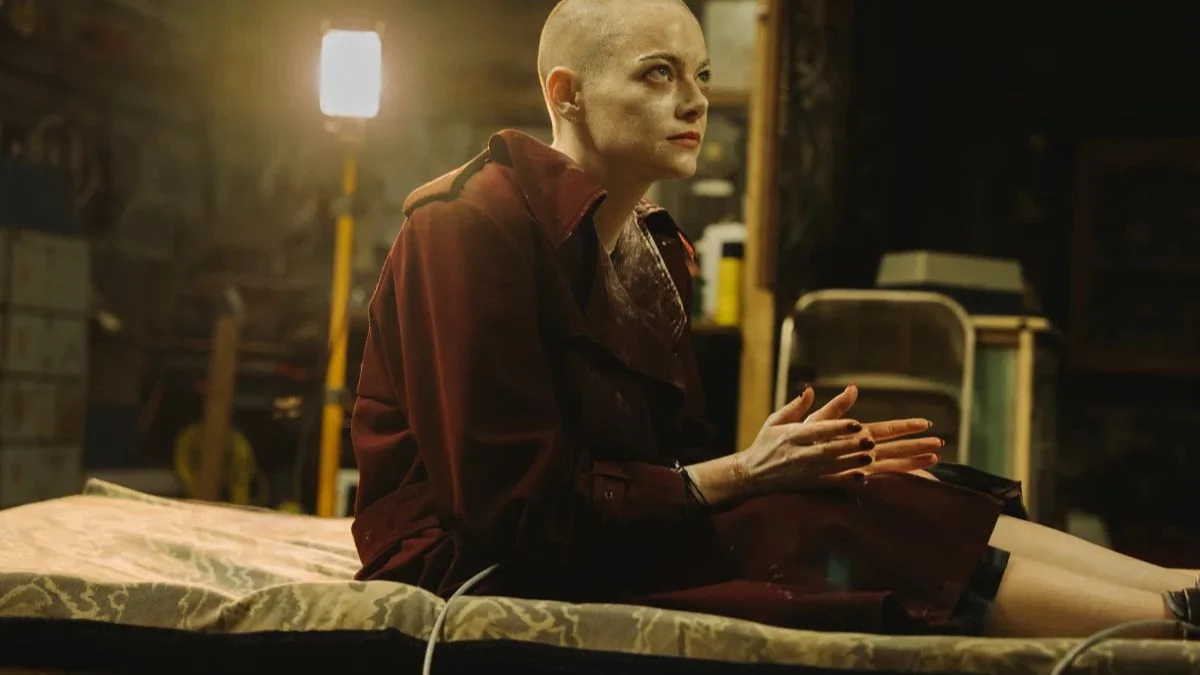
Michelle awakens in a basement, restrained and disoriented. Teddy calmly informs her that she has been chosen because she is not human. He believes she is an Andromedan operative responsible for mass suffering through pharmaceutical experimentation and corporate exploitation.
For the audience, this moment establishes a clear moral line — or so it seems. Kidnapping and imprisonment are inexcusable. Teddy appears dangerous. Michelle appears to be a victim.
But Bugonia is not interested in simple binaries.

Inside the Basement: A Battle of Worldviews
Much of the film unfolds within the basement, turning it into a psychological pressure chamber. Teddy subjects Michelle to interrogations rooted in his alien mythology. He shaves her head, applies chemicals to her skin, and isolates her from any sense of time or authority.
Michelle, however, does not behave like a conventional hostage.
She remains composed, analytical, and emotionally distant. Rather than pleading, she questions Teddy’s logic. Rather than expressing fear, she studies him.
This dynamic slowly destabilizes the audience’s assumptions. Michelle’s language mirrors the same corporate detachment seen earlier in boardroom scenes. She speaks in terms of outcomes, efficiency, and acceptable losses — language that sounds eerily inhuman even if she were entirely human.

Don’s Crisis of Conscience
As the interrogations intensify, Don begins to unravel. Unlike Teddy, he lacks ideological certainty. He is motivated by loyalty, not belief, and the moral weight of the situation begins to crush him.
Don becomes the film’s emotional anchor — a representation of ordinary people caught between powerful systems and extreme ideologies. He shows compassion toward Michelle, doubts Teddy’s methods, and struggles to reconcile the violence unfolding before him.
His internal conflict highlights one of Bugonia’s most human truths: even when people sense something is wrong with the world, they often lack the emotional resilience to face it directly.
The Confession That Changes the Narrative
Midway through the film, Michelle does something unexpected. She admits she is not human.
At first, the confession feels strategic — a manipulation designed to exploit Teddy’s belief system and secure her release. She speaks of cosmic hierarchies, planetary management, and humanity as a failed experiment.
Crucially, the film still withholds confirmation. The confession could be a lie. Or it could be the truth.
This ambiguity is deliberate. Bugonia forces viewers into the same psychological space as its characters, unsure which version of reality to trust.
Loss, Guilt, and the Collapse of Humanity
Michelle promises Teddy that she can save his comatose mother — a woman harmed during a drug trial linked to Michelle’s company. Desperate for redemption, Teddy believes her.
The promise proves fatal. The treatment kills his mother instead.
This moment marks a turning point. Teddy’s crusade is stripped of any remaining illusion of heroism. Don, overwhelmed by guilt and confusion, takes his own life, unable to reconcile compassion with truth.
By the time the basement story ends, every human character has been psychologically or physically destroyed.
The Escape and the Truth Revealed
Michelle escapes custody during a chaotic transfer and returns to her corporate headquarters. There, she enters a concealed teleportation chamber — a device Teddy had described but which the audience had been encouraged to dismiss as delusion.
The film finally reveals the truth.
Michelle is, in fact, an alien — the ruling empress of the Andromedans. Teddy was right, though his methods were monstrous and his understanding incomplete.
The revelation reframes the entire narrative. The conspiracy was real. The danger was real. But so was the human cost of confronting it.

The Ending Explained: A Silent Extinction

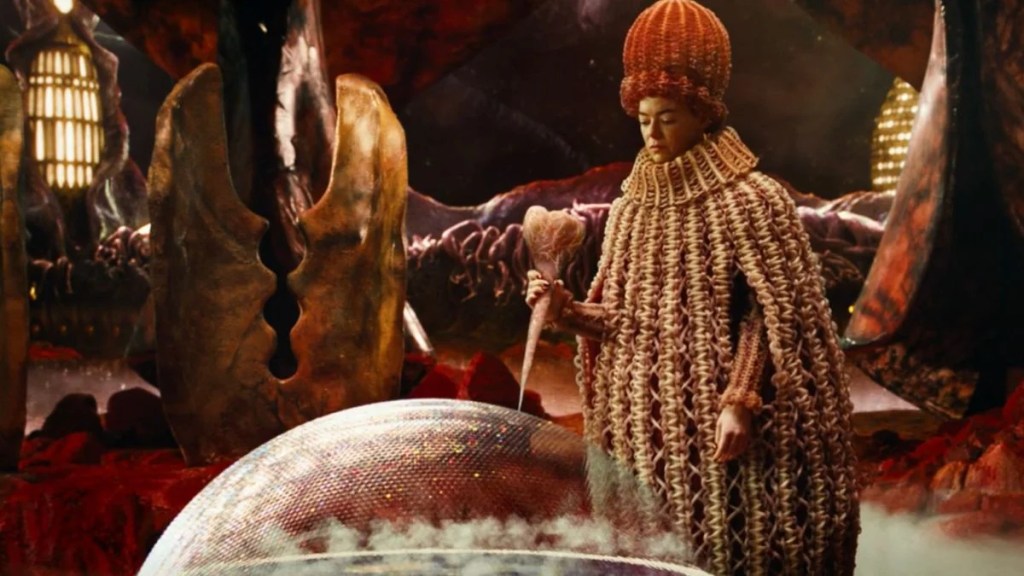
Aboard the alien mothership, Michelle addresses her kind. Humanity, she concludes, has failed. Not because of individual cruelty, but because its systems reward exploitation, apathy, and destruction.
Without anger or ceremony, she authorizes Earth’s termination.
There are no explosions, no screams, no chaos. Humanity simply stops. People collapse mid-conversation, mid-gesture, mid-routine. Life ends not with violence, but with indifference.
In the final moments, the film cuts to nature reclaiming the planet. Bees return. Plants grow. The world continues — just without humans.
What Bugonia Says About the Real World
While Bugonia presents its ideas through science fiction, its themes are unmistakably grounded in real-world anxieties.
Corporate Power and Moral Distance
Michelle’s corporate behavior mirrors real global concerns about pharmaceutical ethics, environmental damage, and profit-driven decision-making. The film asks whether extreme power inevitably leads to moral detachment.
Conspiracy Culture and Distrust
Teddy reflects the modern rise of conspiracy thinking, fueled by alienation and institutional failure. The film neither mocks nor endorses him outright, instead exploring why such beliefs take root.
Humanity’s Environmental Reckoning
The recurring imagery of bees points to ecological collapse and humanity’s strained relationship with nature. In Bugonia, the planet thrives only after humans disappear — a sobering metaphor for environmental debates worldwide.
The Hidden Meaning Behind the Title
“Bugonia” refers to an ancient myth in which bees were believed to emerge from the carcass of a dead animal. The symbolism is clear: life arises from sacrifice.
In the film, humanity becomes that sacrifice. Not as punishment, but as consequence.
Why the Film Resonates Globally
For audiences across the United States, Europe, and beyond, Bugonia resonates because it reflects shared uncertainties: mistrust in institutions, fear of environmental collapse, and questions about humanity’s long-term survival.
It doesn’t offer comfort or solutions. Instead, it asks viewers to sit with discomfort — and to question whether progress without empathy is progress at all.

Final Thoughts: A Film That Lingers
Bugonia is not an easy film to watch, nor is it meant to be. Its power lies in its restraint, its ambiguity, and its refusal to assign simple heroes or villains.
By the time the credits roll, the question left behind isn’t whether Teddy was right — it’s whether humanity, as it exists today, would make a different choice if given the chance.
That question lingers long after the screen fades to black.
More Trending Stories:


Leave a Reply