


Jugnuma: The Fable (released in 2025, directed by Raam Reddy) is a hypnotic work of magical realism that unfolds like a slow-burning myth. Set against the misty Himalayan ranges in 1989, the film blends folklore, environmental anxiety, social hierarchy, and psychological guilt into a meditative cinematic experience. Anchored by a haunting performance from Manoj Bajpayee, the film resists easy explanations, instead inviting the audience to live inside its silences, symbols, and moral ambiguities.
This detailed article presents the complete verified storyline with spoilers, followed by a clear ending explanation and an in-depth breakdown of the philosophical meaning of Jugnuma: The Fable. The narrative is intentionally revealed gradually, mirroring the film’s own patient rhythm, so that each thematic layer unfolds naturally and keeps the reader engaged until the very end.
In This Post:

Dev the Watcher: Wings, Surveillance, and Illusions of Control
Dev does not work the land himself. The orchard’s daily operations are managed by Mohan (Deepak Dobriyal), his loyal estate manager, and Keshav, a worker leader who acts as a bridge between Dev and the local laborers. Dev governs from a distance, asserting control not through presence but through surveillance.
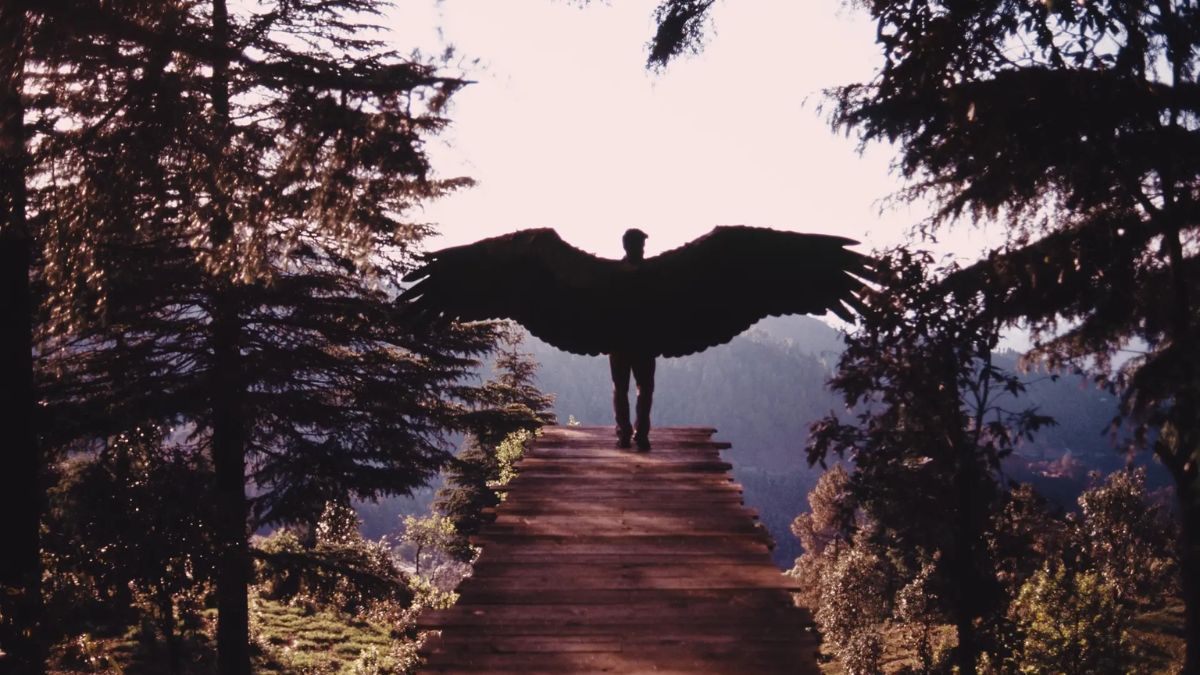
One of the film’s most striking magical realist elements is Dev’s possession of large, dark wings. He spends most of his leisure time perfecting these wings and crafting new sets of wings in his outhouse without the utmost detail. Throughout the movie, he donnes on these wings to glide silently over hills and forests.

The wings symbolize Dev’s hubris: his desire to rise above earthly responsibility, accountability, and emotional consequence. He appears as the guardian of the land, yet remains disconnected from its rhythms and fragility.
The wings also blur the line between myth and psychology. Whether they are literal or symbolic remains deliberately unclear, reinforcing the film’s dreamlike tone and unreliable reality.
The First Fire: When the Orchard Begins to Bleed
The film’s tranquility fractures when Dev discovers mysteriously burnt trees on the estate. The first fires appear in the cherry blossom groves: areas associated with beauty, renewal, and fragility. Night after night, more trees are found charred, their blackened trunks standing like accusations against the land’s owner.
Dev’s first instinct leads him to ponder whether the villagers are unhappy with the use of pesticides. Gradually, his fear quickly turns into suspicion. Dev assumes sabotage and begins to mistrust his own workforce.
As Mohan began to investigate the situation, he cast a suspicious eye on passing horse nomads who traverse the region, viewing them as outsiders and convenient scapegoats. A corrupt, sheriff-like government official repeatedly tries to convince Dev to give him charge of the estate surveillance. Mohan simultaneously suspects the official and warns Dev of his possible role in the sabotage.
Following the initial fires, the sudden death of Keshav’s uncle creates an atmosphere of fear amongst the villagers. It is later revealed that his uncle had come in close contact with pesticides.

Radha as the Voice of the Folklore
Amid the growing unrest emerges Radha (Tillotama Shome), Keshav’s wife. She is an enigmatic presence: quiet, observant, and emotionally grounded.

At night, Radha tells her children stories about parilok—a fairy world where magical beings descend to Earth, become entranced by it, and eventually get stuck in the cycle of birth and death. However, trapped in human flesh, deep down in their souls, they long for the desire to be free again.
Cracks Beneath the Surface: Identity, Belonging, and Guilt
As the fires spread, deeper social fractures come into focus. Class hierarchies harden, and the outsider-versus-insider divide becomes more violent.
Vanya, increasingly restless, encounters a spiritual lama in the jungle. As they crossed paths for the first time, Vanya could hear the lama speak to her mind without ever speaking a word. She grew instantly enchanted, revisiting his living space again and again to catch a glimpse of him. In an attempt to see him again, Vanya drops a message tied to a stone to get the lama’s attention. Finally, after many attempts, Vanya finally meets the lama in private, where they share a spiritual session. Without exchanging a single word, they harmonise into a meditative humming sound.
Vanya, who is mostly portrayed as a restless teenager, transcends into a calm demeanor. As she rests her eyes in peace, a firefly reignites the dark space. The moment feels magical, as if the firefly is trying to connect the young girl to a greater consciousness.
On the other hand, subtle clues suggest that Dev himself may have accidentally ignited the first fire, possibly during one of his reckless flights. Or possibly the fire is the consequence of his decision to cut the workers’ salaries, or for living a grand life on what should have been the entire village’s land. Whether literal or metaphorical, this revelation reframes the entire narrative: the destroyer is not an external enemy but Dev himself. His privilege, denial, and exploitation have sparked both ecological and social collapse.
Collapse of Control: Fire, Fear, and the Loss of Wings
The fires soon spiral beyond containment. Nomads become unintended victims of communal anger, while the estate’s orchards burn relentlessly. The flames mirror real-world deforestation and wildfire crises in Himalayan regions such as Uttarakhand and Himachal, grounding the film’s fable in contemporary ecological reality.

As Dev’s authority disintegrates, so does the magic of his wings. They weaken, symbolizing his diminishing control and the illusion of supremacy unraveling. The colonial mansion, once a symbol of inherited power, now stands threatened by the very land it sought to dominate.

Jugnuma Ending Explained: Fire, Flight, and Fate
In the film’s devastating climax, the orchards of the Northern Wing are completely consumed by a raging inferno. With the repeated fires surrounding the orchids, Dev is forced to think of the recent incidents as more than a sabotage or coincidence. He now sees them as spiritual warnings. Dev instantly takes action, and he sends his family to his wife’s maternal home, while he stays back to fix what he had broken: the balance of nature.

That night, Dev sat on his porch, lost in thought, as a firefly appeared. Followed by the firefly, a group of fireflies filled the sky, forcing Dev to stand and witness the grand beauty that surrounded him. Only, this time, Dev is completely surrounded by the fireflies, almost making him disappear. As the fireflies touch him, his demeanor appears to get calmer, and he appears to be divinely guided on how to make things right.
What follows the next day is a scene of Dev’s family in Nadini’s maternal house. Nandini receives a phone call, where she speaks with the caller in an understanding tone. However, the voice of the caller is not revealed. Meanwhile, Dev is doing some of his routine tasks in the bungalow. It is not clear if it was Dev that Nadini was speaking with.
Following that day, Dev’s family never returns to the bungalow or the village. Dev disappears from the village soon after his family, leaving behind a letter in his outhouse. The letter states that Dev has distributed his estate to the villagers. Dev left his house and the land surrounding it to his loyal caretaker, Mohan.
After these incidents are narrated, a firefly finds Dev’s cherished dark wings and sits on them, igniting a gentle spark. This is followed by a scene of Nandini driving her kids home.
Finally, Dev’s entire family is flying with him, with a similar set of wings, leaving an unexpected but symbolically powerful visual for the audience to decode.
Were Dev and his family part of the fable that once Radha spoke of? Does Dev’s wings catching a burn at the end symbolise his final descent to the clear skies? Or was all this a powerful manifestation of Dev’s mind?
The ending certainly leaves more questions than answers, but it surely trusts the audience to find meaning not in certainty, but in the quiet glow of the fireflies.
The Philosophical Meaning of Jugnuma: Fireflies Against the Fire
At its core, Jugnuma: The Fable is a cautionary tale about human hubris and ecological guilt. Dev’s wings symbolize the desire to escape accountability and transcend constraint.
The fires represent ecological retribution—nature responding harshly to exploitation, pesticides, deforestation, and colonial-style ownership. The film critiques the illusion of control and the moral blindness of inherited privilege.
Fireflies (jugnu) function as the film’s spiritual heartbeat. They symbolize fragile hope, memory, resilience, and legacy. Unlike the destructive blaze, their light is quiet, temporary, and honest. They remind us that survival often exists in small, unassuming forms.
The film also interrogates belonging—who owns land, identity, and freedom. It advocates for communal stewardship over individual domination and suggests that true guardianship requires humility, not surveillance.

Blending folklore, magical realism, and environmental realism, Jugnuma ultimately asks whether freedom without responsibility is an illusion, and whether what we exploit will always return—sometimes gently, sometimes in flames.
In its final moments, the film leaves us not with answers, but with flickering light in darkness—a reminder that even after devastation, something fragile and truthful endures.
More Trending Stories:


Leave a Reply